It is a scenario that has frustrated digital consumers for a decade: You buy a winter coat online, and for the next three weeks, every ad you see is for… winter coats. In 2025, this was a nuisance. In 2026, it is a business failure. The era of generic “Dear [First Name]” email blasts is officially over. We have entered the age of AI Hyper-Personalization Strategy 2026, where the goal isn’t just to sell, but to anticipate.
The friction of the past, where customers had to explain their problems to chatbots or search endlessly for relevant products, is being dismantled by a new technological standard. In this new landscape, personalization is no longer a marketing tactic; it is the product itself.
This deep dive analysis explores how Agentic AI and Generative Engine Optimization (GEO) are rewriting the rules of engagement, turning generic touchpoints into meaningful, high-value conversations.
The Shift: From Segmentation to Individualization
This technological leap marks the transition from Segmentation (grouping people by broad categories like “Millennials in Chicago”) to Individualization (treating every single user as a unique market of one).
According to recent industry forecasts, 75% of all customer interactions are now AI-powered, but the difference lies in the quality of that power. We are moving away from reactive scripts to proactive solutions. When a customer logs into a banking app in 2026, they aren’t just seeing their balance; they are greeted by an agent that has already analyzed their spending, predicted a shortfall for an upcoming bill, and prepared a micro-loan offer to solve it, all before the user clicks a single button.
What is Hyper-Personalization in 2026?
To understand the future, we must first redefine our terms. Traditional personalization was static. It relied on historical data—what you bought last month, where you live, or your age group. Hyper-personalization in 2026 is dynamic, multimodal, and alive. It doesn’t just “know” you; it “perceives” your current state.
The 3 Pillars of 2026 Hyper-Personalization
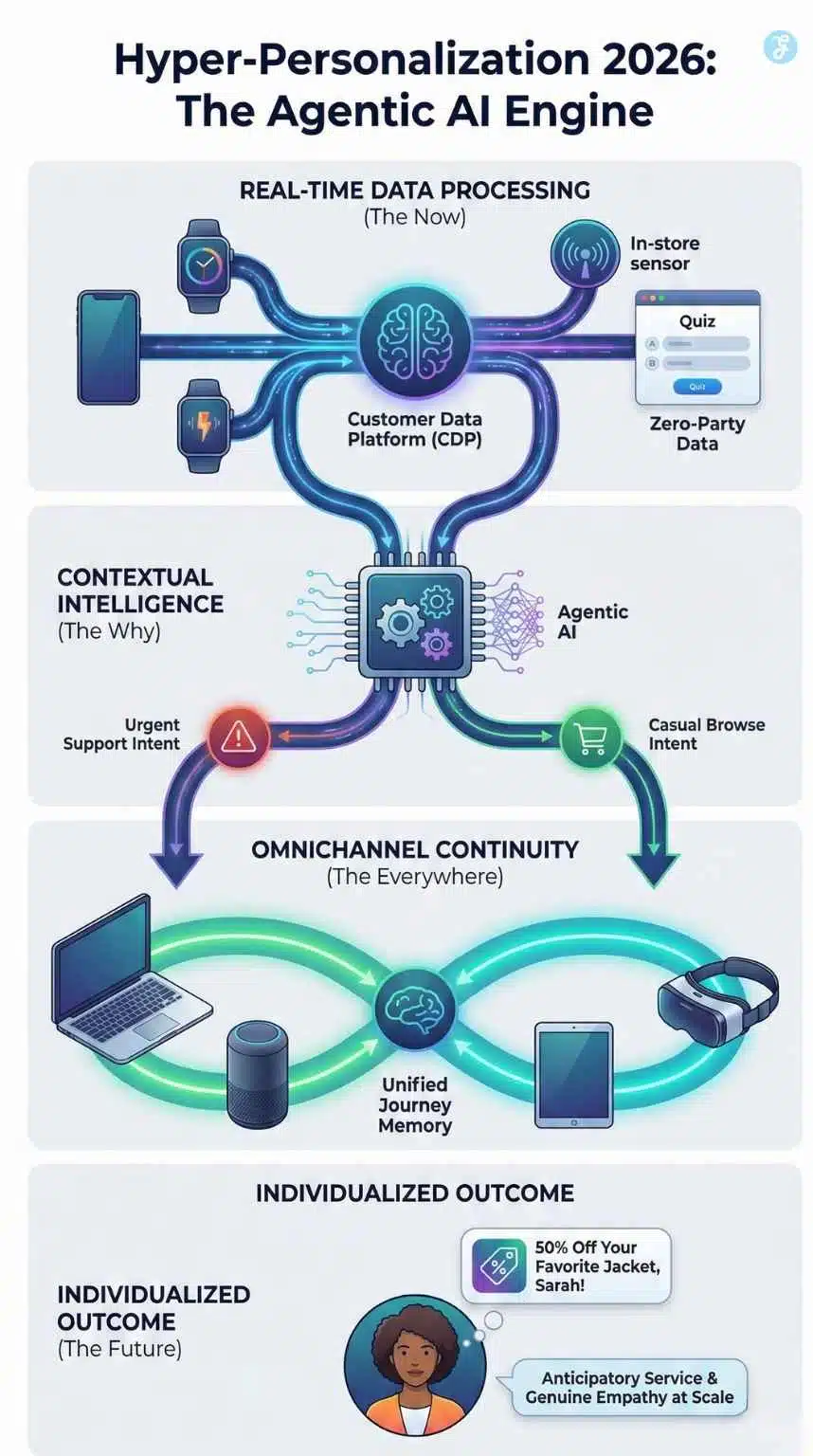
1. Real-Time Data Processing [The “Now” Factor]
Old systems updated customer profiles in nightly batches. If you moved houses or changed jobs on Tuesday, the brand wouldn’t know until Wednesday (or next month). Today’s Customer Data Platforms (CDPs) process signals in milliseconds. If a user’s mouse hovers over a “Return Policy” link for three seconds, the site instantly adapts. The hero banner changes from a “Buy Now” offer to a “Satisfaction Guarantee” message, prioritizing reassurance over sales pressure.
2. Contextual Intelligence [The “Why” Factor]
Demographics tell you who someone is. Context tells you why they are here.
- Scenario A: A user visits a travel site on a Tuesday afternoon from a desktop. They are likely researching a business trip.
- Scenario B: The same user visits the same site on a Saturday morning from a mobile device. They are likely planning a family vacation.
Hyper-personalization treats these as two completely different journeys, dynamically altering the interface, tone, and recommendations to match the specific intent.
3. Omnichannel Continuity [The “Everywhere” Factor]
The conversation never restarts. If a customer starts a dispute with a voice AI on their phone, they can switch to a laptop and the web chat will continue the sentence exactly where the voice agent left off. The “memory” of the brand is unified across every touchpoint.
Visualizing the Shift:
| Feature | Traditional Personalization (2020-2024) | AI Hyper-Personalization (2026) |
| Data Source | Third-party cookies & historical purchases | Zero-party data & real-time intent signals |
| Timing | Reactive (responding to a click) | Anticipatory (predicting the click) |
| Content | Static library of pre-made assets | Generative AI creating content on the fly |
| Interaction | Scripted Chatbots | Autonomous Agentic AI |
| Goal | Higher Conversion Rate | Lifetime Value & Trust |
The Technology Engine: “Agentic AI” vs. Old Chatbots
The buzzword of the year is “Agentic AI.” But what does it actually mean for the customer journey? For years, we dealt with “Scripted Chatbots”, simple decision trees that followed a rigid “If X, say Y” logic. They were frustratingly limited. If you asked a question that wasn’t in their database, they failed.
Agentic AI is different. These are autonomous software agents capable of reasoning, planning, and executing complex tasks across multiple systems without human hand-holding.
The Anatomy of an AI Agent
- Perception: The agent “sees” the customer’s entire history, every email opened, every product returned, every second spent on a webpage.
- Reasoning: It uses Large Language Models (LLMs) to understand nuance. It can detect frustration in a customer’s typing speed or confusion in their navigation pattern.
- Action: Crucially, it has “hands.” It can log into the inventory system to reserve an item, access the billing system to process a refund, or update a shipping address in the logistics database.
Generative AI’s Role in Content Creation
Agentic AI provides the “brains,” but Generative AI provides the “voice.” In a hyper-personalized world, you cannot rely on a marketing team to write 50,000 different email variations. Generative Engine Optimization (GEO) strategies now allow brands to create content dynamically.
- Dynamic Copywriting: An email subject line is written instantly for a specific recipient. If the user is a busy executive, the subject line is short, direct, and data-heavy. If the user is a lifestyle browser, the subject line is emotive and story-driven.
- Visual Generation: Instead of showing a stock photo of a family, a travel app might generate a preview image of a hotel room with a crib in the corner because it knows the user is traveling with an infant.
This technological convergence means that the brand experience is being “rendered” in real-time for each user, much like a video game renders a unique view for every player.
The “Data Trust” Paradox: Winning with Zero-Party Data
With great power comes great skepticism. The “Privacy Paradox” remains the biggest hurdle in 2026. Customers demand hyper-relevant experiences, yet they are increasingly hostile toward covert tracking. The solution that has emerged is the pivot to Zero-Party Data.
Asking vs. Spying
Zero-party data is information that a customer intentionally and proactively shares with a brand. It differs from first-party data (passive tracking of clicks) and third-party data (buying lists from brokers).
The Strategy: Brands are building “Preference Centers” and interactive experiences that trade value for data.
Example: A skincare brand doesn’t just track which creams you look at. They offer a “2026 Skin Health Quiz.” You tell them your skin type, your budget, and your local climate. In exchange, they give you a personalized regimen.
Trust as a Premium: Transparency is now a competitive advantage.
Successful companies explicitly state: “We are asking for your location so we can recommend coats suitable for your current weather.”
When the utility is clear, compliance skyrockets. GDPR and Compliance as Frameworks, Not Hurdles. Far from killing personalization, strict privacy laws have purified it. By forcing brands to rely on consented data, the quality of that data has improved. You no longer have to guess if a customer is interested in golf because they visited a sports site once; they told you they love golf in their onboarding quiz.
Industry Case Studies: Who is Doing it Right?
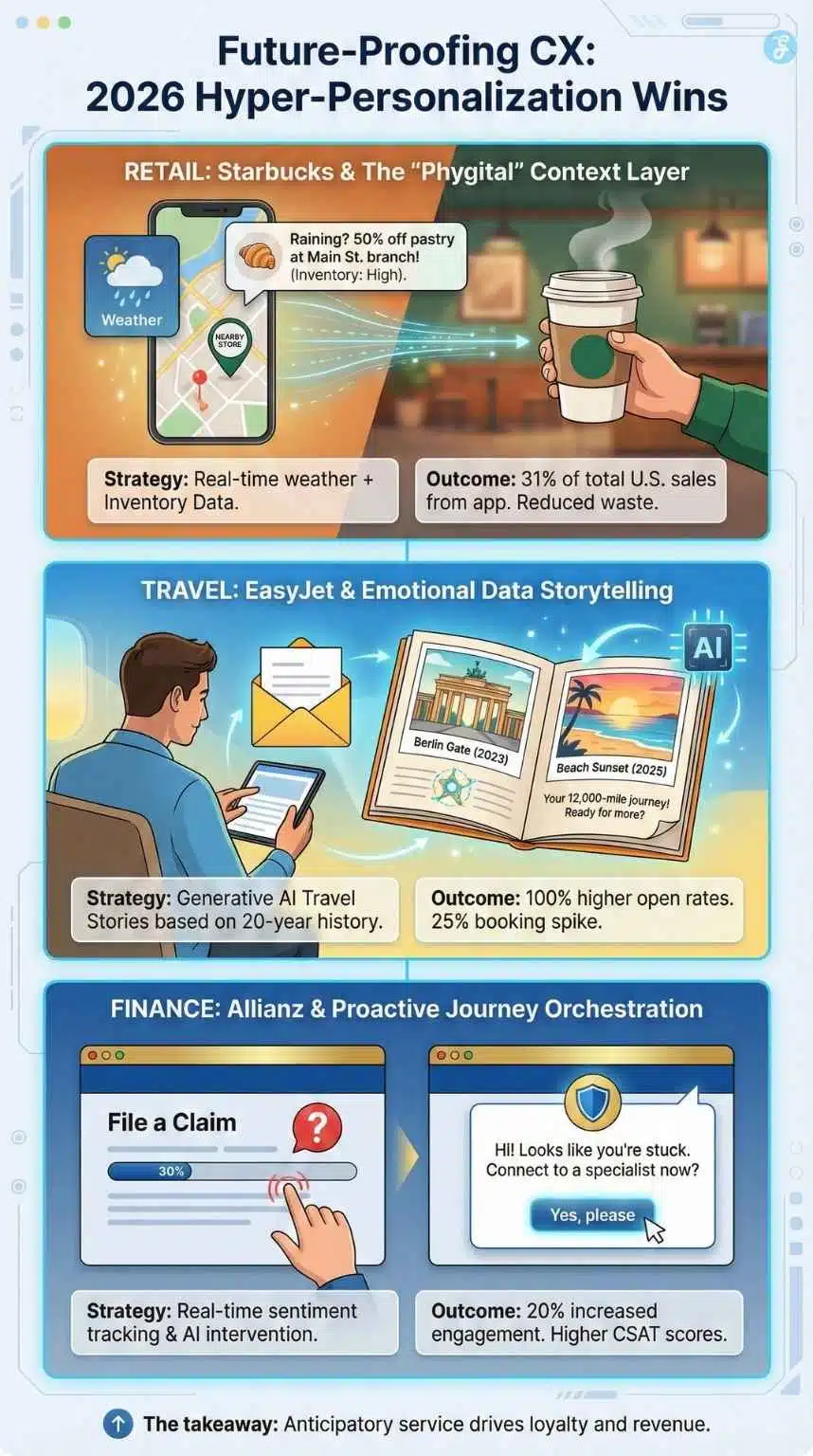
Real-world applications of these strategies are already generating massive ROI. Here are three sector-leading examples from late 2025/early 2026.
1. Retail: Starbucks & The “Deep Brew” Evolution
Starbucks has long been a pioneer, but their 2026 strategy has moved to predictive inventory management combined with individual offers.
- The Strategy: The app uses a “context layer” that includes local weather, time of day, and store inventory levels.
- The Execution: If it’s raining and a specific store has an excess of pastries, the AI sends a push notification to users within a 5-mile radius who have a history of buying food with their coffee: “Warm up with a croissant—50% off at the Main St. branch for the next hour.”
- The Result: The mobile app now drives 31% of total U.S. sales, and inventory waste has been cut significantly.
2. Travel: EasyJet’s “Data Storytelling”
EasyJet moved away from generic “Cheap Flights to Paris” emails to emotional hyper-personalization.
- The Strategy: They utilized 20 years of travel history to build personalized “Travel Stories” for millions of customers.
- The Execution: Emails didn’t just sell; they celebrated. “You’ve flown 12,000 miles with us. You visited Berlin three years ago, ready to go back?” The Generative AI customized the imagery to match the user’s past destinations.
- The Result: Open rates doubled (100% increase), and booking conversion rates spiked by 25% among recipients who received the personalized stories.
3. Finance: Allianz’s Journey Orchestration
The insurance giant tackled the complex issue of claims processing, a high-stress touchpoint.
- The Strategy: They implemented an “Omnichannel Journey Orchestrator” that tracks user sentiment in real-time.
- The Execution: If a user repeatedly visits the “File a Claim” page but drops off, an AI agent proactively triggers a chat: “It looks like you’re having trouble filing a claim. Would you like me to connect you to a human specialist immediately?”
- The Result: Engagement rates increased by 20%, and customer satisfaction scores (CSAT) for the claims process improved drastically.
The “Phygital” Frontier: Where Online Meets Offline
While e-commerce gets the glory, 2026 is the year of “Phygital” (Physical + Digital) convergence. Hyper-personalization is no longer trapped behind a screen; it walks into the store with the customer.
The “Clienteling” Revolution
In high-end retail, store associates are now armed with tablets running Agentic AI. As a customer walks in (identified via app geofencing or biometric opt-in), the associate receives a “whisper” notification:
“This is Sarah. She abandoned a red silk scarf in her online cart yesterday. We have that scarf in stock on Aisle 4. She also prefers vegan leather products.”
This turns a cold sales approach into a warm, helpful service interaction.
Smart Spaces & “Living” Shelves
Physical stores are becoming reactive environments.
- Smart Mirrors: In fitting rooms, RFID-enabled mirrors recognize the clothing items a customer has brought in. They instantly display available sizes, suggest matching accessories, and allow the customer to request a different size from an associate without opening the door.
- Dynamic Pricing Labels: Electronic shelf labels (ESL) now sync with the user’s app. A loyal member might see a “VIP Price” flash on the shelf edge as they approach, rewarding them instantly for their status.
B2B Hyper-Personalization: The “Buying Committee” Approach
Hyper-personalization is often mistaken as a B2C strategy, but the biggest revenue gains in 2026 are happening in B2B. However, the approach is different: you aren’t personalizing for one person; you are personalizing for a committee.
Account-Based Intelligence (ABI)
In 2026, AI doesn’t just score leads; it maps organizational intent.
- The CFO View: When the Chief Financial Officer visits your SaaS pricing page, the site dynamically highlights “ROI,” “Compliance,” and “Cost Savings.”
- The Developer View: When a CTO from the same company visits the same page, the content flips to highlight “API Documentation,” “Uptime,” and “Security Standards.”
Predictive Churn Prevention
For subscription businesses, Agentic AI acts as a “Customer Success Watchdog.”
- Trigger: The AI notices that a key account’s usage of a specific feature has dropped by 15% in two weeks.
- Action: Instead of waiting for a cancellation email, the AI automatically drafts a personalized check-in email for the Account Manager to send, including a custom video tutorial on how to get more value from that specific feature.
| Feature | B2C Personalization | B2B Personalization |
| Target | Individual Impulse | Buying Committee Consensus |
| Speed | Instant (Milliseconds) | Long-term (Months) |
| Content Focus | Emotional & Lifestyle | Technical & ROI-Driven |
| Primary Goal | Conversion (Purchase) | Retention & Expansion (NRR) |
Step-by-Step Implementation Strategy
For organizations looking to deploy AI Hyper-Personalization Strategy 2026, the path forward requires a structural overhaul, not just a software update.
Phase 1: Data Unification [The Spine]
You cannot personalize what you cannot see. The first step is breaking down data silos. Sales data (CRM), website behavior (Analytics), and support history (Helpdesk) must feed into a single Customer Data Platform (CDP). This creates the “Unified Data Spine” necessary for real-time decision-making.
Phase 2: Intent Mapping & Modeling
Stop building “Personas” (e.g., “Marketing Mary”) and start building Intent Models.
- The Urgent Solver: Needs quick answers, low friction, minimal text.
- The Explorer: Wants to browse, open to upsells, enjoys rich media.
- The Skeptic: Needs social proof, reviews, and detailed specs before converting.
Your AI must be trained to recognize these intents within the first 3-5 clicks of a session.
Phase 3: The “Content Factory”
This is where Generative AI scales your efforts. Set up an AI Content Engine that can produce variations of your core message.
- Action: Create a “Prompt Library” for your AI, defining your brand voice, prohibited terms, and tonal guidelines. This ensures that even when the AI generates unique copy, it still sounds like your brand.
Phase 4: Multivariate Testing
The “Set it and Forget it” era is gone. Use AI to run Multivariate Tests continuously. Instead of A/B testing two headlines, AI can test 500 variations of headlines, images, and offers simultaneously, automatically funneling traffic to the winners in real-time.
Challenges & Ethical Pitfalls
While the technology is powerful, the risks are equally high. The line between “helpful” and “creepy” is thinner than ever.
- The “Uncanny Valley” of Marketing: Hyper-personalization fails when it feels robotic or invasive. If an AI references a private conversation or a sensitive health data point without context, it triggers a “defense response” in the user.
Rule of Thumb: Always show the source of the intelligence. (e.g., “Because you bought a crib last week, we thought you might need…”) - Algorithmic Bias: AI agents trained on historical data can inherit historical biases. If your past data shows that certain demographics spend less, the AI might inadvertently deprioritize them, leading to a discriminatory customer experience. Regular AI Audits and “Fairness Checks” are mandatory for ethical compliance in 2026.
- Technical Debt: Real-time personalization is computationally expensive. Maintaining the pipelines that feed data to agents in milliseconds requires robust cloud infrastructure. Companies must balance the cost of compute against the expected uplift in Customer Lifetime Value (CLV).
Measuring the Invisible: The New KPIs of 2026
In the past, we measured “Click-Through Rates” (CTR). But in a world where AI agents solve problems before a click is needed, CTR is a dying metric. How do you measure an interaction that didn’t happen because you prevented the friction?
The New Dashboard:
1. Return on Experience (ROX): This measures the financial impact of improved customer journeys. It correlates higher engagement scores directly to revenue growth, proving that “happier” customers spend more.
2. Time-to-Value (TTV): How fast does the customer get what they came for?
Old Way: User browses for 10 minutes to find a product.
New Way: AI predicts the need, user buys in 30 seconds. A lower time-on-site is now a positive metric for efficiency-focused brands.
3. Zero-Party Data Acquisition Rate: Instead of counting cookies (which are unreliable), brands now measure how much voluntary data they collect. A high rate here indicates high trust. If 40% of your visitors take your “Preference Quiz,” your personalization strategy is healthy.
4. Algorithm Transparency Score: A new governance metric. It tracks how often users ask “Why am I seeing this?” and how effectively the system explains itself. High transparency scores correlate with lower opt-out rates.
Final Thoughts: The Era of Anticipatory Service
As we look toward the latter half of 2026, the trajectory is clear. We are moving toward Anticipatory Service. The ultimate goal of hyper-personalization is not to answer the customer’s question better, but to answer it before they ask. It is the banking app that warns you of a duplicate charge before you check your statement. It is the airline that automatically rebooks your connection before you land.
In this new landscape, the brands that win won’t just be the ones with the best data. They will be the ones that use that data to demonstrate genuine empathy at scale. The technology is complex, but the philosophy is simple: Treat the customer like you know them, because for the first time in history, you actually do.
Ready to future-proof your customer journey? The time to audit your data stack is now.