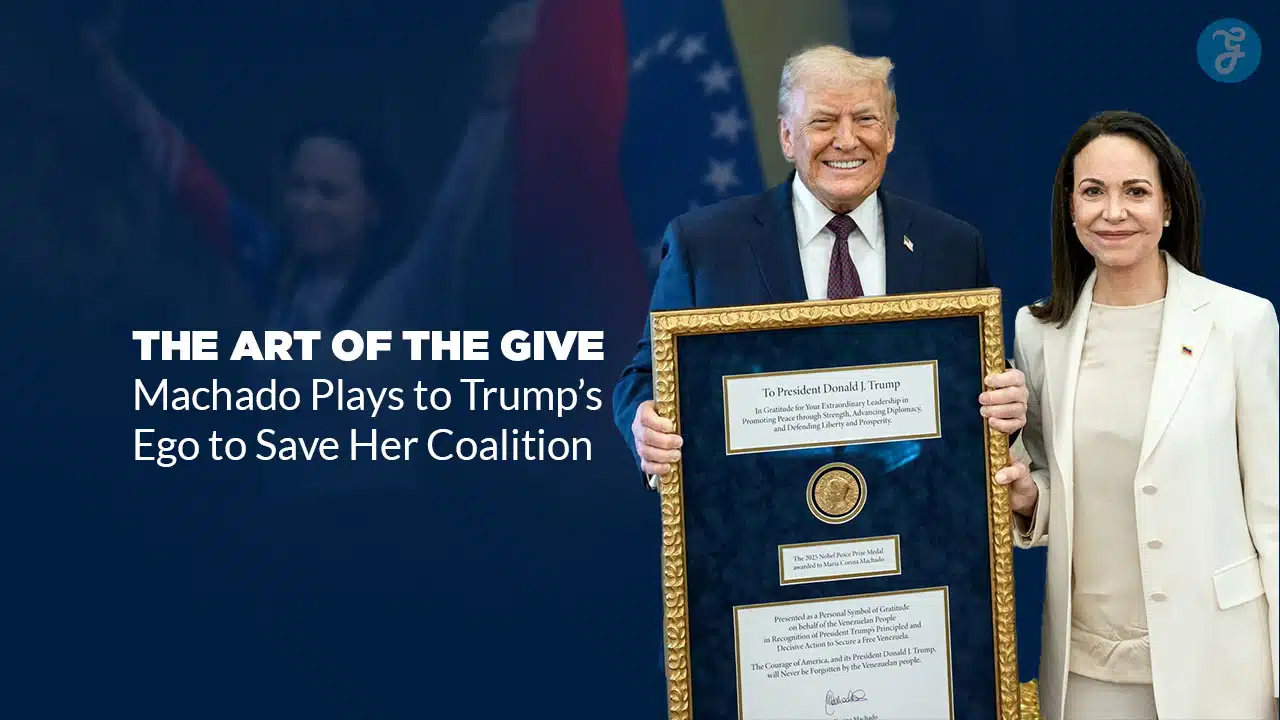
Maria Corina Machado’s symbolic Machado Trump Nobel gesture to former US President Donald Trump marks a calculated pivot in Venezuelan opposition strategy. By placing the physical medal of her Nobel Peace Prize in Trump’s hands, while retaining the laureate status herself, Machado sought to convert moral authority into political leverage, appealing directly to Trump’s affinity for personal loyalty, legacy, and decisive action. The move comes at a moment when Venezuela’s opposition faces renewed repression, internal fractures, and international fatigue, and reflects a broader calculation: in personality-driven geopolitics, moral legitimacy is most effective when personalized and strategically deployed.
Key Takeaways: The Machado Trump Nobel Gesture
Symbolic Leverage
Machado is deploying her Nobel Peace Prize medal as a form of political currency, appealing to Trump’s preference for personal diplomacy and strongman optics rather than institutional processes.
Coalition Preservation
The gesture signals to a fragile Venezuelan opposition that the United States may once again play an active, assertive role rather than limiting itself to statements of concern.
Maximum Pressure 2.0
The meeting suggests a potential return to a hardline US posture toward Caracas, moving away from cautious engagement toward escalatory sanctions and coercive leverage.
Geopolitical Stakes
Machado frames Venezuela as a frontline contest against Russian, Chinese, and Iranian influence in the Western Hemisphere, elevating it from a regional crisis to a strategic priority.
From Democratic Mandate to International Fatigue
The struggle for Venezuelan democracy has long been defined by repression, missed openings, and shifting global attention. Following the disputed 2024 elections, in which the opposition presented extensive documentation supporting Edmundo González Urrutia’s victory, Machado emerged not only as a political leader but as the central symbol of national resistance.
As the Nicolás Maduro government intensified arrests and intimidation under security operations aimed at dismantling opposition networks, the movement faced a familiar danger: erosion through exhaustion. International actors continued to acknowledge democratic irregularities, but without escalation or enforcement. For the opposition, legitimacy alone once again proved insufficient.
Machado’s decision to symbolically present her Nobel Peace Prize medal to Trump reflects this reality. Rather than relying on multilateral institutions or slow diplomatic processes, she chose a direct appeal to an individual whose political style prioritizes personal recognition, legacy, and visible outcomes.
Summary of the Venezuelan Political Struggle
| Category | Description |
| Core Conflict | The struggle for democracy defined by government repression and disputed election results (2024). |
| Key Opposition Figures | Edmundo González Urrutia (documented election winner) and María Corina Machado (symbol of resistance). |
| Government Strategy | Intensified arrests, intimidation, and security operations aimed at dismantling opposition networks. |
| The “Fatigue” Factor | The danger of movement erosion caused by long-term exhaustion and a lack of international enforcement. |
| Diplomatic Shift | A move away from multilateral institutions toward direct appeals to specific world leaders (e.g., Donald Trump). |
| The Symbolic Gesture | Machado presented her Nobel Peace Prize medal to Trump to prioritize personal recognition and visible outcomes. |
The Psychology of the Gesture
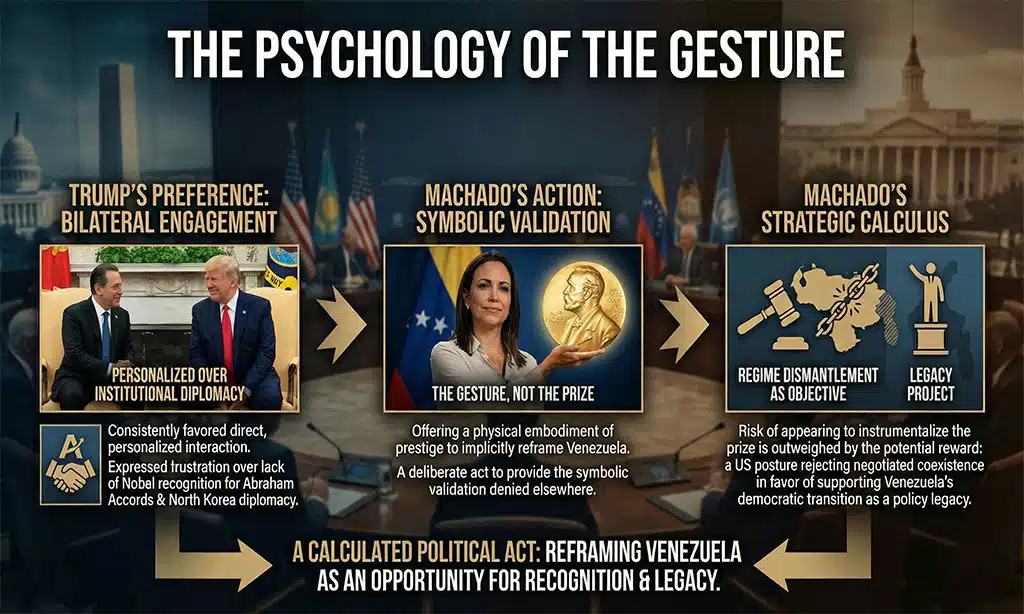
The Nobel gesture functions as a deliberate act of political psychology. Trump’s foreign policy record shows a consistent preference for bilateral, personalized engagement over institutional diplomacy. By offering the physical embodiment of one of the world’s most prestigious honors, Machado was not transferring the prize itself, but offering symbolic validation.
Trump has publicly expressed frustration over not receiving a Nobel Peace Prize, particularly in connection with the Abraham Accords and his diplomacy with North Korea. Machado’s action implicitly reframes Venezuela as an opportunity for recognition denied elsewhere. Supporting Venezuela’s democratic transition becomes not only a policy choice but a legacy project.
For Machado, the risk of appearing to instrumentalize a peace prize is outweighed by the potential reward: a US posture that rejects negotiated coexistence with Chavismo and instead treats regime dismantlement as the objective.
Opposition Fragility and the Need for Momentum
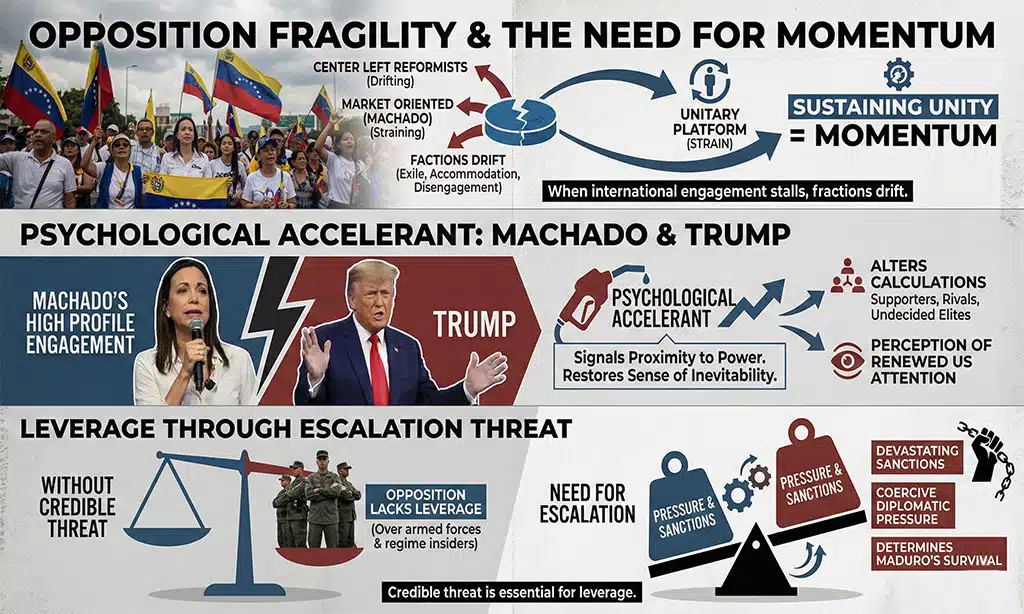
Internally, Venezuela’s Unitary Platform remains under severe strain. It encompasses ideological currents ranging from center left reformists to Machado’s market oriented, center right supporters. Sustaining unity depends on momentum. When international engagement stalls, factions drift toward exile, accommodation, or disengagement.
Machado’s high profile engagement with Trump functions as a psychological accelerant. It signals proximity to power and restores a sense of inevitability. Even before any concrete policy changes, the perception of renewed US attention alters calculations among supporters, rivals, and undecided elites.
Without the credible threat of escalation, including devastating sanctions or coercive diplomatic pressure, the opposition lacks leverage over the armed forces and regime insiders who determine Maduro’s survival.
Strategic Implications of Maximum Pressure 2.0
The Nobel medal gesture effectively serves as the informal launch of what observers describe as Maximum Pressure 2.0. Unlike the earlier sanctions campaign, this iteration would unfold in a more complex global environment.
Maduro has diversified his survival mechanisms through debt arrangements with China and Russia, resource swaps, and illicit economies tied to gold, narcotics, and human trafficking. These dynamics reduce the effectiveness of traditional sanctions alone.
Machado’s argument to Trump is that Venezuela has become a regional security liability rather than a conventional authoritarian state. In this framing, economic tools must be paired with credible enforcement, secondary sanctions, and the threat of escalation sufficient to fracture elite loyalty.
Realism Versus Institutional Caution
Reactions to Machado’s move reflect a broader divide in foreign policy thinking. Realist analysts argue that the Maduro government functions as a criminalized regime that will not relinquish power through electoral or negotiated processes. From this perspective, appealing to Trump’s ego is a pragmatic response to geopolitical reality.
Critics from liberal institutionalist circles warn that personalizing Venezuela’s cause around a polarizing US figure risks alienating allies and narrowing diplomatic options. There is also a transactional risk. Should US priorities shift toward migration management or energy stability, Trump could deprioritize regime change despite the symbolism.
Machado’s strategy implicitly accepts these risks. It reflects a judgment that incremental diplomacy has already failed and that escalation is the only remaining path with a plausible chance of success.
Moral Authority as Political Instrument
Machado’s decision marks a shift in how moral legitimacy is deployed in international politics. Rather than treating ethical recognition as a shield, she is converting it into leverage. The Nobel medal becomes less a symbol of restraint and more a credential of urgency.
This approach reflects a broader transformation in global governance. Authoritarian regimes increasingly survive without legitimacy, relying instead on repression and external backing. In this context, moral authority must be actively exchanged for power to retain relevance.
Whether this gamble is ultimately judged as principled realism or dangerous pragmatism will depend entirely on outcomes.
| Concept | Traditional Approach (Ethical Shield) | New Strategy (Political Instrument) |
| Primary Function | Used as a shield for protection and international recognition. | Converted into leverage to demand specific actions. |
| Role of the Nobel Medal | A symbol of restraint and peaceful merit. | A credential of urgency and a bargaining chip. |
| View of Legitimacy | Seen as an end in itself; assumed to lead to change. | Recognized as insufficient on its own against repression. |
| Global Context | Belief in the power of multilateral norms and “moral right.” | Response to authoritarian survival despite a lack of legitimacy. |
| Strategic Goal | To maintain high ethical standing. | To exchange moral authority for power to achieve outcomes. |
A Strategy Without Retreat
By aligning Venezuela’s democratic cause so closely with Trump, Machado has effectively closed off alternative diplomatic tracks. European mediation, confidence building measures, and gradual engagement lose credibility once escalation becomes the core narrative.
This irreversibility appears deliberate. By eliminating the option of retreat, Machado forces cohesion within the opposition and signals to the regime that the struggle has entered a decisive phase.
Reframing Venezuela as a Security Problem, Not a Moral Tragedy
One of the most consequential aspects of Machado’s engagement with Trump is the reframing of Venezuela’s crisis itself. For years, international discourse treated Venezuela primarily as a humanitarian disaster and a democratic regression. This framing generated sympathy, aid, and rhetorical condemnation, but rarely decisive action. Machado’s strategy deliberately shifts the narrative away from moral outrage toward hard security logic.
By positioning Venezuela as a strategic node in a hostile geopolitical network involving Russia, China, and Iran, Machado transforms the question facing Washington. The issue is no longer whether the United States should intervene to defend democratic norms, but whether it can afford to tolerate an adversarial foothold in the Western Hemisphere. This is a language Trump understands intuitively. His worldview is transactional, competitive, and anchored in zero sum calculations of power.
In this reframing, Venezuela is no longer a failed state in need of compassion. It becomes a platform for sanctions evasion, intelligence cooperation, and regional destabilization. The moral argument does not disappear, but it becomes secondary. What matters is threat perception. Machado’s Nobel gesture operates within this reframing, signaling that even moral legitimacy now serves a strategic function.
This shift also explains why the opposition increasingly emphasizes criminal governance rather than authoritarian governance. By describing the Maduro regime as a transnational criminal enterprise, the opposition seeks to place Venezuela outside the category of states with which normal diplomacy is possible. If the regime is criminal rather than political, compromise becomes complicity. This logic narrows the policy space and pushes escalation from option to necessity.
The Military Equation and the Politics of Fear
No transition in Venezuela is possible without addressing the armed forces. Previous opposition strategies relied heavily on promises of amnesty, institutional reform, and reintegration. These approaches assumed that military elites could be persuaded through reassurance. They failed because they underestimated fear.
The Venezuelan military leadership is deeply entangled in illicit economies and repression. Defection is not simply a political choice but an existential risk. What has been missing is not incentives but credible threats. Machado’s engagement with Trump is designed to manufacture that threat psychologically, even before it materializes materially.
Trump’s reputation for unpredictability plays a central role here. Unlike administrations that signal intentions through policy papers and diplomatic channels, Trump’s decision making style is opaque and abrupt. For regime insiders, this uncertainty is destabilizing. It introduces the possibility of sudden sanctions escalation, international indictments, or covert pressure that cannot be easily anticipated or mitigated.
The Nobel medal amplifies this effect by fusing unpredictability with moral validation. It suggests that escalation would not merely be a policy choice but a righteous act endorsed by a globally recognized symbol of peace. This combination complicates the regime’s narrative that external pressure is illegitimate imperial aggression. It blurs the line between coercion and moral intervention.
For mid level officers and technocrats, this matters. They are less protected than top elites and more sensitive to shifts in perceived inevitability. The opposition’s aim is not mass defection but selective erosion of loyalty. Even limited cracks can paralyze an authoritarian system that depends on discipline and fear.
Regional Silence as Strategic Space
Latin American governments occupy an ambiguous position in this unfolding strategy. Countries such as Brazil, Colombia, and Mexico have favored engagement and dialogue, driven by concerns over migration, economic spillover, and regional stability. They are wary of escalation, particularly one driven by Washington rather than regional consensus.
Yet Machado’s approach exploits a structural weakness in this posture. While these governments may resist overt endorsement of coercive measures, they are equally constrained from defending Maduro openly. The disputed 2024 election, combined with ongoing repression, makes neutrality increasingly difficult to justify.
By engaging Trump directly, Machado reduces the importance of regional approval. Silence becomes sufficient. If neighboring governments neither endorse nor actively oppose escalation, the strategic space remains open. This dynamic shifts the burden of action away from multilateral consensus and toward unilateral decision making.
At the same time, the strategy imposes costs on the region. Any significant escalation risks worsening economic conditions and migration flows in the short term. Machado appears to be betting that regional governments, faced with prolonged deterioration or sharp rupture, will ultimately prefer the latter. A decisive crisis, in this view, is less destabilizing than endless decay.
This is a controversial assumption, but it reflects a broader exhaustion with managed decline. The opposition is no longer appealing to regional solidarity. It is forcing a choice.
Energy Politics and the Limits of Leverage
Energy remains one of the most complex variables in the equation. Venezuela’s oil reserves give it latent leverage, even in a degraded production environment. For the United States, energy considerations intersect with domestic politics, inflation concerns, and global market stability.
Machado’s strategy implicitly challenges the logic of energy pragmatism. By framing the Maduro regime as a security threat rather than a transactional partner, she seeks to delegitimize arguments for limited engagement based on oil access. The Nobel gesture reinforces this framing by casting moral urgency over economic calculation.
However, this is where the strategy encounters its greatest constraints. High energy prices or supply disruptions can quickly shift priorities in Washington. Trump’s own record reflects a willingness to subordinate ideological goals to economic outcomes when domestic interests are at stake.
Machado’s calculation appears to be that personalization mitigates this risk. By tying Venezuela’s fate to Trump’s personal legacy, she raises the political cost of compromise. A deal that preserves the regime in exchange for energy concessions would undermine the narrative of decisive leadership she is offering him.
Whether this calculus holds will depend on external shocks beyond Venezuela’s control. Energy markets are volatile, and strategic patience is often a casualty of economic pressure.
Personalization as Both Strength and Vulnerability
The central innovation of Machado’s strategy is personalization. By bypassing institutions and appealing directly to an individual leader, she accelerates decision making and sharpens focus. But this same feature creates vulnerability.
Personalized alliances are inherently unstable. They depend on continued alignment of interests, attention, and perception. A shift in Trump’s priorities, a domestic political crisis, or a recalibration of strategic focus could rapidly weaken the connection.
Moreover, personalization concentrates risk. By aligning the opposition so closely with Trump, Machado limits its ability to pivot if circumstances change. European actors, multilateral organizations, and regional mediators may be less willing to re-engage once escalation becomes the dominant narrative.
Machado appears aware of this tradeoff and willing to accept it. Her strategy suggests a belief that optionality is an illusion. From her perspective, the opposition has already exhausted gradualist paths. What remains is a binary gamble.
This reflects a broader transformation in opposition politics under authoritarianism. When regimes demonstrate that they can survive indefinitely without legitimacy, opposition movements face a choice between escalation and irrelevance. Machado has chosen escalation.
The Ethics of Urgency
The use of a Nobel Peace Prize medal as a tool of coercive politics raises uncomfortable ethical questions. Peace prizes are traditionally associated with dialogue, restraint, and reconciliation. Repurposing such a symbol to justify pressure challenges conventional moral frameworks.
Yet this tension exposes a deeper contradiction in international norms. Peace without accountability can entrench injustice. Dialogue without leverage can become performance. Machado’s strategy suggests that moral authority divorced from power is insufficient to confront entrenched authoritarianism.
This does not resolve the ethical dilemma, but it reframes it. The question is no longer whether coercion is compatible with moral leadership, but whether moral leadership has any meaning without the capacity to enforce change.
In this sense, Machado’s gamble is not merely political but philosophical. It tests whether symbols of peace can be mobilized in service of decisive action without hollowing out their meaning. The answer will depend on outcomes, not intentions.
Closing the Circle of Inevitability
Perhaps the most important function of Machado’s engagement with Trump is the restoration of inevitability. Authoritarian regimes often survive not because they are strong, but because alternatives appear futile. By signaling escalation, unpredictability, and external commitment, the opposition seeks to reverse this perception.
Inevitability operates as a self reinforcing belief. Once actors begin to assume that change is coming, behaviors shift. Hedging replaces loyalty. Silence replaces propaganda. Delay replaces repression. These micro shifts accumulate.
Machado’s strategy is designed to initiate this process. The Nobel medal is not meant to persuade the regime directly. It is meant to alter expectations across the system.
Whether this expectation becomes reality remains uncertain. But in a political environment defined by paralysis, uncertainty itself can be transformative.
What Happens Next
The coming months will test the effectiveness of this strategy. Key developments to watch include potential shifts in US recognition policy, decisions on oil licenses and secondary sanctions, and the reaction of Venezuela’s military establishment.
Machado has moved beyond the role of loyal opposition. She is betting that the logic of personalized power, applied through symbolic recognition and strategic risk, can succeed where procedural diplomacy has failed.
The Nobel medal, in this context, is not the culmination of her strategy. It is the opening move.