January is when wellness ambition meets stress reality. After holiday sleep debt, budget anxiety, and schedule whiplash, consumers are gravitating toward bio-wearables that translate “how I’m doing” into daily stress, recovery, and readiness insights. In 2026, clearer U.S. regulatory signals, better sensors, and AI-driven coaching are pushing wearables beyond fitness into a mass-market nervous-system companion.
From Step Counts To Stress Scores: How We Got Here?
Wearables began as movement trackers. Then they became heart-rate monitors. In the past few years, they turned into sleep dashboards. Now they are increasingly marketed as stress interpreters.
This shift has less to do with a sudden scientific breakthrough and more to do with a social one: stress has become a mainstream health and productivity problem that people want to manage privately, continuously, and at low friction. The World Health Organization has linked depression and anxiety to enormous productivity losses, estimating about 12 billion working days are lost each year globally, costing roughly $1 trillion in lost productivity. When stress is framed as an economic leak, consumer tech naturally rushes in with tools that promise measurement and mitigation.
The post-holiday moment is also structurally perfect for the category. People feel “off” in January for predictable reasons: late nights, travel fatigue, disrupted exercise routines, and higher spending pressure. A device that says, “Here is what your body is showing today” can feel like certainty in a month that often feels chaotic.
At the same time, the market matured. Global wearables shipments reached 136.5 million units in Q2 2025, up 9.6% year over year (IDC). Even if growth rates fluctuate, the installed base is large enough that companies now compete on daily value, not novelty. Stress is an ideal retention metric because it is relevant whether you are athletic, sedentary, in school, job hunting, parenting, or dealing with caregiving.
| Turning Point | What Changed | Why It Matters For Stress Wearables |
| Fitness-first era | Steps, calories, workouts dominated | Great for athletes, less sticky for everyone else |
| Sleep-first era | “Recovery” became the daily narrative | Sleep is universal and ties to mood and stress |
| Stress-first era | Stress and resilience become core product identity | Stress creates daily engagement and coaching use cases |
| AI coaching era | Guidance becomes as important as measurement | Users demand actionable next steps, not graphs |
What Bio-Wearables Actually Measure: Stress As A Computed Signal?
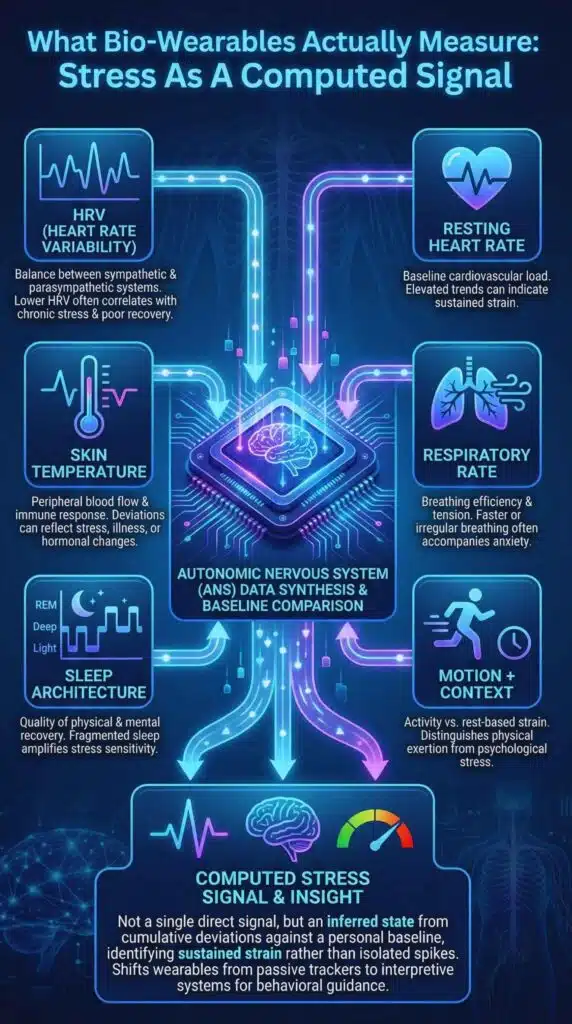
Most wearables do not measure stress directly. They infer it using a bundle of signals that correlate with autonomic nervous system activity and recovery. The big conceptual change in 2026 is that stress is treated as a modeled state, not a single reading.
Common inputs include:
- Heart rate variability (HRV) patterns over time.
- Resting heart rate and deviations from baseline.
- Respiration rate (often during sleep).
- Skin temperature shifts (useful for recovery, illness signals, and cycle-related patterns).
- Sleep duration and fragmentation.
- Movement context (stress at rest versus exertion).
This is why stress features often arrive alongside “recovery,” “readiness,” or “resilience.” The product is effectively saying: your body has a baseline, your behaviors move you away from it, and we will help you steer back.
The hard part is interpretation. A spike in heart rate can be anxiety, but it can also be caffeine, dehydration, heat, excitement, illness, or a tough meeting. That is why newer systems emphasize personal baselines and multi-signal confirmation, reducing the chance that one noisy input becomes a scary conclusion.
The category’s credibility will depend on whether it communicates stress as probabilistic and contextual, not absolute.
| Signal | What It Can Indicate | Common Confounders | Best Use |
| HRV trend | Recovery capacity, autonomic balance | Alcohol, illness, poor sleep, heavy training | Longitudinal patterns, not single-day panic |
| Resting HR | Fatigue, illness, sympathetic activation | Heat, dehydration, stimulants | Detect “off days” early |
| Respiration | Stress arousal, sleep disruption | Allergies, congestion, altitude | Nightly recovery context |
| Skin temperature | Illness onset, hormonal shifts, recovery | Room temperature, bedding, travel | Baseline deviation tracking |
| Sleep fragmentation | Stress load, anxiety, lifestyle mismatch | Kids, noise, shift work | Behavior planning and habit change |
Why 2026 Feels Different: Regulation Is Quietly Reshaping The Market?
A major accelerant in 2026 is regulatory signaling that makes it easier to ship wellness-grade stress features while drawing clearer lines around medical claims.
In early January 2026, U.S. reporting highlighted that the FDA would limit or ease oversight for low-risk wellness wearables and lifestyle software, as long as companies avoid claims that diagnose, treat, or present themselves as medical-grade tools. The practical effect is a wider runway for consumer-grade “stress insights” and “recovery coaching” that are positioned as general wellness.
At the same time, regulators are sending a second message: if you drift into medical territory, scrutiny returns fast. The dividing line is not the sensor. It is the claim. Stress is especially sensitive because consumers can interpret it as a medical verdict, even when the company presents it as a wellness indicator.
In Europe, the pressure is different. The EU’s Data Act provisions applying from 12 September 2025 strengthen user rights to access and share data generated by connected devices. For wearables, this points toward a future where consumers expect portability, interoperability, and clearer rules around who controls the data stream. That matters because stress data is intimate. If the category grows, so will the expectation that users can move their data, restrict it, and understand how it is used.
| Region | Policy Direction | Practical Impact On Stress Wearables |
| United States | Clearer “general wellness” lane for low-risk features | Faster product launches, more competition, more marketing pressure |
| European Union | Stronger user data access and sharing rights for connected devices | Privacy and portability become product differentiators |
| Global | AI governance expectations rising | Transparency, model explanations, and safety claims matter more |
The Business Model Shift: From Hardware To Always-On Coaching
Stress tracking changes the wearable business in a very specific way: it rewards companies that can keep people engaged daily.
Fitness tracking is episodic. Stress is continuous. That is why stress wearables pair measurement with interventions such as breathing prompts, wind-down routines, and “pause” reminders. This logic favors:
- Subscription revenue for analytics and coaching.
- Behavior loops that create routine usage.
- Personalization that improves after weeks of wear.
- Retention as the true growth engine, not only new buyers.
The “post-holiday wellness” story also supports subscriptions. Many buyers treat January as a reset month and are willing to pay for structure. If the product becomes helpful, the subscription becomes sticky. If it feels judgmental or inaccurate, churn is fast.
This is the hidden economic contest of 2026: not which device is the best sensor, but which product becomes the most trusted daily advisor.
| Wearable Strategy | What It Sells | What It Must Prove | Risk If It Fails |
| Hardware-first | Premium design, comfort, battery | Accurate measurements | Becomes a commodity |
| Insights-first | Better scores and dashboards | Clear interpretation and baseline learning | Users distrust “random” scores |
| Coaching-first | Guidance, habits, interventions | Real outcomes, not just engagement | Feels nagging or generic |
| Ecosystem-first | Integrations with apps, clinicians, employers | Privacy controls and consent | Surveillance backlash |
Post-Holiday Stress Is Not Just Personal: It’s A Societal Pattern
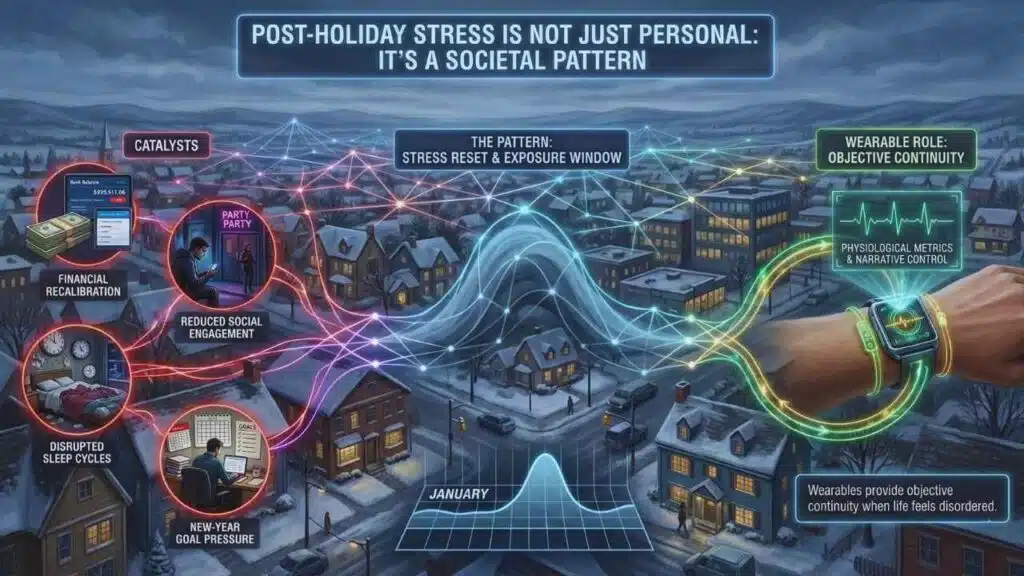
The surge in stress-focused wearables is often framed as individual self-care. But the underlying trend is broader. Stress is increasingly tied to the feeling that life is less predictable and more socially fragmented.
The American Psychological Association’s 2025 findings framed stress through a “crisis of connection,” where social division and loneliness are significant stressors for many adults. That matters for wearables because a device can become a private “anchor” in a disconnected environment. The appeal is not only health. It is emotional certainty. A number feels stable even when relationships and routines feel unstable.
The risk is that wearables can also intensify self-monitoring. For some users, a constant stress score becomes another reason to worry. For others, it is a mirror that helps them see patterns and change behavior. The difference often comes down to product design:
- Does it explain uncertainty clearly.
- Does it encourage self-compassion instead of perfection.
- Does it offer realistic interventions.
- Does it avoid punishing language.
This is where “reader-friendly” reality matters. Stress metrics should be presented like weather forecasts, not like diagnoses.
| User Experience Choice | Helpful Version | Harmful Version |
| Stress feedback | “Your body shows higher arousal than usual today” | “You are stressed” |
| Confidence | Shows trend and context factors | Shows a single absolute number |
| Coaching | Offers 2–3 doable actions | Dumps a long list of rules |
| Emotional tone | Normalizes fluctuation | Implies failure or weakness |
Accuracy And Trust: The Category’s Make-Or-Break Problem
Stress wearables win only if users believe the numbers are meaningful. That belief is fragile because stress is inherently noisy.
Two realities can both be true:
- HRV and related measures can reflect recovery and autonomic balance in useful ways.
- Individuals cannot treat a single reading as a medical truth.
The credibility gap appears when marketing language implies certainty the science cannot support. The safest, most trustworthy framing is this: bio-wearables help you notice physiological patterns that often correlate with stress, and they help you run small experiments to improve recovery.
Trust will be built through:
- Transparent explanations of what a metric can and cannot mean.
- Clear disclaimers around diagnosis and treatment.
- Consistency across weeks, not perfection in a day.
- User control over data sharing and exports.
- Independent research and validation over time.
In 2026, the consumer is becoming more educated. Many already know that HRV is affected by alcohol, sleep, and training load. What they want now is not a science lecture. They want a system that interprets responsibly.
| Trust Builder | What Users Notice | What Brands Must Do |
| Consistent baselines | “It matches how I felt” | Personalize by user history |
| Clear uncertainty | “It explains why it’s unsure” | Provide confidence ranges or context cues |
| Intervention impact | “Breathing helps in 3 minutes” | Validate coaching and avoid gimmicks |
| Privacy | “I control my data” | Strong consent, portability options |
Who Gains And Who Loses: The Emerging Stress-Wearables Economy?
The rise of stress wearables creates predictable winners and losers.
Likely winners:
- Brands that communicate responsibly and avoid medical over-claims.
- Products that pair measurement with simple, effective interventions.
- Systems that prioritize comfort, battery life, and everyday wearability.
- Platforms that treat privacy as a feature, not a policy footnote.
Likely losers:
- Devices that are uncomfortable or demand frequent charging.
- “One-metric” stress claims that ignore context.
- Products that overpromise clinical meaning.
- Employer programs that feel coercive or surveilling.
This is not only about consumer taste. It is about risk. Stress is sensitive. A bad experience is not just a return. It can become a social media warning that harms a brand’s credibility.
| Market Segment | What It Wants | Why Stress Metrics Fit | What Could Break It |
| Everyday consumers | Calm, better sleep, guidance | Stress is a daily concern | Inaccuracy, anxiety, nagging |
| Athletes and fitness users | Recovery optimization | HRV and readiness already familiar | Over-coaching or training confusion |
| Employers and insurers | Lower burnout costs | Stress tied to productivity | Privacy backlash, legal risk |
| Healthcare adjacent | Patient engagement | Continuous data can help context | Claims and validation hurdles |
Data, Privacy, And The New Social Contract Around Stress
Stress data is emotionally loaded. Steps are not. Sleep is somewhat sensitive. Stress is deeply personal because it can reveal patterns of anxiety, social conflict, overwork, and coping behaviors.
As more stress wearables integrate with broader platforms, the key question becomes: Who can see your stress? The safest consumer expectation is that stress data belongs to the individual. Any sharing should be explicit, reversible, and limited.
The European direction on connected-device data rights signals a future where users expect:
- The ability to access and export their data.
- The ability to switch platforms without losing history.
- Clarity about who processes the data and why.
- Strong rules around secondary use.
In parallel, AI tools are increasingly involved in interpretation and coaching. That brings another trust requirement: users want to know whether coaching is generic or personalized, and whether the system can produce harmful advice in edge cases.
This is where the category’s ethics become practical. In the stress domain, “privacy-first” is not a slogan. It is the cost of admission.
| Data Question | What Users Expect In 2026 | Best-Practice Approach |
| Can I export my data | Yes, easily | Simple export and portability pathways |
| Can I delete my history | Yes, without punishment | Clear deletion tools and retention policies |
| Does my employer see this | No, unless I opt in | Opt-in only, aggregate reporting if any |
| Is AI coaching safe | Mostly, with guardrails | Conservative coaching, escalation guidance when needed |
What Comes Next: Five Developments To Watch In 2026–2027?
A Clearer Split Between Wellness And Medical Claims
Expect a stronger market separation between “general wellness stress insights” and devices that push into medical territory. The more the category grows, the more regulators and consumers will demand clarity about what is and is not clinically validated.
More Passive, Screenless Form Factors
Stress tracking works best when it disappears into daily life. Rings, straps, and lightweight devices will continue to gain share because the product’s value comes from continuous baseline learning.
Stress Coaching Becomes A Platform War
The competitive battlefield will shift toward coaching quality. The winners will be the systems that deliver:
- Simple interventions.
- Clear explanations.
- Sustainable behavior change.
- High retention without guilt-based engagement.
Workplace Adoption Will Rise, Then Face A Trust Test
Employers will remain interested because stress is tied to absence, productivity, and burnout. But the programs that succeed will be the ones that prove they are supportive, voluntary, and privacy-protective.
Outcomes Evidence Will Become The Differentiator
By late 2026 and into 2027, consumers will be less impressed by “stress scores” and more persuaded by outcomes like:
- Better sleep consistency.
- Improved self-reported well-being.
- Reduced next-day fatigue patterns.
- Higher adherence to calming routines.
The category’s future belongs to products that can show measurable, realistic improvements without overstating causality.
| Near-Term Milestone | What To Watch | Why It Matters |
| Claim discipline | Fewer medical-sounding stress promises | Trust and regulatory safety |
| Coaching evolution | More real-time, contextual nudges | Better behavior change and retention |
| Privacy competition | Portability and consent become product features | Sensitive data requires confidence |
| Workplace standards | Voluntary adoption and aggregated insights | Avoids surveillance backlash |
| Evidence race | More published validation and outcome studies | Separates serious players from hype |
Why Bio-Wearables For Stress Matter Now?
Bio-wearables for stress are rising because they offer a compelling trade: wear the device, and it will help translate invisible strain into visible patterns you can act on. In a post-holiday season defined by disrupted routines and renewed self-improvement goals, that promise feels timely.
But the category will not be judged by how clever the metrics look. It will be judged by whether it improves lives without increasing anxiety, and whether it respects privacy while scaling into daily routines. In 2026, the stress wearable that wins is not the one that detects the most. It is the one that helps the user feel safer, steadier, and more in control.