Quantum Networking Qubit Growth is becoming the real 2026 battleground because the industry is shifting from “more qubits” to “usable, error-corrected qubits” that can be linked into larger systems. That turns quantum networking from a niche security add-on into a scaling strategy for quantum computing, with major implications for standards, investment, and national infrastructure.
Beyond The Hype: Quantum Networking Qubit Growth In 2026 And What Comes Next
The Quantum Insider’s (TQI) 2026 outlook is less a prediction of one blockbuster breakthrough and more a warning that the scoreboard is changing. The past era rewarded whoever announced the biggest raw qubit count. The coming era rewards whoever can show logical qubits, lower error-correction overhead, and credible system integration, including the network links and memory needed to scale beyond a single device.
That matters because quantum networking is no longer just “quantum key distribution” (QKD) in government pilots. It is increasingly the infrastructure layer that lets the industry keep growing when physics and engineering make monolithic scaling painful. In other words, 2026 qubit growth will mean little unless it pairs with network readiness: stable nodes, memory, repeaters, and standards that let multi-node systems behave like one machine.
What makes this moment unusually consequential is timing. Security agencies are pushing post-quantum cryptography (PQC) migration now, while Europe’s EuroQCI space segment targets an early prototype satellite window around late 2025 to early 2026, and U.S. quantum internet planning has matured from blueprint workshops into testbed thinking. Meanwhile, experimental science is inching toward the missing link for networks: matter-based memories that can share entanglement over intercity-scale fiber.
The result is a convergence: computing roadmaps are becoming network-shaped, and networking roadmaps are becoming compute-dependent. That convergence is the “why now” behind TQI’s expectation of a faster-feeling year.
How We Reached A Network Moment?
Quantum technology entered the 2020s with a deceptively simple narrative: build more qubits and new algorithms will follow. Reality intervened. Qubits drift, gates misfire, and scaling creates wiring, calibration, and thermal headaches that do not shrink with clever marketing. The industry learned that raw growth without reliability produces diminishing returns.
So the field pivoted. Instead of asking “how many qubits,” decision-makers increasingly ask:
- How many logical qubits can you sustain?
- What is your logical error rate over long circuits?
- Can you integrate with high-performance computing (HPC) workflows so the quantum part delivers measurable value?
This is why vendor roadmaps have started to highlight deeper circuits, modular components, memory, and hybrid benchmarking. One major roadmap, for example, frames 2026 milestones around running substantially deeper circuits on hundreds of qubits and demonstrating a fault-tolerant module that combines logical processing with quantum memory. That is not just a compute story. It is a “future network node” story.
Meanwhile, quantum networking matured along a parallel track. QKD deployments proved that quantum principles can protect keys, but also exposed limitations. Many early systems relied on trusted nodes, where intermediate sites must be physically secure. That works for high-security corridors but does not scale like the internet.
To scale, quantum networks need a different architecture: repeaters and memories that allow entanglement to hop across distance without trusting every midpoint. This is where the science is finally producing credible intercity-scale demonstrations, and where standards bodies have accelerated work on interoperability, interfaces, and deployment models.
By early 2026, the industry is effectively mid-transition from experiments to infrastructure planning.
Quantum Networking Qubit Growth Needs A New Scoreboard
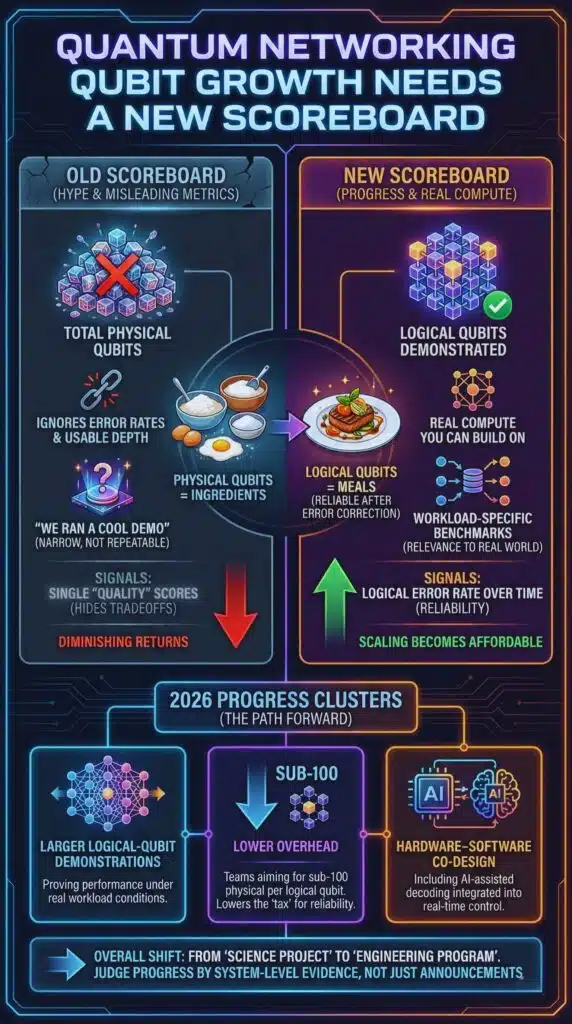
TQI’s most useful contribution is the implicit reminder that qubit growth can look dramatic while practical capability barely moves. The antidote is a clearer scoreboard that separates hype from progress.
Here is the simplest version: physical qubits are ingredients, logical qubits are meals. Physical qubits are what you fabricate. Logical qubits are what you can reliably compute with after error correction and control.
| Old Metric Buyers Used | Why It Misleads | 2026 Metric That Matters | What It Signals |
| Total physical qubits | Ignores error rates and usable depth | Logical qubits demonstrated | Real compute you can build on |
| “We ran a cool demo” | Narrow, not repeatable | Workload-specific benchmarks | Relevance to chemistry, finance, logistics |
| Single “quality” scores | Can hide tradeoffs | Logical error rate over time | Reliability for long circuits and networking |
| Qubit growth alone | Scaling can increase noise | Error-correction overhead trend | Whether scaling is becoming affordable |
TQI expects the most visible 2026 progress to cluster in three places: larger logical-qubit demonstrations, lower overhead (teams aiming for sub-100 physical qubits per logical qubit), and hardware–software co-design, including AI-assisted decoding integrated into real-time control. That combination is important because it directly lowers the “tax” you pay for reliability.
A practical way to think about overhead is budgeting. If a single logical qubit needs hundreds or thousands of physical qubits, then “a few logical qubits” already consumes a large chip. When the overhead drops, roadmaps begin to look more realistic, and investment shifts from “science project” to “engineering program.”
This scoreboard shift is also why readers should treat 2026 qubit announcements cautiously. The question is not whether a company claims growth. The question is whether it proves logical performance under conditions that resemble real workloads.
Networking Is Becoming The Scaling Strategy For Quantum Computing
Quantum networking used to mean “secure links.” In 2026, it increasingly means how the entire industry plans to scale.
There are two networking layers to watch.
Inside The Machine: Modular Quantum Computing
As systems grow, they hit physical constraints. Cryogenic environments limit wiring density. Control electronics struggle to scale. Calibration becomes a daily battle. Modular architectures offer an escape route: build smaller, higher-quality modules and connect them.
The key point is that once you commit to modularity, you are effectively building a network, even if it sits inside a single data center. You need photonic or microwave interconnects, routing logic, synchronization, and error management. In that sense, “quantum networking” becomes part of the quantum computer’s internal architecture.
| Modular Scaling Requirement | Why It Matters | What “Good” Looks Like In 2026 |
| Quantum memory | Allows buffering and synchronization | Memory integrated into fault-tolerant modules |
| High-fidelity interconnect | Links modules without destroying advantage | Stable, repeatable link performance and calibration |
| Co-designed control stack | Hardware and software must share timing | Real-time decoding and feedback loops |
| Hybrid HPC integration | Early value is quantum + classical | Workflow tools, benchmarks, and scheduling |
Outside The Machine: Quantum Networks And The Quantum Internet
External networks focus on distance. Fiber loss and noise make long links hard. Satellites extend reach but need ground infrastructure. Repeaters and memories are the missing layer between metro demos and national networks.
This is where the most meaningful scientific signals appear. A 2025 research demonstration reported entanglement between two quantum memories over 420 km of fiber, using quantum frequency conversion to telecom wavelengths and careful phase stabilization. That is not yet an operational network, but it is a major indicator that intercity-scale architectures are becoming experimentally tangible.
| Network Stage | Typical Distance | What It Enables | Main Bottleneck |
| Point-to-point QKD | Tens to ~100 km | Secure key exchange | Loss and device security |
| Metro multi-node | City scale | Multi-user QKD services | Interoperability and key management |
| Intercity with memories | Hundreds of km | Synchronization, early repeater logic | Rate, stability, memory lifetime |
| Repeaters and entanglement swapping | National scale | True scaling beyond trusted nodes | Engineering repeaters and error control |
If 2026 is truly a “fast-moving year,” it is because both layers are advancing at once. Compute vendors are talking in modular terms, and network researchers are proving memory-based distance. That reinforces a feedback loop: better nodes make better networks, and better networks make modular scaling plausible.
Infrastructure Race: Satellites, Fiber Corridors, And Standards
Quantum networking is quickly becoming geopolitical infrastructure, not just a technical curiosity.
Europe’s EuroQCI program is the clearest example of an infrastructure mindset: a hybrid system that includes terrestrial fiber upgrades plus a space segment. The European Commission’s EuroQCI materials describe Eagle-1 as a prototype satellite due to be launched in late 2025 or early 2026, forming the basis for a future constellation.
The U.S. took a different route: a national planning blueprint and testbed approach under the National Quantum Initiative framework. The Department of Energy’s “quantum internet blueprint” work framed stages from secure links over existing fiber to larger networks supported by repeaters.
China has already demonstrated large-scale deployment patterns via long fiber backbones and satellite integration, though much of it relies on trusted nodes. Historically, the Beijing–Shanghai quantum-secured backbone network is often cited as an early proof of national-scale ambition.
| Region Or Program | What It Prioritizes | Strategic Advantage | Key Challenge |
| Europe (EuroQCI, space + ground) | Sovereign secure comms | Interoperable procurement and standards | Cost and operational complexity |
| United States (testbeds + blueprint) | Research-to-infrastructure pipeline | Strong lab ecosystem and HPC integration | Coordinating across carriers and agencies |
| China (fiber + satellite integration) | Early deployment at scale | Fast infrastructure rollout | Reducing reliance on trusted nodes |
Standards bodies matter here because the first generation of quantum networks can fragment quickly. ETSI’s QKD work focuses on security profiles, interfaces, component characterization, and interoperability. ITU-T has published recommendations describing network models for QKD support. Together, these standards efforts shape what telecom operators can buy and operate safely.
| Standards Body | What It Covers | Why Readers Should Care |
| ETSI (QKD work) | Interfaces, protection profiles, deployment parameters | Makes multi-vendor networks feasible |
| ITU-T (QKD network recommendations) | Network models supporting QKD | Helps telecom carriers operationalize designs |
| Government frameworks | Procurement and security requirements | Determines where early budgets flow |
In plain terms, standards are the boring force that decides who scales. If you control interfaces and certification expectations, you influence procurement. Infrastructure programs tend to choose what can be audited, operated, and maintained.
Security Deadlines Are Pulling Quantum Networking Forward
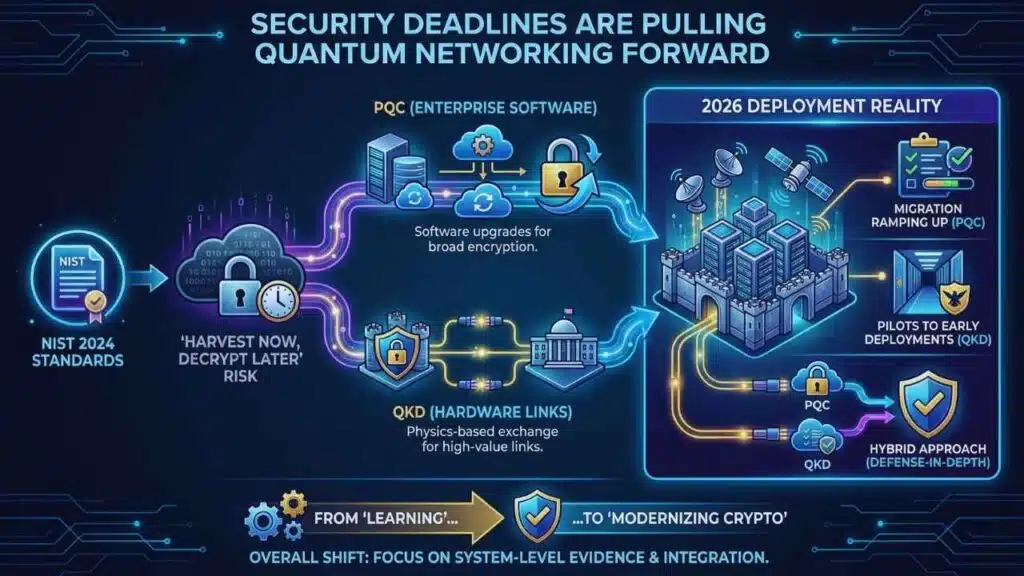
Security is the bridge that pulls quantum technology into near-term budgets.
NIST finalized its first post-quantum encryption standards in August 2024, and the U.S. National Quantum Initiative messaging emphasized readiness and adoption. NIST has also published migration guidance work to help organizations move away from quantum-vulnerable cryptography.
This matters because the security transition changes how leaders interpret “qubit growth.” Even if large-scale cryptographically relevant quantum computers remain years away, the risk model includes “harvest now, decrypt later,” where attackers collect encrypted traffic today to decrypt later.
PQC and QKD serve different needs:
- PQC scales broadly through software upgrades. It is the default path for most enterprises.
- QKD offers physics-based key exchange but requires hardware, fiber, and operational discipline. It is more likely to concentrate in high-value links and national security corridors.
| Security Approach | Where It Fits Best | Deployment Reality In 2026 | Limitation |
| Post-Quantum Cryptography | Enterprise-wide encryption | Migration programs ramping up | Complex inventory and legacy systems |
| Quantum Key Distribution | High-value links, government corridors | Pilot-to-early deployments | Cost, distance, and integration complexity |
| Hybrid (PQC + QKD) | Defense-in-depth for critical paths | Likely in strategic networks | Requires careful key management |
A useful way to think about 2026 is that security procurement is shifting from “learn about quantum” to “modernize crypto.” That favors vendors and integrators who can translate standards into practical deployment, including key management, hardware certification, and interoperability testing.
Investment And Industry Structure: Growth With Consolidation
The investment story is strong, but the structure is changing. Funding is flowing not only to “who has the best qubit,” but to companies that can connect quantum to existing compute ecosystems, especially AI and GPUs.
One major industry report estimates quantum computing revenue growth from roughly the low single-digit billions in 2024 toward a much larger market over the next decade, with chemicals, life sciences, finance, and mobility among the most affected sectors. Market forecasts from research firms project quantum computing technologies growing from roughly $1.6 billion in 2025 to about $7.3 billion by 2030, implying rapid compound growth.
At the same time, consolidation is picking up. A highly visible early-2026 example is D-Wave’s announced $550 million acquisition of Quantum Circuits, signaling a strategic pivot toward gate-model systems and error-correction roadmaps.
Large financings also show that investors increasingly value manufacturing scale and ecosystem partnerships. A prominent late-2025 funding round valued PsiQuantum at about $7 billion, with a reported $1 billion raise and a collaboration involving Nvidia. Nvidia itself has publicly signaled deeper involvement via a quantum research center initiative and partnerships with multiple hardware modalities.
| Signal | What Happened | Why It Matters For 2026 |
| Market growth forecast | Rapid CAGR projections through 2030 | Sustains long-term capex and hiring |
| Big funding rounds | Photonics and scale narratives attract capital | Manufacturing and supply chain become decisive |
| Consolidation | Acquisitions reshape roadmaps | Smaller teams may get absorbed into “platform stacks” |
| GPU ecosystem integration | CUDA-Q and hybrid workflows expand | Quantum adoption rides on classical infrastructure |
The bigger story is that the industry is moving from “competing prototypes” to “competing stacks.” Stacks include hardware, control electronics, cloud access, benchmarking, error management, and networking integration. In that competition, the winner is often the company that makes the technology deployable, not merely impressive.
Expert Perspectives: Optimists, Skeptics, And What Both Get Right
Optimists argue that the field is entering a compounding phase. As logical qubits improve, error-correction overhead drops. As overhead drops, larger logical systems become feasible. As systems become feasible, more money flows into deployment, which strengthens the supply chain and accelerates iteration.
Skeptics argue that quantum timelines routinely slip because the “last mile” is brutal. Noise, scaling complexity, and system integration can erase apparent progress. Quantum networking adds a second difficulty layer: even if you build good nodes, networks must solve synchronization, routing, and operational uptime in real environments.
Both perspectives can be true. The healthiest reading of TQI’s 2026 prediction is this: expect more announcements, but judge progress by system-level evidence. Look for:
- Logical qubits that remain stable across longer runs
- Repeatable performance across machines, not just one-off hero demos
- Clear integration into HPC workflows
- Network demonstrations that include memory, not only photons
| “Optimist Proof” | What Would Validate It | “Skeptic Proof” | What Would Validate It |
| Overhead is dropping fast | Sub-100 physical per logical becomes common | Scaling stalls in practice | Performance fails to reproduce at scale |
| Networking enables modular growth | Multi-module prototypes show reliable links | Networks stay niche | Trusted-node deployments dominate |
| Security drives adoption | PQC migration accelerates broadly | Security sticks to pilots | QKD remains too costly to expand |
This is why 2026 matters even without a single dramatic “quantum internet launch.” It is an inflection in incentives. The market is learning what to measure and what to buy.
What Happens Next: Milestones That Will Define The Post-2026 Trajectory?
If 2026 delivers meaningful progress, the next stage will not look like a sudden replacement of the classical internet. It will look like selective, high-value network corridors, modular quantum computing inside data centers, and a growing “quantum-enhanced networking” standards ecosystem.
Here is a practical milestone list to watch through 2028:
| Window | Milestone | Why It Changes The Story |
| 2026 | Larger logical-qubit demonstrations and overhead reductions | Makes roadmaps economically plausible |
| 2026 | EuroQCI space segment progress around Eagle-1 timeline | Signals operational intent, not research only |
| 2026 | Deeper hybrid HPC + quantum workflows | Turns quantum into a workflow component |
| 2027 | More memory-based intercity entanglement rate gains | Enables repeater engineering and routing logic |
| 2027–2028 | Interoperability and certification maturity | Lets telecom operators deploy at scale |
| 2028 | Early modular multi-node compute prototypes | Proves network-as-scaling strategy |
A reasonable forecast, clearly labeled: Analysts suggest 2026–2027 will be the “architecture lock-in” period, when governments and large buyers effectively choose which stacks they want to scale. Once those procurement choices harden, the industry’s direction becomes difficult to reverse.
In 2026, the quantum conversation is graduating from spectacle to infrastructure. Quantum Networking Qubit Growth matters because it reflects the new reality that scaling depends on reliability, memory, modularity, and standards. The headline numbers will still rise, but the real winners will be those who make qubits usable and connectable. For policymakers, that means aligning security transitions with realistic infrastructure plans. For enterprises, it means treating PQC migration as a current program and viewing QKD as a targeted tool. For investors, it means betting on systems and supply chains, not only on raw qubit counts.