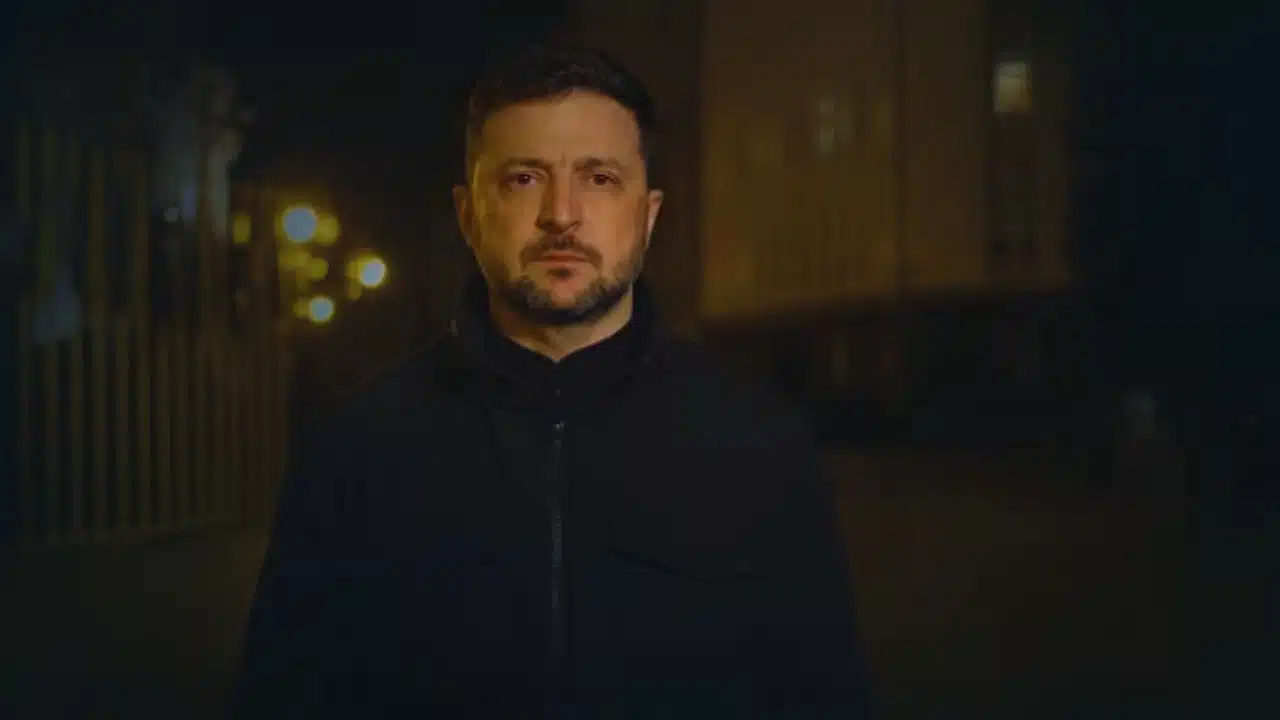
Zelensky presented the zelensky-20-point-peace-plan in Kyiv on Dec. 24, 2025, saying a US-backed draft was sent to Moscow to lock in a ceasefire, security guarantees, and major rebuilding support—while leaving territory and the Zaporizhzhia nuclear plant as the toughest disputes.
What Zelensky’s 20-point peace plan is and what changed?
Ukraine’s President Volodymyr Zelensky says Ukraine and the United States have narrowed a longer peace draft into a 20-point framework meant to stop the war and set rules for what happens after the guns fall silent.
The plan is presented as a package: it blends immediate steps to stop fighting with medium- and long-term commitments on security, reconstruction, trade, humanitarian issues, and political normalization. Zelensky has emphasized that the framework is not simply a ceasefire proposal. It is designed to be an “end-to-end” pathway: stop the fighting, prevent renewed invasion, and rebuild a functioning economy.
The most important shift is practical. The plan tries to define who guarantees Ukraine’s security and what happens if Russia violates a deal. It also puts concrete economic and governance items on the table, rather than leaving them for “later.”
At the same time, Zelensky has openly acknowledged that the hardest questions remain unresolved. Two issues stand out because they touch Ukraine’s sovereignty and long-term safety: (1) how territory and front lines are treated, and (2) what happens to the Russian-occupied Zaporizhzhia Nuclear Power Plant (ZNPP).
Another key element is timing. Zelensky has described the ceasefire as taking effect quickly once all parties agree, with additional domestic steps in Ukraine—such as parliamentary action or a referendum—discussed as part of how a final deal would be validated.
Here’s a simple snapshot of how the plan tries to move from war to post-war order:
| Phase | What the plan tries to achieve | What must happen first |
| Deal reached | A single text accepted by Ukraine, Russia, and key partners | Political approval by leaders and signatories |
| Ceasefire starts | Fighting stops and the front line is stabilized | Final agreement and all-party acceptance |
| Monitoring begins | Violations are detected quickly, disputes handled fast | Technical teams and monitoring setup |
| Security guarantees activate | “Article 5–like” support is defined and triggers are clear | Signed commitments from guarantors |
| Reconstruction accelerates | Funds, trade steps, and investment structure go live | Governance and transparency rules |
The 20 points, explained: what each section tries to do?
Zelensky did not publish a full draft text publicly, but he described the plan point-by-point in a briefing. The 20 points can be grouped into five themes: sovereignty and non-aggression, security guarantees, economic recovery and trade, conflict-line rules and international law, and humanitarian/political steps.
1) Sovereignty reaffirmed.
The plan starts by stating Ukraine is sovereign and that all signatories recognize this formally. It is meant to set a legal baseline that cannot be “reinterpreted” later.
2) A full non-aggression agreement plus monitoring.
This clause is the plan’s backbone. It calls for a non-aggression pact between Russia and Ukraine and establishes monitoring along the line of contact. The monitoring concept includes space-based or unmanned surveillance tools and early notification of violations. Technical teams would work out details.
3) Strong security guarantees.
This is a headline item: Ukraine would receive security guarantees meant to deter renewed attack.
4) Ukraine’s peacetime force level set at 800,000.
The plan states Ukraine’s armed forces would remain at 800,000 in peacetime—an attempt to balance deterrence with predictability.
5) “Article 5–like” guarantees from the U.S., NATO, and European signatories.
This is one of the most consequential points. The plan describes guarantees that “mirror” NATO’s collective defense idea, but it frames them as commitments by signatory states rather than a formal NATO membership clause.
It also includes enforcement logic:
- If Russia invades Ukraine again, the response is described as coordinated military support plus reinstatement of global sanctions.
- If Ukraine attacks Russia or fires into Russia without provocation, the guarantees are treated as void.
- Bilateral security guarantees are not excluded, meaning existing agreements can remain alongside the new structure.
6) Russia formalizes non-aggression toward Europe and Ukraine in law.
This point seeks to lock commitments into Russian legal and ratification processes, aiming to make a deal harder to reverse.
7) EU membership within a defined period and short-term market access.
Ukraine’s EU path is framed both as economic integration and as a security anchor. The plan also mentions privileged access to the EU market in the short term.
8) A global development package and a “Ukraine Development Fund.”
This section calls for a separate economic agreement covering investment and “future prosperity.” It mentions high-growth sectors such as technology, data centers, and artificial intelligence. It also includes cooperation on gas infrastructure, pipeline and storage modernization, and broader infrastructure rebuilding.
9) Multiple recovery and humanitarian funds.
The plan describes a set of funds aimed at reconstruction and humanitarian needs, including a target capital-and-grants fund of $200 billion from the U.S. and Europe, plus broader global financial mechanisms. It also states Ukraine reserves the right to compensation for damage.
10) Accelerate a U.S.–Ukraine free trade agreement process.
This point aims to lock in economic alignment with the U.S. and attract investment with clearer trade rules.
11) Ukraine remains non-nuclear under the NPT.
Ukraine reiterates that it remains a non-nuclear state consistent with the Nuclear Non-Proliferation Treaty framework.
12) Zaporizhzhia Nuclear Power Plant operated jointly by Ukraine, the U.S., and Russia.
This point is among the most controversial because it proposes shared operation of a strategic nuclear site that has been under Russian occupation. Zelensky has signaled that Ukraine does not accept Russian control of the plant and has pressed for demilitarization as a condition for safe operation.
13) Education and anti-prejudice programs; minority and tolerance commitments.
The plan calls for educational programs promoting tolerance and fighting racism and prejudice, and it references alignment with EU norms on religious tolerance and protection of minority languages.
14) De facto recognition of current troop positions as the line of contact in four regions.
This clause addresses Donetsk, Luhansk, Zaporizhzhia, and Kherson. It says the line of troop deployment on the date of agreement would be recognized de facto as the line of contact.
It also includes several operational elements:
- A working group would determine redeployment and define parameters for possible future special economic zones.
- International forces would be deployed along the line to monitor compliance after an equivalent basis for movement of forces is defined.
- Russia would have to withdraw forces from certain areas listed for the agreement to take effect.
- Parties agree to adhere to the Geneva Conventions and additional protocols, and to universally recognized human rights.
15) No altering future territorial arrangements by force.
This is a “freeze-the-force-option” clause. It says that once a territorial arrangement is agreed, neither side changes it militarily.
16) Russia will not obstruct Ukraine’s commercial use of the Dnipro River and the Black Sea.
This point aims to protect trade routes, shipping, and commercial access—critical for Ukraine’s export-driven sectors.
17) A humanitarian committee and major exchanges.
This includes all-for-all prisoner swaps, return of detained civilians and hostages (including children and political prisoners), and measures to address conflict victims’ suffering.
18) Elections as soon as possible after signing.
The plan calls for elections after an agreement is signed, signaling a return to normal political life after wartime governance constraints.
19) A legally binding agreement monitored by a Peace Council chaired by President Donald Trump.
This point creates a monitoring and guarantee body with Ukraine, Europe, NATO, Russia, and the U.S. included. It states sanctions apply for violations.
20) A full ceasefire takes effect once all parties agree.
The final point is the immediate stop to fighting—framed as contingent on all parties agreeing to the deal.
To make the full structure easier to scan, here’s how the 20 points map to real-world questions negotiators must answer:
| Plan section | Practical question it raises | Why it can stall talks |
| “Article 5–like” guarantees | Who responds, how fast, and with what force? | Allies may disagree on triggers and scope |
| Monitoring and international forces | Who deploys, where, and under what legal mandate? | Russia and Ukraine may reject certain troop presences |
| De facto line of contact | Is this temporary stabilization or a step toward partition? | Domestic politics in both countries |
| ZNPP joint operation | Who controls safety, staffing, security, and revenue? | High sovereignty and security sensitivities |
| Sanctions snapback | Are sanctions automatic, partial, or negotiable? | Enforcement credibility vs diplomatic flexibility |
| Elections timing | When is “as soon as possible,” and under what conditions? | Security, legitimacy, and constitutional constraints |
The hardest clauses: territory, front line, and the Zaporizhzhia nuclear plant
Even when peace frameworks look comprehensive on paper, negotiations often collapse around a few clauses that touch identity and survival. Zelensky’s own description points to two such fault lines: territory and ZNPP.
Territory and the “de facto line of contact.”
Point 14 effectively acknowledges today’s battlefield positions as the “line of contact” in four regions on the day an agreement is signed. This can reduce immediate fighting because it clarifies what is being monitored and where.
But the political risks are obvious. A de facto line can harden into a de facto border if the next step—future territorial arrangements—never becomes politically possible. That is why point 15 matters: it says territorial arrangements, once agreed, must not be changed by force. Yet it does not itself settle what the “final” territorial arrangements are.
The plan tries to bridge this by proposing a working group to determine redeployment and by raising the concept of potential special economic zones. That concept appears designed to offer a face-saving mechanism: reduce fighting while offering future economic arrangements that do not require immediate recognition of sovereignty changes.
Why Donbas is central?
The Donbas question is not only about land. It is about political control, identity, security depth, and the ability to rebuild without fear of renewed war. Zelensky has indicated that territorial decisions may require leader-to-leader talks rather than negotiator-level compromises, because the domestic stakes in Ukraine are extremely high.
ZNPP: safety, sovereignty, and leverage
The Zaporizhzhia Nuclear Power Plant is Europe’s largest nuclear power plant and has been caught in the middle of the war. The plan’s point 12—joint operation by Ukraine, the U.S., and Russia—raises several immediate questions:
- Who physically controls the perimeter and security?
- Who employs staff and runs day-to-day operations?
- Who decides safety policy and emergency procedures?
- Who receives the electricity and revenues?
- How is demilitarization verified and enforced?
Ukraine’s position has emphasized that safe operation is impossible while the site and surrounding areas remain militarized. The nuclear safety issue is not theoretical. The UN nuclear watchdog has repeatedly warned through the war about the fragility of off-site power and the dangers of military activity near the plant. In December 2025, the watchdog reported another temporary loss of off-site power, underlining the risk environment.
The inclusion of ZNPP in a peace framework signals that negotiators see energy infrastructure as inseparable from any durable settlement. But it also means a single clause can derail the entire package if it is seen as legitimizing occupation or compromising safety.
Enforcement and security guarantees: ceasefire monitoring, “Article 5–like” support, and sanctions
Peace deals fail most often when enforcement is vague. The 20-point framework is unusually explicit about enforcement architecture, even if many details remain to be negotiated.
Monitoring built around speed and evidence
The monitoring idea described in point 2 aims to detect violations quickly and reduce disputes over “who fired first.” Space-based unmanned monitoring implies satellite imagery and other remote-sensing tools, paired with technical teams that standardize what counts as a violation.
In practice, this would likely require:
- A shared incident reporting protocol.
- Agreed “no-fire” zones or buffers in high-risk areas.
- A rapid review mechanism so disputes do not become renewed offensives.
- A clear chain of custody for evidence, so violations cannot be denied without consequence.
International forces along the line of contact
Point 14 introduces international forces deployed along the line to monitor compliance. This is one of the most sensitive ideas because international deployments create facts on the ground. For Ukraine, it could provide reassurance and visibility. For Russia, it could be framed as unacceptable foreign presence. For Europeans, it raises questions about mandates, risk, and rules of engagement.
What “Article 5–like” means in practice?
The plan’s security guarantee clause is written to resemble NATO’s deterrence logic: an attack triggers response. But the plan also tries to protect against escalation and moral hazard by specifying that guarantees could be void if Ukraine attacks Russia without provocation.
This structure suggests the guarantors are seeking two things at once:
- deter Russia from renewed invasion, and.
- reassure publics that guarantees will not be used to launch offensives.
Sanctions snapback as a deterrent tool
The plan ties renewed Russian invasion to the reinstatement of global sanctions. This is designed as a predictable penalty rather than a politically debated decision each time. That predictability is meant to strengthen deterrence.
Yet sanctions are never purely automatic in real life. The effectiveness of “snapback” depends on:
- whether partners agree in advance on what sanctions return,
- how fast those sanctions can be reimposed,
- and whether enforcement is coordinated across major economies.
A Peace Council chaired by Trump
The plan proposes a Peace Council chaired by U.S. President Donald Trump and including Ukraine, the U.S., Europe, NATO, and Russia. This is an unusually high-profile structure for a ceasefire enforcement body.
Supporters may see it as a way to keep major powers engaged, prevent drift, and force rapid responses to violations. Critics may argue that putting enforcement into a political council invites pressure tactics and politicized decision-making.
Why enforcement details decide whether war restarts?
If a ceasefire starts but violations go unpunished, fighting tends to resume. If enforcement is strict but seen as biased, one side may walk away. The plan’s challenge is to be both credible and acceptable—two goals that often collide.
Economic recovery, humanitarian steps, and what happens next?
Beyond stopping the war, the 20 points try to answer a practical question: what makes peace “worth it” for a society after years of destruction?
A reconstruction model that tries to unlock private capital
The plan’s development and funds sections focus heavily on investment structure. That matters because governments alone rarely cover rebuilding at scale. The framework mentions:
- a development fund for high-growth sectors,
- special financing packages through major institutions,
- infrastructure and city rebuilding,
- and governance steps meant to attract foreign direct investment.
This is designed to shift from emergency aid to economic growth—especially in energy, infrastructure, and technology.
Why the gas infrastructure clause is politically important?
Ukraine’s gas transit and storage systems have long been part of European energy geography. Modernization and joint investment could attract capital quickly, but it also raises questions about ownership, security, and whether infrastructure becomes a bargaining chip in future disputes.
Humanitarian measures that aim to lock in public support
Point 17 covers prisoner exchanges and the return of detained civilians and children. These are among the most emotionally powerful issues for Ukrainian society. A humanitarian committee could provide a structured process, but it will still face challenges:
- verifying identities and locations,
- negotiating sequencing,
- and ensuring that releases are not used as leverage to extract political concessions.
Elections: a return to peacetime politics, but not a simple switch
Point 18 calls for elections as soon as possible after signing. This clause is likely intended to restore democratic normality and legitimacy. But elections after war are complicated:
- security conditions must allow campaigning and voting,
- displaced citizens need access to voting mechanisms,
- and legal constraints under martial conditions may need formal changes.
The timeline and conditions for elections could become politically charged inside Ukraine, especially if voters perceive external pressure.
Navigation and trade routes: a quiet but major economic issue
Point 16 addresses access to the Dnipro River and the Black Sea for commercial purposes. This is not just a trade clause. It is a lifeline for exports, shipping insurance markets, and investor confidence. If trade cannot move reliably, reconstruction stalls.
What to watch next?
The zelensky-20-point-peace-plan is built to be comprehensive, but it is also vulnerable to a few clauses that are existential for Ukraine and strategically sensitive for Russia.
Four near-term signals will show whether this becomes a real negotiation track or another stalled framework:
- Whether Russia responds with written counter-terms, rather than general statements.
- Whether the ZNPP clause is rewritten into a form Ukraine can accept publicly and safely.
- Whether the “de facto line of contact” is paired with a credible, time-bound pathway to future settlement rather than indefinite freezing.
- Whether European states are willing to sign and operationalize security guarantees and monitoring forces with clear triggers and funding.