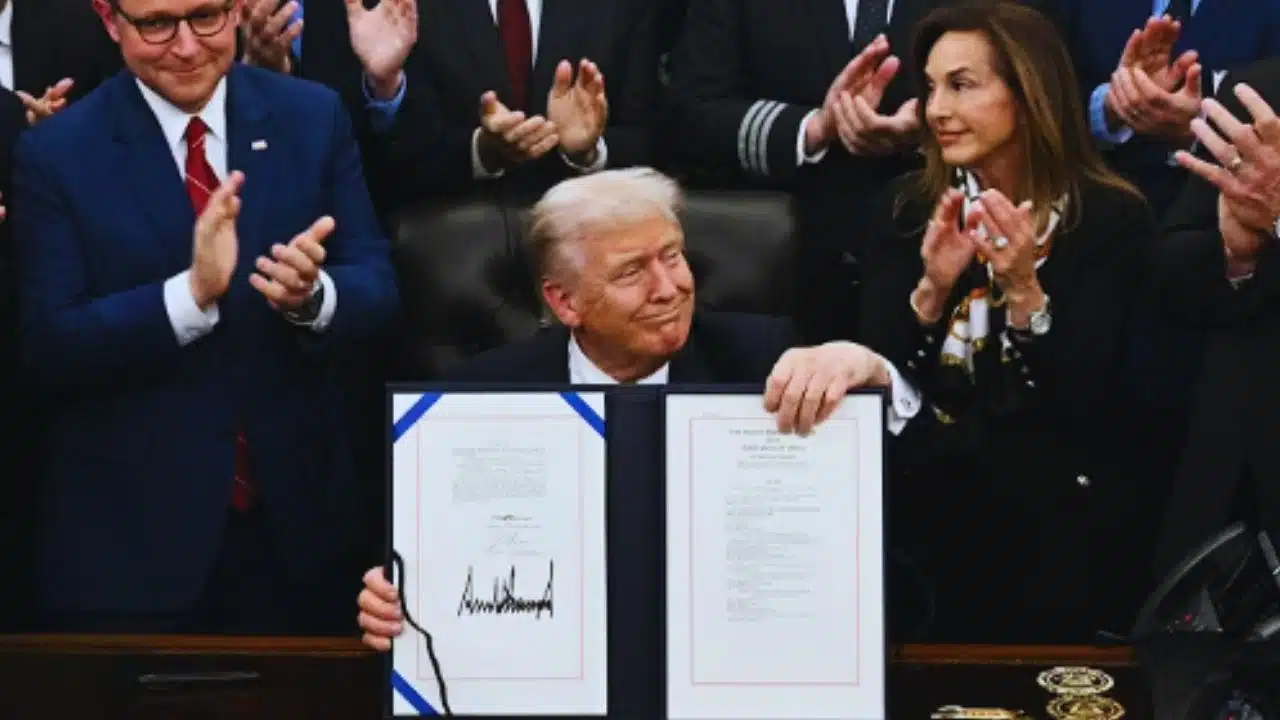
After forty-three long days of halted services, unpaid workers, and political gridlock, President Donald Trump officially signed a bipartisan funding bill to reopen the United States government. Standing in the Oval Office, he declared, “It’s a great day,” before putting pen to paper on legislation that ends the most prolonged shutdown in American history.
The shutdown, which began on October 1, stretched beyond six weeks and surpassed the previous record of thirty-five days that occurred during Trump’s first term. As he signed the bill, the president smiled and told reporters, “The country has never been in better shape.” Yet behind the optimism lay months of political frustration, bitter negotiations, and growing pressure from Americans affected by the freeze.
The bill funds federal agencies, provides back pay for hundreds of thousands of employees who had gone without salaries, and restores operations across vital departments. It also extends money for major programs such as SNAP food assistance, the Department of Veterans Affairs, and the Department of Agriculture through the next fiscal cycle. For many families and communities, the act marks a long-awaited return to normalcy.
The Fallout and Slow Return to Normal Life
The reopening does not mean an instant return to stability. According to estimates from the Bipartisan Policy Center, nearly 670,000 federal employees were furloughed, while another 730,000 were forced to continue working without pay. For them, paychecks are expected to arrive within days, but the emotional and financial strain will take far longer to heal.
Across the nation, national parks, museums, forests, and historic landmarks are preparing to reopen. Yet the process could take time. After the previous shutdown, it took the Smithsonian museums four days to resume operations. This time, the closures lasted longer, meaning additional cleanup, maintenance, and coordination will be needed.
Essential programs such as SNAP food benefits, which provide food aid to about 42 million Americans, will be restored immediately. But others will lag. The Low-Income Home Energy Assistance Program (LIHEAP) — a critical heating subsidy for 6 million households — won’t restart for several weeks, leaving many vulnerable families facing winter without support. Similarly, Head Start, the early-childhood education program for low-income families, is expected to take weeks to return to normal scheduling.
Airports across the country will also take time to recover. During the shutdown, air-traffic control centers were short-staffed as controllers called out of work to protest unpaid labor. The Federal Aviation Administration had even ordered reductions in flights at 40 major airports. With the new bill, the FAA can fully restore normal operations, but flight delays may persist as workers and systems stabilize.
Political Reactions and Power Plays
The political aftershocks of this shutdown will echo for months. At the Capitol, the House of Representatives voted 222–209 to pass the funding bill, with six Democrats crossing party lines to support the Republican-led measure. When the final vote was called, loud applause erupted across the chamber. Members hugged, shook hands, and shared a collective sense of relief after weeks of bitter tension. “We’ve got the lights back on,” said Speaker Mike Johnson, calling the episode “a Democrat shutdown that hurt real people.”
President Trump celebrated the outcome as a personal and political victory. Speaking at Arlington Cemetery earlier that day during a Veterans Day ceremony, he told reporters, “We’re opening up our country. It should have never been closed.” Later, in a Fox News interview, he mocked Senate Democratic leader Chuck Schumer, saying, “He thought he could break the Republican Party, and the Republicans broke him.”
Still, Democrats left the battle bruised and divided. Their main demand — an extension of healthcare subsidies under the Affordable Care Act — was not secured. Instead, they received only a promise of a future vote in December, with no guarantee of Senate or House support. Many within the party’s progressive wing viewed the compromise as a defeat. California Governor Gavin Newsom, who has national ambitions for 2028, called the deal “pathetic” and “a surrender.” Even moderate Democrats acknowledged that the weeks of shutdown pain might have been for nothing.
Trump, meanwhile, urged voters not to forget this episode when they head to the polls in the 2026 midterm elections. “Democrats were happy for millions of Americans to suffer,” he said. “People were hurt so badly — nobody’s ever seen anything like this one.” The president characterized the shutdown as “extortion,” arguing that Democrats tried to “hold the country hostage” for political gain.
What’s in the Funding Bill
The 328-page legislation that reached Trump’s desk extends government funding for most agencies until 30 January 2026. It also contains several unexpected provisions. Among them is a clause that bars federal prosecutors from searching senators’ phone records without notice — a response to concerns raised during the 2021 Capitol Hill riot investigations. Violations could lead to payouts of up to $500,000 per case and apply retroactively to 2022, giving some Republican senators grounds for lawsuits.
Another surprise inclusion is a reversal of the 2018 legalization of hemp-based products containing small amounts of THC. The earlier law had allowed a booming multibillion-dollar market for hemp-derived edibles and drinks. The new bill closes that loophole, effectively banning most of those products nationwide. The decision is already sparking debate within the agricultural and wellness industries.
The bill also guarantees full back pay for furloughed and unpaid federal employees and restores benefits that were frozen during the shutdown. However, it excludes one of the Democrats’ top demands — a permanent extension of the Affordable Care Act subsidies that keep insurance affordable for about 24 million Americans. Lawmakers agreed to revisit the issue in December, setting up another potential political fight just before year-end.
Aftermath and the Road Ahead
With the government reopened, federal workers are trickling back to offices, agencies are restoring operations, and millions of Americans are breathing a sigh of relief. Yet economists warn that the full financial impact will last for months. Delayed paychecks, interrupted benefits, and disrupted services have already slowed local economies that depend heavily on federal spending.
Trump’s administration has framed the reopening as proof of effective Republican leadership. Still, the president’s celebration comes amid renewed controversy. On the same day the bill was signed, members of the House Oversight Committee released new documents related to the Jeffrey Epstein investigation, overshadowing what should have been a political victory for the White House. Trump vented on his social media platform, complaining that the “Epstein hoax” was stealing attention from the government-funding success.
Meanwhile, the question of “how long until normalcy returns?” looms large. Experts predict that it may take weeks before all systems are fully restored. Programs like SNAP and LIHEAP must process backlogs; airports and national parks will reopen gradually; and agencies will face months of administrative cleanup. For the millions of Americans affected, recovery won’t be instant — but the wheels of government are turning once again.
As Trump left the signing ceremony, he repeated his message: “The country is back open. The people have won.” Yet even as he savored the moment, the underlying divisions in Washington — over healthcare, spending, and trust — made one thing clear: the longest shutdown in U.S. history may be over, but the fight over America’s political future is far from finished.