Imagine a world without Google.
No quick answers at your fingertips. No maps guiding you through traffic. No instant emails, YouTube tutorials, or the ability to translate a foreign phrase in seconds. Just two decades ago, that was our reality. Searching for information meant flipping through encyclopedias or scrolling endlessly through clunky early search engines that rarely gave accurate results.
Then came Google. What began in 1998 as a university research project quickly grew into the backbone of the modern internet. Today, Google is more than a search engine—it’s a tech ecosystem that powers smartphones, drives businesses, fuels entertainment, and even pushes the boundaries of artificial intelligence.
As Google celebrates its birthday on today, September 27, it’s not just a milestone for the company—it’s a celebration of how far technology has come and how one company transformed the way the world works. From organizing the web’s chaos to shaping our daily routines, Google’s innovations have become woven into the fabric of our lives.
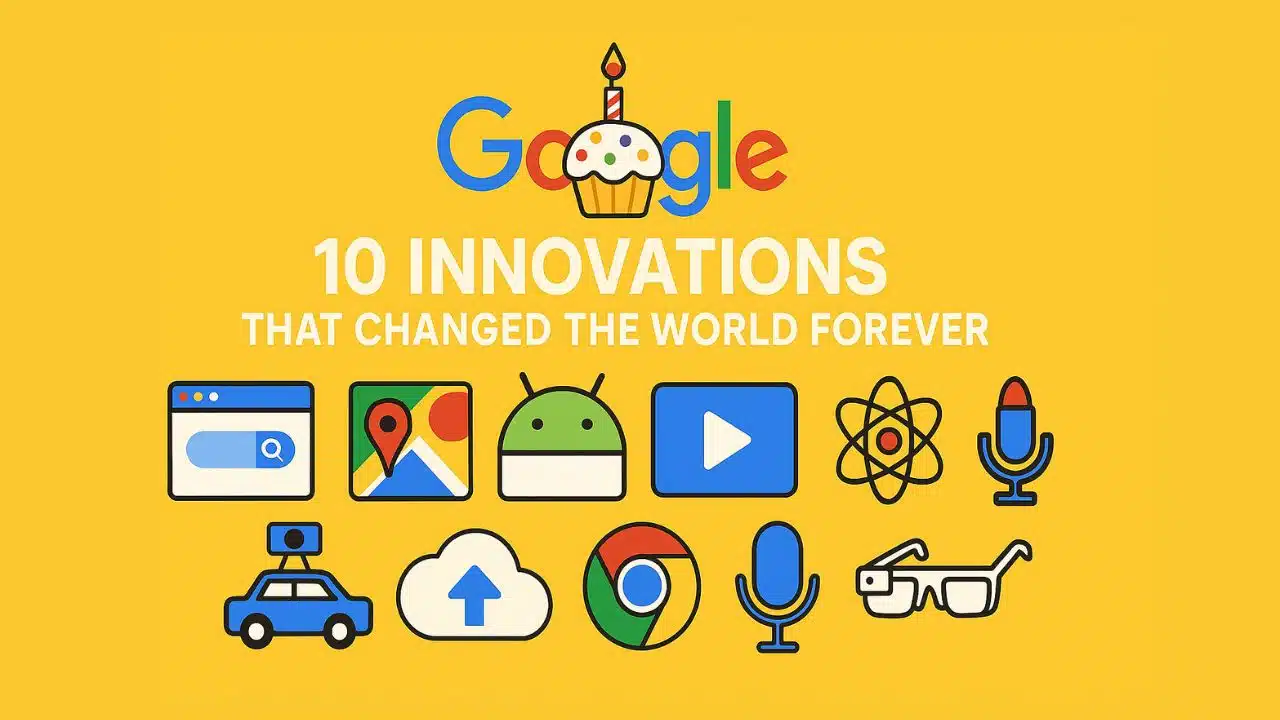
In this special feature, we’ll explore 10 Google innovations that changed the world forever. These are not just products, but milestones that redefined industries, improved accessibility, and connected billions of people across the globe.
The Birth of Google: A Quick Look Back
Google’s story began in September 1998, when Larry Page and Sergey Brin, two PhD students at Stanford University, launched their company with the vision of organizing the world’s information and making it universally accessible and useful.
The idea was simple but revolutionary: instead of ranking web pages based on how often a search term appeared, Google’s PageRank algorithm analyzed the quality and relevance of links between pages. This innovation made search results faster, more accurate, and more useful than anything available at the time.
Interestingly, Google’s official incorporation date was September 4, 1998, but the company eventually settled on September 27 as its official birthday to mark the growth of its search index. Since then, this date has been celebrated globally, often with playful Google Doodles on the homepage.
10 Google Innovations That Changed the World Forever
Since its launch, Google has gone beyond just being a search engine. Its innovations have shaped industries, transformed daily life, and redefined how people connect with information. Here are 10 world-changing Google creations.
1. Google Search – Reinventing Information Access
Imagine a world where finding information took hours. Google Search turned it into seconds.
When Google Search launched, the internet was already crowded with search engines like Yahoo, AltaVista, and Lycos. However, none could deliver precise results quickly. Google’s PageRank algorithm changed everything by ranking websites based on relevance and authority rather than just keywords.
Over the years, Google Search evolved from simple keyword searches into a powerful tool that now includes voice search, image search, instant answers, and AI-powered results. Today, people use it not just for finding websites but for real-time updates, definitions, translations, and even solving math problems.
The impact is monumental: Google democratized knowledge. What once required libraries and experts can now be accessed in seconds, shaping education, research, and daily problem-solving for billions.
2. Google Ads – Redefining Digital Advertising
The internet wasn’t profitable until Google created a new economy through ads.
In 2000, Google introduced AdWords (now Google Ads), which transformed the internet into a thriving commercial space. This pay-per-click model allowed businesses—big and small—to advertise directly to people searching for related products or services.
Soon after, Google launched AdSense, enabling website owners and publishers to earn money by hosting relevant ads. This innovation not only made Google a trillion-dollar company but also created a new economy for online businesses, bloggers, and media outlets.
Digital advertising is now the backbone of the internet, and Google Ads remains at its core, shaping how businesses reach customers and how free content is funded online.
3. Gmail – Redefining Email Communication
An email service with endless storage sounded like a dream—until Gmail made it real.
When Google launched Gmail in 2004, it shocked the world by offering 1GB of free storage—at a time when most email providers gave only a few megabytes. Gmail also introduced threaded conversations, powerful spam filters, and search-friendly organization, making email smarter and easier to manage.
Today, Gmail has over 1.5 billion users worldwide and is deeply integrated with Google’s other services like Google Drive, Calendar, and Meet. For both personal and professional use, Gmail has set the global standard for modern communication.
Getting lost became nearly impossible once Google put the world in our pockets.
Before 2005, navigation relied heavily on paper maps and GPS devices. With the launch of Google Maps, the world got an interactive, easy-to-use tool that redefined how people traveled.
Features like real-time traffic updates, turn-by-turn navigation, Street View, and satellite imagery gave people unprecedented control over their journeys. Google Earth expanded this further by offering detailed views of cities, landmarks, and even outer space.
The impact is far-reaching: Google Maps is essential for ride-hailing apps, delivery services, tourism, and local businesses. It has fundamentally changed how people move through the world.
5. Android – Democratizing Smartphones
Smartphones for everyone? Google’s Android made mobile power accessible worldwide.
In 2005, Google acquired a small startup called Android, and by 2008, the first Android-powered phone was released. Unlike Apple’s iOS, Android was built as an open-source platform, allowing multiple phone manufacturers to adopt it.
This decision fueled the global smartphone revolution, making advanced mobile technology affordable and accessible to billions of people worldwide. Today, Android powers more than 70% of smartphones globally, from budget devices to flagship models.
Android not only made smartphones mainstream but also helped expand access to the internet in developing nations, bridging digital divides.
6. YouTube – The Video Revolution
From cat videos to global movements, YouTube redefined how we share stories.
When Google acquired YouTube in 2006 for $1.65 billion, many doubted its value. Nearly two decades later, YouTube has become the second-largest search engine in the world and a central hub for entertainment, education, music, and culture.
YouTube gave rise to content creators, influencers, and online celebrities while transforming traditional media industries. It’s also a powerful educational platform, with millions of tutorials, lectures, and DIY guides available for free.
From viral videos to global movements, YouTube has changed how people consume content and how businesses advertise through video.
7. Chrome Browser – Redefining Internet Browsing
A fast, clean, and secure browser became the gateway to the modern web.
In 2008, Google launched Chrome, a browser that was faster, cleaner, and more secure than its competitors. Chrome’s minimalist design, speed, and cross-device syncing quickly made it the most popular browser in the world.
Extensions and developer tools also turned Chrome into a versatile platform for both casual users and professionals. Today, Chrome dominates the browser market with over 60% market share, setting standards for web performance and security.
8. Google Cloud – Powering the Digital Economy
Behind the apps and services you use daily, Google Cloud keeps the digital world running.
Google’s foray into cloud computing with Google Cloud Platform (GCP) and Google Workspace (formerly G Suite) revolutionized how businesses operate. From startups to Fortune 500 companies, Google Cloud provides scalable computing, storage, and AI tools.
Services like Google Docs, Sheets, and Drive enabled real-time collaboration, reshaping workplace productivity. Meanwhile, GCP supports cutting-edge technologies, powering apps, machine learning models, and enterprise systems worldwide.
Google Cloud is a backbone of today’s digital economy, supporting industries from healthcare to finance.
9. Google AI & DeepMind – Leading Artificial Intelligence
From beating world champions to solving biology’s toughest problems, Google’s AI is shaping the future.
Artificial intelligence is Google’s future, and its progress has already changed the world. Google Translate makes cross-language communication seamless, while Google Assistant brings AI into everyday life.
Through its subsidiary DeepMind, Google has achieved groundbreaking milestones such as AlphaGo, which defeated world champions in the complex game of Go, and AlphaFold, which solved protein folding—a challenge in biology for decades.
Now, with generative AI models like Gemini (formerly Bard), Google is pushing boundaries in conversational AI, creativity, and problem-solving.
10. Google Doodles – Creativity Meets Technology
Even a simple logo became a canvas for art, culture, and playful surprises.
One of Google’s most beloved traditions is its Doodles—playful modifications of the Google logo to celebrate holidays, milestones, and cultural icons. What started in 1998 with a simple stick figure has evolved into interactive games, animations, and global art pieces.
Google Doodles are more than fun—they highlight diverse cultures, achievements, and stories that resonate with people worldwide. They remind us that technology doesn’t have to be cold or corporate; it can also be human, creative, and joyful.
Timeline of Google’s 10 World-Changing Innovations
| Year | Innovation | Impact on the World |
|---|---|---|
| 1998 | Google Search | Revolutionized access to information with PageRank, making knowledge instantly accessible. |
| 2000 | Google Ads | Created a new digital economy by enabling businesses of all sizes to advertise online effectively. |
| 2004 | Gmail | Transformed email with massive free storage, spam filters, and smart organization. |
| 2005 | Google Maps & Earth | Changed navigation and travel with real-time maps, Street View, and global exploration. |
| 2005 | Android (acquired) | Brought affordable smartphones to the masses, dominating the global mobile market. |
| 2006 | YouTube (acquired) | Ushered in the video revolution, empowering creators and redefining entertainment. |
| 2008 | Chrome Browser | Set new standards for internet browsing with speed, simplicity, and security. |
| 2008–2012 | Google Cloud & Workspace | Enabled collaboration and powered businesses with scalable cloud solutions. |
| 2014–Present | Google AI & DeepMind | Pioneered breakthroughs in AI, from AlphaGo to protein folding, shaping the future of tech. |
| 1998–Present | Google Doodles | Turned the Google logo into a cultural icon celebrating global events, art, and history. |
Other Notable Google Innovations (Bonus Mentions)
While the top 10 are groundbreaking, Google has introduced many other important innovations:
-
Google News: Aggregating journalism and reshaping news consumption.
-
Google Photos: AI-driven photo storage with automatic categorization.
-
Google Drive: Cloud productivity and file sharing.
-
Pixel Devices: Expanding into hardware with phones, earbuds, and AI-powered cameras.
These products further solidify Google’s influence across different aspects of daily life.
Life Before vs After Google’s Innovations
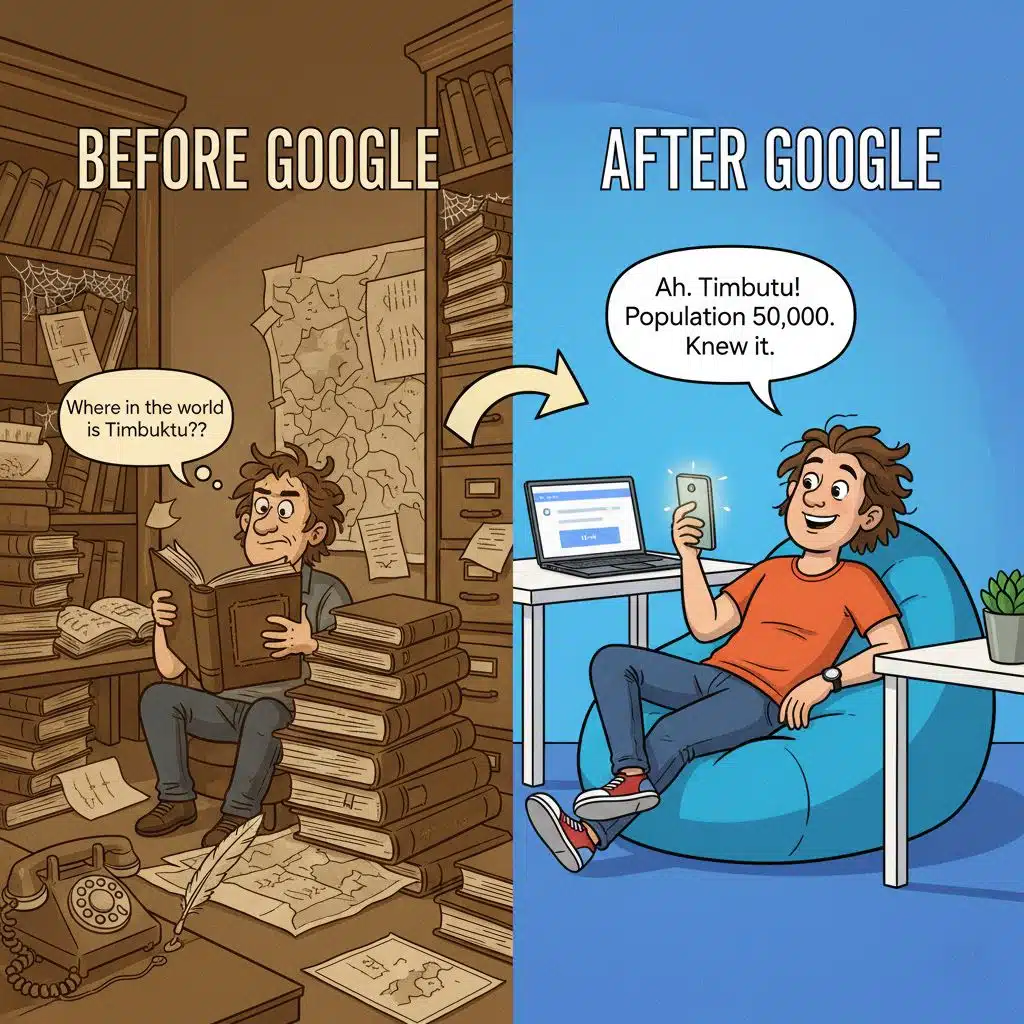
| Innovation | Life Before Google | Life After Google |
|---|---|---|
| Google Search (1998) | Searching for information meant browsing libraries, encyclopedias, or unreliable early search engines. | Instant, accurate answers in seconds, accessible to anyone with internet access. |
| Google Ads (2000) | Businesses relied on print, TV, and banner ads with limited targeting and reach. | Small and large businesses can target audiences globally, fueling the digital economy. |
| Gmail (2004) | Email storage was limited to a few MBs, with cluttered interfaces and poor spam control. | Gigabytes of free storage, clean interface, powerful spam filters, and smart search. |
| Google Maps & Earth (2005) | Travelers depended on paper maps, GPS devices, or asking for directions. | Real-time maps, Street View, and accurate navigation in every smartphone. |
| Android (2005) | Smartphones were expensive and limited to a few users. | Affordable smartphones for billions, bringing internet access to developing countries. |
| YouTube (2006) | Sharing videos required DVDs, TV broadcasts, or clunky file transfers. | A free global platform where anyone can share, learn, and earn from videos. |
| Chrome Browser (2008) | Browsers were slow, unstable, and filled with toolbars. | Fast, secure, and lightweight browsing with extensions and cross-device syncing. |
| Google Cloud (2008–2012) | Businesses relied on expensive in-house servers and outdated collaboration tools. | Scalable cloud storage, real-time document collaboration, and enterprise AI solutions. |
| Google AI & DeepMind (2014–Present) | Complex problems like protein folding or natural language understanding seemed unsolvable. | AI breakthroughs transforming healthcare, science, communication, and daily life. |
| Google Doodles (1998–Present) | Logos were static and rarely changed. | Google’s homepage became an evolving cultural space celebrating global events and creativity. |
Google’s Impact on Society and the Future
Google’s innovations go far beyond technology—they have reshaped education, business, media, healthcare, and culture. Billions of people rely on Google every day to navigate the world, stay informed, and connect with others.
However, with great power comes great responsibility. Google faces challenges over privacy concerns, antitrust lawsuits, and ethical use of AI. Balancing innovation with accountability will define its future.
Looking ahead, Google is investing heavily in AI, quantum computing, sustainability projects, and next-generation connectivity, aiming to stay at the forefront of technology for decades to come.
Final Words: Celebrating Google’s Legacy
It’s hard to imagine modern life without Google. From the moment we wake up and check Gmail, to navigating our commute with Google Maps, watching videos on YouTube, or asking Google Assistant a quick question—its innovations are seamlessly woven into our daily routines. What started in a garage in 1998 has now become a digital backbone for billions of people around the globe.
Yet, Google’s birthday is more than just a reminder of past successes. It’s also a glimpse into the future. As the company pushes forward with breakthroughs in AI, quantum computing, cloud infrastructure, and sustainability, we stand at the edge of another wave of transformation. If the last 25 years of Google reshaped how we access knowledge, the next 25 could redefine how humanity solves its biggest challenges.
On this birthday celebration, one thing is clear: Google is not just a search engine or a tech company—it’s a symbol of how innovation can change the world. And as we look ahead, we can only wonder: what surprises will Google bring on its next birthday?