

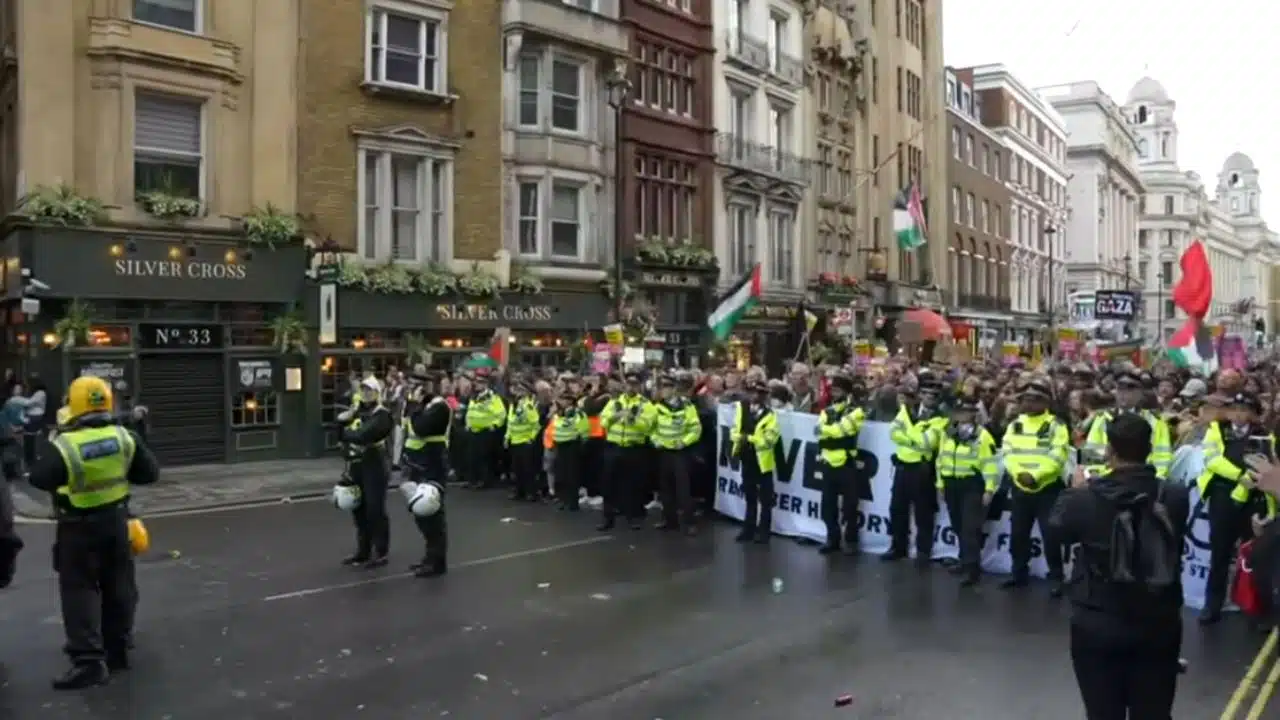
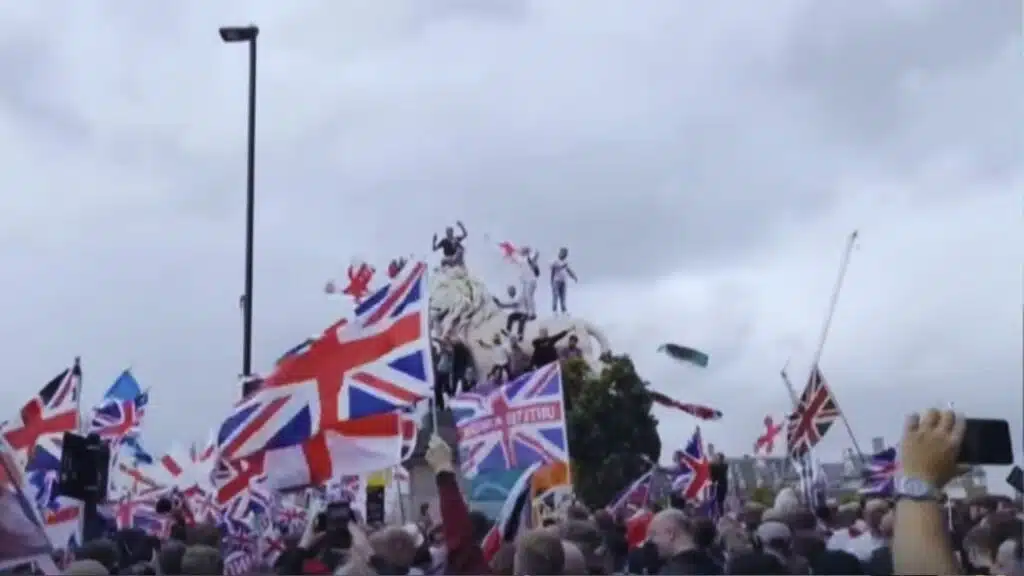
London saw one of its largest far-right demonstrations in recent years on Saturday, 13 September 2025, when the Unite the Kingdom march—organized by political activist Tommy Robinson—brought more than 110,000 demonstrators onto the streets of the British capital. The rally, promoted as a show of strength for nationalist and anti-immigration voices, quickly escalated into violent confrontations with the police and counter-protesters.
The marchers, carrying Union Jacks and St. George’s flags, filled key parts of central London, including Whitehall, where many government buildings and the prime minister’s office are located. Their chants focused on border control, immigration limits, and defending “British culture.”
Alongside the march, a smaller but vocal counter-protest of nearly 5,000 people, organized by groups like Stand Up to Racism, gathered to challenge the message of Robinson and his supporters. They carried placards denouncing racism, chanted “No justice, no peace, no fascists on our streets”, and rallied behind left-wing politicians including John McDonnell and Diane Abbott, who gave fiery speeches against hate and division.
Clashes with Police
The Metropolitan Police had created “sterile areas” to keep the two sides apart, but tensions spilled over. Demonstrators from the Unite the Kingdom march attempted to breach police lines multiple times. According to police statements, bottles, cans, and projectiles were thrown, and officers were “attacked and assaulted” in several locations.
- 26 officers were injured, with four suffering more serious harm.
- 25 protesters were arrested for violent disorder, public order offences, and assaulting police.
- Fires, flares, and smoke bombs were also reported during the scuffles.
Assistant Commissioner Matt Twist strongly condemned the violence, calling it “wholly unacceptable” and confirming that investigations had already begun. He warned that anyone identified as attacking officers or breaking the law would face “robust police action” in the coming days and weeks.
Political and Community Reactions
London Mayor Sadiq Khan released a statement emphasizing that while freedom of speech and protest are fundamental rights, “attacking police officers is completely unacceptable and undermines democracy.”
There was also concern among Muslim Londoners, as previous marches linked to Tommy Robinson have been associated with anti-Muslim chants and Islamophobic rhetoric. Ahead of the protest, Commander Clair Haynes of the Metropolitan Police publicly reassured residents that they should not feel pressured to stay at home:
“Everyone should be able to feel safe traveling into and around London. That is our priority.”
However, reports surfaced of some Muslim families avoiding central London on Saturday out of fear of harassment.
Who Is Behind the March
The driving figure behind the march, Tommy Robinson—born Stephen Yaxley-Lennon—has long been one of the UK’s most controversial political activists. He was the founder of the now-defunct English Defence League (EDL), a far-right movement known for its anti-Muslim campaigns.
Robinson has served multiple prison sentences, most recently for contempt of court after spreading false claims about a Syrian refugee. He was released earlier this year but has quickly returned to the public spotlight.
During the rally, Robinson framed the movement as a patriotic awakening. He told his supporters:
“Britain has finally awoken. Patriotism is the future, borders are the future, and we want our free speech.”
In a surprising move, high-profile international voices were also connected to the march. For example, Elon Musk appeared via video link to speak about free speech, amplifying global attention to the event.
Broader Context: A Summer of Unrest
The London protest did not happen in isolation. Throughout the summer of 2025, Britain has witnessed a wave of anti-immigration demonstrations, some of which turned violent. Many of these protests targeted hotels and housing facilities used for asylum seekers.
Symbols such as the Union Flag and the St. George’s Cross have increasingly been displayed at these events, signaling both national pride and growing anti-immigration sentiment. At Saturday’s rally, one marcher was even seen carrying a photograph of Charlie Kirk, the American right-wing commentator who was shot and killed earlier in the week in the United States. His image was raised as protesters chanted his name, linking UK events to global far-right networks.
Counter-Protests: Voices Against Hate
The counter-protests, while much smaller in size, were diverse and energetic. Activists, politicians, trade unionists, and ordinary Londoners from different backgrounds came together to send a message of unity.
Journalist Sangita Myska, who attended the counter-rally, described the scene as “people of all political persuasions, class, race, gender, and ability uniting to show that Robinson’s hate-filled rhetoric does not represent true British values.”
Chants of “this is what community looks like” echoed through central London, as demonstrators aimed to project an alternative vision of Britain—one built on inclusion rather than exclusion.
Looking Ahead
The Metropolitan Police are now reviewing footage and social media evidence to identify more suspects. Legal experts expect further arrests and prosecutions in the weeks ahead, particularly against individuals caught on camera assaulting officers or destroying property.
The events also raise larger questions about how Britain will handle rising tensions around immigration, identity, and nationalism. With a general election on the horizon and immigration continuing to dominate political debates, rallies like Unite the Kingdom show both the strength of far-right organizing and the resilience of those opposing it.
For now, the city is left counting the cost: injured officers, disrupted communities, and renewed fears of polarization on Britain’s streets.
The Information is Collected from CNN and BBC.





















