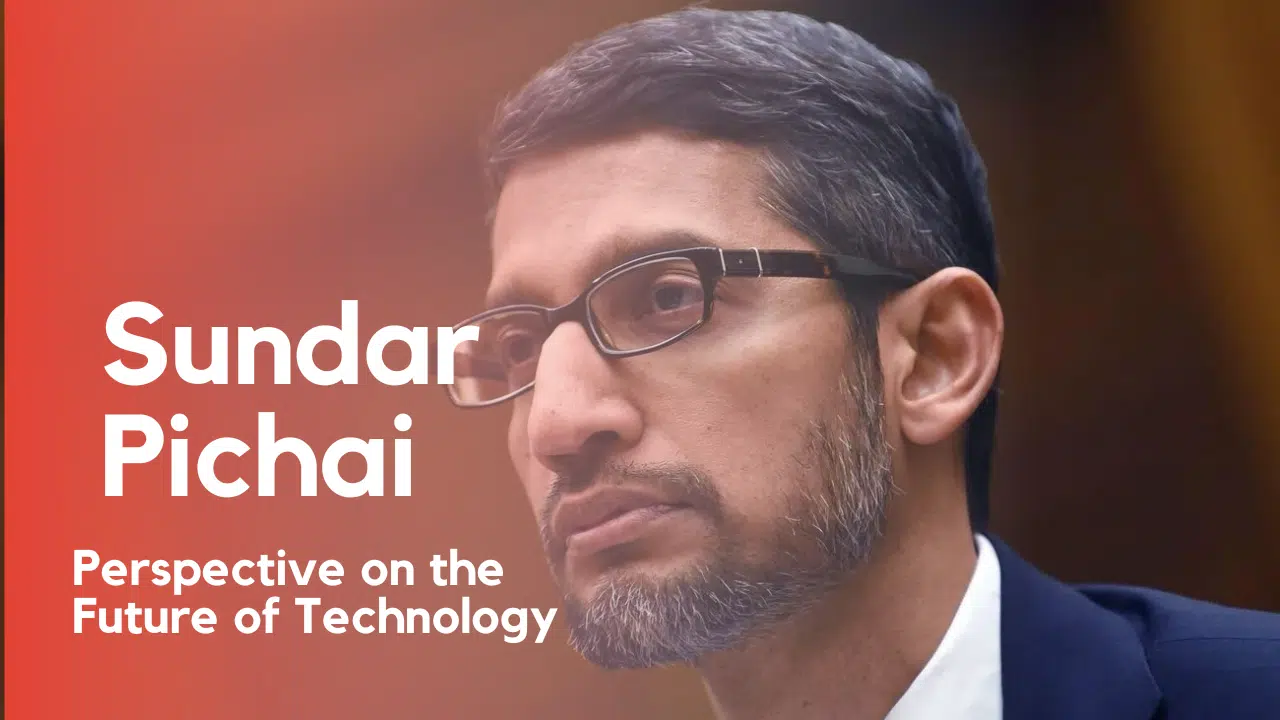
Sundar Pichai is the CEO of Google and its parent company, Alphabet. He is one of the most important people in the tech world today. Pichai has had an amazing journey, from growing up in India to leading one of the biggest companies in the world. He has played a big part in shaping how technology will change in the future. In this article, we will look at what Sundar Pichai thinks about new technologies, what he thinks will happen in the tech industry, and how he plans to keep Google at the top of new ideas and inventions.
Sundar Pichai’s Life and Career Timeline
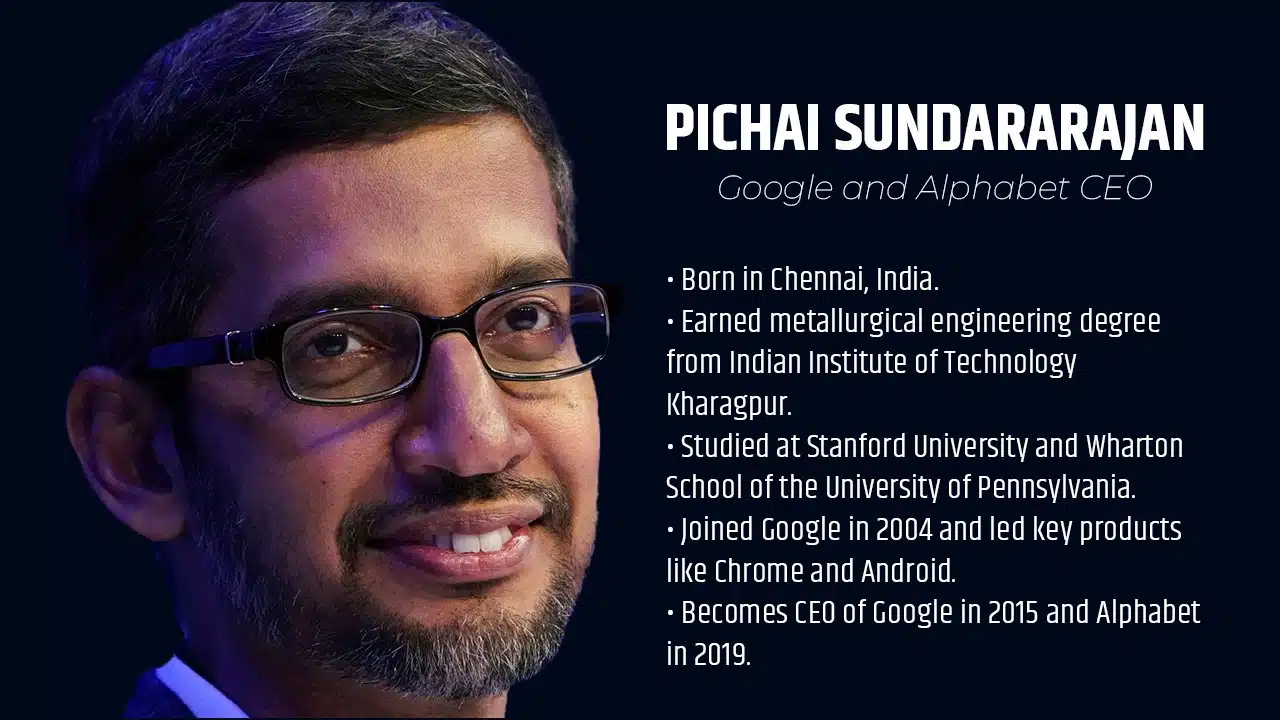
- 1972: Sundar Pichai was born in Madurai, Tamil Nadu, India.
- 1989: He finished high school at Jawahar Vidyalaya.
- 1993: He earned a B.Tech in Metallurgical Engineering from IIT Kharagpur.
- 1995: He got an M.S. in Material Sciences and Engineering from Stanford University.
- 2002: He earned an MBA from the Wharton School at the University of Pennsylvania.
- 2004: He started working at Google as a product manager.
- 2008: He became the Vice President of Product Development.
- 2012: He was made Senior Vice President of Chrome and Apps.
- 2014: He was chosen as product chief by CEO Larry Page.
- 2015: He became the CEO of Google.
- 2019: He was named the CEO of Alphabet Inc., which is Google’s parent company.
(Sources: Bloomberg, Forbes, Google)
What Pichai Thinks About New Technologies
Artificial Intelligence (AI) and Machine Learning (ML): Sundar Pichai has always said that AI and ML are very important for the future of technology. He believes these technologies will have a huge impact on many different industries and parts of our lives. In a 2018 interview with MSNBC, Pichai said, “AI is one of the most important things humans are working on. It’s more important than fire or electricity” (Clifford, 2018). He thinks AI can be used to solve big problems like climate change, healthcare, and education.
But Pichai also knows that there are risks that come with AI. He says it’s important to develop AI responsibly and think about ethics. In a 2018 article he wrote for The New York Times, he said, “The ability of AI systems to learn from data and make connections that humans might miss is what makes them so powerful. But it’s also what makes them vulnerable to bias” (Pichai, 2018). To deal with these worries, Google has developed AI principles that focus on fairness, openness, and responsibility when making and using AI technologies.
New research from @GoogleDeepMind brings together soccer and robotics. Using reinforcement learning, robots display agile and reactive movements similar to a soccer player, no shin guards needed:) https://t.co/K0WgdiIL10
— Sundar Pichai (@sundarpichai) April 11, 2024
Quantum Computing: Pichai sees huge potential in quantum computing. Quantum computers use quantum mechanics to solve very hard problems much faster than regular computers. In a 2019 interview with MIT Technology Review, he said, “Quantum computing will help us create new medicines and new materials, and it will help us do many things that are impossible today” (Gershgorn, 2019). Google has been doing a lot of research on quantum computing. In 2019, they showed that their quantum computer could do a specific task faster than the world’s most powerful supercomputer, which was a big deal.
Cloud Computing and Digital Transformation: Under Pichai’s leadership, Google has been focusing a lot on cloud computing. He believes that the cloud will be very important in helping businesses in all industries go digital. In a 2019 earnings call, Pichai said, “We continue to believe that the biggest growth opportunity in the near term is helping businesses move to the cloud” (Alphabet Inc., 2019). Google Cloud has been growing very fast, with its income going up 47% from the year before in Q4 2020 (Alphabet Inc., 2021).
Pichai also says that digital transformation is about more than just moving to the cloud or using new technologies. In a 2020 interview with The Wall Street Journal, he said, “Digital transformation isn’t just about moving to the cloud or using new technology. It’s about changing your organization and building new skills” (Mims, 2020). Google has been working closely with businesses to help them through their digital transformation journeys with things like the Google Cloud Platform and Google Workspace.
Sundar Pichai’s Approach to Innovation and Product Development
Sundar Pichai has a unique philosophy when it comes to innovation and encouraging creativity within Google. He believes in fostering an environment where employees feel empowered to experiment and take risks. Under his leadership, Google has launched several innovative products and services, such as Google Duplex, an AI system that can make phone calls on behalf of users; Google Lens, which uses computer vision to help users understand the world around them; and Google Stadia, a cloud gaming platform.
Pichai’s emphasis on user experience and his “AI-first” approach have been key drivers of Google’s product strategy. He has often spoken about the importance of making technology more accessible and helpful for everyone. In a 2017 interview with The Verge, Pichai said, “We want to build technology that works for everyone. We want to make sure we are thoughtful about how we approach these technologies and that we are doing it in a way that is good for society” (Kastrenakes, 2017).
Google’s Role in Shaping the Future of Work
As remote work and collaboration have become increasingly important, especially during the COVID-19 pandemic, Google has been at the forefront of developing tools and platforms to support this shift. Under Pichai’s guidance, Google has enhanced and promoted products like Google Workspace (formerly G Suite), which includes tools like Gmail, Google Drive, Google Meet, and Google Docs.
In a 2020 blog post, Pichai shared his thoughts on the future of work, stating, “We have an opportunity to reimagine how we work together, and we’re committed to building products that help people collaborate effectively, securely, and sustainably” (Pichai, 2020). He believes that technology can help create a more flexible and inclusive work environment, enabling people to work from anywhere and collaborate seamlessly.
Sundar Pichai’s Leadership During Times of Crisis
Pichai’s leadership has been tested during challenging times, such as the COVID-19 pandemic and increased scrutiny of tech giants by governments and regulators. Throughout these crises, Pichai has demonstrated a clear and empathetic communication style, keeping employees and customers informed and supported.
In response to the pandemic, Google took several steps to help its employees, customers, and communities. These included providing $800+ million in grants and ad credits to support small businesses, setting up a COVID-19 fund to support temporary staff and vendors, and offering free access to advanced Google Meet features for schools, businesses, and individuals (Google, 2020).
Pichai has also been vocal about Google’s commitment to privacy, security, and responsible innovation as the company faces increased regulatory pressure. In a 2020 interview with TIME, he said, “I think it’s important that we stay focused on building helpful products for users and that we do it in a way that is responsible and thoughtful” (Fitzpatrick, 2020).
Google’s Initiatives in Education and Skills Development
Education and skill development are areas where Sundar Pichai believes technology can make a significant impact. Under his leadership, Google has launched and expanded several initiatives to support learning and digital skills training.
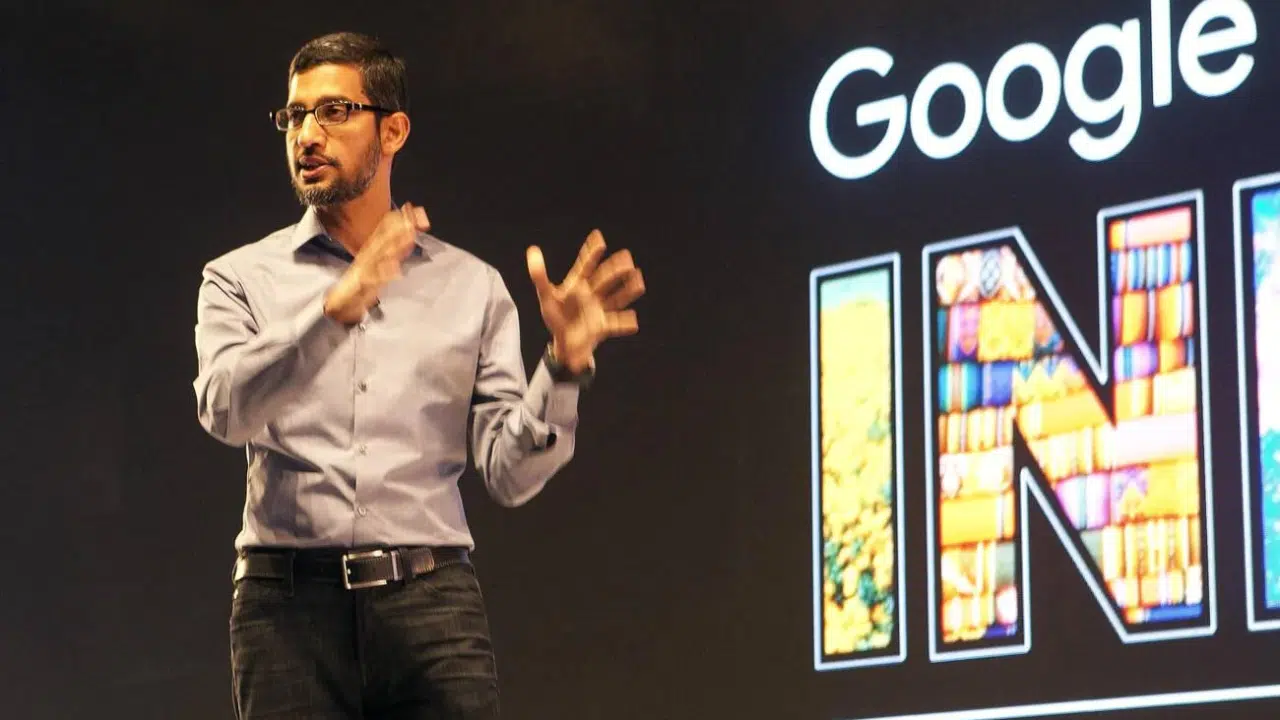
Google for Education provides tools and resources for teachers and students, such as Google Classroom, which helps manage assignments and communication. In 2020, Google announced a $10 billion investment in India over the next five to seven years, with a focus on improving access to education, enabling affordable internet connectivity, and supporting local language content (Pichai, 2020).
The company also offers programs like Grow with Google, which provides free training, tools, and resources to help people develop digital skills and grow their careers or businesses. In a 2018 blog post, Pichai emphasized the importance of digital skills, saying, “We believe that everyone should have access to the tools and opportunities that come with technology” (Pichai, 2018).
Sundar Pichai’s Personal Life and Philanthropy
Sundar Pichai’s personal life and background have greatly influenced his leadership style and values. Born and raised in India, Pichai grew up in a middle-class family that emphasized the importance of education. He has spoken about how his father, an electrical engineer, inspired his love for technology (Salam, 2018).
Pichai is married to Anjali Pichai, whom he met while studying at IIT Kharagpur. They have two children together. Despite his busy schedule, Pichai makes time for his family and has spoken about the importance of maintaining a work-life balance (Salam, 2018).
Philanthropy is also important to Pichai. He and his wife have made significant donations to various causes, including education and social welfare. In 2019, they donated $1 million to the Shri Ram Janmabhoomi Teerth Kshetra Trust, which is overseeing the construction of the Ram Temple in Ayodhya, India (PTI, 2019). The Pichai Family Foundation also supports education and technology access initiatives.
Comparing Pichai’s Leadership Style and Achievements
| CEO | Company | Leadership Style | Notable Achievements |
|---|---|---|---|
| Sundar Pichai | Google & Alphabet | Works well with others, uses data to make decisions, thinks long-term | Google’s value grew from $500B to over $1.5T, making important products like Chrome, Android, and Google Assistant |
| Tim Cook | Apple | Runs things efficiently, makes supply chains better, and focuses on customers | Apple’s value grew from $350 billion to more than $2 trillion, and it successfully launched the Apple Watch and AirPods. |
| Satya Nadella | Microsoft | Cares about people, wants to grow, puts the cloud first | Microsoft’s value grew from $300B to over $1.8T, turning Microsoft into a cloud leader with Azure |
| Jeff Bezos | Amazon | Obsessed with customers, thinks long-term, and never stops innovating | Amazon’s value grew from $150B to over $1.7T, became the biggest in e-commerce and cloud (AWS) |
(Sources: Bloomberg, Forbes, CNBC)
Pichai’s leadership style is all about working together, making decisions based on data, and thinking about the long term. He is known for being calm and good at getting teams to agree. With Pichai as the leader, Google has done some really big things. When he became CEO in 2015, Google was worth about $500 billion, and by 2021, it was worth over $1.5 trillion (Bloomberg, 2021).
Real Quotes from Pichai’s Interviews and Speeches
- “Wear your failure as a badge of honor. It’s okay to fail, but if you do, do it fast, learn from it, and move on.” Google I/O Conference, 2015 (Carson, 2015)
- “As a leader, it’s important to not just see your own success, but focus on the success of others.” – IIT Kharagpur Graduation Speech, 2017 (Economic Times, 2017)
- “We will move from a mobile-first world to an AI-first world.” Google I/O Conference, 2017 (Levy, 2017)
- “The Internet and digital technology can be equalizers. It can be a great global leveler.” World Economic Forum, 2020 (World Economic Forum, 2020)
Awards, Recognitions, and Milestones
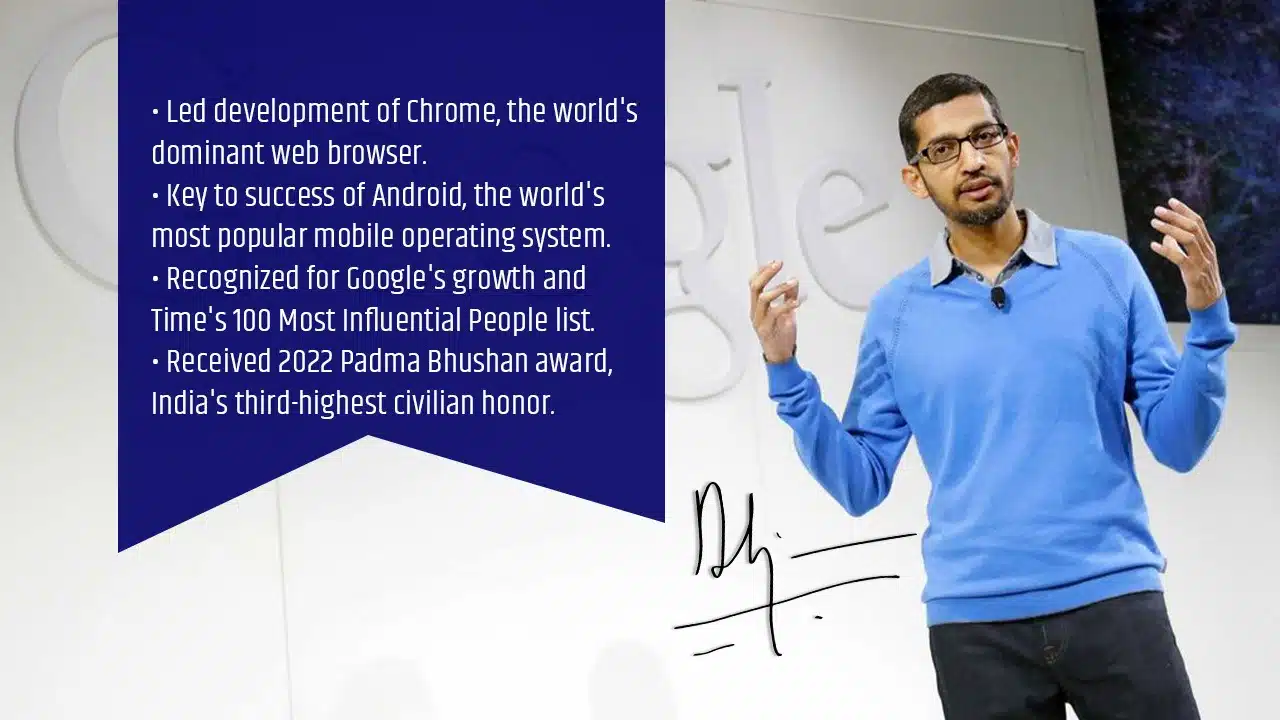
- 2015: Named CEO of Google
- 2016: Named one of Time’s 100 Most Influential People
- 2017: Received the Global Leadership Award from the US-India Business Council
- 2019: Named Global Indian of the Year by the Economic Times Awards for Corporate Excellence
- 2020: Google’s market value passed $1 trillion for the first time
- 2022: Received the Padma Bhushan, India’s third-highest civilian award
(Sources: Google, Time, US-India Business Council, Economic Times)
How Google Has Done Financially and Its Market Share Under Pichai: Since Sundar Pichai became the CEO of Google in 2015, the company has grown a lot and stayed at the top in important markets.
Financial Performance: Google’s income has gone up steadily, with Pichai as the leader. In 2015, Google’s income was $74.5 billion. By 2020, it had grown to $182.5 billion. That’s an average growth rate of 19.6% each year (Alphabet Inc., 2021).
- Search Engine Market: Google is still the world’s top search engine, with a global market share of 92.2% as of January 2021 (StatCounter, 2021).
- Mobile Operating System Market: Android, which Google made, has a global market share of 71.9% as of January 2021 (StatCounter, 2021).
- Browser Market: Google Chrome, which was launched under Pichai’s leadership in 2008, has a global market share of 63.6% as of January 2021 (StatCounter, 2021).
(Sources: Alphabet Inc. Annual Reports, StatCounter)
Takeaways
Sundar Pichai’s vision for the future of technology and his strategic leadership have put Google and Alphabet at the forefront of innovation. His focus on developing AI responsibly, investing in quantum computing, and pushing for cloud computing and digital transformation have set Google up for continued success. Pichai’s approach to innovation, his emphasis on user experience, and his commitment to using technology for good have been key drivers of Google’s growth and impact.
Under Pichai’s guidance, Google has also played a significant role in shaping the future of work, education, and skills development. His leadership during times of crisis, such as the COVID-19 pandemic, has demonstrated his ability to navigate challenges with empathy and resilience.
As technology continues to evolve at an unprecedented pace, Sundar Pichai’s insights, vision, and leadership will undoubtedly continue to shape the future of the tech industry and its impact on society. With his focus on innovation, responsibility, and inclusivity, Pichai is poised to lead Google and Alphabet to new heights while making a positive difference in the world.
References:
Alphabet Inc. (2019). Alphabet Q3 2019 Earnings Call Transcript. https://abc.xyz/investor/static/pdf/2019Q3_alphabet_earnings_transcript.pdf
Alphabet Inc. (2021). Alphabet Q4 2020 Earnings Release. https://abc.xyz/investor/static/pdf/2020Q4_alphabet_earnings_release.pdf
Bloomberg. (2021). Alphabet Inc. https://www.bloomberg.com/quote/GOOGL:US
Carson, B. (2015, May 28). The most powerful quote from Google’s conference came from the company’s new CEO. Business Insider. https://www.businessinsider.com/the-most-powerful-quote-from-googles-io-conference-came-from-new-ceo-sundar-pichai-2015-5
Clifford, C. (2018, June 12). Google CEO: A.I. is more important than fire or electricity. CNBC. https://www.cnbc.com/2018/02/01/google-ceo-sundar-pichai-ai-is-more-important-than-fire-electricity.html
Economic Times. (2017, August 5). Sundar Pichai’s speech at IIT Kharagpur: Read the full transcript. The Economic Times. https://economictimes.indiatimes.com/sundar-pichais-speech-at-iit-kharagpur-read-the-full-transcript/articleshow/53568420.cms
Gershgorn, D. (2019, December 11). Google CEO Sundar Pichai on achieving quantum supremacy. MIT Technology Review. https://www.technologyreview.com/2019/10/23/102523/google-ceo-quantum-supremacy-interview-qahttp-apiai/
Levy, S. (2017, May 17). Google Shifts from Mobile-First to AI-First. Medium. https://medium.com/backchannel/google-shifts-from-mobile-first-to-ai-first-d2c2ec543e4
Mims, C. (2020, April 26). Google Takes Aim at Amazon. Again. The Wall Street Journal. https://www.wsj.com/articles/google-takes-aim-at-amazon-again-11587920068
Pichai, S. (2018, June 7). AI at Google: Our Principles. The New York Times. https://www.nytimes.com/2018/06/07/opinion/artificial-intelligence-google-principles.html
StatCounter. (2021). Search Engine Market Share Worldwide. https://gs.statcounter.com/search-engine-market-share
StatCounter. (2021). Operating System Market Share Worldwide. https://gs.statcounter.com/os-market-share
StatCounter. (2021). Browser Market Share Worldwide. https://gs.statcounter.com/browser-market-share
World Economic Forum. (2020, January 24). Sundar Pichai, CEO of Alphabet and Google: Technology Can Be a Great Equalizer. https://www.weforum.org/events/world-economic-forum-annual-meeting-2020/sessions/special-address-by-sundar-pichai-ceo-of-alphabet-and-google