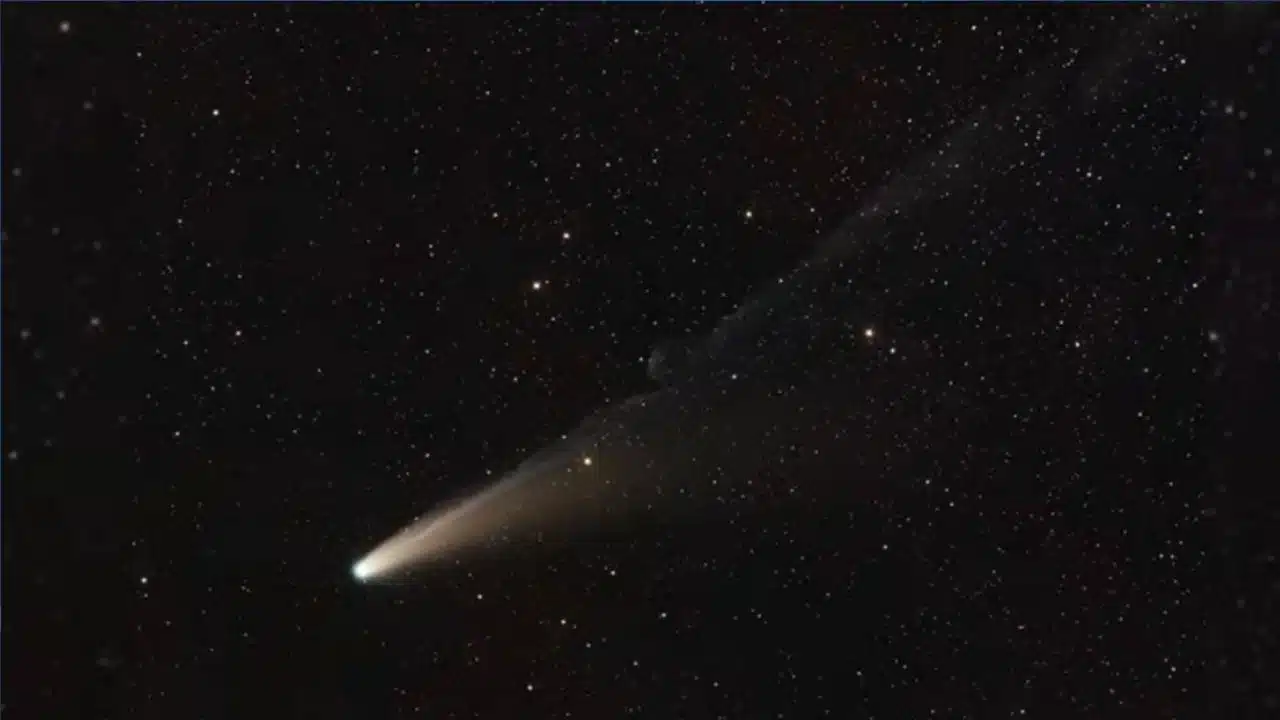
Astronomers around the world are currently observing a mysterious object known as 3I/ATLAS, a newly discovered interstellar comet that is displaying highly unusual characteristics. Unlike typical comets that grow long, bright tails as they near the Sun, 3I/ATLAS appears to be breaking all the rules. It has already passed its closest point to the Sun — known as perihelion — yet scientists say it shows no visible tail, an odd and puzzling feature for something that should be shedding gas and dust due to solar heating.
The object first drew attention when researchers confirmed its hyperbolic orbit, meaning it came from outside our solar system and will not return. This makes it only the third known interstellar object ever detected after the famous ‘Oumuamua in 2017 and Borisov in 2019. The lack of a typical cometary tail, along with strange changes in color and movement, has prompted deeper investigation by physicists and astronomers who are eager to understand what it really is and how it formed.
According to Harvard astrophysicist Dr. Avi Loeb, 3I/ATLAS passed within about 203 million kilometers of the Sun on October 29. During that time, it displayed what he described as non-gravitational acceleration — motion that cannot be explained purely by gravity. The comet also became brighter and bluer than the Sun itself, which is highly unusual for any natural comet. Instead of forming a long luminous tail, new telescope images reveal a compact glowing blob, sparking speculation about its true composition. Some astronomers suggest it may be made mostly of metallic or highly reflective materials that behave differently under solar radiation. Others are exploring whether the object could be partially icy but covered with a dense crust that prevents normal outgassing.
Dr. Loeb notes another fascinating coincidence: the comet appears to have entered our solar system from roughly the same direction as the famous “Wow!” signal detected in 1977 — a powerful radio signal that scientists have never fully explained. The two events occurred nearly half a century apart and were separated by about nine degrees in the sky, but the alignment has nonetheless reignited discussion about whether they might be connected. “It should just make us curious,” Loeb said. “We don’t know if it’s natural or technological, but we should remain open to both possibilities.”
Loeb even went so far as to suggest that if 3I/ATLAS turned out to be technological — perhaps a probe or debris from an advanced civilization — it would force humanity to rethink its place in the universe. “If it’s technological, we are in trouble,” he joked, adding, “But if we survive any such encounter, it should humble us and remind us that intelligent life may exist beyond Earth — perhaps far more advanced than we are. That should inspire us to do better.”
The Scientific Debate: Natural Object or Something Else?
Not all scientists share Loeb’s speculative view. Many in the astronomy community argue that unusual does not necessarily mean artificial. Dr. Ken Gayley, a professor of astronomy at the University of Iowa, believes that 3I/ATLAS can still be explained by natural processes — even if it defies some expectations. “We always start with the assumption that these are natural objects,” he said. “If there is overwhelming evidence to the contrary, then we can explore other options. But right now, there’s plenty of data suggesting this is just a comet formed in a different star system.”
Gayley explains that interstellar comets are likely to vary widely in appearance because they originate under diverse conditions. They might be composed of different mixtures of ice, dust, or metal, depending on the environment in which they formed. For example, a comet born around a red dwarf star could be more carbon-rich or contain exotic ices that behave differently near sunlight. When such material heats up, it might release gas without producing the familiar dust tail we expect from comets formed in our own solar system. That could easily account for the “tailless” look of 3I/ATLAS.
Many scientists also point out that ‘Oumuamua — the first interstellar visitor discovered eight years ago — behaved strangely as well, accelerating slightly without showing visible outgassing. The difference is that ‘Oumuamua was a rocky, elongated object, whereas 3I/ATLAS is clearly active and has a more rounded shape. Comparing the two could reveal important clues about how different planetary systems eject comets and asteroids into interstellar space.
Spectroscopic studies already suggest that 3I/ATLAS may be composed of abundant water ice mixed with nickel, carbon compounds, and silicates, giving it a chemical fingerprint unlike most local comets. Its bluish hue could indicate the presence of fine metallic grains or frozen gases. These findings point toward a complex and possibly ancient body — perhaps billions of years old — that formed long before our solar system even existed.
Still, the possibility of non-gravitational acceleration raises questions. If jets of gas are responsible, they might be coming from areas on the surface not visible from Earth, or they might be faint enough to evade detection. Another explanation could involve uneven heating or an unusually reflective surface that alters how sunlight pushes on it. Until further data arrives, most researchers prefer natural explanations grounded in physics rather than invoking extraterrestrial technology.
What’s Next for 3I/ATLAS and What It Could Teach Us
Astronomers will continue tracking 3I/ATLAS as it approaches its closest distance to Earth on December 19, just days before Christmas. Although the object will still be millions of kilometers away and pose no danger, this period will provide the best opportunity to study its composition and motion using high-power telescopes on Earth and in space. Observatories such as Hubble, the James Webb Space Telescope, and various ground-based facilities are expected to collect data to refine its orbit and analyze its emissions.
Dr. Loeb humorously remarked, “That’s six days before Christmas, and I hope we won’t receive an unwanted gift for the holidays. The last thing we want is for it to send a probe to planets like Earth.” Despite the lighthearted tone, scientists agree that studying 3I/ATLAS could yield serious insights. It may reveal how small bodies form and evolve in other star systems, what materials they contain, and how interstellar space transports water and organic compounds — the very building blocks of life — across vast cosmic distances.
NASA explains that comets are named according to their discoverers, which is why this one carries the ATLAS designation. The “I” in its name stands for “interstellar,” confirming its origin outside our solar system. It is the third of its kind, following 1I/‘Oumuamua and 2I/Borisov, both of which also taught scientists valuable lessons about objects born around other stars. Each of these encounters gives researchers a rare window into environments far beyond the reach of our spacecraft.
Ultimately, while some scientists entertain the idea that 3I/ATLAS might be artificial, the overwhelming view remains that it is a natural — though very peculiar — comet. Its tail-less body, strange glow, and curious acceleration challenge established models of cometary behavior and encourage scientists to rethink what is possible. Regardless of its origin, this interstellar wanderer serves as a reminder of how little we still know about the universe and how much remains to be explored.
In the coming weeks, data from observatories worldwide will determine whether 3I/ATLAS behaves more like a traditional comet as it moves away from the Sun or continues to defy expectations. Whatever the outcome, its journey through our skies in late 2025 will stand as one of the most intriguing cosmic events of the decade — a true messenger from another star system, carrying secrets of creation and raising profound questions about life beyond our own world.
The Information is Collected from Space and Yahoo.