
Ireland has entered a transformative era for employee welfare, significantly bolstered by the full implementation of the Work-Life Balance and Miscellaneous Provisions Act. As of 2026, the legislative landscape has matured, offering a suite of protections designed to harmonize professional obligations with personal and family needs. Whether you are navigating new remote work protocols or managing care responsibilities, understanding these statutory pillars is essential for both career sustainability and personal well-being in the modern Irish economy.
How We Selected Our 7 Best Work-Life Balance Rights in Ireland Facts
To identify the most critical rights for 2026, we filtered through the latest statutory instruments and the recent 2026 overhaul of the Workplace Relations Commission (WRC) codes of practice. Our selection criteria prioritized rights that provide immediate financial or temporal relief to employees, those with the highest volume of inquiries in the Irish labor market, and recently updated provisions that many workers might still overlook. We focused on rights that empower employees to maintain their professional status while addressing significant life events, from starting a family to managing health crises or domestic challenges.
7 Essential Truths About Work-Life Balance Rights in Ireland
The following breakdown highlights the core statutory entitlements that define the current balance between labor and life in Ireland. These facts represent the legal minimums that every employee should be aware of when negotiating their working conditions.
1. The Statutory Right to Request Remote Working
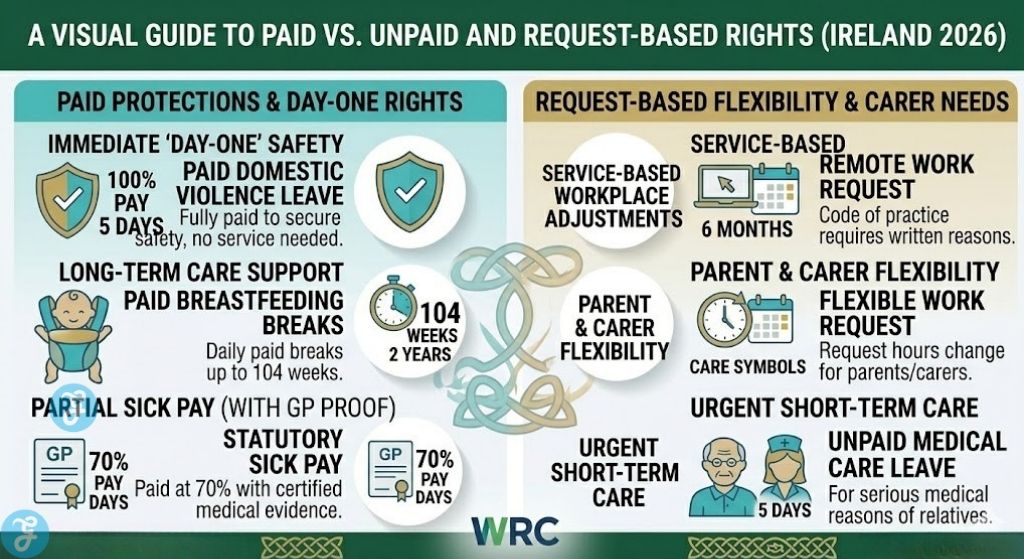
All employees in Ireland now have a legal right to request a remote working arrangement after completing six months of continuous service. Under the 2026 enhanced Code of Practice, employers are required to follow a transparent, standardized process when evaluating these requests, and they must provide objective, written reasons if a request is refused.
Best for: employees seeking to reduce commuting stress and improve daily flexibility.
Why We Chose It:
-
It is the most requested workplace adjustment in the post-pandemic era.
-
The 2026 Code of Practice update provides clearer templates and stricter timelines for employer responses.
- It offers significant potential for reducing carbon footprints and living costs.
Things to consider:
-
An employer can still refuse a request based on legitimate business needs, such as operational requirements or team collaboration.
2. Paid Domestic Violence Leave
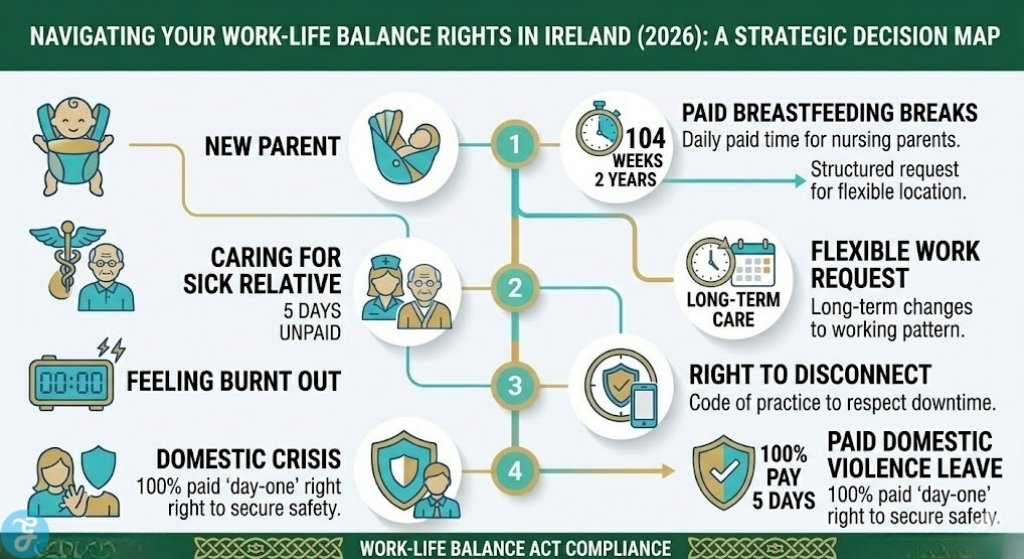
Ireland was one of the first countries in the European Union to implement a statutory right to paid leave for victims of domestic violence. Employees are entitled to five days of leave in any 12-month period at 100% of their normal rate of pay, intended to allow time for seeking medical help, legal advice, or relocation.
Best for: individuals facing urgent domestic crises who require financial and job security.
Why We Chose It:
-
It recognizes domestic abuse as a workplace issue and provides a vital safety net.
-
No minimum service requirement is needed to avail of this leave.
-
It maintains full pay, ensuring that victims are not financially penalized for seeking safety.
Things to consider:
-
While no advance notice is required in emergencies, employees should inform their employer as soon as reasonably possible.
3. Extended Breastfeeding Break Protections
The period during which an employee is entitled to paid breastfeeding breaks or a reduction in working hours has been dramatically extended. Previously capped at six months, the right now covers up to 104 weeks (two years) following the birth of the child, allowing for one hour of paid time per day.
Best for: nursing parents returning to the workforce while continuing to provide care.
Why We Chose It:
-
It aligns Irish law with global health recommendations for long-term breastfeeding.
-
It provides a concrete financial incentive by keeping the break time fully paid.
- It supports retention of skilled professionals following maternity leave.
Things to consider:
-
The one-hour break can be split into shorter periods of 30 or 20 minutes depending on workplace agreements.
4. Flexible Working Requests for Parents and Carers
While remote work is a right for all, “flexible working” (which includes adjusted hours or term-time working) is a specifically protected right for parents of children under 12 (or 16 if the child has a disability) and for those caring for relatives with serious medical needs.
Best for: employees with significant, ongoing caregiving responsibilities.
Why We Chose It:
-
It targets the specific needs of the “sandwich generation” caring for both children and elderly parents.
-
It allows for diverse arrangements like job sharing or compressed hours.
-
It includes a right to request a return to the original working pattern after a set period.
Things to consider:
-
Similar to remote work, employees must have at least six months of service before making a formal request.
5. Unpaid Leave for Medical Care Purposes
Employees can now take up to five days of unpaid leave per year to provide “significant care or support for a serious medical reason” to a specified person. This includes spouses, parents, children, or someone living in the same household who requires urgent assistance.
Best for: managing short-term family medical emergencies that do not fall under standard sick leave.
Why We Chose It:
-
It provides a legal framework for emergency care without risking disciplinary action.
-
It covers a wide definition of “relevant persons,” including cohabitants and siblings.
-
It can be taken in single days or as a block, offering flexibility during health crises.
Things to consider:
-
Employers are entitled to request medical evidence or a certificate to verify the need for care.
6. The 2026 Statutory Sick Pay Freeze
As of 2026, the statutory sick pay (SSP) entitlement in Ireland remains at 5 days per year, paid at 70% of gross salary up to a maximum of €110 per day. While original plans suggested an increase to 10 days by this year, the government has maintained the 5-day cap to balance the cost burden on small businesses.
Best for: workers needing short-term income protection during minor illnesses.
Why We Chose It:
-
It is a critical fact because it corrects the common misconception that the entitlement has already reached 10 days.
-
It ensures a baseline of pay from day one of a medically certified illness.
-
It applies to all employees who have at least 13 weeks of continuous service.
Things to consider:
-
A medical certificate from a GP is required from the first day to qualify for statutory payment.
7. The Right to Disconnect Protocol
Ireland utilizes a Code of Practice on the Right to Disconnect, which creates an expectation that employees should not be contacted for work purposes outside of their normal hours. This right protects workers from the “always-on” culture and is a key metric in WRC assessments of working time violations.
Best for: remote and hybrid workers struggling with the blurring lines between home and office.
Why We Chose It:
-
It is essential for mental health and preventing burnout in a digital-first economy.
-
It empowers employees to ignore emails or calls after their shift has ended.
-
It places the onus on employers to foster a culture of respect for downtime.
Things to consider:
-
While not a standalone law, it is frequently used as evidence in larger employment disputes regarding unpaid overtime or stress.
An Overview Of 7 Work-Life Balance Rights in Ireland Highlights
The integration of these rights into the daily Irish workplace has created a more resilient and inclusive labor market. By combining “day-one” rights like domestic violence leave with service-based rights like remote work requests, the Irish system attempts to provide both immediate protection and long-term career flexibility.
Overview Of 7 Work-Life Balance Rights in Ireland: A Quick Comparison
The following table provides a simplified view of the various leave and request entitlements available in 2026. This allows for a quick assessment of which rights require service time and which are available immediately.
Overview Comparison Table
Use the table below to distinguish between the different types of support available under current Irish labor laws.
| Right / Leave Type | Payment Status | Duration / Cap | Service Requirement |
| Remote Work Request | N/A | Variable | 6 Months |
| Domestic Violence Leave | 100% Paid | 5 Days / Year | None |
| Medical Care Leave | Unpaid | 5 Days / Year | None |
| Statutory Sick Pay | 70% Paid | 5 Days / Year | 13 Weeks |
| Breastfeeding Breaks | 100% Paid | 1 Hour / Day | Up to 104 Weeks |
| Flexible Work Request | N/A | Variable | 6 Months |
Our Top 3 Picks and Why?
-
The Right to Request Remote Working: We selected this as the top pick because it is the most transformative right for the widest number of people, directly affecting daily quality of life and expenses.
-
Paid Domestic Violence Leave: This is a top pick due to its compassionate design and the fact that it is a 100% paid “day-one” right, offering genuine protection when it is needed most.
-
Statutory Sick Pay: Despite the freeze at 5 days, this remains a cornerstone of worker security, ensuring that no one is forced to work through illness for fear of a total loss of income.
How to Choose the Right Work-Life Balance Rights in Ireland Strategy by Yourself?
Navigating these rights requires a proactive approach. You should not wait for a crisis to understand your company’s specific policies on how these statutory minimums are implemented in your workplace.
The Selection Framework
-
Assess Your Service Time: Always check your start date. If you are approaching the six-month mark, you may want to wait to submit a formal remote work request to ensure you have the full weight of the Act behind you.
-
Review the GP Requirements: For sick pay and medical care leave, the cost of a GP visit can sometimes rival the €110 daily cap. Consider if your company offers a more generous “uncertified” sick leave policy first.
-
Document the Business Case: When requesting remote or flexible work, focus on how you will maintain or improve your output. Employers are more likely to approve requests that clearly address operational needs.
-
Understand the “Relevant Person” List: Before taking medical care leave, confirm that your relationship with the person in need fits the statutory definition to avoid pay or attendance disputes.
Use the decision matrix below to identify the best course of action for your current life circumstances.
Decision Matrix Table
This matrix compares different situational needs with the most appropriate statutory right to exercise in 2026.
| If you are… | Choose X if… | Choose Y if… |
| Caring for a sick relative | Unpaid Medical Leave if the need is urgent and short-term. | Flexible Work Request if the care need is permanent or long-term. |
| New parent returning | Breastfeeding Breaks for daily paid time away from your desk. | Remote Work Request to eliminate the commute entirely. |
| Feeling burnt out | Right to Disconnect to set hard boundaries on after-hours contact. | Statutory Sick Pay if the stress has resulted in a certified medical issue. |
| Planning a move | Remote Work Request to see if your role can be done from a new location. | Flexible Work Request if you need to adjust hours for the transition. |
The Final Checklist: 5-Point Balance Plan
-
Confirm your current continuous service length with your HR department.
-
Check your employee handbook to see if your company offers “enhanced” leave beyond the statutory minimums.
-
Keep a log of any after-hours contact to support a “Right to Disconnect” conversation if needed.
-
Verify the specific medical evidence requirements for your company’s sick pay and carer’s leave.
-
Prepare a written proposal for any remote or flexible work requests at least 8 weeks before your intended start date.
The Work-Life Balance rights available in Ireland in 2026 are more than just a set of rules; they are a blueprint for a more humane and sustainable way of working. While the pause on sick pay increases reflects current economic sensitivities, the overall trend remains firmly in favor of the employee. By understanding the nuances of remote work requests and the specific protections for parents and victims of abuse, you can effectively advocate for a career that respects your time and your family. Staying informed is the best way to ensure that these legislative victories translate into a better daily reality for you and those you care for.