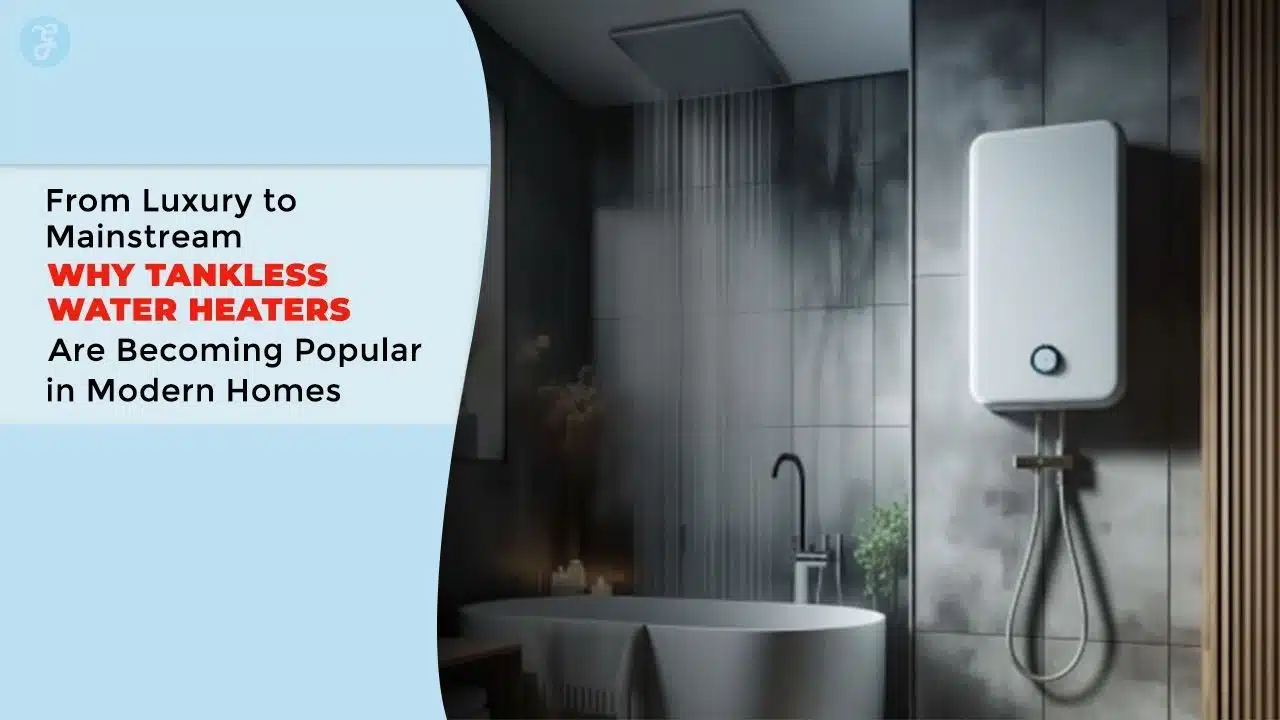
For years, most homes relied on one basic solution for hot water: a large storage tank hidden in a corner, quietly heating and reheating the same volume of water all day. That picture is changing fast. Around the world, more homeowners are asking a simple question: why are tankless water heaters becoming popular, and whether this shift makes sense for them.
What started as a niche or “premium” upgrade in a few markets has now turned into a visible global trend. Tankless water heaters – also known as on-demand or demand-type water heaters – are moving from specialist catalogs into mainstream retail, online marketplaces, and installer recommendations. Growing market size, steady year-on-year sales, and more models from major brands all point in the same direction: tankless is no longer an experiment.
This change is not just about new technology. It reflects broader forces that shape modern homes: rising energy prices, tight urban spaces, climate targets, and the desire for more comfort and control over everyday utilities like hot water.
What Exactly Is a Tankless Water Heater?
A clear explanation of how tankless systems work, how they differ from traditional tank heaters, and the main types available for various home setups.

How On-Demand Heating Works
A traditional storage-tank heater keeps 30–80 gallons (or more) of water hot at all times. It burns gas or uses electricity to maintain a set temperature, even when nobody is using hot water. This leads to “standby losses” – wasted energy.
A tankless water heater works differently. There is no big tank. Instead, cold water flows through a compact unit that heats it only when a hot tap is opened:
- A sensor detects the water flow.
- A gas burner or electric heating element switches on.
- Water passes through a heat exchanger and leaves the unit hot.
- When the tap closes, the heater shuts off.
Because water is heated only on demand, the system can be more energy efficient and eliminates standby losses. Typical whole-home tankless systems deliver a specific flow rate (often between about 2 and 5 gallons per minute, depending on the model and fuel), which is a key factor in how many fixtures the unit can support at once.
Tankless vs Traditional Storage-Tank Heaters
The core differences between a tankless and a traditional tank water heater are straightforward:
- Storage-tank heater
- Heats and stores a fixed volume of hot water.
- Runs periodically to maintain temperature.
- It can run out of hot water if the tank is emptied.
- Takes up more floor space.
- Often lasts around 8–12 years.
- Tankless water heater
- No storage tank; heats water only when needed.
- Eliminates standby heat loss.
- Provides continuous hot water within its flow-rate limits.
- Mounts on the wall, saving space.
- Often has a longer lifespan, sometimes up to 20 years, with proper care.
From a homeowner’s point of view, the difference is felt in daily use. With a correctly sized tankless system, back-to-back showers and running appliances at the same time can be more manageable, as long as demand stays within the unit’s capacity.
Types of Tankless Water Heaters
There are several key variants:
- Gas tankless water heaters: Use natural gas or LPG. They typically offer higher flow rates and are common for whole-home applications. They require proper venting and, in some cases, upgraded gas lines.
- Electric tankless water heaters: Use high-power electric elements. They are often easier to install where gas is not available, but may require substantial electrical capacity. Smaller electric models are common as point-of-use water heaters under sinks or for single bathrooms.
- Condensing vs non-condensing gas units: Condensing models recover more heat from exhaust gases, making them more energy-efficient. This design is increasingly favored by energy standards and incentive programmes.
- Whole-home vs point-of-use systems: Whole-home units serve multiple fixtures; point-of-use units serve a single tap or shower. Some homes combine both, using small point-of-use tankless heaters to eliminate long pipe runs and reduce water waste.
The Big Drivers Behind Their Rising Popularity
A breakdown of the major factors making tankless water heaters more appealing—energy efficiency, space savings, smart features, policy support, and long-term value.
1. Energy Efficiency and Lower Utility Bills
One of the most important reasons tankless water heater benefits have become a talking point is energy efficiency. Because tankless systems avoid heating water around the clock, they can reduce total energy use compared to conventional tanks.
For smaller households that use less hot water, the gains are often higher. When properly sized and installed, an energy-efficient water heater of the tankless type can cut both gas or electricity consumption and monthly bills. Larger families with heavy hot water use can still see savings, though the difference might be narrower because the system operates more hours per day.
In markets with rising energy prices or strong efficiency standards, the appeal is clear: less wasted heat, more precise use of fuel or power, and better alignment with climate and cost goals.
2. Compact, Space-Saving Design
Space is one of the most visible advantages of a tankless design. Traditional storage tanks can occupy a full closet, a corner of a utility room, or a large area in a flat. By contrast, a space-saving water heater that mounts on the wall can open up valuable area for storage, laundry, or other uses.
This matters in:
- Urban apartments and small homes.
- Renovations where designers are trying to reclaim every square metre.
- Multi-family buildings where utility space is limited.
The neat, minimal footprint also appeals to homeowners who prefer a cleaner, less cluttered mechanical room or utility area.
3. Lifestyle Appeal: “Endless” Hot Water
Marketing for tankless systems often focuses on “endless hot water.” This is one of the most powerful lifestyle arguments.
With a correctly sized, properly installed tankless unit:
- The system can deliver continuous hot water as long as demand stays within its flow-rate limit.
- There is no waiting for a tank to reheat after someone has taken a long shower.
- Multiple showers in a row become routine, not a negotiation.
In households with teenagers, multi-generational families, or several bathrooms, this shift can feel like a major comfort upgrade. As people spend more time at home, especially in remote-work settings, hot water demand can increase – and so does the perceived value of a system that keeps up.
4. Longer Lifespan and Perceived Value
Another factor behind why tankless water heaters are becoming popular is their typical lifespan. While traditional tank heaters often need replacement after about a decade, a well-maintained tankless unit can run significantly longer.
From an investment standpoint, this matters:
- The total cost of ownership includes purchase, installation, energy use, and replacement.
- If a tankless system lasts almost twice as long, the higher upfront price can be easier to justify over time.
- For homeowners who plan to stay in their property long term, the idea of “buy once, maintain well, and keep for many years” is attractive.
There is also a reduced risk of a full tank failure that can flood a room, although tankless systems still need maintenance and can fail in other ways.
5. Policy, Regulations, and Incentives
In many countries, energy-efficiency standards and climate targets push the market toward more efficient appliances. Water heaters are a part of this puzzle.
New regulations often:
- Set minimum efficiency requirements that older, low-efficiency tank models cannot meet.
- Encourage higher-efficiency gas or electric units, including condensing tankless models.
- Support consumers with rebates, tax credits, or low-interest financing for upgrades.
While details vary by country and region, the trend is clear. Policies that favour efficient appliances indirectly push demand for energy-efficient tankless water heaters, especially in new construction and major renovations.
At the same time, political debates around gas, electrification, and building codes are shaping how quickly these changes take place. For homeowners, the key point is that incentives and rules can affect both the cost and timing of a potential switch.
6. Smart-Home Integration and Tech Features
Tankless water heaters are also benefiting from the broader smart-home wave.
Many modern models offer:
- Wi-Fi connectivity and mobile apps.
- Remote temperature control and scheduling.
- Usage tracking and efficiency statistics.
- Diagnostic alerts when maintenance or service is needed.
For tech-savvy homeowners, the ability to monitor and adjust a smart water heater from a phone fits neatly into an ecosystem of connected thermostats, lighting, and security systems.
7. Strong Marketing and Installer Recommendations
Finally, manufacturer and installer behaviour play a big role.
As more major brands invest in tankless product lines:
- Retail stores and online platforms display more models and highlight their tankless water heater pros and cons.
- Local plumbers and HVAC companies offer tankless options as an “upgrade” during replacements.
- Online reviews, comparison videos, and social media discussions increase awareness.
Over time, this visibility helps normalise tankless systems as a mainstream choice rather than a niche experiment.
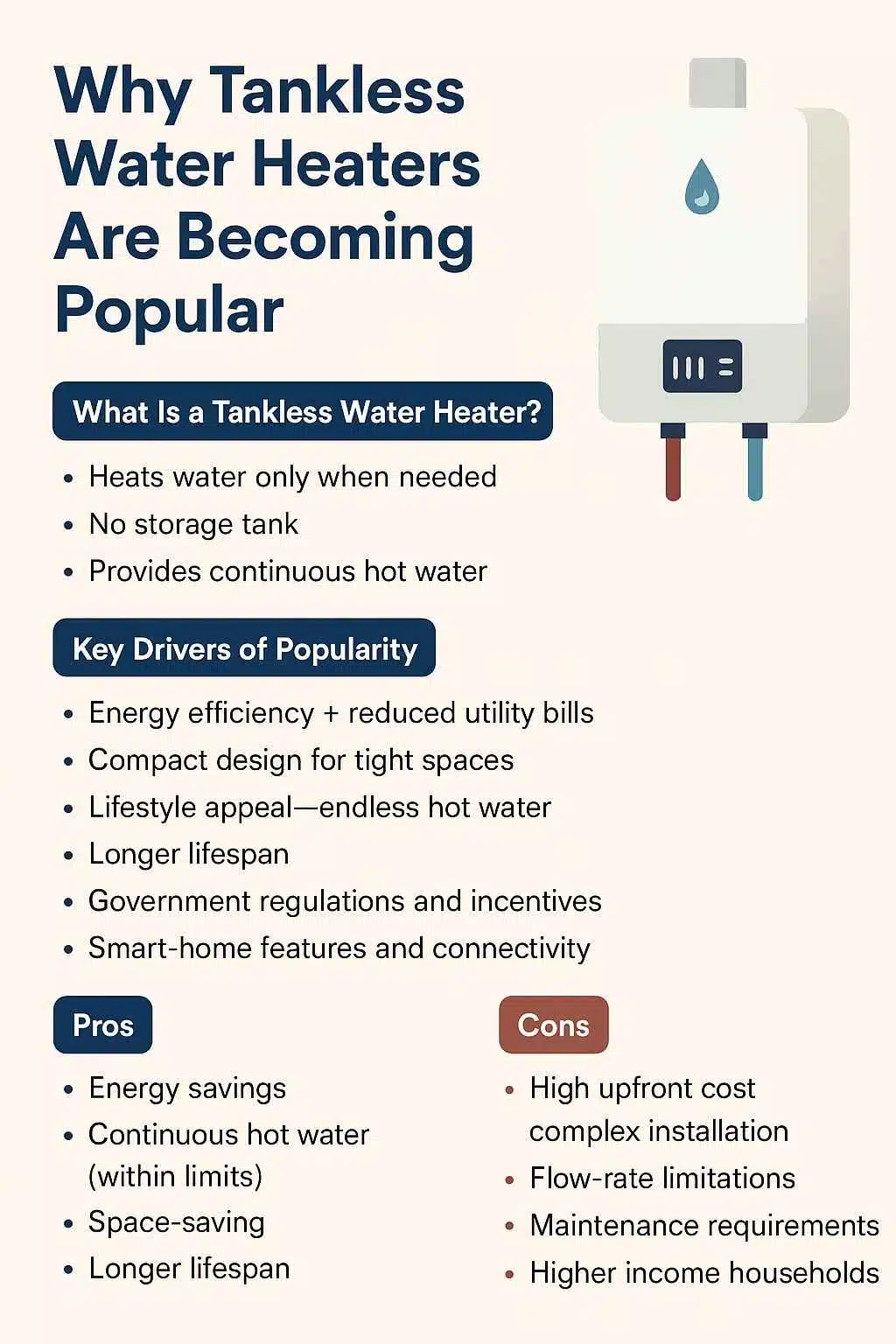
The Real-World Pros of Tankless Water Heaters
A practical look at the top benefits, from lower energy use and endless hot water to better space utilisation and longer system lifespan.
Energy Savings and Climate Benefits
The combination of on-demand heating and reduced standby losses is the core of tankless water heater benefits.
Less fuel or electricity for the same level of comfort means:
- Lower household energy bills over time.
- Reduced emissions compared to older, inefficient systems.
- Better alignment with national and local climate goals.
For environmentally conscious consumers, this is a strong argument in favour of tankless technology.
Continuous Hot Water – Within Limits
When correctly sized, a tankless heater can deliver a steady stream of hot water.
The key phrase, however, is “within limits”:
- One unit might handle a shower and a sink simultaneously.
- For a shower, a dishwasher, and a washing machine running at once, multiple units or careful system design may be needed.
Still, the experience of not “running out” of hot water remains a major positive for many households.
Space, Aesthetics, and Flexible Design
The compact form of a wall-mounted tankless heater provides more than just physical space. It supports more open, flexible interior design in modern homes.
Instead of hiding a large tank:
- Designers can integrate a slim unit into a utility wall.
- Homeowners can use the freed-up space for storage or appliances.
- Mechanical rooms can feel cleaner and more organised.
Longer Life and Lower Risk of Tank Leaks
While no system is risk-free, a tankless heater removes one specific failure mode: a large tank full of water that suddenly ruptures. Many homeowners choose tankless units as part of a strategy to reduce water damage risk, especially in flats or rooms above living spaces.
The Hidden Trade-Offs: Why Tankless Isn’t a Fit for Everyone
A balanced examination of the downsides, including high upfront costs, flow-rate limitations, installation complexity, and maintenance requirements.
High Upfront Cost and Installation Complexity
Despite their advantages, tankless systems come with real trade-offs. The most obvious is cost.
-
- The unit price of a tankless heater is usually higher than that of a basic storage tank.
- Installation can be more complex, especially when converting from an old tank system.
- Homes may need:
-
- Larger gas lines or new venting for gas units.
- Electrical upgrades for high-power electric models.
As a result, the initial outlay can be much higher than a like-for-like tank replacement, even if long-term savings are possible.
Flow-Rate Limitations and Sizing Mistakes
The promise of “endless hot water” comes with a technical condition: the unit must be sized properly for the home’s expected demand and climate.
Common issues include:
- Choosing a unit with too low a flow rate for a large household.
- Underestimating winter conditions, when the incoming water is much colder.
- Running many fixtures at once beyond the unit’s capacity.
These mistakes lead to complaints about lukewarm water or inconsistent temperatures. They also highlight the importance of professional sizing and installation.
Maintenance, Descaling, and Reliability
Tankless heaters are not maintenance-free. In hard-water areas, mineral buildup can reduce efficiency and lifespan if regular descaling is ignored.
Typical maintenance may include:
- Annual or periodic descaling with a pump and cleaning solution.
- Checking filters, vents, and condensate drains.
- Monitoring error codes via the unit’s display or app.
Repairs can also be more complex than replacing a simple tank heater, which many installers can swap quickly with standard parts.
Income and Equity Concerns
Another, less visible trade-off is affordability.
Higher upfront costs mean:
- Tankless systems may be more common in higher-income households.
- Low-income families, who may benefit most from lower energy bills, can struggle to access the technology.
This creates a policy challenge: how to make energy-efficient upgrades accessible beyond the top income brackets.
Global and Regional Trends in Adoption
Europe and the UK: Efficiency and Decarbonisation
In many European countries and the UK, energy efficiency and decarbonisation targets are reshaping heating choices. Stricter building regulations and strong awareness of climate issues create a favourable environment for:
- High-efficiency gas appliances, including condensing tankless heaters.
- Hybrid systems that combine renewable energy with on-demand hot water.
- Smaller, space-saving solutions in dense urban housing.
North America: Incentives and Standards
In North America, the shift is driven by:
- Updated efficiency standards for water heaters.
- Federal, state, or provincial incentives that lower the effective cost of high-efficiency units.
- A mix of political debates around gas vs electrification, which influences consumer choices.
Tankless units are increasingly visible in new builds and high-efficiency retrofits, while traditional tanks remain common in budget-sensitive replacements.
Asia-Pacific: Dense Cities and Limited Space
In parts of the Asia-Pacific region, dense urban living and smaller homes make space-saving water heaters more attractive. Compact gas or electric tankless units fit naturally into apartments where every square metre counts.
At the same time, rising middle-class incomes and infrastructure improvements are driving demand for higher-quality hot water solutions.
Emerging Markets: Balancing Cost and Future Gains
In many emerging markets, tankless systems are still niche. Upfront cost, inconsistent fuel supply, or limited electrical capacity can slow adoption.
Yet as incomes rise and energy policies evolve, there is potential for these markets to leapfrog directly to modern, efficient technologies rather than replicating older, wasteful designs.
Are Tankless Water Heaters Really Worth It? Key Questions to Ask
Because there is no universal answer, homeowners need to evaluate their own situation. A few simple questions can guide the decision.
1. How Much Hot Water Does Your Household Use?
- Small households with moderate daily hot water use often see the most benefit from a high-efficiency tankless system.
- Large families with many simultaneous demands may still benefit, but they must pay close attention to unit sizing and system design.
2. What Energy Sources Are Available and Affordable?
The balance between gas and electricity varies by region:
- In areas with cheap gas and costly electricity, gas tankless units may look more attractive.
- In regions pushing electrification, or where renewable electricity is widely available, electric tankless models may be preferred.
Understanding local tariffs and long-term trends helps clarify which technology offers better value.
3. Can Your Home Support a Tankless Upgrade?
Before choosing a tankless system, it is important to check:
- Gas line capacity and venting options for gas models.
- Electrical service size and panel capacity for electric units.
- Space for safe installation and future maintenance.
These technical constraints can influence both cost and feasibility.
4. Are There Incentives or Regulations in Your Area?
Available incentives can significantly change the payback period:
- Tax credits or rebates reduce upfront cost.
- Financing programmes can spread payments over time.
- Upcoming standards might favour early adoption to avoid last-minute upgrades.
Checking local policies helps determine the best timing for an upgrade.
5. How Long Do You Plan to Stay in the Property?
If you plan to move soon, a basic tank replacement may be more economical. If you expect to stay for 10–20 years, the long life and lower operating costs of a tankless system may be more appealing.
Practical Tips for Homeowners Considering the Switch
Actionable buying and installation advice that will help you to choose the right tankless model, avoid common mistakes, and understand efficiency labels.
Reading Efficiency Labels and Specifications
When comparing models, look at:
- The Uniform Energy Factor (UEF) or similar efficiency rating.
- Whether the unit qualifies as an energy-efficient water heater under local programmes.
- Flow rate at typical temperature rise, especially for winter conditions.
Higher UEF and carefully matched flow rates usually signal better performance and lower bills.
Choosing Between Gas and Electric Tankless
Each option has advantages:
- Gas tankless water heaters
- Higher flow rates for whole-home use.
- Require careful venting and combustion safety.
- Electric tankless water heaters
- Simpler mechanical installation.
- Demand strong electrical capacity; ideal where electricity is relatively clean and stable.
The right choice depends on local energy prices, climate, and building constraints.
Questions to Ask Your Installer
Before signing a contract, consider asking:
- How did you calculate the unit size for my home and climate?
- What flow rate can I expect at my winter water temperature?
- What is the recommended maintenance schedule and cost?
- How long is the warranty, and what does it cover?
- What is the expected lifetime and payback period compared to a tank?
Clear answers to these questions can prevent disappointment later.
Avoiding Common Mistakes
Common pitfalls include:
- Undersizing the unit to save on initial cost.
- Ignoring hard water conditions and skipping descaling.
- Overlooking venting, combustion air, or electrical requirements.
- Expecting “endless hot water” even when running multiple high-demand fixtures without proper design.
Planning ahead and following manufacturer guidelines can avoid most of these issues.
The Bottom Line: Popular, Promising – and Still a Choice
Tankless systems are gaining ground because they sit at the intersection of several powerful trends. They are:
- More energy efficient than old, low-efficiency tanks.
- Compact and space-saving, ideal for modern housing.
- Capable of providing continuous hot water within their design limits.
- Supported by policies, incentives, and smart-home features.
These strengths explain why tankless water heaters are becoming popular across many markets. Yet they are not the automatic best choice for everyone.
Higher upfront cost, installation complexity, and the need for careful sizing mean that tankless water heaters work best when chosen deliberately, not simply because they are fashionable. For some households, a high-efficiency tank or a hybrid system may still be more practical.
The most balanced approach is to treat tankless technology as one strong option among several. By looking honestly at your own hot water usage, energy prices, property plans, and local incentives, you can decide whether a tankless water heater is the right upgrade – or whether a different solution fits your home better.