
Looking for mutual fund options that balance lower risk and predictable returns? Choosing debt mutual funds can be a prudent decision. Recent data show that debt-oriented funds witnessed strong momentum in October 2025, with net inflows reaching ₹1.6 lakh crore. This impressive figure highlights the growing importance of these investments in a balanced portfolio.
Debt funds invest in fixed-income instruments. These can be Government Securities (G-Secs), Commercial Papers (CPs), Treasury Bills (T-bills), and Certificates of Deposit (CDs). The major benefits of these investments are their combination of stable returns, lower risk than equities, and better liquidity than options like Fixed Deposits (FDs).
Learn in detail how debt funds work, the types you can choose from based on your goals, and easy ways to invest online
How do debt mutual funds work?
Here is a brief overview of how these mutual fund investments work:
Building the investment mix
The fund manager uses the pooled money to buy debt securities at prevailing market prices. They usually follow the scheme’s investment mandate to stay aligned with stated objectives. For example, gilt funds focus on central or state government securities, while corporate bond funds mainly target corporate debt of private or public sector undertakings. This approach of debt mutual funds helps keep risk profiles predictable.
Income generation
Interest from debt securities serves as a reliable and steady source of returns, directly boosting the fund’s Net Asset Value (NAV). Debt funds can generate further gains through capital appreciation when a security is sold for more than its original purchase price. Note that debt funds may distribute dividends too, though growth options reinvest for compounding.
NAV fluctuations
The NAV of debt fund investments varies daily due to market revaluation of underlying assets, such as bonds. Bond prices adjust based on interest rate movements, credit rating changes, inflation, and market sentiment.
Different types of debt mutual funds available for investing
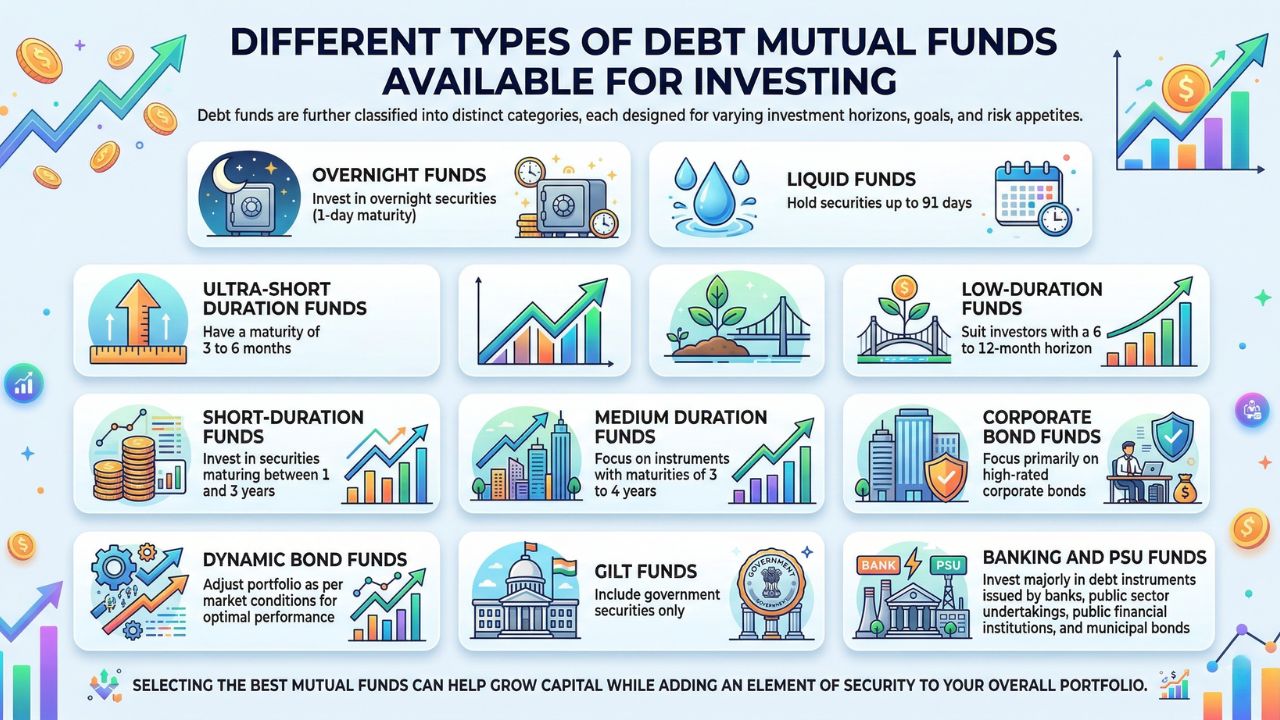
Debt funds are further classified into distinct categories, each designed for varying investment horizons, goals, and risk appetites. Look at some popular categories:
- Overnight funds: Invest in overnight securities (1-day maturity)
- Liquid funds: Hold securities up to 91 days
- Ultra-short duration funds: Have a maturity of 3 to 6 months
- Low-duration funds: Suit investors with a 6 to 12-month horizon
- Short-duration funds: Invest in securities maturing between 1 and 3 years
- Medium duration funds: Focus on instruments with maturities of 3 to 4 years
- Dynamic bond funds: Adjust portfolio as per market conditions for optimal performance
- Corporate bond funds: Focus primarily on high-rated corporate bonds
- Gilt funds: Include government securities only
- Banking and PSU funds: Invest majorly in debt instruments issued by banks, public sector undertakings, public financial institutions, and municipal bonds
Selecting the best mutual funds can help grow capital while adding an element of security to your overall portfolio.
How to invest in debt mutual funds online?
You can invest in debt funds easily through your mobile banking app or internet banking portal. Most platforms follow a similar set of steps.
Open your banking app or net banking portal and go to the investments section. Next, click on mutual funds. Select debt funds from the categories listed. After that, pick a suitable scheme, choose between Systematic Investment Plan (SIP) or lump sum (one-time payment), enter your investment amount, and complete the transaction via a linked bank account.
You can also directly invest in mutual funds through the fund house’s website.
To sum up
Debt mutual funds can be a valuable addition to a well-planned portfolio when used thoughtfully alongside equity and other assets. They may not offer aggressive growth but provide stability, predictability, and protection of capital. These funds offer varied maturity options that suit investors with different risk profiles and financial goals.
Make sure to carefully evaluate interest rate movements, credit quality, and your own investment horizon before investing. Selecting the right mutual funds after proper research can help you protect capital and maintain a balanced portfolio.