Climate change is no longer something we can ignore. It’s a reality we face daily, with rising temperatures, extreme weather events, and changing ecosystems. As individuals, organizations, and governments strive to reduce their environmental impact, carbon offsets are becoming a popular topic of discussion.
But what exactly are carbon offsets? How do they work? And are they a real solution to climate change? In this beginner’s guide, we’ll break down the concept of carbon offsets, their mechanisms, and their effectiveness in combating global warming.
What are Carbon Offsets
Carbon offsets are measurable reductions in greenhouse gas emissions designed to compensate for pollution produced elsewhere. Essentially, if you or your company produce a certain amount of carbon dioxide (CO2) or other GHGs, you can purchase a carbon offset that represents the same amount of CO2 either prevented from entering or removed from the atmosphere by specific projects.
The core idea is that global emissions are what matter most. If you emit one tonne of CO2, and a project somewhere else prevents or removes one tonne, the net effect on the atmosphere is theoretically zero.
Quick Breakdown of Carbon Offsets
| Aspect | Explanation |
|---|---|
| Purpose | Neutralize unavoidable emissions |
| How it works | Buy credits from projects that remove or reduce CO₂ |
| Who uses them | Individuals, companies, airlines, governments |
| Goal | Move toward carbon neutrality and net-zero commitments |
Importance of Maintaining Carbon Offsets
Maintaining carbon offsets is essential for managing the environmental impact of activities that continue to generate greenhouse gas emissions. While reducing emissions at the source should always be the priority, offsets play a critical supporting role by compensating for emissions that cannot yet be eliminated. Properly maintained offsets ensure that sustainability efforts remain consistent, credible, and effective over time.
-
Helps balance unavoidable carbon emissions from energy use, transportation, and operations
-
Supports verified projects that reduce or remove greenhouse gases, such as reforestation or renewable energy initiatives
-
Ensures long-term accountability by requiring regular tracking, renewal, and validation of offset programs
-
Strengthens environmental credibility by demonstrating a sustained commitment rather than a one-time action
-
Contributes to broader climate goals by aligning individual or organizational impact with global emission-reduction efforts
-
Encourages continued investment in sustainable practices while cleaner technologies are being adopted
Carbon Credits vs Carbon Offsets vs Renewable Energy Certificates (RECs)
A lot of confusion comes from mixing up three different instruments:
Carbon Credits
A carbon credit is a tradable instrument that conveys a claim to avoided emissions or enhanced removals.
In everyday language, people often use “carbon credit” and “carbon offset” interchangeably.
Carbon Offsets
“Offsetting” is the act of using carbon credits to counterbalance your emissions inventory. That’s why you’ll hear, “We bought offsets for our shipping emissions.”
RECs (Renewable Energy Certificates)
Renewable energy certificates (or similar instruments) generally track renewable electricity attributes, not full greenhouse gas equivalency across project types. They’re important—but they’re not automatically the same as carbon offsets.
Practical takeaway: In your article, define carbon offsets as a use of carbon credits to counterbalance emissions, and then explain how the credits are created and verified.
How Do Carbon Offsets Work
Carbon offsets follow a structured process that ensures emissions reduction is real, measurable, and traceable.
Key Steps
-
Measure emissions created by an activity.
-
Purchase carbon credits from certified climate projects.
-
Credits equal the amount of emissions reduced or removed.
-
Credits are retired, ensuring they cannot be reused.
Common Offset Project Types
| Project Type | What It Does |
|---|---|
| Renewable Energy | Replaces fossil fuel power with solar, wind, hydro |
| Forestry | Plants or restores forests to absorb CO₂ |
| Avoided Deforestation | Protects forests at risk of being destroyed |
| Methane Capture | Captures methane from landfills or farms |
| Energy Efficiency | Upgrades stoves, buildings, or factories to cut emissions |
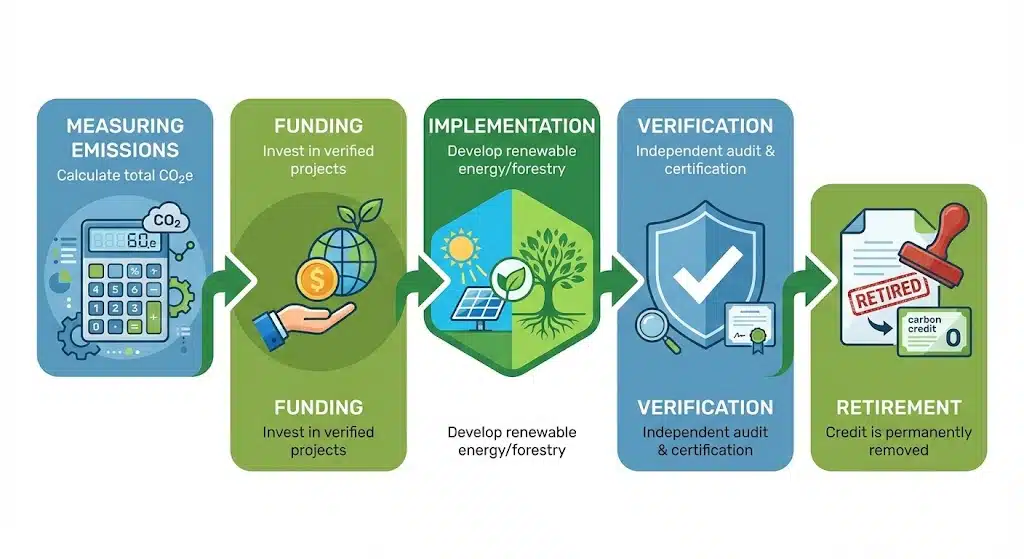
Measuring Emissions
Individuals or organizations first calculate their carbon footprint—the total GHG emissions caused by activities like travel, energy use, or manufacturing.
Funding an Offset Project
Once emissions are measured, they purchase carbon credits from projects that remove or prevent equivalent amounts of GHGs from the atmosphere. These projects are often located in different regions or countries.
Project Implementation
Carbon offset projects can be diverse, including:
- Renewable Energy: Building wind or solar farms to replace fossil fuel power plants.
- Forestry: Planting trees (afforestation), restoring degraded forests (reforestation), or preventing deforestation (avoided deforestation).
- Energy Efficiency: Providing cleaner cookstoves in developing countries or upgrading industrial machinery.
- Methane Capture: Capturing methane from landfills or agricultural waste and using it as energy.
Verification and Certification
To ensure credibility, offset projects must be verified by third-party organizations such as Verra (VCS) or Gold Standard. These standards ensure the projects are real, measurable, permanent, and provide no significant negative side effects.
Retirement of Credits
Once a carbon offset is purchased, it is “retired” from a registry. This prevents the offset from being resold or double-counted, ensuring that each tonne of CO2 is offset only once.
Types of Carbon Offset Projects
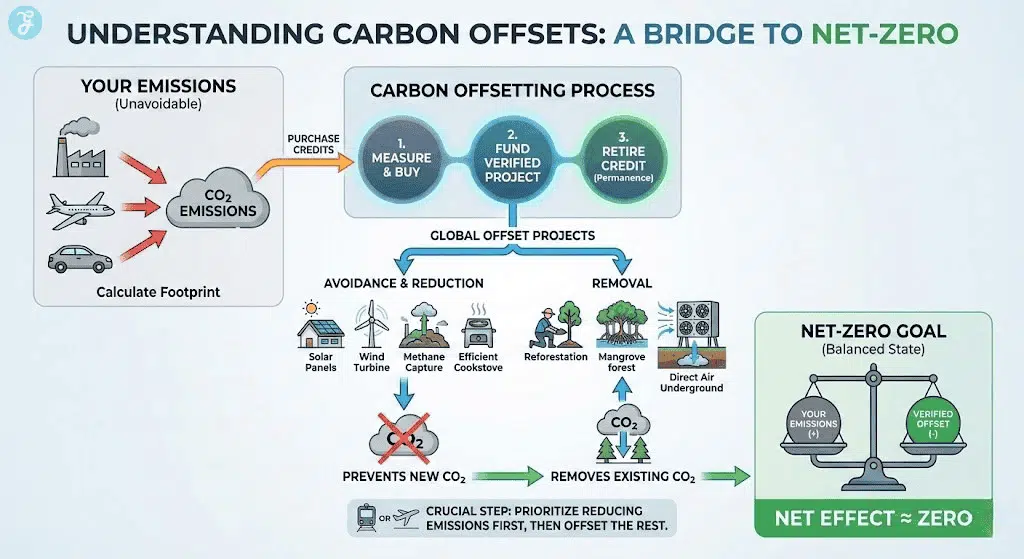
Carbon offset projects fall into two main categories: avoidance and reduction, and removal.
Avoidance vs Removal
| Type | How It Works | Example |
|---|---|---|
| Avoidance | Prevents emissions from being produced | Wind energy is replacing coal |
| Removal | Extracts CO₂ already in the air | Reforestation, direct air capture |
Avoidance and Reduction Projects
These projects aim to stop new emissions from entering the atmosphere. Examples include:
- Renewable Energy: Funding solar or wind energy projects to replace coal-fired power plants.
- Methane Capture: Capturing methane from landfills or agricultural waste to prevent it from entering the atmosphere.
- Community Projects: Distributing efficient cookstoves to reduce deforestation and indoor air pollution in developing nations.
Removal Projects
These projects actively remove CO2 from the atmosphere. Examples include:
- Nature-Based Solutions: Planting new forests (afforestation) or restoring damaged ecosystems (reforestation, mangrove restoration).
- Direct Air Capture: Using high-tech machinery to filter CO2 from the air and store it underground. This method is highly effective but currently very expensive.
What makes a “high-quality” carbon offset
This is the most important part of the guide. A carbon offset is only as good as the rules, evidence, and governance behind it.
1) Additionality (the core question)
Would this climate benefit happen without carbon finance?
Strong additionality means the project depends on credit revenue to exist or expand. Weak additionality means the project likely would have happened anyway.
What to look for
-
Clear explanation of why carbon finance is necessary
-
Financial or policy barriers documented
-
Conservative assumptions
2) Baseline integrity
The baseline is the “alternate reality” used for comparison. If the baseline is unrealistic, credits can be over-issued.
What to look for
-
Transparent baseline logic
-
Credible data sources
-
Conservative, defensible assumptions
3) MRV strength (measurement, reporting, verification)
High integrity requires strong measurement and ongoing monitoring.
What to look for
-
Regular monitoring and updates
-
Independent verification
-
Public documentation (project description, methodology, monitoring reports)
4) Permanence and durability
How long does the climate benefit last?
-
Forest carbon can be reversed (fire, disease, land use change)
-
Geological storage can be very durable, but it depends on design and regulation
What to look for
-
Clear permanence commitments
-
Buffer mechanisms (for reversal risk)
-
Ongoing monitoring
5) Leakage management
Does the project cause emissions elsewhere?
What to look for
-
Leakage assessment
-
Mitigation plans
-
Conservative deductions if the leakage risk is high
6) Double-counting protections
Double-counting happens when more than one party claims the same reduction/removal.
This can happen through:
-
Selling the same credit twice (registry tracking helps prevent this)
-
Two entities claiming the same climate benefit (more complex; often related to national accounting)
What to look for
-
Transparent registry retirement
-
Clear ownership and claim rules
-
Credible accounting practices
7) Social and environmental safeguards
Climate solutions should not harm communities or ecosystems.
What to look for
-
Community consultation
-
Respect for land rights
-
Grievance mechanisms
-
Co-benefit tracking (when relevant)
8) Registry transparency and traceability
Buyers should be able to verify that credits are real and retired.
What to look for
-
Registry serial numbers
-
Retirement certificates
-
Public retirement records (where available)
How to use carbon offsets responsibly (individuals)
If you’re an individual buying offsets for flights or lifestyle emissions, here’s a simple “do it right” framework:
1) Reduce what you can first
Offsets are most credible when they cover emissions you can’t avoid yet. Even small changes help:
-
Fewer flights or switching to rail when possible
-
Better home energy efficiency
-
Renewable electricity options (where available)
-
Eating less food waste; shifting toward lower-emission meals
2) Estimate your emissions (don’t guess)
Use a reputable calculator (many exist), and be transparent that it’s an estimate. Precision matters less than honesty and consistency.
3) Choose higher-integrity credits
If you want the most “future-proof” choice, consider:
-
Credits with strong MRV and transparency
-
Credits with meaningful durability (especially for long-term compensation goals)
-
Projects with clear safeguards and community benefits
4) Retire credits and keep records
Save your retirement certificate or proof so you can support any claim you make.
5) Make modest, accurate claims
Instead of: “I’m carbon neutral.”
Say: “I estimated my flight emissions and purchased and retired verified carbon credits to compensate for them.”
That’s more accurate and less likely to be challenged.
Why Do People Use Carbon Offsets
People and companies use carbon offsets for several reasons:
-
To address emissions that cannot currently be avoided
-
To support global climate solutions
-
To meet net-zero or carbon-neutral goals
-
To fund environmental projects in developing regions
-
To reduce the climate impact from travel or manufacturing
Offsets act as a bridge while cleaner technologies continue to evolve. Carbon offsets serve several purposes, particularly in the context of climate change mitigation:
For emissions that are difficult or impossible to eliminate (e.g., air travel, certain industrial processes), offsets provide a way to take climate action.
Achieving Net-Zero Goals
Many companies and governments use offsets as part of their strategy to reach net-zero emissions—balancing out the emissions they can’t eliminate through carbon offset purchases.
Funding Climate Solutions
Purchasing offsets helps fund essential projects that wouldn’t otherwise receive the financial backing, particularly in developing countries. These projects can foster sustainable development and technology transfer.
Corporate Social Responsibility
Companies use offsets to show environmental commitment to customers, employees, and stakeholders.
The Controversy Around Carbon Offsets: Is It Just Greenwashing
Carbon offsets are useful but often misunderstood. Critics argue that some companies rely on offsets to avoid making real reductions. Others question whether certain projects genuinely remove emissions.
Common Concerns
-
Not all offset projects deliver the impact they claim
-
Some companies use offsets as a substitute for real emissions cuts
-
Land-based projects can be reversed by wildfire or deforestation
-
Poor-quality offsets can overstate carbon benefits
Pros and Cons of Carbon Offsets
| Pros | Cons |
|---|---|
| Support climate projects worldwide | Some projects lack proper verification |
| Help balance unavoidable emissions | Risk of being used as a license to pollute |
| Can fund renewable energy and forests | Impact varies by project quality |
| Make climate action accessible to everyone | Long-term carbon storage may fail |
A Balanced Approach
While offsets shouldn’t be seen as a substitute for reducing emissions, they can still play a role in reducing the overall environmental impact. When used to address the emissions that are hard to eliminate, offsets are a valid strategy. However, it’s essential to verify that the projects are legitimate and actually deliver the promised results.
How to Buy Offsets Responsibly
If you’re considering buying carbon offsets, it’s important to be informed about where your money goes. Not all carbon offsets are equal. High-quality offsets must be independently verified and transparent.
What to Look For
- Third-party certifications
- Transparent reporting and measurable results
- Additionality (project would not happen without funding)
- Permanence (carbon storage is long-term and secure)
- No double-counting across organizations
- Gold Standard: Known for its rigorous certification process, especially for energy and community-based projects.
- Verra (VCS): The world’s largest carbon credit registry, often used for forestry and land-use projects.
Pro Tip: Avoid cheap offsets. Low cost often signals poor-quality carbon accounting or weak oversight.
These certifications ensure that the projects are credible, effective, and properly tracked.
Common Myths About Carbon Offsets
Here are the 5 most common myths and misunderstandings about carbon offsets:
Myth 1: “All carbon offsets are scams.”
Reality: Quality varies. Some credits are rigorously measured and verified; others are weak. The solution is not “ignore offsets,” but choose high-integrity credits and use them responsibly.
Myth 2: “If I buy offsets, I can pollute guilt‑free.”
Reality: Offsets should be a complement to reduction—not permission to keep emissions high indefinitely. Credible climate strategies prioritize cuts first.
Myth 3: “One offset is always one tonne, so they’re all equal.”
Reality: While credits may be issued in one‑tonne units, the real climate impact depends on additionality, measurement, permanence, and leakage.
Myth 4: “Nature-based offsets are always better.”
Reality: Nature-based projects can be excellent, but they can also face permanence and measurement challenges. Technology removals can be more durable but are often more expensive. The best choice depends on your goals and quality criteria.
Myth 5: “Cheapest offsets are the best deal.”
Reality: Price doesn’t guarantee quality—but extremely cheap credits can reflect weak additionality, limited monitoring, or higher risk. Aim for value, not bargain hunting.
The Future of Carbon Offsets
Carbon offsets are changing fast. Here are the trends most likely to shape what “good” looks like in the years ahead.
1) Stronger integrity standards and clearer labels
The market is moving toward more consistent definitions of “high integrity” across methodologies, standards, and registries. This trend reduces confusion and helps buyers compare options.
2) Better monitoring using technology
Remote sensing, satellite data, improved sensors, and advanced analytics can strengthen MRV—especially for land-based projects. Expect more real-time monitoring and tighter reporting requirements.
3) More emphasis on removals and durability
As net-zero strategies mature, many organizations will prioritize:
-
deeper reductions first
-
Then, durable carbon removals for residual emissions
This doesn’t mean avoidance credits disappear, but it does mean removal credits may become more central for long-term claims.
4) Tighter rules for marketing and green claims
Across many jurisdictions, regulators and consumer protection authorities are increasingly skeptical of vague climate claims. The future favors:
-
specific, substantiated statements
-
clear boundaries and disclosures
-
less reliance on sweeping “neutral” language
Projects will be expected to demonstrate not just carbon impact but also:
-
community consultation
-
respect for rights and livelihoods
-
transparent benefit sharing
-
safeguards and grievance mechanisms
6) More demand for transparency and traceability
Buyers will increasingly expect:
-
serial-number traceability
-
public retirement records (where possible)
-
clear documentation that prevents double use
Bottom line: Offsets are not going away, but low-transparency, low-evidence credits will be harder to justify—and harder to defend publicly.
The Verdict
Carbon offsets are a valuable tool in the fight against climate change, helping us mitigate emissions we can’t yet eliminate. However, they are not a replacement for direct efforts to reduce carbon emissions. When used responsibly and transparently, offsets can support vital climate solutions and help us move toward a net-zero future.
As a beginner, it’s essential to understand that offsets complement, rather than replace, actual emission reductions. By prioritizing verified projects and contributing to sustainable solutions, we can all play a part in protecting the planet. We hope you found our guide to what carbon offsets are to be useful and that it helps you reduce your own carbon footprint.
Frequently Asked Questions (FAQs)
Here are some of the most commonly asked questions among readers:
Do carbon offsets actually stop climate change?
No, offsets alone cannot stop climate change. They help manage emissions we cannot eliminate yet. True climate action requires drastically reducing fossil fuel use, with offsets serving as a bridge during the transition.
How much does a carbon offset cost?
The cost varies based on the project type and complexity. Basic credits can cost around $3 per tonne, while advanced technologies like Direct Air Capture can cost over $600 per tonne.
Can I resell a carbon offset after I buy it?
No, carbon offsets are typically retired after purchase to ensure the reduction is only counted once, preventing double-counting.
What is the difference between carbon neutral and net zero?
“Carbon neutral” balances emissions through offsets, while “net-zero” requires eliminating almost all emissions first, typically reducing emissions by 90% before offsetting the small remaining amount.
Are tree-planting projects the best option?
Not always. While valuable, tree-planting projects take decades to yield significant results and are vulnerable to fires or disease. Alternatives like methane capture and energy efficiency projects offer more immediate, permanent solutions.