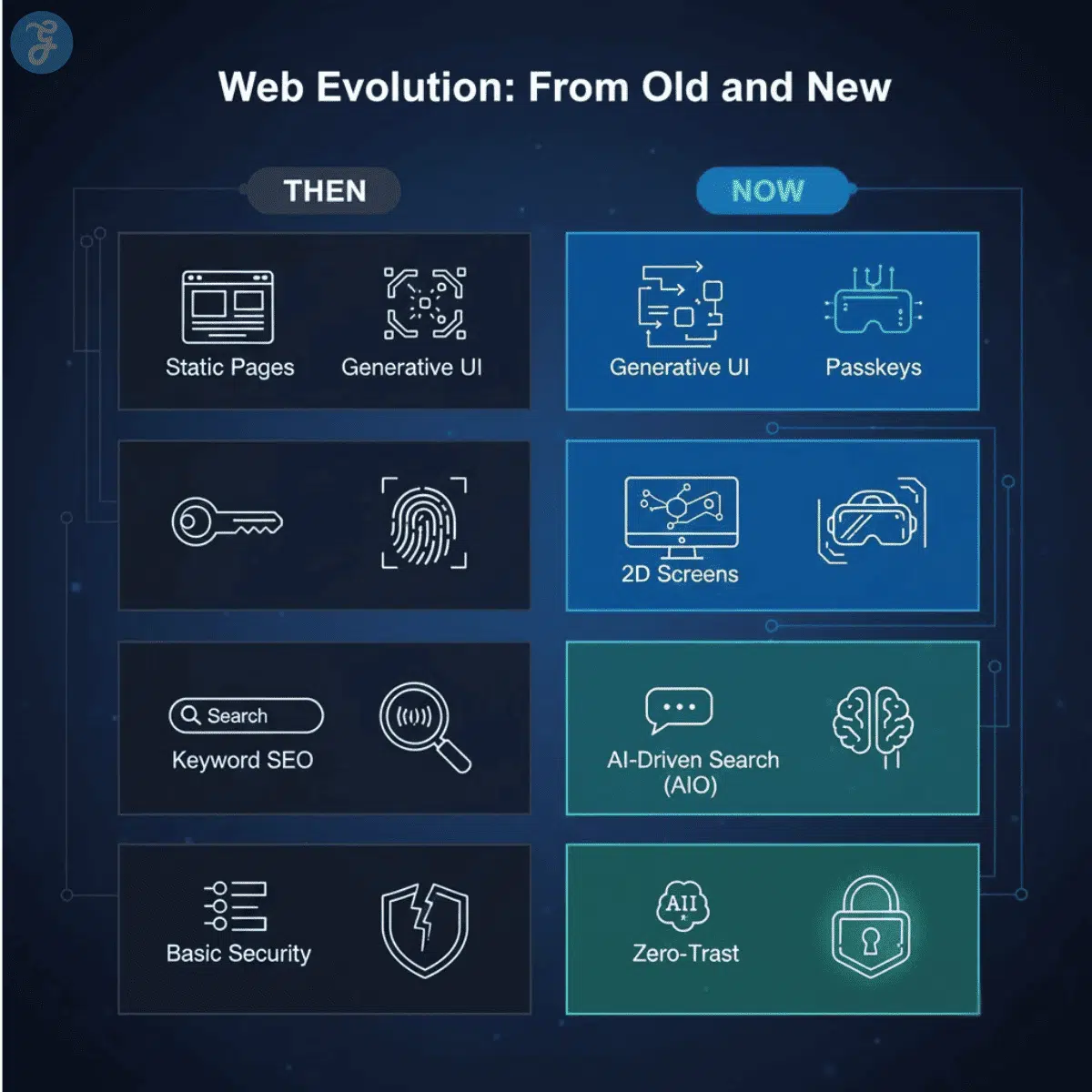
Ever wonder what the internet will look like in a few years? We are standing on the edge of a massive shift. The era of static webpages, where everyone sees the same layout, is ending. We are moving toward a “living web” that adapts, reacts, and evolves based on who is looking at it.
It is not just about faster loading times or prettier pictures anymore. The web is constantly evolving, driven by artificial intelligence and our appetite for immersive experiences. We are entering an era where the browser is no longer just a document viewer. It is becoming a spatial operating system.
What Are Web Trends?
Web trends are patterns in how websites, apps, and online experiences are designed, built, and used over time. They reflect shifts in user behavior, technology, and expectations across the internet. Some trends focus on visual design, while others relate to performance, accessibility, security, or how people interact with digital platforms.
These trends often emerge when new tools or technologies become widely available or when user needs change. For example, faster mobile internet pushed mobile-first design, while growing privacy concerns influenced data protection and cookie practices. Web trends are not just aesthetic choices; they often signal deeper changes in how people consume and trust digital experiences.
How Are Web Trends Shaping the Future of Online Experiences?
Web trends are shaped by a combination of technology advances, user behavior, and industry adoption. No single group controls them, but certain players influence their direction more strongly than others.
Key factors that set web trends include:
-
New technologies introduced by browsers, frameworks, and platforms
-
Changes in how users browse, shop, and consume content
-
Design and development choices made by large tech companies
-
Search engine guidelines and performance standards
-
Feedback loops from analytics, usability testing, and user demand
Once these factors align, trends spread as designers, developers, and businesses adopt what works best. Over time, successful approaches become standard practice, while ineffective ones fade away. These emerging web trends are set to redefine our digital lives.
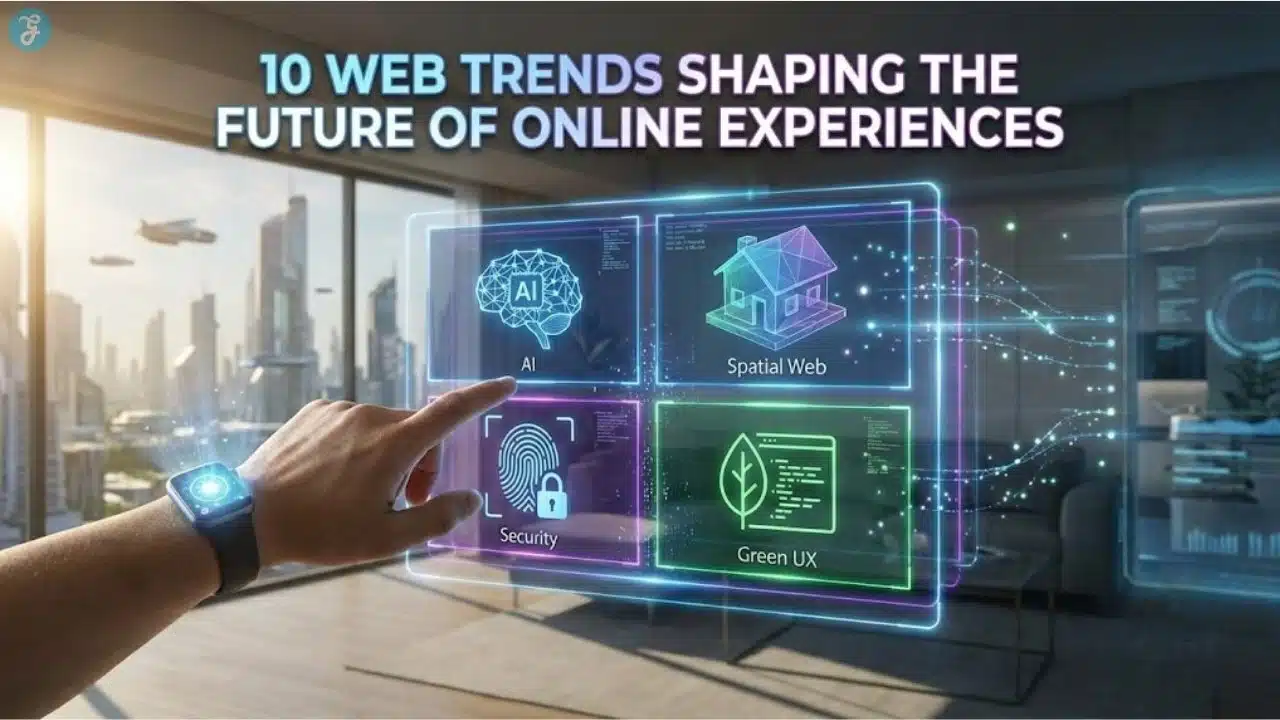
Here are 10 Web Trends Shaping the Future of Online Experiences
Let’s explore the 10 key web trends shaping the future of online experiences:
1. Generative UI: Interfaces that Build Themselves
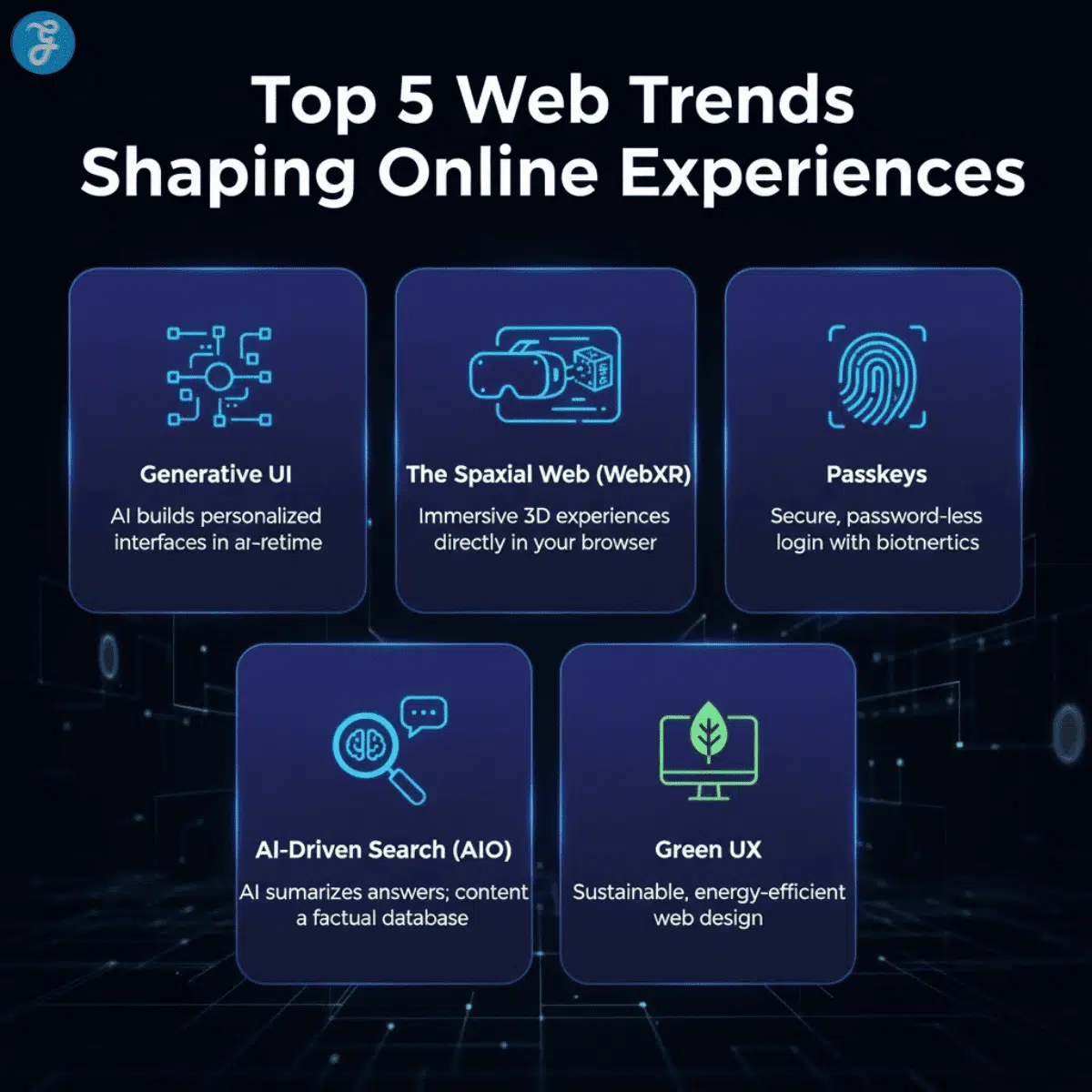
We are moving beyond simple personalization, like seeing your name on a webpage. The next big leap is Generative User Interface, or Generative UI. For years, designers built static templates that we all had to navigate. With Generative UI, artificial intelligence builds the interface in real-time based on your specific goal.
Imagine you visit a travel site to book a relaxing spa weekend. The AI might generate a soothing, minimalist layout with soft colors and slow-motion video. If you visit that same site for a frantic, last-minute business trip, the AI could strip away the visuals and present a high-contrast, data-dense dashboard built for speed. The website literally rebuilds itself to match what you need in that moment.
This approach tailors online experiences to an individual’s immediate context, making the web feel less like a collection of fixed pages and more like a helpful assistant.
2. The Spatial Web and WebXR
Get ready to move beyond flat screens. With the rise of mixed-reality headsets like the Apple Vision Pro and Meta Quest 3, the web is breaking out of the 2D monitor. This evolution is known as the Spatial Web.
It is powered by WebXR (Extended Reality), an API that lets developers create immersive 3D experiences that run directly in your browser. You will not need to download a separate app.
Think about what this means for online shopping. You could be looking at a new couch and, with a simple gesture, drag a 3D model of it from the browser into your actual living room to see how it fits. This trend transforms the internet from a library of pages into a collection of spaces you can step inside.
3. The “Bento Box” Design Grid
In terms of pure visual design, one of the most popular current trends is the “Bento Grid.” This layout, inspired by the compartmentalized Japanese lunch box, divides content into distinct, modular rectangular boxes.
Its functionality is a key reason for its popularity. The grid works perfectly on both mobile and desktop screens, allowing designers to organize complex information into digestible chunks. Companies like Apple and Microsoft have adopted this style heavily across their product pages.
A well-executed bento grid creates a clear visual hierarchy. It allows videos, maps, text, and images to coexist side-by-side without creating a sense of clutter, making the entire page feel organized and modern.
4. The Death of Passwords: The Rise of Passkeys
Cybersecurity is shifting from what you know, like a password, to who you are, which involves biometrics. This change is being driven by passkeys, which are quickly replacing traditional passwords. Backed by the FIDO Alliance and major tech companies like Google, Apple, and Microsoft, passkeys are becoming the new standard.
A passkey is a secure digital credential stored on your device. To log in to a website, you simply use your fingerprint or Face ID. There is no password to steal, phish, or forget.
This creates a frictionless login experience that is vastly more secure than typing in a complex string of characters you can barely remember.
5. Green UX and Carbon-Aware Computing
The internet consumes a massive amount of electricity. In fact, some 2025 estimates suggest that information and communication technologies account for up to 4% of global greenhouse gas emissions, a figure comparable to the entire aviation industry. As environmental concerns grow, sustainable web design, known as Green UX, is becoming a priority.
Developers are now writing “carbon-aware” code. This might mean a website automatically switches to a dark mode or loads lower-resolution images if it detects your device has a low battery or the local energy grid is under heavy load. It also involves optimizing code to run efficiently, which reduces the energy needed to load a page.
You can even measure your own website’s impact with tools like:
- Website Carbon Calculator: This tool gives your site a grade and shows how its emissions compare to real-world examples.
- Ecograder: It provides a detailed report and scores your site on performance, efficiency, and user experience.
- Digital Beacon: This gives a technical breakdown of CO₂ generated on a first visit versus a return visit.
Ultimately, a faster website is almost always a greener website.
6. AI-Driven Search (AIO)
We are in the middle of a major shift from Search Engine Optimization (SEO) to Artificial Intelligence Optimization (AIO). This is one of the most impactful web trends for content creators.
Users are no longer just typing keywords into Google. They are asking complex, conversational questions to AI agents like ChatGPT or Perplexity. This means web content needs a new structure. It must provide direct answers to questions rather than simply containing relevant keywords.
Websites are essentially becoming databases of facts that AI agents can read, understand, and summarize for users. The new goal is to be cited as a source by the AI, not just to be clicked on in a list of blue links.
7. Micro-Interactions and “Scrollytelling.”
With attention spans shorter than ever, designers are using micro-interactions to keep users engaged. These are the subtle animations and visual feedback that happen when you hover over a button, scroll past an image, or click a link. Research shows that thoughtful interaction elements can make users feel up to 70% more engaged.
This technique is a core part of “scrollytelling,” where a story unfolds as you scroll down a page. The background color might change, elements can slide into view, or 3D objects might rotate. It turns reading an article into an interactive journey. These small moments provide feedback, guide users, and keep their eyes glued to the screen.
8. Headless Architecture and the API Economy
This is an “under the hood” trend that affects everything you see online. More and more companies are moving toward “headless” architecture. This means the back end of a website, where all the data and content live, is completely separated from the front end, which is what you see and interact with.
This separation allows brands to push their content anywhere. For example, a company like K2 Sports can use a headless system to manage product information for 16 different websites from a single back end. The same database can send content to a website, a mobile app, a smartwatch, and a voice assistant all at once.
The global headless commerce market is projected to grow significantly, showing that businesses are investing heavily in this flexible approach. This makes the web infinitely more scalable and allows for faster updates.
9. Hyper-Accessibility and AI Agents
Web accessibility is no longer an afterthought. It is a legal and ethical requirement guided by standards like the Web Content Accessibility Guidelines (WCAG). AI is playing a massive role in making the web truly usable for everyone.
New AI agents can navigate the web on behalf of users with disabilities. For example, a blind user could ask an AI agent to “Book me a flight to London,” and the agent would be able to navigate the complex airline menus, fill out all the necessary forms, and complete the purchase.
This makes it critical for websites to be built with clean, semantic code that machines can easily understand. Following WCAG not only prevents legal issues but also improves SEO and makes your site more usable for everyone.
10. Zero-Trust Security Architecture
In an age of remote work and constant connectivity, the old security model of “trust, but verify” is dead. The new standard is “Zero Trust,” and its adoption is growing rapidly. Gartner estimates that 60% of organizations will embrace Zero Trust as a core part of their security strategy by 2025.
A Zero Trust approach treats every single request as suspicious, even if it comes from inside the company network. It involves continuous authentication and strict access controls for every user and device.
This shift has a real financial impact. The 2024 IBM Cost of a Data Breach Report found that the global average cost of a data breach has hit a record high of $4.88 million. By assuming no user or device is automatically trustworthy, Zero Trust architecture makes it much harder for a hacker who gets into one part of a system to move laterally and steal other data.
Why Should You Bother Keeping Up with Web Trends?
In the digital world, standing still is the same as moving backward. For businesses and creators, staying informed about web trends is not about chasing every new “shiny object”; it is about strategic survival. Here is why it matters:
-
Competitive Advantage: Early adopters of technologies like passkeys or AIO (AI optimization) gain a massive head start. While competitors are still struggling with forgotten passwords and outdated SEO, you are providing a frictionless, future-proof user experience.
-
User Trust and Security: Trends like Zero-Trust Architecture and Green UX signal to your audience that you value their privacy and the planet. In an era of record-high data breach costs ($4.88 million on average), demonstrating modern security standards is essential for brand reputation.
-
Operational Efficiency: Moving to a headless architecture or utilizing edge computing isn’t just a tech upgrade; it’s a way to scale faster and reduce hosting costs. A faster, more modular site is easier to maintain and cheaper to run.
-
Accessibility and Inclusion: Following trends like hyper-accessibility ensures you aren’t leaving 15% of the global population behind. Modern web standards make your site usable for everyone, which directly correlates to higher conversion rates and better search rankings.
What Can We Expect Moving Forward?
As we move deeper into this decade, expect a shift from “generic” to “hyper-personalized.” The following changes will become standard:
-
AI-First Navigation: Browsers will evolve into AI assistants that “read” the web for us, meaning websites must focus on providing structured, factual data (AIO) rather than just keyword-heavy articles.
-
The Rise of “Zero-Party” Data: As privacy laws tighten, brands will stop tracking users and start asking them. We will see more interactive, consent-based experiences where users trade information for genuine value.
-
Sustainability as a Metric: Just as we track “Time to First Byte,” developers will begin tracking the carbon footprint per visit. “Light” websites will be prioritized by search engines and environmentally conscious users alike.
-
Hardware Synergy: With the adoption of spatial headsets and wearable tech, the web will move into our physical rooms. Every brand will need to consider how their product looks in 3D, not just on a 2D grid.
Embracing the Future of Online Experiences
These web trends are not isolated. They weave together and amplify one another. Generative UI relies on powerful AI, the Spatial Web is built on a flexible headless architecture, and Green UX depends on efficient code.
The future of the web promises to be more intelligent, more intuitive, and more deeply integrated into our physical lives. Keeping an eye on these developments ensures we are not just observers of technology but active participants in shaping our digital world.
Frequently Asked Questions (FAQ)
Here are some common questions about these emerging trends.
1. What is the difference between AI and generative UI?
Think of AI as the brain and generative UI as the creative output. AI is the underlying technology that analyzes data and makes decisions. Generative UI is the actual visual interface that the AI creates for you in real time. Instead of a designer manually placing a button, the AI places it where it predicts you will need it most based on your actions.
2. Will WebXR replace standard websites?
No, it is unlikely to replace them entirely. We will still need standard 2D websites for tasks like reading news or checking email, where text is easiest to consume on a flat surface. WebXR will become the go-to for specific online experiences where 3D depth adds significant value, such as shopping, gaming, education, and virtual tours.
3. Why are passkeys better than passwords?
Passkeys are fundamentally more secure because they are resistant to phishing. A hacker can trick you into typing your password into a fake website, but they cannot steal the unique cryptographic key that is securely stored on your device and linked to your face or fingerprint. Because passkeys are unique to every site, a data breach at one company does not compromise your accounts anywhere else.
4. What is Scrollytelling?
Scrollytelling is a web design technique where the narrative of a webpage advances as the user scrolls. It is an immersive way to tell a story by combining text, audio, video, and animation. As you scroll, the background might fade from day to night, or a complex chart might build itself piece by piece. It transforms static content into a more cinematic and engaging experience.
5. How does Green UX save money?
Green UX is all about efficiency. By optimizing images, reducing unnecessary code, and using efficient servers, you lower the amount of data that needs to be transferred. This directly reduces your hosting and bandwidth costs. A faster, more efficient website also tends to rank better in search results and provides a better user experience, which often leads to higher conversion rates.