
In an era where online privacy and security are more important than ever, applications like VPNs and proxies are no longer just for corporate users trying to access remote resources. But many people mix the two up or believe they do the same thing. Though a VPN proxy both re-routes your internet traffic and changes your IP address, their usage, capabilities, and limitations are quite dissimilar. In this article, we examine the key advantages and disadvantages of VPNs and proxies, helping you decide which option you should opt for based on your needs.
What Is a Proxy?
A proxy server sits between your device and the internet. When you visit with a proxy, your internet request is made to the proxy, and the proxy then makes the request on your behalf and returns the data to you. That helps to obscure your IP addresses from the sites you visit, making it harder for anyone who may snoop to determine where your traffic is coming from.
There are different proxies, such as ones you ask explicitly to use and others that run invisibly in the background.
- HTTP Proxies – These proxies are only for web traffic.
- SOCKS Proxies – Good for any kind of traffic, such as P2P and video streaming, but can be slower.
Transparent Proxies – These proxies are transparent, which is why they are often used by nefarious individuals and persons working in corporations, and are not good for privacy.
Proxies can offer basic anonymity but can also help you bypass some geo-restrictions; however, they don’t encrypt your data. It means you are still being tracked by your internet service provider (ISP) and vulnerable to hackers on unsecured networks.
What Is a VPN?
VPN takes a more generalized approach to securing oneself online. Similar to a proxy, a VPN sends your internet traffic to a remote server and disguises your IP address. But it also encrypts all the data you send — but not the data you receive — to create a secure layer of protection between your device and the internet.
With encryption, not even your internet provider or a hacker on public Wi-Fi would know what you do online. VPNs are also often used not only to protect privacy but also to access geo-blocked content and navigate ad-blocking and other forms of censorship at home, and when away from home for safer public Wi-Fi use.
The vast majority of high-quality VPN providers rely on strong encryption standards such as OpenVPN, IKEv2, or WireGuard, and most also include popular options like kill switches, DNS leak protection, and split tunneling.
VPN or Proxy: Which one to choose?
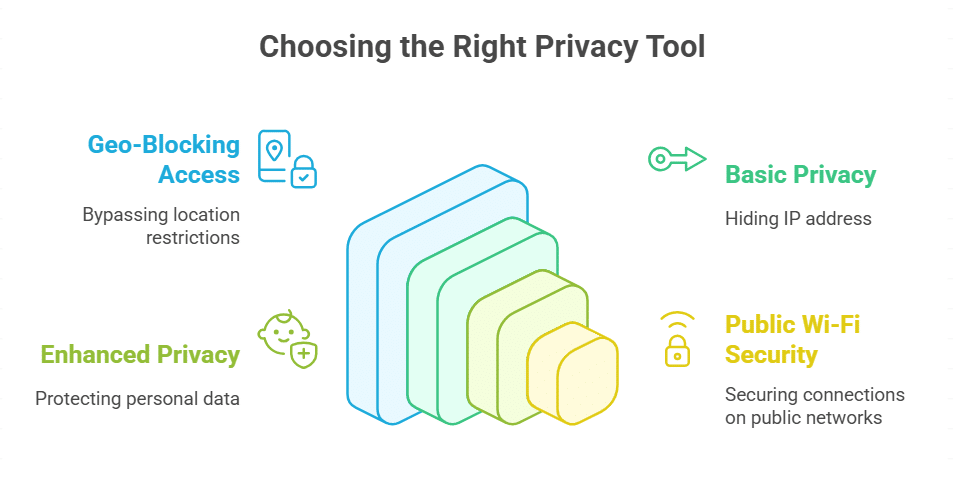
If all you’re looking to do is hide your IP address to access geo-blocked websites such as YouTube or broadcasters abroad, or read news from a different location, a proxy will do the job. But if you’re worried about your online privacy and want to protect your identity, sending or sharing personal, sensitive information, or using public Wi-Fi, a VPN proxy is much safer.
When to Use a Proxy
- To circumvent simple work or school website restrictions
- For streaming that’s region-locked
When to Use a VPN
- When you need total encryption and privacy
- While using public Wi-Fi
- Watching for sensitive logins (such as a bank or sensitive account) or for performing any online banking.
- To avoid government censorship or ISP throttling
Final Thoughts
VPNs and proxies share the same goal (masking your identity online), but they are designed for different degrees of protection. It’s the best of both worlds because it doesn’t require you to cut cards, but a full VPN service is better for security and privacy, at least for most people. Assess your needs — whether it’s speed, security, or anonymity — and pick the one that suits you best. Nowadays, it would be a mistake not to attempt to shield your online identity by taking measures to protect your privacy.