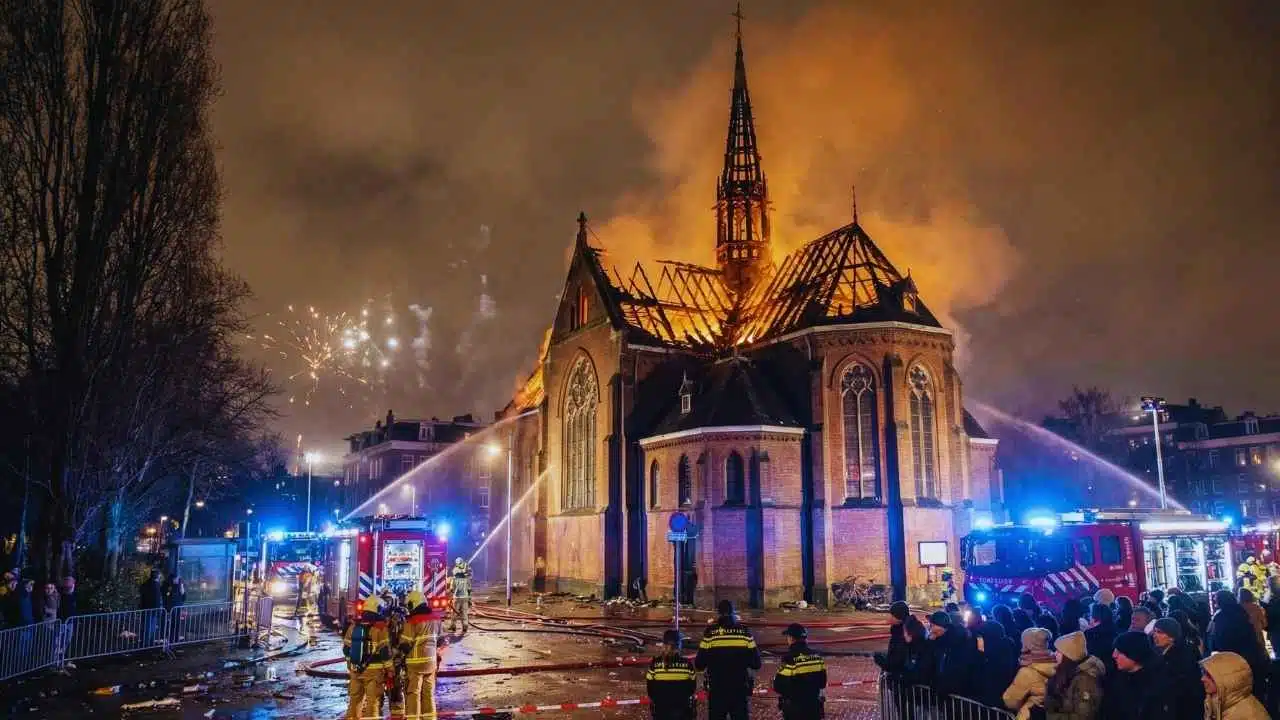
A Vondelkerk fire tore through the historic church near Vondelpark in Amsterdam early January 1, 2026, collapsing major roof sections, forcing evacuations, and cutting power to nearby homes as firefighters battled flames for hours and police opened an investigation.
What Happened: The Fire, The Collapse, And The Response?
The fire broke out shortly after midnight in Amsterdam’s Vondelstraat area, a dense neighborhood of historic buildings near the edge of Vondelpark. Residents and passersby quickly saw flames and heavy smoke coming from the Vondelkerk, a well-known landmark that has long served as a cultural and events venue.
As the fire intensified, authorities reported extensive damage almost immediately. In the early stages, pieces from the upper portion of the building broke off. Strong wind pushed sparks and burning debris outward, increasing the danger to nearby streets, homes, parked vehicles, and bicycles.
Fire crews arrived and began suppression operations, but the fire spread rapidly across the entire roof. To maintain the volume needed for a large structure fire, firefighters pumped significant amounts of water from Vondelpark. The operation continued for hours, with crews rotating in from surrounding regions as the response moved into a prolonged firefight.
By early morning, officials warned the blaze would likely take hours to control. Later in the morning, the fire service declared the fire extinguished. Even after the “fire out” signal, crews continued cooling hot spots and stabilizing the area.
Key Operations And Actions (At A Glance)
| Operational Need | What Was Done | Why It Mattered |
| Rapid roof fire spread | Sustained, high-volume suppression | Roof structures can fail quickly once fire travels through attic and truss spaces |
| Water supply for long incident | Water pumped from Vondelpark | Maintained continuous firefighting capacity |
| High-reach access | Large aerial platform deployed (60m reach reported) | Enabled crews to work at height during roof involvement and collapse risk |
| Safety perimeter | Streets cordoned off; later, fences installed | Prevented injuries from falling debris and restricted public access |
The incident also became a public safety challenge because many people approached the scene during New Year celebrations. Officials repeatedly urged the public to stay away so emergency services could operate safely and so crowds would not be exposed to smoke, falling debris, or flying embers.
Impact On Residents: Evacuations, Shelter, Power Cuts, And Cleanup
Because sparks and burning debris were being blown toward nearby buildings, authorities evacuated a large number of homes around the church. The goal was straightforward: move residents out of a zone where wind-driven embers, smoke, and potential collapse could threaten lives.
Dozens of evacuees were directed to a temporary shelter set up at De Roos on P.C. Hooftstraat. For many residents, it was an unsettling start to the year—leaving homes in the middle of the night with little information about when they could return.
A separate disruption affected the neighborhood’s electricity. Officials said power was cut to approximately 90 households along Vondelstraat toward Amstelveenseweg to help ensure the firefighting operation could proceed safely. The cutoff limited risks around equipment and operations in a high-hazard environment.
As morning progressed, authorities said it was still not safe for immediate neighbors to return, citing ongoing smoke and the active firefighting effort. A structural engineer later assessed that the church’s walls would remain standing and that there was no further risk of collapse at that time. That finding was important because it allowed the response to shift from emergency rescue posture toward site control, damage assessment, and phased recovery.
Later updates said residents would be allowed to return later in the afternoon, but only after the municipality cleaned the streets. Officials warned that electricity might not yet be fully restored when residents returned because grid restoration was expected to happen in phases and take at least several hours.
Community Disruptions And Public Guidance
| Issue | What Residents Experienced | Guidance Given |
| Evacuations | Homes cleared around the church | Wait for official clearance before returning |
| Shelter | Dozens housed temporarily at De Roos | Stay registered so officials can share updates |
| Power outage | ~90 households without electricity | Restoration staged; return home may precede full power |
| Soot and debris | Possible soot on cars, windows, garden furniture | Rinse carefully with water and mild soap |
| Restricted access | Fences installed; bicycles inside perimeter not retrievable | Avoid perimeter; retrieve items only when cleared |
The cleanup element was not minor. Officials said the municipality would use street-cleaning vehicles and cautioned that soot particles might have settled on nearby property. For residents, this meant the after-effects could include cleaning windows, cars, outdoor furniture, and outdoor surfaces—an added burden on top of a disrupted night and uncertainty about when life would return to normal.
Investigation Underway: What Authorities Have Said So Far?
Police opened an investigation into the cause of the fire. At the time of official updates, no confirmed cause was announced.
That matters because fires during New Year celebrations can generate immediate public assumptions—particularly in cities where fireworks are part of the tradition and where emergency services handle many fire calls overnight. But investigators generally need time to establish a credible timeline, identify the fire’s point of origin, and determine whether it began inside the structure, on the roofline, or from an external ignition source.
For a large fire that severely damages or collapses a roof, determining the origin can be especially complex. Collapse can destroy key indicators, fire suppression can disturb the scene, and the heat impact can remove traces that investigators normally rely on. Investigators may also review available video, eyewitness accounts, and any relevant monitoring systems connected to the building.
At minimum, investigators typically aim to answer:
- Where the fire started (the likely point of origin)
- How it spread (roof space, tower area, interior, external exposure)
- What ignited it (mechanical, electrical, open flame, external ignition, or other causes)
- Whether human action played a role (accidental or deliberate)
Until police confirm a cause, reporting stays limited to verified facts: a major overnight fire, severe destruction, evacuations, power interruptions, and a continuing investigation.
Why Vondelkerk Matters: A Protected Monument With A Complicated Past?
The Vondelkerk is not just another old building in Amsterdam. It is a protected national monument and a recognized part of the city’s architectural identity. The church is known as the former Roman Catholic Heilig Hartkerk and is associated with architect Pierre Cuypers, whose work helped define Dutch Gothic Revival architecture.
Heritage records describe the Vondelkerk as a distinctive church placed centrally in Vondelstraat, surrounded by residential buildings also associated with Cuypers’ broader planning and development vision for the street. Over time, the building’s role changed as congregations declined and the church’s religious function ended.
The Vondelkerk stopped functioning as a church decades ago and later became a public venue, hosting concerts, cultural programming, and private events. In the years after closure, the building faced deterioration and the threat of demolition. Preservation efforts eventually pushed the structure into a new chapter—restoration, adaptive reuse, and renewed public access.
Historical records also note that the church experienced major fire damage long before the 2026 blaze. In the early 20th century, a significant fire destroyed the original tower. The tower was later replaced with a new design associated with Joseph Cuypers. That earlier episode is often cited as part of the building’s complex history—fire loss, reconstruction, and continued evolution.
Restoration and adaptive reuse became central to keeping the site alive. The building’s later use included office areas and event space to support maintenance and ongoing costs, with modern amenities added to allow contemporary public and private use while preserving heritage character.
Vondelkerk: Key Facts And Milestones
| Topic | Details |
| Official status | Protected national monument (rijksmonument) |
| Architectural identity | Dutch Gothic Revival / neo-Gothic, associated with Pierre Cuypers |
| Location | Vondelstraat area near Vondelpark, central Amsterdam |
| Religious use | Served as a church until the late 20th century, then repurposed |
| Earlier major fire | Historic fire in the early 1900s destroyed an earlier tower, later replaced |
For many Amsterdammers, the Vondelkerk became less about religious life and more about community memory—concerts, lectures, weddings, receptions, and cultural moments. That public identity explains the emotional impact: the building was both a landmark and a living venue, connected to residents’ personal timelines.
What Happens Next: Safety Work, Restoration Decisions, And Community Recovery?
With the fire extinguished and the incident stabilized, officials moved into a new phase: securing the site, cleaning the surrounding streets, restoring utilities, and preparing for investigation work.
The immediate “next steps” typically include:
- Site security and controlled access to prevent injuries and preserve investigation integrity
- Detailed structural assessments to confirm what can be stabilized or safely removed
- Utility restoration coordination so residents can return to homes with basic services
- Damage assessment to determine the feasibility of restoration and the scale of work required
For heritage buildings, the restoration question is especially demanding. Decisions are shaped by structural reality (what still stands), heritage requirements (what must be preserved or documented), and funding (what can be financed). There is also the human side: displaced tenants and canceled bookings, plus neighborhood disruption that extends beyond the fire itself.
Even if outer walls remain standing, the loss of a roof, interior structural elements, and key architectural features can transform a restoration into a long-term, high-cost project. In such cases, recovery discussions often involve building owners, heritage authorities, structural specialists, insurers, and city officials.
For residents, the near-term recovery is more practical: when can they return, when will electricity be fully restored, how long will streets remain restricted, and what cleanup is needed for soot and debris.
What Residents And Visitors May See In The Coming Days?
| Area | Likely Developments |
| Around Vondelstraat | Cleanup operations, fencing, restricted zones |
| Building site | Structural stabilization, inspection activity, investigation work |
| Local services | Phased utility restoration and follow-up safety checks |
| Events and tenants | Rebooking efforts and support planning for affected users |
The story of the Vondelkerk has long included survival through change—closure, deterioration, restoration, and reinvention. The January 2026 blaze now forces another turning point: whether the site can be restored, how much of the historic character can be preserved, and what new form the building may take if rebuilding becomes necessary.