AI can save hours every week, but it can also make your brand sound like everyone else. If you are trying to use AI without losing authenticity, the goal is not to replace your voice. The goal is to scale your best thinking, keep your tone consistent, and protect trust while you move faster.
This guide is built for small businesses that want real results from AI without turning into bland, generic content. You will learn where AI fits, where it does not, and how to set up a simple workflow that keeps your messaging human.
Why Authenticity Is Your Biggest Advantage In 2026
Customers are overwhelmed with content. They are also more skeptical than ever. When everything starts to sound the same, authenticity becomes the differentiator.
Authenticity is not about being perfect. It is about sounding like a real business run by real people. It is the specific way you speak, the stories you share, and the way you solve problems.
AI can help you scale your output, but it can also flatten your personality. If you copy and paste AI content without shaping it, you risk losing the very thing that makes people choose you.
The solution is not avoiding AI. The solution is using it intentionally, with guardrails.
Where AI Helps And Where Humans Must Stay In Control
The fastest way to protect your brand is to be honest about what AI is good at. AI is great at speed, structure, and first drafts. It is not great at lived experience, nuance, and judgment.
If you treat AI like an assistant, it becomes powerful. If you treat it like the author, it becomes risky.
Safe Zones For AI
AI works well in areas where you need a starting point, a framework, or variations.
Here are common safe zones for small businesses:
- Brainstorming headline options and angles
- Generating outlines for blog posts and guides
- Turning bullet notes into readable paragraphs
- Rewriting for clarity and tighter flow
- Creating variations for ads and email subject lines
- Summarizing internal notes into customer friendly language
- Building checklists, templates, and standard operating steps
In these areas, you still review. But the risk is manageable because you are shaping an output, not trusting AI with the final truth.
High Risk Zones For AI
Some areas require human ownership because trust is on the line.
High risk zones include:
- Legal, financial, and medical advice
- Claims that require proof or accuracy
- Sensitive brand messages and public statements
- Customer support responses involving conflict
- Pricing promises, guarantees, and policies
- Personal stories that are not true
- Anything that could be misinterpreted or shared widely
If you want to use AI in these areas, do it only for structure. Keep the facts, the tone, and the final decision human.
The Real Reason AI Makes Brands Sound Fake
Most small businesses do not lose authenticity because they use AI. They lose authenticity because they use AI without a voice system.
If your voice is not documented, AI will guess. And when AI guesses, it defaults to generic marketing language.
Generic language has patterns:
- Overly polished tone
- Safe, vague claims
- Repetitive phrases
- Empty motivation lines
- Buzzwords without detail
That is why two different businesses can prompt AI and end up with content that feels identical.
So the first step is not a better tool. The first step is a better voice foundation.
Build A Brand Voice System Before You Automate
A brand voice system does not need to be complicated. It needs to be clear enough that you can enforce it across emails, blogs, landing pages, and social posts.
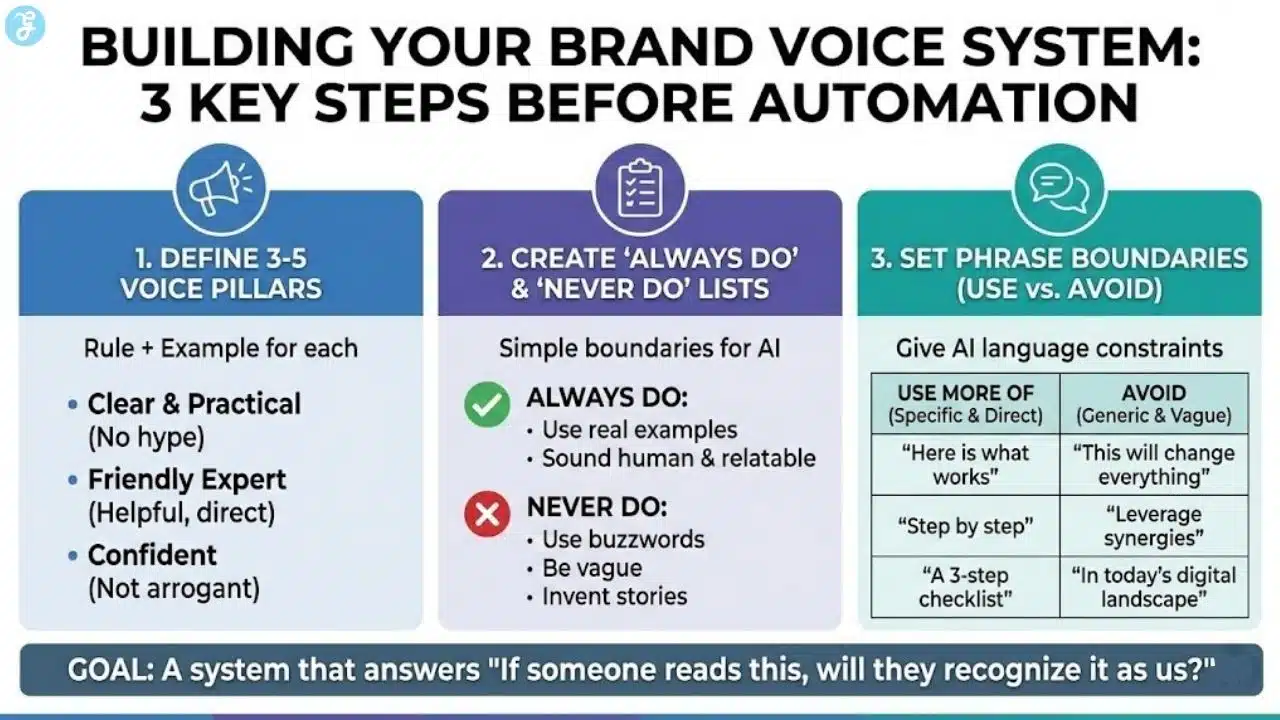
You want a system that answers one question: “If someone reads this, will they recognize it as us?”
Voice Pillars You Can Define In One Hour
Create 3 to 5 voice pillars. Each pillar should include a rule and a quick example.
Here is a simple set that many SMEs use:
- Clear and practical, no hype
- Friendly and direct, like a helpful expert
- Confident, but never arrogant
- Specific and grounded, not vague
- Human and relatable, with real examples
Then add a short section called “Always do” and “Never do.”
Example Phrases To Use And Avoid
You can make AI better instantly by giving it language boundaries.
A simple table helps.
| Voice Element | Use More Of | Avoid |
| Confidence | “Here is what works for most SMEs” | “This will change everything.” |
| Clarity | “Step by step” | “Leverage synergies” |
| Warmth | “You can start small.” | “Users must implement” |
| Specificity | “A 3 step checklist” | “In today’s digital landscape” |
This is not about sounding perfect. It is about sounding like you.
How To Prompt AI So It Sounds Like Your Business
Most prompts are too short. When you give AI a vague prompt, you get a generic answer.
A better prompt includes context, role, audience, and voice constraints.
Here is a simple prompt structure you can reuse:
- Role: “You are a content strategist for a small business”
- Audience: “Write for busy SME owners”
- Goal: “Help them take action quickly”
- Voice rules: “Friendly, direct, no hype, no buzzwords”
- Input: your bullet notes, examples, or rough draft
- Output format: “Short paragraphs, H2 and H3 headings, include one table”
If you want to use AI without losing authenticity, the prompt is where you protect your voice before the first sentence appears.
A Simple AI Workflow That Protects Your Voice
The best workflow is one your team will actually follow. If it is too complex, people will skip it. Then authenticity disappears again.
Use this workflow for blogs, newsletters, scripts, and landing pages.
Step 1: Human First Notes
Before AI writes, you write 5 to 10 bullet points:
- What you believe is true
- What your customers struggle with
- A quick story or example
- The main takeaway you want readers to remember
This makes the content yours, not AI generated fluff.
Step 2: AI Draft For Structure
Ask AI to turn your notes into a draft with clear sections.
Do not ask for perfection. Ask for:
- A logical outline
- Smooth transitions
- Simple explanations
- A draft that you will edit
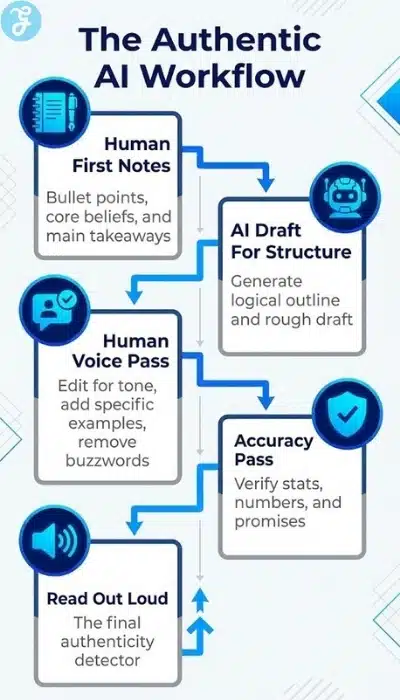
Step 3: Human Voice Pass
Do a voice editing pass:
- Replace generic phrases with your natural language
- Add specific examples from your business
- Cut anything that sounds like it could belong to any company
A good test is simple. If you remove your logo, can readers still guess it is you
Step 4: Accuracy Pass
Even without citations, you must protect accuracy.
Use a checklist:
- Are there any numbers, stats, or claims that might be wrong
- Are there any promises that could create legal risk
- Are there any statements that are too absolute
If you cannot verify something quickly, remove it or rewrite it as a general guideline.
Step 5: Final Read Out Loud
Reading out loud is the fastest authenticity detector.
If it feels awkward, it will feel awkward to your customers too.
A Quick Human Review Checklist For AI Content
Use this 5 minute checklist before publishing.
- Does this sound like how we speak
- Are there real examples, not just theory
- Is the advice specific enough to take action
- Are there any exaggerated claims
- Are there any weird phrases we never use
- Is the flow natural from section to section
- Did we keep paragraphs short and readable
This checklist can turn AI from risky to reliable.
How To Use AI For Customer Communication Without Sounding Robotic
Many small businesses use AI for customer support, replies, and follow-ups. This is where authenticity matters most because the customer is already in a relationship with you.
The key is to use AI for structure and clarity, not personality.
Here are safe ways to do it:
- Draft a response, then rewrite the opening and closing in your voice
- Use AI to shorten long messages so they are easier to understand
- Use AI to create a calm version of a heated reply, then personalize it
Avoid letting AI decide the tone when emotions are involved. Your voice and empathy should lead.
Your Authentic AI Starter Kit For Small Teams
If you want a simple setup you can do today, start here.
1 Brand Voice One Pager
Include:
- 3 to 5 voice pillars
- Words and phrases you use
- Words and phrases you avoid
- A few sample lines from your best content
A Prompt Library
Create 5 to 10 prompts your team can reuse:
- Blog outline prompt
- Email rewrite prompt
- Social post variations prompt
- Landing page section prompt
- FAQ creation prompt
A Two Step Approval Rule
For any public content:
- One person drafts with AI
- Another person reviews for voice and clarity.
Even a tiny review step protects authenticity.
Common Mistakes That Kill Authenticity Fast
Small businesses usually make the same mistakes when they start using AI.
Mistake 1: Publishing The First Draft
AI first drafts almost always need a human voice pass. If you publish it raw, it will sound generic.
Mistake 2: Using The Same Prompt For Everything
Different content needs different prompts. A blog post is not an ad. A customer email is not a landing page.
Mistake 3: Letting AI Invent Details
If AI does not know, it will fill gaps. That is how you get incorrect claims and fake-sounding stories.
Mistake 4: Over-automating Too Early
Start with one workflow. Prove it works. Then scale.
If you want to use AI without losing authenticity, consistency beats speed in the beginning.
A Simple Table To Decide What AI Should Touch
Use this as a quick internal rule set.
| Task Type | AI Role | Human Role | Risk Level |
| Blog outline | Generate structure | Choose an angle, add examples | Low |
| Social captions | Create variations | Edit for voice | Low |
| Product descriptions | Draft and format | Verify features and tone | Medium |
| Customer support | Draft clarity | Add empathy, final decision | Medium |
| Policy and pricing | Organize language | Own the facts, approve | High |
| Public statements | Draft options | Final message and tone | High |
This keeps your team aligned.
How To Keep Your Team Consistent With AI
If multiple people create content, authenticity can drift fast.
Do these three things:
- Keep one shared voice doc
- Keep one shared prompt library
- Do monthly “voice calibration” using your best-performing content
In calibration, you review:
- What sounded most like you
- What felt too generic
- What customers responded to
That way, your AI use improves over time.
How To Use AI Without Losing Authenticity At Scale
When you increase output, your voice is the first thing that slips. Guardrails keep quality consistent across people, platforms, and fast deadlines. If you want to use AI without losing authenticity, treat these guardrails like a lightweight operating system.
Build A Voice Bank That AI Can Follow
A voice bank is a small set of your best writing examples that your team uses to guide AI prompts and edits.
Include:
- 2 blog intros that sound unmistakably like you
- 2 email examples with your natural tone
- 2 landing page sections that convert
- 5 to 10 social posts that performed well
- A short list of phrases you use often
How to use it:
- Paste 1 to 2 examples into your prompt as style guidance
- Ask AI to mirror tone and sentence rhythm
- After drafting, compare the output to your examples before publishing
Use The Three Layer Voice Filter Before Anything Ships
Run every AI-assisted draft through this filter. It takes a few minutes and catches the most common “AI voice” problems.
Layer 1: Remove Generic Lines
- Delete vague openers like “In today’s world.”
- Replace buzzwords with plain language
- Cut statements that could fit any brand
Layer 2: Add Texture
- Add one real detail from your work
- Add one specific step, number, or constraint
- Add a short point of view, not just neutral advice
Layer 3: Match Your Cadence
- Break long sentences into shorter ones
- Use the words you actually say in real conversations
- Make the opening sound like you, not a template
Create A No Go List That People Actually Remember
A no go list is short, specific, and easy to follow. Keep it to 10 to 20 items.
Common no go items:
- Hype promises you cannot prove
- Empty motivational lines
- “We are passionate about” filler sentences
- Over polished corporate tone
Add your own:
- Words your brand never uses
- Phrases that customers have mocked or ignored
- Any repeated AI patterns you keep seeing
Lock In Point Of View With “Belief Statements”
Authenticity is not only tone. It is what you believe. Write 5 to 10 belief statements and reuse them in prompts.
Examples:
- “Simple systems beat complicated tools for most SMEs.”
- “Consistency matters more than volume in early marketing.”
- “Trust is built through clarity, not cleverness.”
Prompt tip:
- Ask AI to write from your belief statements, then edit with your examples from the voice bank.
Use A Lightweight Quality Scorecard
This avoids arguments about taste. Everyone follows the same definition of good.
Score each item from 1 to 5:
- Clarity: easy to understand, fast
- Specificity: real steps, not vague advice
- Brand Voice: sounds like us
- Trust: claims are reasonable and accurate
- Action: the reader knows what to do next
Rule:
- If Brand Voice or Specificity is 3 or below, it gets a rewrite pass.
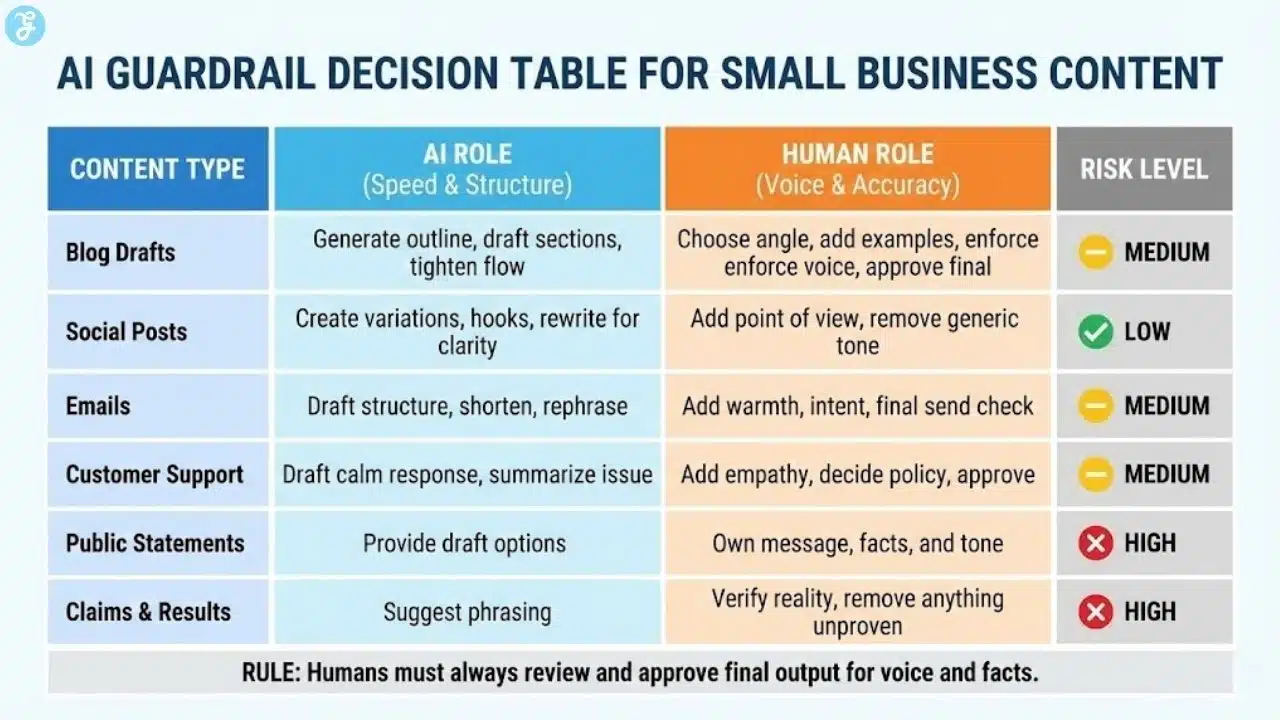
AI Guardrail Decision Table
Use this table to align your team on what AI can touch.
| Content Type | AI Can Do | Human Must Do | Risk Level |
| Blog Drafts | Outline, draft sections, tighten flow | Add examples, enforce voice, approve final | Medium |
| Social Posts | Variations, hooks, rewrite for clarity | Add point of view, remove generic tone | Low |
| Emails | Draft structure, shorten, rephrase | Add warmth, intent, final send check | Medium |
| Customer Support | Draft calm response, summarize issue | Add empathy, decide policy, approve | Medium |
| Public Statements | Provide draft options | Own message, facts, and tone | High |
| Claims And Results | Suggest phrasing | Verify reality, remove anything unproven | High |
Avoid The Template Trap In Social And Email
Templates help speed, but they can make you sound repetitive. Rotate your formats so you still sound human.
Rotate:
- Open with a question, then a short answer
- Open with a mistake you see often
- Open with a mini story from a real situation
- Open with a simple checklist
Keep one rule:
- Every piece should include at least one line that could only come from your business.
Personal Story Rule That Protects Trust
Never publish invented stories. If you do not have a real example, use a general scenario and label it clearly as common.
Allowed:
- Real experiences
- Anonymized client lessons without identifying details
- Common situations framed as common
Not allowed:
- Fake outcomes
- Fake testimonials
- Fake personal experiences
Quick Team Policy You Can Copy
- AI can draft, outline, and rewrite for clarity
- Humans own the ideas, claims, and examples
- Every publishable piece gets a voice pass and an accuracy pass
- No invented stories and no unverifiable promises
- If it does not sound like us, it does not ship
With these guardrails, you can use AI without losing authenticity even when you publish more often and more people touch your content.
Wrap Up And Next Steps
AI does not have to dilute your brand. If you set voice rules, use human first notes, and keep a simple review system, you can use AI without losing authenticity while still producing more content and communicating faster.
Start small. Document your voice. Build a prompt library. Then scale with confidence.
Frequently Asked Questions
Here are the most frequently asked questions people have about How Small Businesses Can Use AI Without Losing Authenticity.
Can AI content be authentic
Yes, but only if the business leads with its own ideas, voice, and examples. AI can structure, draft, and polish, but authenticity comes from real experience, specific details, and a human review pass that removes generic language and adds your natural tone.
Should small businesses disclose AI use
In many cases, you do not need to announce that AI helped with a draft. What matters is whether the message is truthful, accurate, and aligned with your values. If AI is directly involved in customer-facing decisions or sensitive communication, transparency can build trust, especially if you explain that humans still review and approve the final outcome.
How do I keep my brand voice consistent with AI
Create a one-page brand voice guide with a few tone rules, phrases you use, and phrases you avoid. Then build a prompt library that includes those rules and requires a short voice editing pass before anything gets published. Consistency comes from systems, not talent.
What are the biggest AI mistakes for small businesses
The biggest mistakes are publishing first drafts, using vague prompts, letting AI invent details, and over-automating before building quality control. A simple human first notes step, and a review checklist prevents most of these issues.
How do I avoid AI hallucinations in marketing content
Treat AI outputs as drafts, not facts. Remove or rewrite any specific claim you cannot verify quickly. Keep your content grounded in your real processes, real offers, and real customer outcomes, and do an accuracy pass before publishing.