
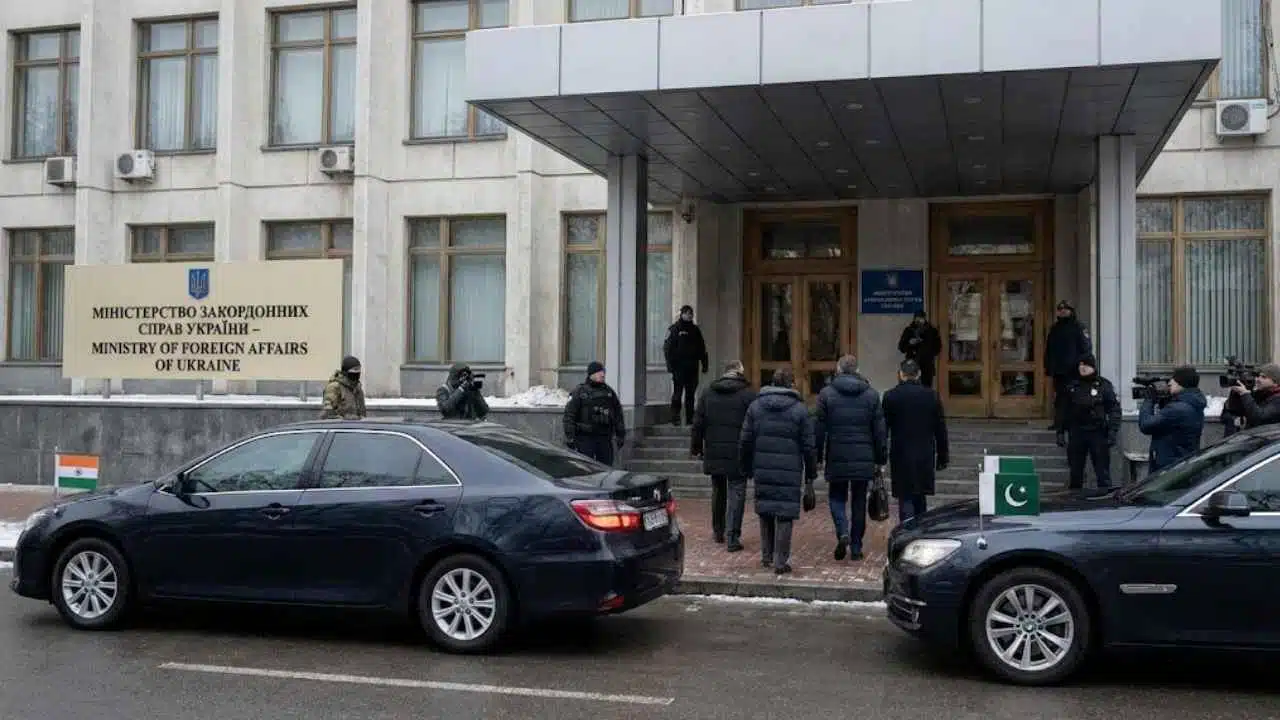
Ukraine summons India Pakistan diplomats after Kyiv said New Delhi and Islamabad echoed a Russian narrative alleging a drone attack on President Vladimir Putin’s residence—an incident Ukraine says never happened.
What Happened And Why Ukraine Responded
Ukraine’s Foreign Ministry said it summoned the chargés d’affaires of India and Pakistan on December 31, 2025, after both countries issued statements condemning an alleged drone attack on a Russian presidential residence linked to President Vladimir Putin. Ukraine says the claim is false and part of a Russian information operation.
Kyiv’s move signaled growing sensitivity about how third countries react to Russia’s wartime messaging—especially when those reactions, in Ukraine’s view, risk legitimizing allegations that could be used to justify escalation or disrupt diplomacy.
Ukraine has framed the episode as more than a dispute over a single incident: it argues that repeating Moscow’s allegations—without independent verification—helps amplify disinformation at a delicate moment for peace contacts and war-time diplomacy.
Conflicting Claims About The Alleged Drone Incident
Russian officials said Ukraine launched a large-scale drone operation aimed at a presidential residence in Russia’s Novgorod region, alleging 91 drones were involved and that air defenses intercepted them.
Ukraine rejected the allegation, publicly disputing that any such attack occurred and calling the evidence presented by Russia unconvincing. In response to Russia’s release of video footage presented as proof, a Ukrainian Foreign Ministry spokesperson described the material as not credible and insisted Ukraine was confident the alleged attack did not take place.
Meanwhile, a U.S. intelligence assessment reported by major outlets said U.S. national-security officials concluded Ukraine did not target Putin or his residences—undercutting Moscow’s version of events.
Why India And Pakistan’s Statements Triggered A Demarche
Ukraine’s Foreign Ministry said the summoning was specifically tied to statements from India and Pakistan that, in Kyiv’s view, supported a “fake” Russian narrative about an “attack on Putin’s residence.”
From Ukraine’s perspective, the issue is not only diplomatic optics but also precedent: Kyiv has repeatedly argued that Russia uses dramatic claims—especially involving senior leadership targets—to reshape international reactions and justify retaliation.
Ukraine’s concern is that when countries publicly condemn an incident that is unverified—or disputed by credible counter-assessments—it can harden narratives before facts are established, and it can place Kyiv on the defensive even when it denies involvement.
Peace Efforts And Timing: Why The Dispute Matters Now
The dispute unfolded against a backdrop of intensified international messaging about potential peace talks and negotiation frameworks, where both Kyiv and Moscow have been vying to influence external actors’ perceptions of intent and culpability.
In parallel reporting on the broader episode, officials and analysts noted that the alleged incident threatened to complicate U.S.-led diplomatic engagement and could be used as leverage in negotiations.
Ukraine’s argument—echoed by some European voices—has been that unproven allegations can be deployed to stall talks or justify additional strikes, particularly if framed as “state terrorism” or an attempted decapitation strike.
Key Dates At A Glance
| Date (2025) | Event | What Was Claimed / Done |
| Dec 29 | Russian officials publicly alleged an attempted drone attack on a presidential residence in Novgorod | Russia said 91 drones were involved and all were intercepted |
| Dec 31 | Russia released video footage it said showed a downed Ukrainian drone | Ukraine disputed the proof and denied the incident |
| Dec 31 | Ukraine summoned India’s and Pakistan’s chargés d’affaires | Kyiv said the demarches were over statements supporting a “fake” narrative |
| Dec 31 | U.S. assessment reported that Ukraine did not target Putin/residences | U.S. officials reportedly found no evidence of a Putin-targeting operation |
How Russia’s Video Claim Was Received
Russia’s Defense Ministry video showed debris presented as remnants of a drone and described the operation as planned and intercepted, with no casualties or damage reported.
But the footage could not be independently verified by outside observers in real time, and Ukrainian officials rejected it. The lack of independent confirmation became central to the controversy, particularly as the claim spread internationally and drew diplomatic reactions.
What This Means For India, Pakistan, And Other Partners
For India and Pakistan, the incident exposes a recurring challenge in a fast-moving information war: governments often feel pressure to respond quickly to headline allegations involving major powers, even when details are contested or unclear.
For Ukraine, the demarches underscore that Kyiv is increasingly willing to confront partners—publicly or privately—when it believes their statements inadvertently strengthen Russia’s messaging.
This episode also lands in a wider geopolitical context where several states seek balanced relations with both Moscow and Kyiv, while simultaneously engaging with Western-led diplomatic tracks.
Ukraine’s decision to summon India and Pakistan’s diplomats reflects a broader strategic line: Kyiv is pushing back hard against narratives it says are fabricated, especially when those narratives gain traction abroad through official statements.
The larger question now is whether international actors will shift toward more cautious language—such as calling for verification—when confronted with contested claims in a conflict where disinformation has become a routine weapon. At the same time, the intelligence assessment reported in the U.S. press adds pressure on Russia to substantiate extraordinary allegations, particularly when those claims could affect negotiations and trigger escalation.