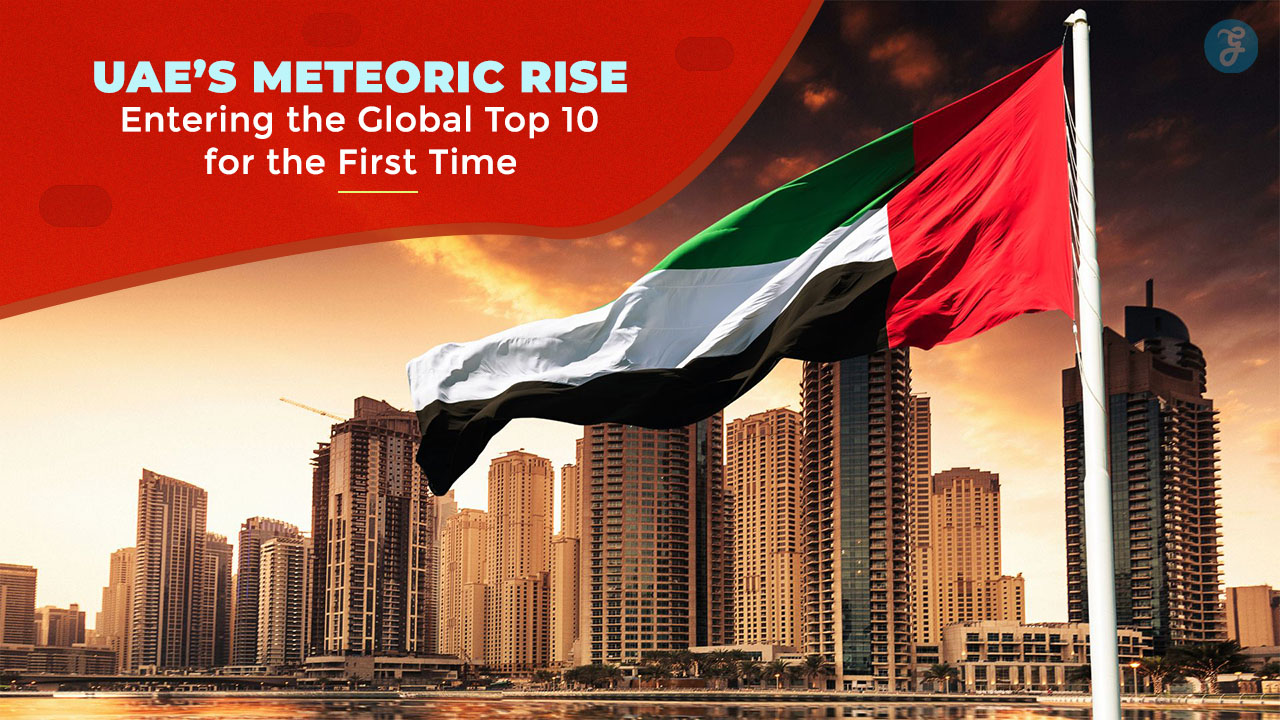
The United Arab Emirates (UAE) has defied regional gravity to secure its first-ever spot among the top 10 most influential nations on the Global Soft Power Index. This milestone, fueled by a 22% surge in Nation Brand value to $1.22 trillion, marks a historic pivot from an oil-reliant state to a premier global “super-connector” of trade, talent, and technology.1
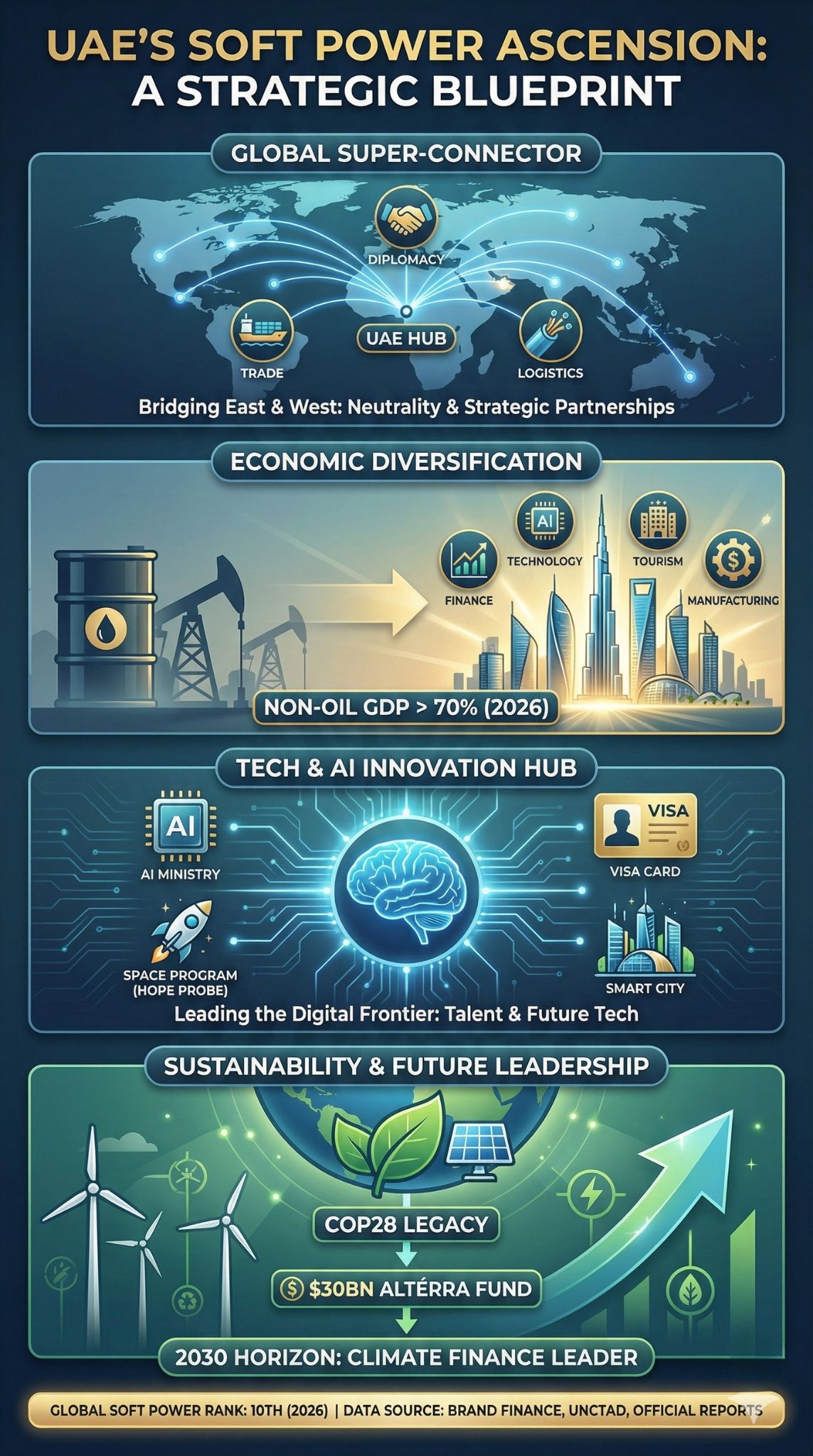
The ascent of the UAE into the global elite is not a sudden stroke of luck but the culmination of a decade-long strategic overhaul.2 From the launch of the “Hope” Mars probe to the hosting of COP28 and the normalization of ties via the Abraham Accords, the nation has methodically built a “brand” centered on agility and neutrality.3 Historically, Middle Eastern influence was measured by barrels of oil or military expenditure; today, the UAE has rewritten that playbook, leveraging “Soft Power”—the ability to attract and persuade—to punch far above its demographic weight.
The Architecture of Influence: How the UAE Cracked the Top 10
The Global Soft Power Index 2025/2026, published by Brand Finance, highlights that the UAE is the only nation from the Middle East and North Africa (MENA) region to break into the top tier. This rise is particularly striking given the “soft power recession” currently affecting many of its neighbors due to regional instability. The UAE’s strategy rests on a “no-enemies” foreign policy and a domestic environment that prioritizes ease of doing business above almost all else.4
The Super-Connector Strategy
While global superpowers like the US and China are increasingly locked in a “zero-sum” competition, the UAE has positioned itself as the neutral ground.5 By maintaining strong security ties with Washington while simultaneously becoming a key node in China’s Belt and Road Initiative and joining the BRICS+ bloc, Abu Dhabi has ensured it remains indispensable to all sides. This “transactional diplomacy” allows the UAE to capture trade flows that are being redirected due to geopolitical friction elsewhere.
Economic Fortification and Diversification
The UAE’s non-oil sector now accounts for over 70% of its GDP, a feat once thought impossible for a Gulf state.6 In 2024, the nation registered a record 200,000 new businesses, many in the high-tech and AI sectors.7 The introduction of the 9% corporate tax in 2023 was a risk that paid off; rather than scaring away capital, it signaled to the IMF and global investors that the UAE is maturing into a transparent, Western-standard financial jurisdiction.8
Key Performance Indicators: UAE vs. Global Peers (2025-2026)
| Metric | UAE Rank (2026) | Trend (vs 2024) | Primary Driver |
| Global Soft Power Index | 10th | $\uparrow$ 5 Places | Diplomatic Mediation & COP28 |
| Ease of Doing Business | 2nd | $\uparrow$ 3 Places | Golden Visa & Legal Reforms |
| Future Growth Potential | 4th | $\uparrow$ 2 Places | AI & Space Exploration |
| Economic Stability | 7th | $\leftrightarrow$ Stable | Non-oil Trade ($1T+ target) |
| Safety & Security | 1st | $\uparrow$ 1 Place | High-Tech Urban Monitoring |
The “Silicon Oasis” Pivot: AI and Digital Sovereignty
A primary driver of the UAE’s new global standing is its aggressive bet on Artificial Intelligence.9 While other nations debated regulation, the UAE appointed the world’s first Minister of AI and established the Mohamed bin Zayed University of Artificial Intelligence (MBZUAI).
This technological foresight has created a “flywheel effect.” By positioning itself as a sandbox for frontier technologies—from autonomous taxis in Dubai to AI-driven “smart” government services—the UAE has attracted a global “creative class.”10 The expansion of the Golden Visa program (granting 10-year residency to talent) has effectively reversed the “brain drain” often seen in the region, turning the UAE into a net importer of global intellectual capital.11
The Green Diplomacy: Post-COP28 Momentum
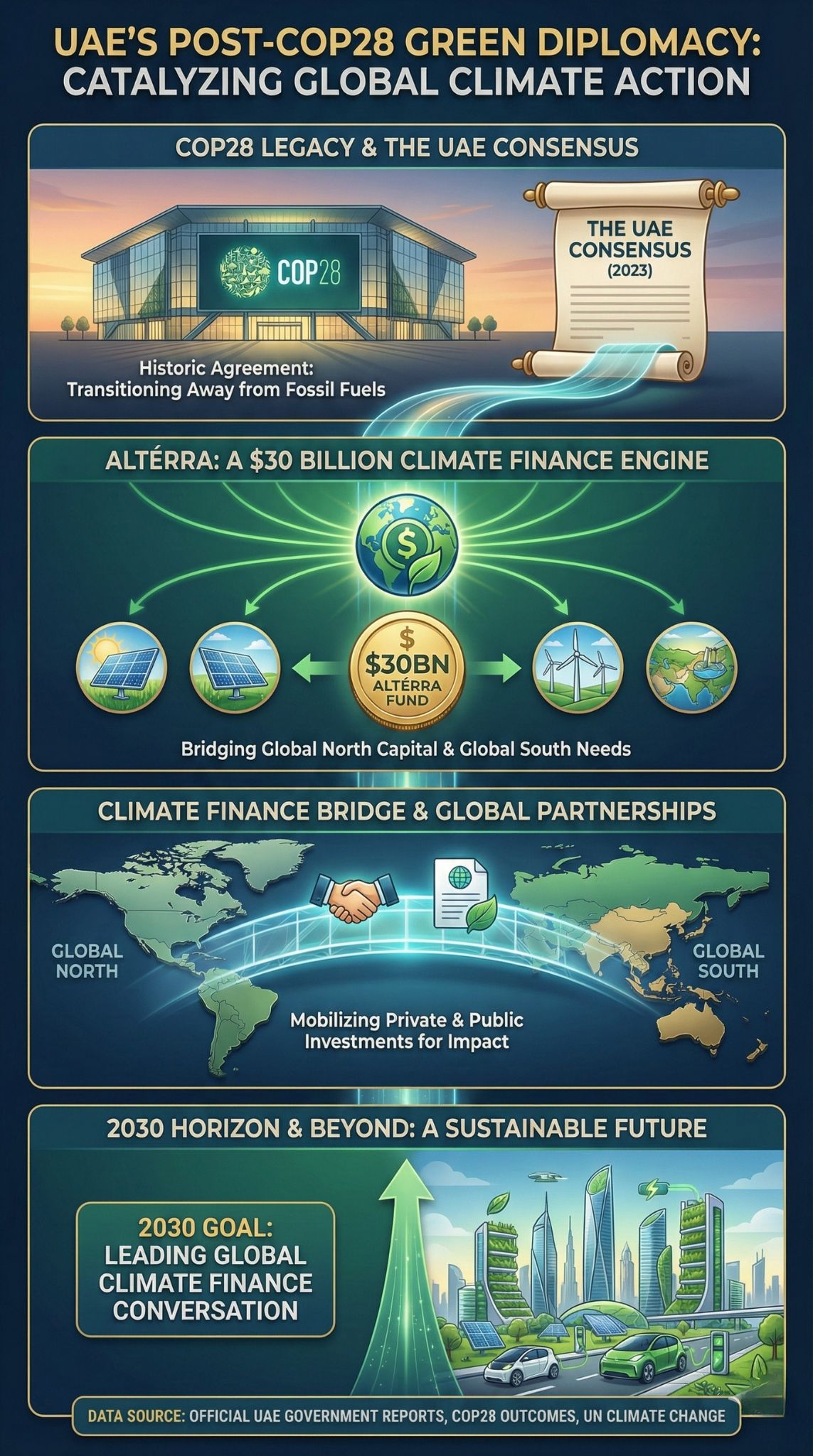
The UAE’s hosting of COP28 in late 2023 was a watershed moment. Initially met with skepticism due to its status as a major oil producer, the “UAE Consensus” eventually secured a historic, if controversial, agreement to transition away from fossil fuels.
By 2026, this has translated into the UAE leading the “Global Climate Finance” conversation. The launch of the $30 billion ALTÉRRA fund has allowed the UAE to act as a bridge between the Global North’s capital and the Global South’s infrastructure needs. This “Green Soft Power” serves a dual purpose: it mitigates the reputational risk of being an oil state and secures a seat at the table where the future of the global energy transition is decided.
Strategic Wins: Before vs. After the 2025 Milestone
| Category | Pre-2024 Context | 2026 Reality |
| Trade Focus | Primarily Hydrocarbon Exports | Total Foreign Trade approaching $1 Trillion |
| Workforce | Transitory expatriate labor | Permanent “Golden Visa” talent hub |
| Diplomacy | Regional/Sub-regional actor | Global mediator (Ukraine/Sudan/BRICS+) |
| Technology | Consumer of Western Tech | Producer of LLMs (Falcon) and Space Pioneer |
Expert Perspectives: The Risks of Rapid Ascent
While the data paints a picture of meteoric success, analysts suggest the UAE faces three critical challenges in maintaining its top-10 status:
- The “Regional Drag” Effect: Despite the UAE’s “de-risking” strategy, prolonged conflict in the Levant or the Red Sea could eventually impact tourism and logistics—the lifeblood of the non-oil economy.
- The Saudi Competition: Saudi Arabia’s “Vision 2030” is now in high gear. As Riyadh opens its doors to global entertainment and tourism, the competition for the same pool of foreign direct investment (FDI) and talent will intensify.
- The Neutrality Paradox: As the world moves toward a more bipolar structure (US vs. China), the UAE’s “friends to all” approach will be tested. Washington may eventually demand more alignment on sensitive tech sectors, such as semiconductors and 5G/6G infrastructure.
“The UAE has successfully transitioned from a regional gateway to a global destination.12 The challenge now is moving from ‘influence through investment’ to ‘influence through values.’ As the world’s 10th most powerful nation brand, the expectations for the UAE to lead on human rights and labor reforms will only grow.” — Regional Analyst, Think Tank Perspective.
Future Outlook: Predicting the 2030 Horizon
The UAE’s trajectory suggests that its stay in the Top 10 is not a temporary anomaly. By 2026, the country is expected to see a GDP growth of 5%, significantly outperforming the global average.13
Upcoming Milestones to Watch:
- The $1 Trillion Trade Goal: Analysts expect total foreign trade to hit the $1 trillion mark by late 2026, driven by the UAE-Asia corridor.14
- The Lunar Mission 2026: A successful rover landing on the Moon will further solidify the UAE’s “Space Soft Power.”
- Digital Government 2.0: The full integration of generative AI into judicial and administrative systems is set to make the UAE the world’s first “AI-native” state.
The UAE’s rise is a signal of a broader shift in the global order—a move toward “Minilateralism” where smaller, hyper-efficient, and wealthy states can leverage technology and diplomacy to rival traditional G7 powers. For the global community, the UAE is no longer just a destination for luxury travel; it is a blueprint for how a 54-year-old nation can re-engineer its identity for the 21st century.