
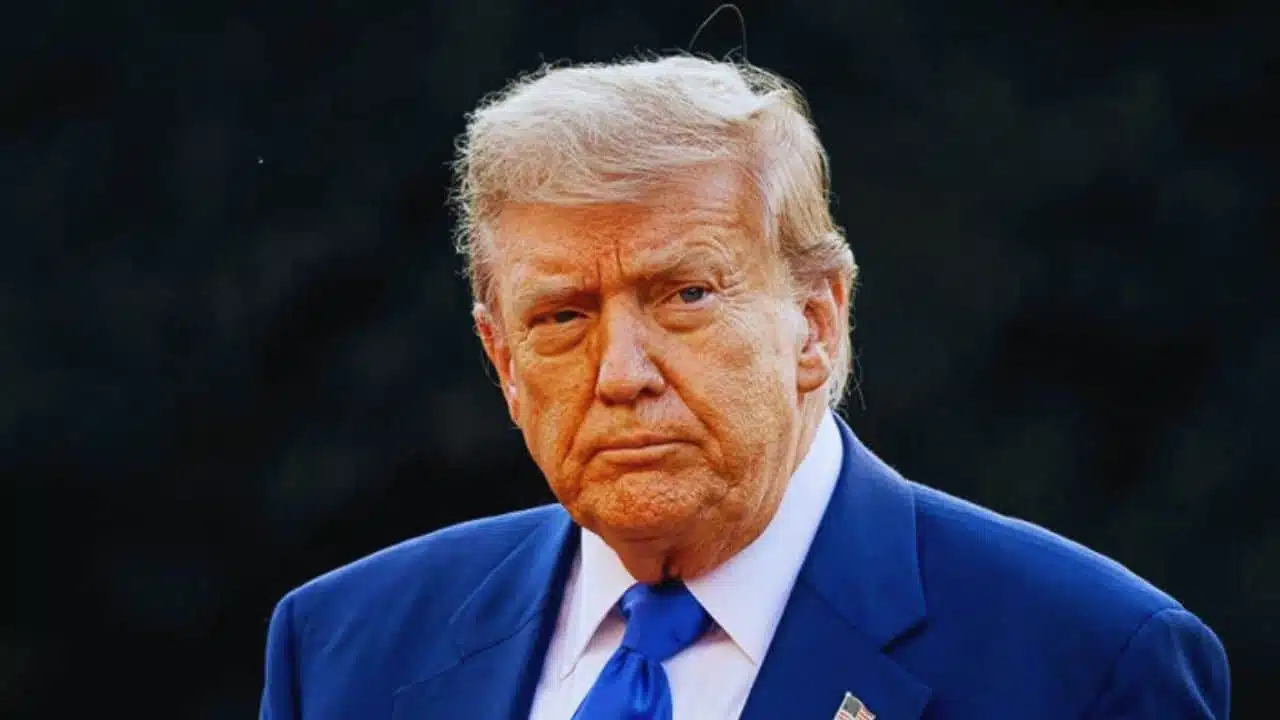
President Donald Trump announced that he is preparing to sign an executive order aimed at ending the use of mail-in ballots and reducing reliance on electronic voting machines across the United States. He revealed the plan during a meeting with Ukrainian President Volodymyr Zelenskyy at the White House and later reiterated it on his social media platform, Truth Social. Trump framed the decision as part of a broader effort to “lead a movement” to overhaul voting practices in advance of the 2026 midterm elections.
The President argued that mail-in ballots are fundamentally flawed and claimed that voting machines are unreliable, expensive, and less efficient than traditional paper ballots. His remarks were particularly striking given that he had previously encouraged his supporters to use absentee or mail-in ballots in earlier elections, including before the 2024 presidential vote. The shift in tone underscores how voting by mail has increasingly become a partisan issue, with Democrats far more likely than Republicans to utilize it since the pandemic-era election of 2020.
Constitutional Limits on Executive Authority
Legal experts have emphasized that Trump’s plan faces significant constitutional and logistical hurdles. The U.S. Constitution delegates the power to regulate federal elections to Congress, while individual states retain authority over how they conduct their own elections. Scholars at multiple universities have underscored that the president alone has no legal authority to mandate or prohibit voting methods.
Michael Morley of Florida State University explained that the executive branch does not have the power to dictate election rules, while UCLA law professor Richard Hasen added that only congressional action could legally change how ballots are cast nationwide. This means that even if Trump signs an executive order, it is almost certain to face immediate legal challenges from states, advocacy groups, and potentially even Congress itself.
David Becker, who leads the nonpartisan Center for Election Innovation & Research, further pointed out that the Founders deliberately excluded the executive branch from election oversight to prevent abuses of power. He cited historical writings like Federalist 59, which stress that dispersing election authority among states is essential to protecting democracy.
The Political Divide Over Mail-In Voting
Mail-in voting has become increasingly polarizing since 2020. Democrats embraced the method in large numbers during the pandemic, while Republicans—driven by Trump’s skepticism—shifted heavily toward in-person voting. The trend has only widened in recent years as GOP-led state legislatures introduced new restrictions on absentee ballots, including tighter deadlines, stricter identification requirements, and limits on ballot drop boxes.
Trump’s proposal to eliminate mail-in ballots altogether could further deepen the partisan divide. While his allies believe it could energize Republican voters who already distrust the system, critics argue that it risks alienating moderates and independent voters who appreciate the flexibility of absentee voting. Republican strategists have warned that such a move may also hurt GOP turnout, particularly among elderly or rural voters who rely on mail ballots due to accessibility challenges.
The Role of Voting Machines
Trump has also targeted voting machines, claiming that they are inaccurate and insecure. Election officials and independent audits, however, have consistently found that modern voting machines, especially when paired with paper ballot backups, are reliable and safe from large-scale manipulation. Since 2020, both Republican and Democratic state officials have defended the integrity of their election systems, rejecting widespread fraud allegations.
Eliminating electronic machines in favor of fully hand-counted paper ballots would create massive logistical challenges. Counting millions of ballots by hand would dramatically slow election results, increase the potential for human error, and require large numbers of trained staff and volunteers. Election administrators have argued that such changes would reduce efficiency and undermine public confidence rather than improve it.
Logistical Barriers to Implementation
Experts say that even if Trump pushes forward with his executive order, the practical challenges are immense. States would have to rewrite election laws, purchase new equipment, and redesign their voting processes. Local election offices would need to secure larger numbers of polling locations and recruit thousands more poll workers to handle the surge in in-person voting.
Matt Germer of the R Street Institute noted that forcing millions of mail voters into in-person polling would overwhelm existing infrastructure unless substantial resources were invested. This would involve securing new venues, hiring and training staff, and educating voters on rapidly changing rules—all in a very short timeframe before the 2026 primaries.
Litigation would further complicate matters. Any executive order restricting mail ballots or machines would almost certainly be challenged in federal courts. Cases could take months to resolve, leaving states in limbo and potentially creating widespread voter confusion.
Broader Concerns About Election Destabilization
Voting rights advocates argue that the larger goal behind Trump’s proposal is not logistical reform but the erosion of public trust in elections. Barbara Smith Warner, who leads the National Vote at Home Institute, said that efforts to eliminate mail-in voting ignore data showing its security and effectiveness. She warned that the true impact of Trump’s statements is to destabilize confidence in democratic institutions.
Legal scholars also drew parallels to Trump’s attempts to overturn the 2020 election results. Richard Hasen cautioned that the proposal fits into a broader pattern of undermining established election practices and may be intended to create grounds for contesting future outcomes. This has led several experts to call for courts, state governments, and election officials to begin preparing now to safeguard the fairness of the 2026 midterms.
International and Historical Context
While Trump has portrayed mail-in voting as uniquely problematic, many democratic nations around the world—including Canada, Germany, Australia, and the United Kingdom—offer mail voting options. Far from being insecure, these systems are widely accepted as reliable. In the U.S., multiple states such as Colorado, Washington, and Oregon have successfully conducted elections almost entirely by mail for years without significant issues.
Historically, U.S. service members stationed overseas have also relied on mail ballots for generations. Experts argue that banning mail-in voting would disenfranchise not only ordinary voters but also military personnel and Americans living abroad.
What Comes Next
Trump’s executive order is expected to be released in the coming weeks, though its legal validity remains in serious doubt. Congress is unlikely to support the measure, given the partisan split and the lack of constitutional authority. Court battles are almost certain to follow, with states and advocacy groups preparing to file lawsuits immediately if the order is signed.
Election administrators are also monitoring the situation closely. They stress that stability is essential in maintaining voter confidence and that sweeping last-minute changes could create unnecessary chaos. With the 2026 midterm elections approaching, the coming months will be critical in determining whether Trump’s proposal is a symbolic political maneuver or the start of a significant legal and electoral battle.