Trump Rejects Putin Residence Drone Claim at a pivotal moment when Washington is trying to convert backchannel diplomacy into a durable ceasefire. Moscow’s allegation was built to raise the political cost of compromise, and Trump’s pushback reshapes who carries blame, what leverage looks like, and what “peace” could realistically mean in 2026.
How We Got Here
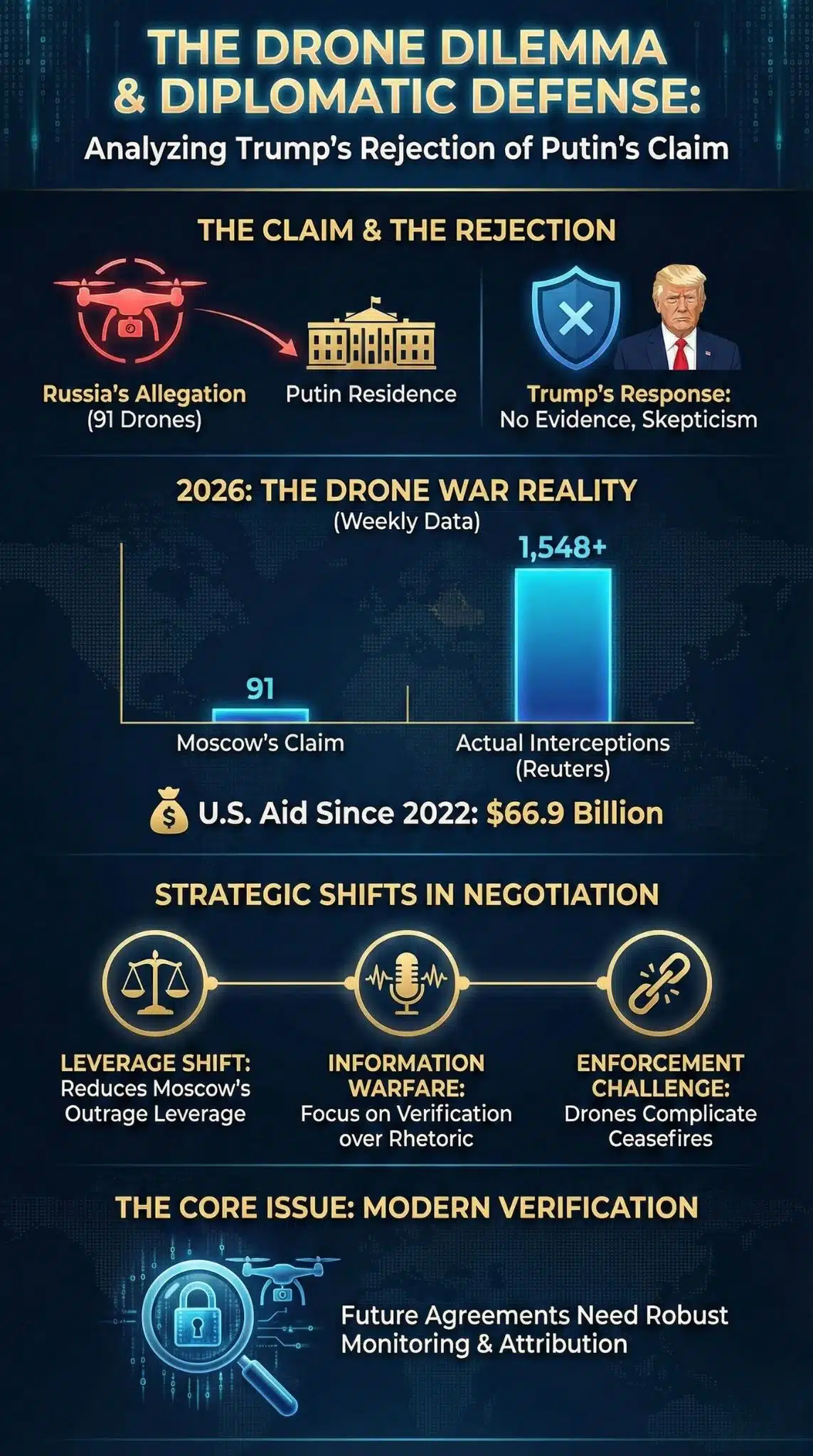
The allegation that set off this mini crisis was dramatic by design. Russia said Ukraine tried to strike a residence used by Vladimir Putin in the Novgorod region with a large wave of long-range drones, and Russian officials framed it as evidence Kyiv was escalating during sensitive negotiations.
At first, Trump appeared to treat the claim as a serious provocation, telling reporters he was angry after speaking with Putin. But within days he pivoted, saying he did not believe the strike on Putin’s residence happened as Russia described it, and that while “something” occurred nearby it was not what Moscow claimed.
That swing matters because it is not only about one incident. It is about how the next phase of the war will be negotiated, sold to domestic audiences, and enforced. In negotiations, facts are not just facts. They are bargaining chips, moral framing devices, and sometimes traps.
A key reason this episode resonated is timing. The drone claim surfaced as U.S.-Ukraine talks intensified around a multi-point peace framework that includes long-term security guarantees, and as European leaders tried to shape the guardrails around any ceasefire so it does not become a reset button for Russia’s next offensive.
Why This Claim Appeared Now
Russia’s narrative playbook in wartime often treats information as a shaping operation, not a commentary on events. An allegation of an attempted strike on Putin’s residence offers Moscow three immediate advantages.
First, it tests Trump’s instincts. If Trump publicly embraces Moscow’s framing, Russia gains proof-of-concept that it can influence the mediator’s political posture with a well-timed accusation. If Trump rejects it, as he did, Russia still learns what kinds of “incidents” fail to move him and may recalibrate future pressure points.
Second, it shifts the conversation from territory and security guarantees to “terrorism” and retaliation. That change in vocabulary is not cosmetic. It lays the rhetorical groundwork for Russia to justify intensified strikes while claiming it is responding rather than escalating.
Third, it puts Ukraine on the defensive inside a peace process that is already politically perilous in Kyiv. If Ukraine is forced to spend negotiating capital debunking allegations, it has less room to press for enforcement mechanisms and long-term deterrence.
The key analytical takeaway is that the claim functioned like a negotiating wedge. Even if it was not meant to be believed by everyone, it was meant to be repeated long enough to complicate the momentum of talks.
What Trump’s Rejection Signals About Leverage
Trump’s public skepticism alters the bargaining environment in two ways.
It reduces Russia’s ability to manufacture a pretext that forces Washington to pressure Kyiv into unilateral restraint. If Washington treats Kremlin claims as unverified until substantiated, Moscow’s “outrage leverage” weakens.
It also implicitly raises the bar for what counts as credible justification for Russia to “reconsider” or harden its negotiating position. In a mediation setting, the side perceived as playing games with facts pays a reputational cost, especially if allies around the table already believe Moscow is stalling.
This is not the same as Trump aligning with Ukraine. It is better understood as Trump protecting his own negotiating bandwidth. If Trump is trying to close a deal, he cannot let either side constantly redefine the agenda with unverifiable claims. That is a mediator’s self-defense move.
There is a second-order effect too. By rejecting Russia’s claim, Trump gives European leaders more room to argue that the primary obstacle is not Kyiv’s “provocations” but Moscow’s terms and tactics, including maximalist war aims.
The Drone War Is Evolving Faster Than Diplomacy
One reason the “Putin residence” claim found oxygen is that drone warfare has changed the perceived geography of the conflict. Strikes are no longer confined to front lines.
Reuters reporting based on Russian Defense Ministry data said Ukraine targeted Moscow with drones every day of 2026 so far, with Russia claiming dozens intercepted in a single night and over a thousand intercepted over a week across Russian territory and Crimea.
Even allowing for the fog of war and Russia’s incentives to frame numbers in particular ways, the trendline is clear: drones have become a routine pressure tool, not an occasional signal. This creates a strategic paradox for ceasefire talks.
- For Ukraine, deep strikes can be framed as a way to raise Russia’s cost of war, disrupt logistics, and offset Russia’s advantages in massed missiles and manpower.
- For Russia, the same strikes can be framed as justification to demand restrictions on Ukraine’s future force posture, especially long-range capabilities.
- For negotiators, drones are an enforcement nightmare because attribution is hard, defenses are imperfect, and “violations” can be narrated into existence.
This is why ceasefire proposals that ignore air, drone, and cyber domains tend to collapse into recrimination. A modern ceasefire needs monitoring and enforcement that match modern disruption.
Key Statistics Shaping The Negotiation Reality
- Russia claimed an attempted strike on a Putin residence involved 91 long-range drones.
- Russia’s Defense Ministry data, as reported by Reuters, said 57 drones were destroyed over the Moscow region in one night and at least 1,548 Ukrainian drones were intercepted over a week across Russia and Crimea.
- The U.S. State Department said the U.S. has provided $66.9 billion in military assistance since Russia’s full-scale invasion in February 2022 and $69.7 billion since 2014.
- The Kiel Institute reported new European military aid allocations in 2025 fell toward their lowest level since 2022, with only about €4.2 billion in new military aid allocations and a gap not offset by Europe after a halt in U.S. support.
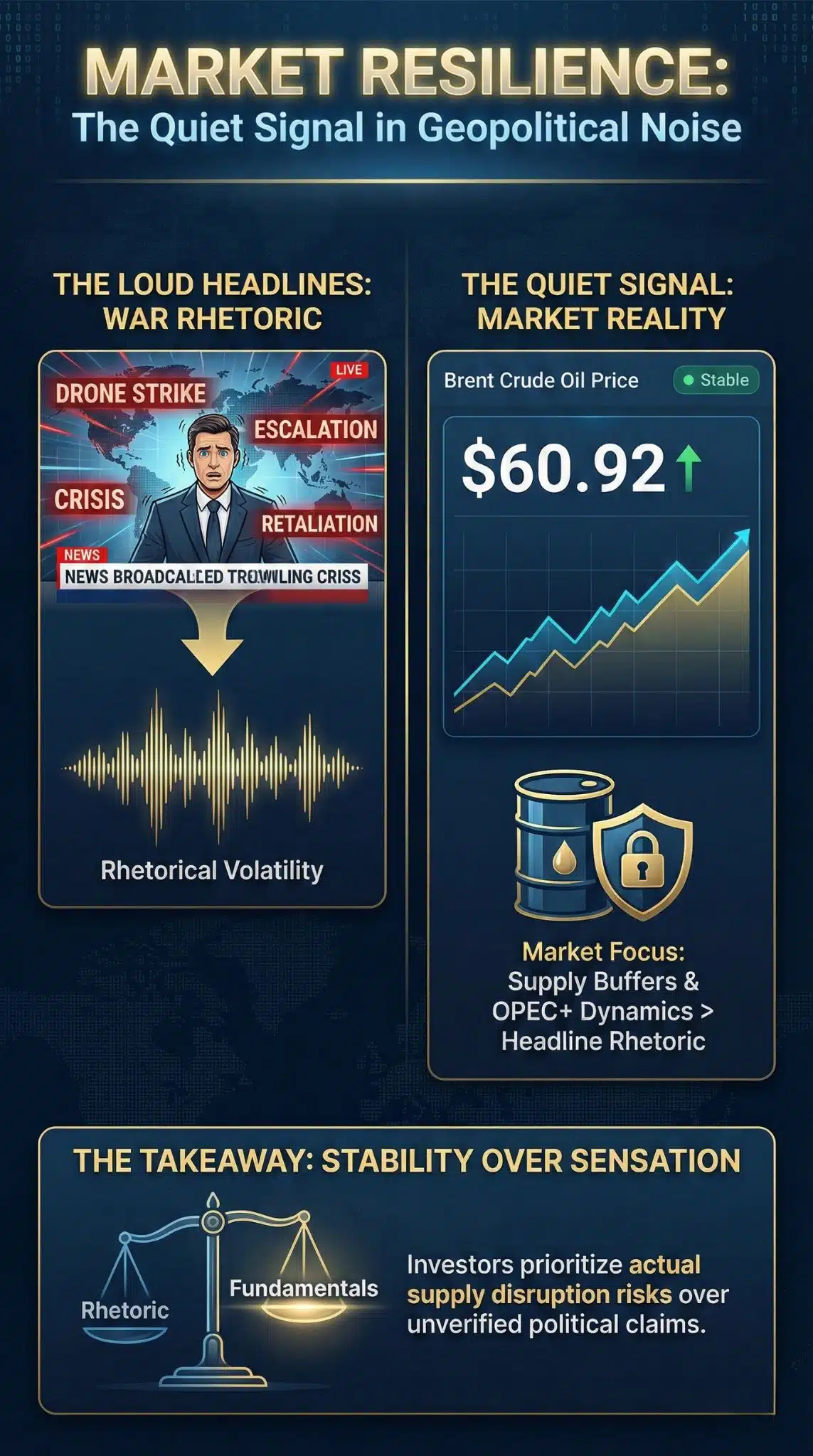
- Brent crude traded around $60.92 per barrel and WTI around $57.43 in early January 2026, signaling markets were not pricing a major immediate energy shock from geopolitics at that moment.
A Timeline That Shows Why The Narrative Battle Matters
| Date (Late 2025 to Early 2026) | What Happened | Why It Matters For Talks |
| Late Dec 2025 | Russia publicly alleges a major drone attempt against a Putin-linked residence; Ukraine denies. | Creates a “retaliation” and “terrorism” frame that pressures negotiators. |
| Early Jan 2026 | Trump says he does not believe the alleged strike happened as claimed. | Signals the U.S. may not accept unverifiable incidents as agenda-setters. |
| Early Jan 2026 | Reporting indicates escalating drone activity targeting Moscow region. | Makes enforcement and verification central to any ceasefire design. |
| Early Jan 2026 | U.S.-Ukraine peace discussions include long-term security guarantee concepts. | Raises the core question: deterrence after a ceasefire, not just stopping fire now. |
Information Warfare As A Negotiating Weapon
The most important lens here is not whether the claim was true. It is what the claim was meant to do. RAND’s research on Russian disinformation since 2022 describes a high-volume, multichannel campaign aimed at undermining Ukrainian resilience and depleting international support. That goal maps neatly onto a moment when Western unity is under strain and aid flows are uneven.
A ceasefire process is especially vulnerable to disinformation because it depends on trust and sequencing. If one side can constantly generate “violations” or “outrages,” it can delay concessions while presenting itself as the aggrieved party. That creates a diplomatic incentive to confuse.
European and Ukrainian officials have repeatedly argued that unsubstantiated Russian claims around high-profile incidents are often designed to justify future aggression or derail talks. Reporting from outlets such as the Financial Times and Le Monde highlighted the lack of publicly provided evidence and the suspicion among analysts that the story functioned as a provocation.
One way to think about this is as narrative terrain. Russia has incentives to ensure that if talks fail, blame does not concentrate on Moscow. A claim like “Kyiv tried to hit Putin’s residence” is built to pre-load the blame map.
The Ceasefire Problem: Stopping Fire Versus Stopping War
The United States and its partners are trying to design something more durable than a temporary lull. But history offers an uncomfortable warning: ceasefires that freeze lines without credible enforcement can become launchpads for future offensives.
Carnegie’s analysis of lessons from the Minsk agreements argues that earlier ceasefire frameworks reduced violence temporarily but proved insufficient to prevent renewed escalation and eventually the 2022 full-scale invasion. The lesson is not “ceasefires never work.” The lesson is that ceasefires without credible deterrence often fail against revisionist objectives.
CSIS has emphasized that a credible ceasefire requires enforcement across domains and sustained defense commitments so that Moscow cannot exploit the pause.
This is why the “Putin residence” claim is not a sideshow. It is a preview of the enforcement fights to come.
If negotiators cannot agree on what happened in a drone incident today, what happens when a ceasefire is in effect and both sides have incentives to accuse the other of violations?
Where Aid And Defense Spending Shape The Bargaining Table
Negotiations are always backed by capabilities, even when the language is diplomatic.
On the U.S. side, official figures show the scale of military assistance already provided to Ukraine, which shapes both Kyiv’s expectations and Washington’s leverage.
On the European side, the Kiel Institute’s Ukraine Support Tracker has warned that new aid allocations in 2025 dropped sharply, and Europe did not offset the halt in U.S. support. If Ukraine believes future support is uncertain, it faces pressure to accept worse terms. If Russia believes Ukraine’s support pipeline is weakening, it has less incentive to compromise quickly.
Separately, NATO’s defense expenditure reporting shows that alliance spending has been rising since 2014, with 2024 and 2025 figures treated as estimates in NATO’s official reporting. The strategic implication is that Europe is rearming, but unevenly and on timelines that may not align with Ukraine’s near-term needs.
A Simple Before And After View Of Support And Deterrence
| Indicator | Earlier Pattern | What The Latest Data Suggests Now |
| U.S. military assistance | Large-scale packages through 2024 and into 2025; official tallies exceed $66.9B since Feb 2022. | The support level is massive historically, but future flows are politically contingent. |
| European military allocations | Surges at points, but uneven burden-sharing | Kiel reports 2025 new allocations falling toward the lowest levels since 2022, with only ~€4.2B in new European military allocations cited in its update. |
| NATO deterrence posture | Post-2014 increases | NATO data show continued upward trend, but “2%” is a floor, and many allies hover just above it. |
Markets: The Quiet Signal Behind The Loud Headlines
Markets are not moral arbiters, but they are useful sensors. If traders expect major disruption, energy and risk assets often move quickly.
On January 5, 2026, Reuters reported Brent crude around $60.92 and WTI around $57.43, with markets weighing political turmoil in Venezuela and broader supply conditions.
The fact that oil was not spiking on the Russia-Ukraine narrative front suggests the market consensus at that moment was that the “Putin residence” claim was not, by itself, a trigger for immediate escalation that threatened global supply. That matters because Russia’s leverage over Europe has long been linked to energy, and the less markets fear disruption, the less bargaining power an “escalation narrative” automatically generates.
This does not mean escalation is unlikely. It means markets were signaling that supply buffers and OPEC+ dynamics mattered more in the short run than headline-grabbing war rhetoric in early January 2026.
Expert Perspectives And Counter-Arguments
A neutral analysis has to entertain the competing interpretations.
One view, often advanced by Ukrainian officials and some independent analysts, is that Russia’s claim was a classic provocation designed to justify retaliation and stiffen Moscow’s negotiating posture without changing any underlying war aims.
A more cautious counterview is that even if the specific “Putin residence” targeting is unsubstantiated, the broader escalation of drone operations is real, and Russia may see itself as having domestic political incentives to respond harshly to any perceived penetration of elite security. The Reuters reporting on routine drone activity around Moscow underscores why Russia can plausibly claim it is under sustained pressure.
A third, more structural view focuses on incentives: Russia benefits from ambiguity. If attribution remains uncertain, Moscow can choose when to treat an incident as casus belli and when to treat it as background noise. That optionality is power.
Finally, there is a pragmatic diplomatic view: Trump’s rejection may be less about adjudicating truth and more about preventing either party from hijacking negotiations with allegations that cannot be verified quickly.
What Comes Next: Three Scenarios To Watch
| Scenario | What It Looks Like | Key Milestones |
| Managed Momentum | Talks continue, with a push toward a limited ceasefire framework paired with security guarantees and monitoring | Any formal outline of security guarantees, plus a verification mechanism that covers drone and missile incidents |
| Narrative Spoiler Cycle | Repeated claims of “terrorism” or “provocations” are used to justify retaliatory strikes and pause negotiations | Watch for public evidence releases, third-party verification demands, and shifting preconditions |
| Hardening Maximalism | Russia uses perceived Western aid fatigue and battlefield realities to insist on terms Ukraine cannot accept | Watch for statements tying any ceasefire to Ukrainian force restrictions and territorial concessions |
The throughline is simple: if the ceasefire architecture does not solve attribution and enforcement in the drone era, every incident becomes a political weapon, and negotiations become episodic theater.
Final Thoughts
Trump Rejects Putin Residence Drone Claim is an early stress test of a negotiation environment where truth is contested, military technology is democratizing strike capacity, and political time horizons are mismatched.
Ukraine needs a settlement that deters the next invasion attempt, not just pauses the current one. Russia wants outcomes that lock in gains and constrain Ukraine’s future military options. The United States and Europe want an endgame that does not reward aggression while also stabilizing broader global risk.
Trump’s rejection of the Kremlin’s claim does not resolve those contradictions. But it does shift the optics of who is manipulating the process, and it reduces the chance that Moscow can unilaterally redefine the diplomatic agenda with a single dramatic allegation.
The next phase will be defined by mechanisms, not slogans: verification, monitoring, sanctions triggers, and the concrete shape of security guarantees. That is where this story stops being about one residence and starts being about whether a modern ceasefire can survive modern warfare.