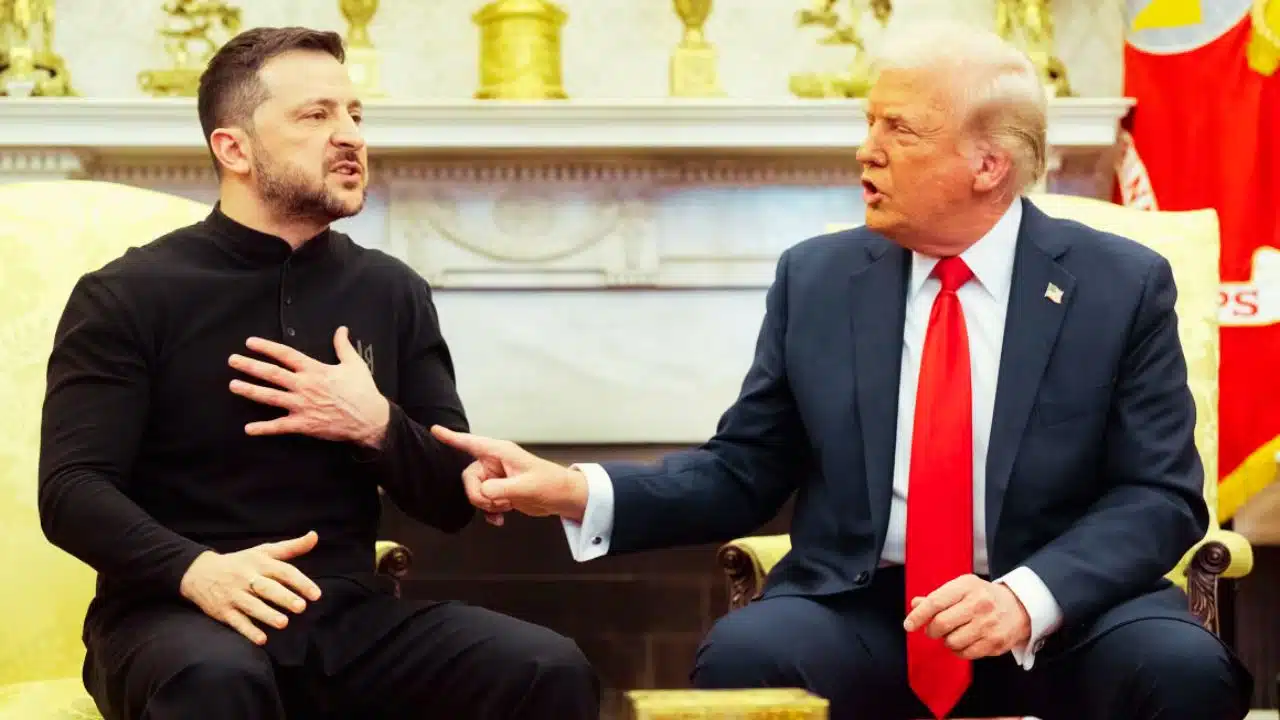
Ukraine’s President Volodymyr Zelensky briefed European and NATO partners on coordinated red lines and security guarantees on Dec. 27, ahead of Trump peace talks with U.S. President Donald Trump in Palm Beach, as Russia’s air attacks again hit Kyiv and kept pressure on the negotiations.
What’s happening now
Zelensky used a stopover in Canada to hold consultations with European Union and NATO counterparts, urging unified positions both at the front and in diplomacy before the next round of U.S.-led talks on ending the war.
European Commission President Ursula von der Leyen was expected to join the coordination call, reflecting European efforts to stay closely aligned with Washington as the process accelerates.
The White House schedule listed a Trump–Zelensky meeting for Sunday in Palm Beach, Florida, signaling the most senior in-person engagement in weeks as the sides try to narrow remaining gaps.
Why Zelensky is briefing Europe first
Zelensky’s outreach aimed to prevent fractured positions among allies, as Kyiv argues that any deal must include credible, enforceable security guarantees to deter renewed Russian aggression.
He has framed allied unity as essential to stop Moscow from manipulating and evading a settlement that Ukraine views as fair and durable.
The timing also reflects concern that a fast-moving negotiation track could lock in terms without enough European and Ukrainian input on security arrangements that would largely be carried by Europe.
Trump peace talks: agenda and sticking points
The Palm Beach meeting is expected to focus on the structure of security guarantees, the sequencing of any ceasefire or broader agreement, and unresolved disputes tied to territory and strategic infrastructure.
Public outlines of the current draft track include competing frameworks that evolved after a U.S. 28-point proposal surfaced in late November and a subsequent 20-point working framework discussed with Ukrainian participation.
Zelensky has said the talks are advanced but not finished, describing the latest framework as close to completion while still requiring political decisions at the leader level.
Security guarantees at the center
Zelensky has emphasized that security guarantees must be simultaneous with the end of the war, arguing Ukraine cannot accept a pause that leaves Russia able to rearm and strike again.
One publicly described concept discussed in the negotiation orbit is a security assurance model referenced against NATO’s Article 5-style logic—support commitments if Ukraine is attacked again—while stopping short of immediate NATO membership.
Another reported element under discussion is maintaining a large Ukrainian force posture, with one described figure being an 800,000-strong military, reflecting Kyiv’s push to avoid post-war demilitarization.
Territory and major assets
Zelensky has pointed to territorial questions in eastern Ukraine’s Donbas as among the hardest issues still blocking agreement.
He has also indicated that control of a nuclear power plant occupied by Russian forces is on the agenda, underscoring how critical infrastructure and energy security have become inseparable from ceasefire design.
Separately, a demilitarized zone concept in eastern Ukraine has been described as a possible mechanism to reduce immediate battlefield friction while deferring final political questions.
War pressure as diplomacy intensifies
The diplomatic push has unfolded under continued Russian air attacks, with strikes reported in and around Kyiv that caused casualties and damage as leaders prepared for the Palm Beach talks.
In one reported overnight wave, more than 20 people were injured in Kyiv and at least one person was killed in the surrounding region, reinforcing Kyiv’s argument that Moscow is using violence to shape negotiating leverage.
Zelensky has described the attacks as Russia’s response to peace efforts, urging partners to maintain military and political pressure alongside negotiations.
Key dates and milestones
The current negotiation sprint sits within a longer timeline that includes Russia’s full-scale invasion in February 2022 and several recent U.S.- and Europe-facing diplomatic rounds that increased in pace late in 2025.
Diplomacy timeline (late 2025)
| Date | Event | Why it matters |
| Late Nov. 2025 | A U.S. 28-point peace proposal surfaced publicly. | Triggered urgent consultations in Kyiv and across Europe over perceived imbalances and enforceability. |
| Dec. 15, 2025 | Allies discussed security guarantees as part of an evolving proposal. | Put deterrence commitments at the heart of any viable end-state for Ukraine. |
| Dec. 26, 2025 | Zelensky confirmed he would meet Trump in Florida. | Elevated talks to leader level to resolve political deal-breakers. |
| Dec. 27, 2025 | Zelensky coordinated positions with EU/NATO partners before the meeting. | Sought allied unity on terms, sequencing, and enforcement mechanisms. |
| Dec. 28, 2025 | Trump scheduled to host Zelensky in Palm Beach. | Could determine whether a near-term framework moves forward or stalls over guarantees and territory. |
Open issues (what negotiators still must settle)
| Issue | What’s being discussed | What remains unresolved |
| Security guarantees | Assurance models described as aligned with NATO-like collective support logic. | Scope, legal form, who commits forces/funding, and triggers for action. |
| Territorial disputes | Donbas status identified by Zelensky as a core obstacle. | Whether territorial control is addressed now, frozen, or deferred to later talks. |
| Demilitarized arrangements | A demilitarized zone concept has been floated publicly. | Monitoring, enforcement, and whether it creates durable security or a temporary freeze. |
| Strategic infrastructure | A Russian-occupied nuclear power plant is cited as an agenda item. | Governance, safety oversight, and who controls operations post-agreement. |
Final thoughts
The immediate test of the Trump peace talks is whether the U.S., Ukraine, and European partners can align on enforceable security guarantees while Russia continues to strike Ukrainian cities.
If leaders cannot close gaps on guarantees and territory, negotiations may slow into a longer technical phase even if diplomatic contacts remain intense.
If they do align, the next stage would likely involve broader engagement to translate political commitments into monitoring, financing, and defense arrangements that can survive violations and future shocks.