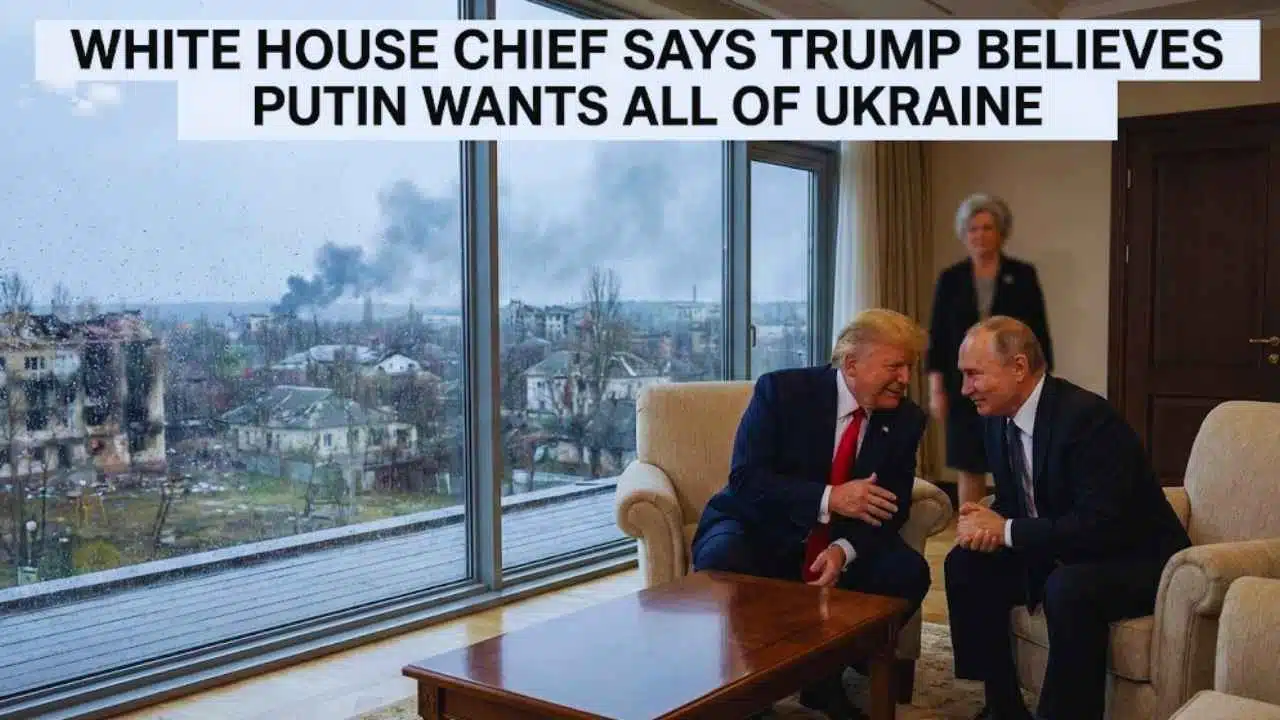
White House Chief of Staff Susie Wiles has disclosed that President Donald Trump privately believes Russian President Vladimir Putin ultimately wants control over all of Ukraine, not just the eastern territories currently under Russian occupation.
This assessment, shared during a wide-ranging interview, offers a rare glimpse into Trump’s internal thinking and sharply contrasts with his more restrained public comments on the war.
According to Wiles, Trump is skeptical of the idea—held by some foreign policy analysts—that Putin would be satisfied once Russia secures full control over the remaining parts of the Donbas region, particularly Donetsk. Instead, Trump believes Putin’s long-term objective is much broader and more aggressive. In Wiles’s words, while many experts think territorial gains in eastern Ukraine could bring the conflict to a close, Trump believes Putin’s ambitions extend to the entire country.
This view suggests that, behind closed doors, Trump sees the war not as a limited territorial dispute but as a fundamental challenge to Ukraine’s sovereignty and existence as an independent state.
Senior U.S. Officials Echo Deep Concerns Over Russia’s Intentions
Wiles’s remarks also shed light on conversations within the highest levels of the U.S. government. She revealed that Secretary of State Marco Rubio shared similar concerns during internal discussions last fall. Rubio reportedly questioned Russia’s true goals after Moscow repeatedly rejected peace proposals that would have allowed it to retain significant territorial gains.
These proposals, according to U.S. officials, would have effectively frozen the conflict along existing lines of control. They included large portions of Ukrainian territory already under Russian occupation, including Crimea, which Russia annexed in 2014. Despite these substantial concessions, Russia declined to accept the terms.
For Rubio and others, this pattern raised a troubling question: if Russia refuses deals that already grant it major strategic and symbolic victories, what is it really seeking? The conclusion drawn by some inside the administration is that Putin may not be negotiating for peace at all, but rather positioning himself to pursue broader domination of Ukraine.
Peace Talks Advance in Berlin, but Territorial Disputes Persist
These revelations come amid renewed diplomatic efforts to end the war. U.S., Ukrainian, and European officials recently completed two days of intensive negotiations in Berlin aimed at crafting a comprehensive peace framework. American officials said that roughly 90 percent of disagreements had been resolved in a draft plan consisting of 20 key points.
Ukrainian President Volodymyr Zelenskyy welcomed the progress, describing the framework as practical and workable. He suggested that final proposals could be completed within days and then formally presented to Moscow.
However, optimism remains cautious. The Kremlin has shown little willingness to compromise, with officials insisting that Russia seeks a “comprehensive peace” rather than a temporary ceasefire. Moscow has warned against what it calls short-term or unstable solutions, reinforcing concerns that it may be holding out for far-reaching political and territorial outcomes.
Territory remains the most difficult issue. Zelenskyy has repeatedly stated that Ukraine will not recognize Russian sovereignty over any part of its land, including the Donbas. A U.S. proposal to turn disputed regions into a “free economic zone” has been discussed, but details remain vague, and it is unclear whether such an arrangement would imply Russian control.
Public Messaging vs. Private Assessments Inside the Trump White House
Wiles’s comments highlight a clear divide between Trump’s public rhetoric and his private assessments. Publicly, Trump has often emphasized Ukraine’s weaker position, urging Kyiv to consider making a deal with a much larger and more powerful Russia. He has frequently suggested that limited territorial concessions could end the war.
Privately, however, Wiles suggests Trump is far less confident that such compromises would satisfy Putin. This internal view paints the conflict as a far more serious and existential struggle for Ukraine.
After the interview was published, Wiles criticized the portrayal of her remarks, calling the profile unfairly framed and lacking context. She defended the administration’s record but notably did not deny the substance of her statements about Trump’s beliefs.
Taken together, her comments add depth to the ongoing debate over Russia’s war aims and raise difficult questions about whether any peace deal that leaves Ukraine partially occupied could ever deliver lasting stability.