In a move that escalates the war of words between the White House and a growing national protest movement, President Donald Trump posted a bizarre, AI-generated video to his Truth Social account on Saturday evening, depicting himself as a crowned fighter pilot named “King Trump” dumping a brown, sludge-like substance on demonstrators. The post, a direct jab at the nationwide “No Kings” protests that saw millions march against his administration, has ignited a firestorm of criticism, with opponents calling it a dangerous trivialization of political violence, while supporters have lauded it as sharp-edged political satire.
The 19-second, digitally altered clip was posted at approximately 8:45 PM Eastern Time on October 19, 2025, as reports were solidifying the massive scale of the day’s protests. Set to the tune of Kenny Loggins’ “Danger Zone,” the video shows a crowned Trump figure in a cockpit, flying a jet emblazoned with “King Trump” over what appears to be New York’s Times Square, before releasing a payload onto crowds below. Among those specifically targeted in the video is a likeness of Harry Sisson, a prominent 23-year-old Democratic-aligned social media influencer.
The post represents a significant new chapter in the use of artificial intelligence in presidential communication, moving beyond static images to dynamic, confrontational animations. While the Trump administration has previously shared AI-generated portraits of the president in heroic or monarchical poses, this is the first instance of depicting a simulated act of aggression against American citizens.
- What Happened: President Donald Trump posted an AI-generated video on Truth Social showing himself as “King Trump” in a fighter jet, dumping a brown substance on “No Kings” protesters.
- Timing: The video was posted on the evening of Saturday, October 19, 2025, the same day as the second major wave of “No Kings” nationwide protests.
- Scale of Protests: Organizers for the “No Kings” movement, a coalition of over 200 progressive groups including Indivisible and the ACLU, claim that over seven million people participated in more than 2,600 events across all 50 states.
- Official Response: While no official statement has been released from the White House press office specifically about the video’s content, senior Republicans and campaign-aligned media have consistently branded the protests as “Hate America” rallies.
- Targeted Individual: The video specifically depicts an attack on an animated figure of Harry Sisson, a vocal young critic of the President.
- Immediate Impact: The video has been widely condemned by Democratic figures and civil liberties groups as an incitement and a threat, while many of the President’s supporters have defended it as humorous trolling. Viewership numbers on the tightly controlled Truth Social platform are not publicly verifiable, but the video was shared tens of thousands of times across other platforms like X (formerly Twitter) and Instagram within hours.
The “No Kings” Movement
The “No Kings” protests represent one of the most significant, sustained opposition movements of Trump’s second term. The coalition, which held its first major nationwide event on June 14, 2025, was formed to protest what organizers describe as the Trump administration’s “authoritarian excesses and corruption. Their stated grievances include the deployment of federal agents to U.S. cities, restrictive immigration policies, and what they see as an erosion of democratic norms.
The name itself is a direct response to President Trump’s own rhetoric and imagery. The president has, at times, referred to himself in king-like terms, and his campaign has previously promoted merchandise and memes depicting him as a monarch. In an interview with Fox Business just days before the October 18th protests, Trump addressed the moniker directly, stating, “They’re referring to me as a king. I’m not a king”.
Saturday’s protests were geographically widespread, from major rallies in Washington D.C. and Los Angeles to smaller gatherings in rural towns. Participants were encouraged to wear yellow, a color historically associated with pro-democracy movements globally.
The AI Video: A New Political Weapon
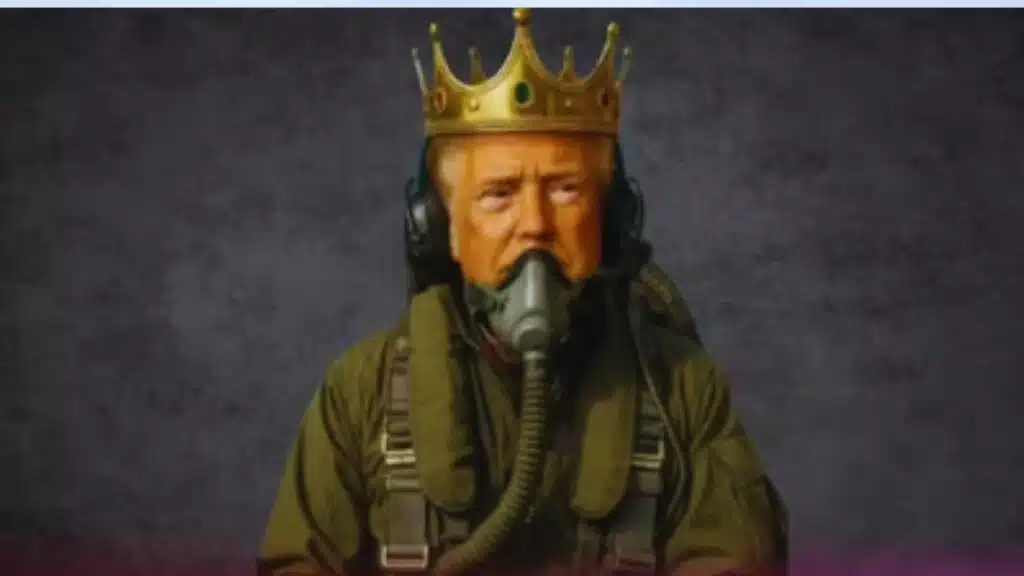
The video posted by Trump is rudimentary in its technical execution but powerful in its symbolism. It opens with the “King Trump” jet taking off, cuts to a close-up of the president in the cockpit, and culminates in the aerial “bombardment” of protesters.
The inclusion of Harry Sisson, a Gen-Z political commentator with a massive following on TikTok and X, is a notable element. Sisson has been a frequent and biting critic of the administration. In the week prior to the video’s release, a “Deport Harry Sisson” hashtag trended on X, pushed by Trump supporters who questioned his American citizenship (Sisson is a U.S. citizen who was born in Singapore). Targeting a specific, private citizen in a depiction of an attack marks a significant departure from previous presidential communications.
In a post on X responding to the video, Sisson wrote, “That plane wouldn’t have made it off the ground with your fatass in the pilot’s seat”.
Official and Political Responses
As of Monday, October 20, the White House has not issued a formal clarification or statement regarding the video. The Trump campaign’s rapid response team has remained silent on the specific content. However, the broader Republican strategy has been to delegitimize the protesters. House Speaker Mike Johnson, speaking on Fox News on Sunday morning, referred to the demonstrations as “an apparently violent free speech exercise,” adding, “There were a lot of hateful messages yesterday. We have video and photos of pretty violent rhetoric calling out the president, saying fascists must die.
Democratic leadership has been swift in their condemnation. While a direct statement from Senate Majority Leader Chuck Schumer or House Minority Leader Hakeem Jeffries on this specific video is still pending, the Democratic National Committee (DNC) released an email statement late Sunday.
The President of the United States has a duty to protect all Americans, not fantasize about attacking those who exercise their constitutional right to protest,” the DNC statement read. This video is not a joke; it is a chilling glimpse into a leader who sees political dissent as something to be violently suppressed. It is deplorable, un-presidential, and dangerous.”
Normalizing Political Violence?
Experts in political communication and digital media have expressed alarm at the video’s content and its implications for political discourse.
Dr. Evan Cornog, a political historian and author of “The Power and the Story,” commented on the broader trend of Trump’s use of AI in an interview with PBS News prior to this incident. He noted that such images are “primed for people to react” and require no effort for consumption, making them highly effective for messaging. He argued that while past presidents had to “actually have fought in a war to run as a war hero,” AI allows a politician to simply generate that image.
Other analysts have focused on the danger of depicting violence. Dr. Henry Ajder, a leading expert in AI and deepfakes, has previously warned that even obviously fake content can “satisfy a kind of truth” for viewers who are already aligned with the message. By depicting protesters as a legitimate target for a military-style attack, experts fear the video normalizes the idea of using force against political opponents.
“It’s a form of stochastic terrorism,” one media analyst, who wished to remain anonymous due to online harassment, told this journalist. “The president isn’t directly ordering an attack, but he’s planting a seed and creating a permission structure for his most extreme followers to view their fellow citizens as enemies to be targeted.
The fallout from this incident will likely unfold on several fronts. First, there will be continued pressure on the White House and the Trump campaign to either defend or disavow the video’s content. Second, the “No Kings” coalition will likely use the video as a powerful recruiting and fundraising tool, arguing that it proves their central claim about the administration’s authoritarian leanings. Third, this may open the door for more extreme uses of generative AI in the political sphere, pushing the boundaries of what is considered acceptable campaign material.
This event marks a clear escalation in the culture war, waged not just with words, but with increasingly sophisticated and provocative digital weaponry. The line between trolling and threatening has become perilously blurred.