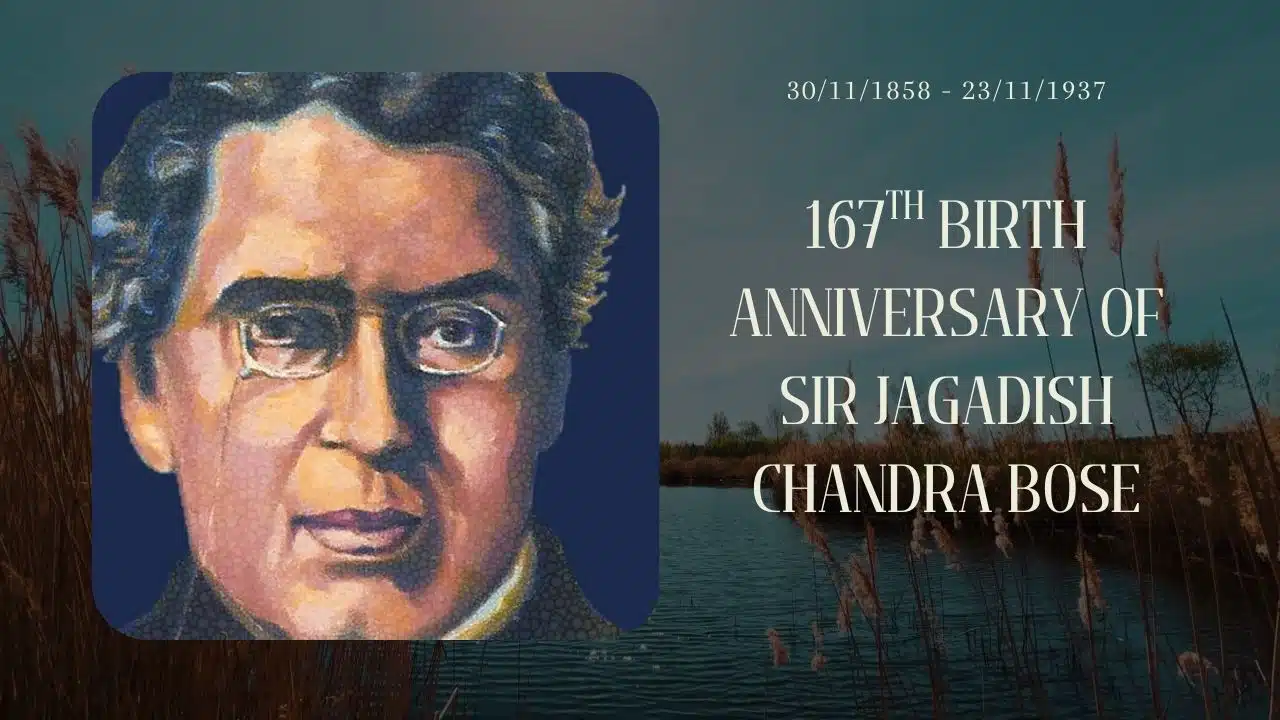
Today marks the 167th birth anniversary of Sir Jagadish Chandra Bose, the pioneering physicist, biologist, and science fiction writer widely regarded as one of the founding figures of radio science. Born on this day in 1858, in Mymensingh, Bengal Presidency—now part of present-day Bangladesh—Bose remains celebrated across the subcontinent for his groundbreaking contributions to scientific research and education.
Born to Bhagwan Chandra Bose, a respected Deputy Magistrate and the first Headmaster of Mymensingh District School, Jagadish Chandra spent his formative years deeply rooted in Bengali culture. Despite holding a senior position under British administration, Bhagwan Chandra enrolled his son in a Bengali-medium school, believing that children must first master their mother tongue before pursuing English education. This decision profoundly influenced Bose’s worldview and writing, enriching the Bengali language and shaping his lifelong commitment to cultural identity.
After early schooling in Mymensingh, Bose studied at Hare School in Calcutta before completing his BA from St. Xavier’s College in 1879. It was here that Belgian Jesuit scientist Father Eugene Lafont sparked his interest in natural sciences. Although Bose initially expressed a desire to pursue the Indian Civil Service in England, his father encouraged him instead toward scholarship and scientific inquiry.
Bose left for London in 1880 to study medicine but soon shifted his focus to natural sciences due to health issues. With support from his brother-in-law, the renowned reformer Ananda Mohan Bose, he was admitted to Christ’s College, Cambridge. He later completed his B.Sc. from the University of London in 1884. During his time in England, Bose studied under some of the world’s most distinguished scientists, including Lord Rayleigh, Michael Foster, James Dewar, Francis Darwin, and Sidney Vines, experiences that deeply shaped his scientific vision.
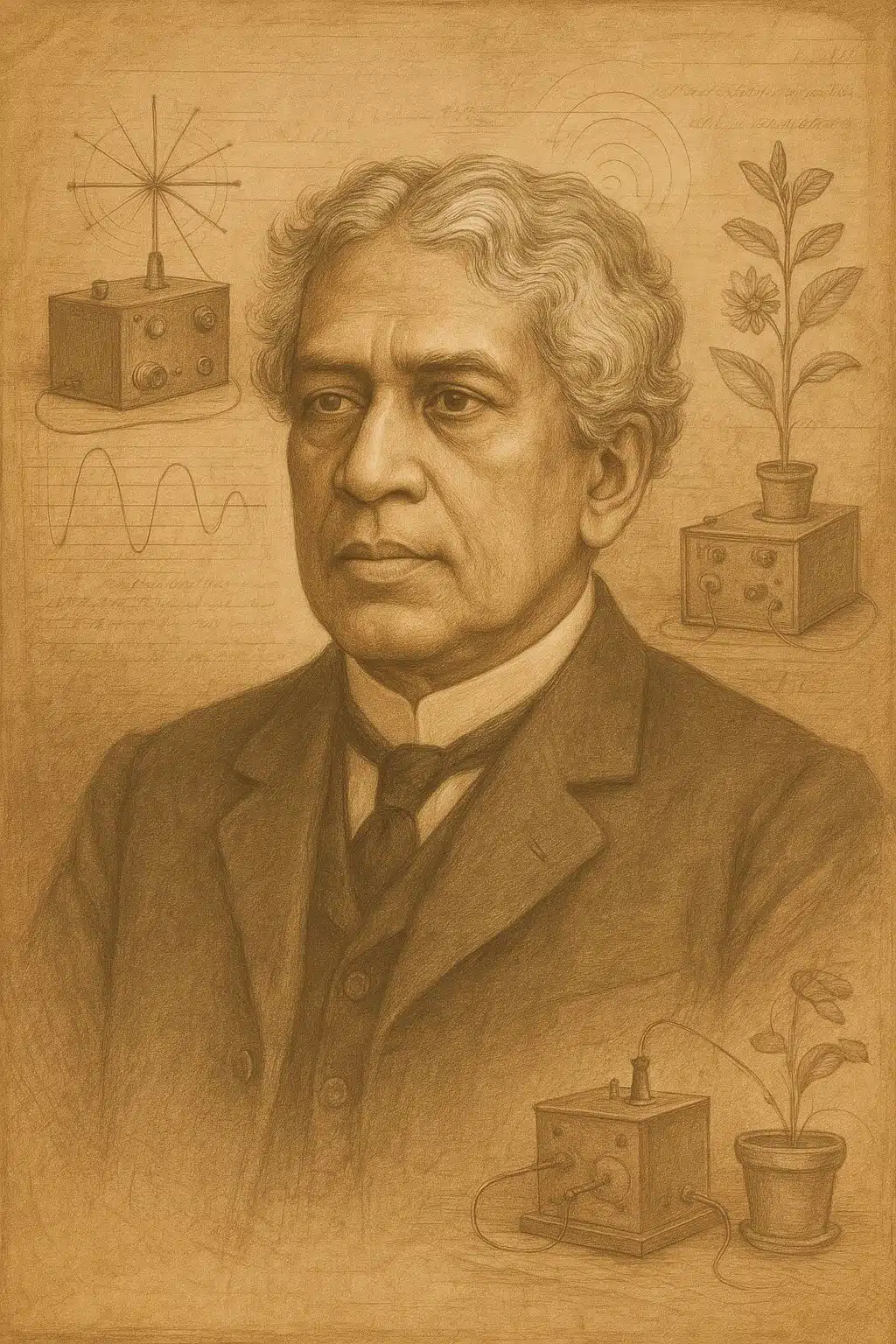
Returning to India in 1885, Bose joined Presidency College as a professor of physics on the recommendation of the governor-general of India. However, he faced resistance from the college principal, who opposed the appointment of an Indian professor. Denied proper laboratory facilities and paid less than half the salary of his European counterparts, Bose protested by refusing his salary for three years. His perseverance eventually led the administration to grant him equal pay.
Despite working in a cramped 24-square-foot room without advanced equipment, Bose pressed on with his research, training local artisans to build scientific instruments at minimal cost. His dedication astonished his contemporaries, including Sister Nivedita, who often described his relentless pursuit of scientific truth as heroic.
Bose’s pioneering experiments in electromagnetic waves during his first 18 months at Presidency College were soon recognized internationally. His research was published in the Journal of the Royal Society of London, earning him a DSc from the University of London in 1896. His groundbreaking findings led to invitations to lecture at prestigious institutions across Europe, including the Royal Institution in London and scientific academies in France and Germany.
The Institute of Electrical and Electronics Engineers (IEEE) later honored Bose as one of the fathers of radio science for his early work on wireless communication—achievements that predated many globally recognized innovations in the field.
Beyond his scientific legacy, Bose’s ancestral home in Radhikhal village of Bikrampur remains a symbol of pride, with several educational institutions named in his honor. His contributions have inspired several generations of students and researchers in Bangladesh and around the world.
Sir Jagadish Chandra Bose passed away on 23 November 1937 at the age of 78 in Giridih, Bengal Presidency. Today, as Bangladesh pays homage to one of its greatest sons, scholars and admirers across the globe reflect on his unparalleled contributions to science, culture, and intellectual freedom.