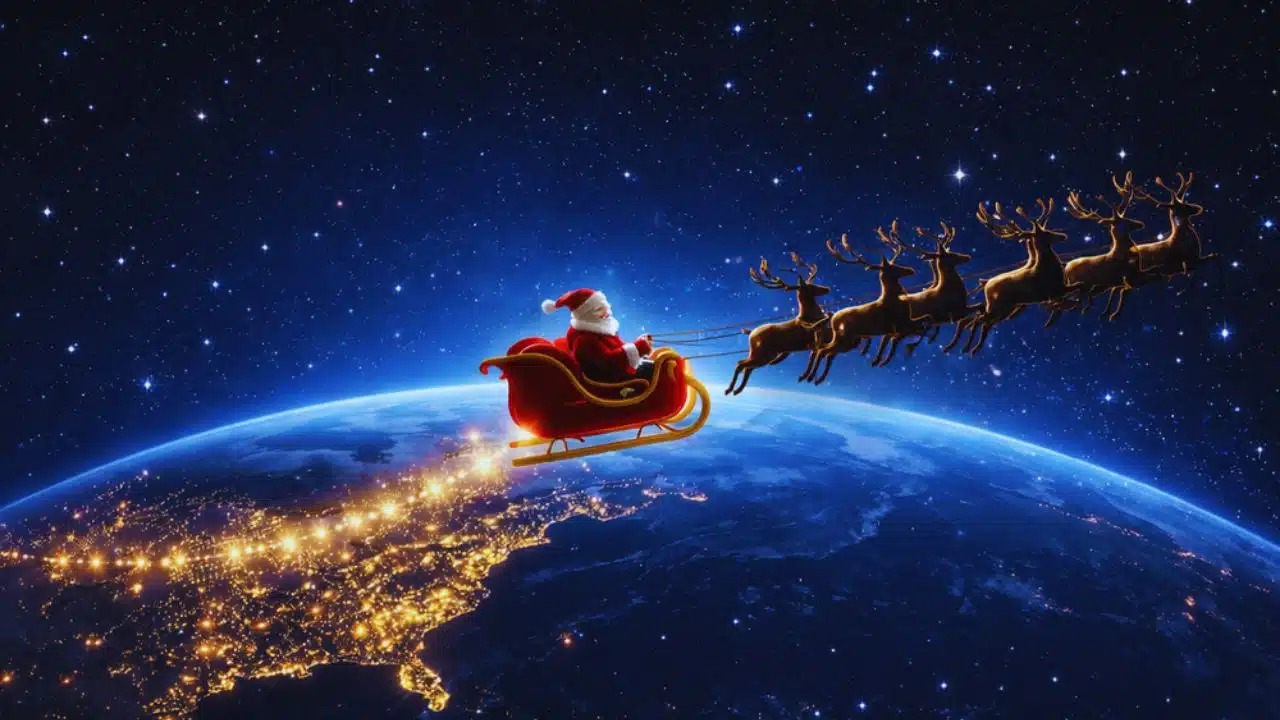
Track Santa 2025 is live again, with NORAD celebrating the 70th year of its Christmas Eve tracking tradition and Google reopening its Santa Tracker map and holiday “village” for families worldwide.
What’s happening this Christmas Eve
NORAD said it is prepared to track Santa’s flight on Dec. 24 as part of the program’s 70th anniversary year, alongside its year-round aerospace warning and control mission for North America.
The military-led experience runs across the NORAD Tracks Santa website and official mobile apps, with digital publishing through major social platforms and partner integrations such as Amazon Alexa, SiriusXM and OnStar.
Google’s Santa Tracker also returns with a live map experience on Dec. 24, designed as a family-friendly, interactive way to follow Santa’s route while exploring games and activities in “Santa’s Village.”
Why the 70th year matters
NORAD traces the tradition to 1955, when a child trying to call Santa dialed a number that reached the Continental Air Defense Command (CONAD) operations center in Colorado Springs.
NORAD says Col. Harry Shoup reassured the caller and the center agreed to “guarantee Santa a safe journey,” creating a tradition that continued after NORAD formed in 1958.
Today, NORAD frames the annual effort as a global public-facing event run with volunteers and outside contributors, built on top of a command whose primary responsibility is real aerospace and maritime warning.
A quick timeline of Santa tracking
| Year | Milestone | What changed |
| 1955 | First “Santa call” reaches CONAD | The mistaken call sparks the tracking tradition. |
| 1958 | NORAD is formed | The tradition continues under NORAD. |
| 2004 | Google begins tracking Santa | Google says it has tracked Santa since 2004 (initially with Google Earth). |
| 2025 | NORAD’s 70th anniversary year | NORAD adds a web-based calling option and expands translation support. |
How NORAD’s tracker works in 2025
NORAD said its website launches Dec. 1 with a “North Pole Village” that includes a countdown, games, a movie theater, music and more, and is available in nine languages.
On Dec. 24, people can call 1-877-HI-NORAD from 4 a.m. to midnight MST to ask live operators about Santa’s location.
New for this anniversary year, NORAD said it is introducing a web-based calling option on noradsanta.org so children without phone access can call the operations center directly from the site.
Scale, access and language support
NORAD’s official fact sheet says the NORAD Tracks Santa website has drawn nearly 15 million unique visitors from more than 200 countries and territories in a typical year.
The same fact sheet says volunteers receive more than 130,000 calls to the hotline from children around the world each year.
For 2025, NORAD said virtual translation services will support more than 200 languages via its call center, expanding accessibility for families worldwide.
The “AI tools” angle around NORAD
NORAD’s 2025 press release lists OpenAI among the corporate contributors supporting the program, alongside major technology firms and platforms.
Separately, industry reporting this season describes NORAD adding generative-AI-style holiday experiences, including tools that can transform photos into “elf” themed images and create printable toy or story content from prompts.
NORAD itself emphasizes that the program is sustained by contributors and volunteers and is delivered across web, apps, social media and voice/vehicle platforms to reach families where they are.
How Google’s Santa Tracker works (and what’s new)
Google’s Santa Tracker experience centers on a live map that shows Santa’s location “moment to moment,” how far away Santa is from a user’s town, and how long it will take to get there.
Google says Santa and the reindeer visit more than 400 locations, and the tracker incorporates photos of seasonal scenes submitted by Local Guides around the world.
Google has also promoted Santa Search features that let users view Santa in 3D through their phones, extending the experience beyond maps into more immersive formats.
Google’s long-running tech foundation
Google has described Santa tracking as a project it has run since 2004, and earlier updates highlighted engineering work such as route algorithms to chart Santa’s Christmas Eve journey.
In its Santa Tracker messaging, Google has repeatedly positioned the product as both entertainment and a playful learning hub, built around “Santa’s Village” activities alongside the Dec. 24 live map.
Google’s public posts also note multiple access points—Android, Google Maps and Google Search—depending on device and region.
NORAD vs Google: what families get
Both trackers are built to be simple for kids and parents—open the site, watch the map, and use extra features if you want them—yet they differ in emphasis and access.
NORAD’s experience is anchored in a volunteer-supported operations center with phone support and multilingual translation, while Google’s experience leans into interactive map storytelling and “village” activities.
Feature comparison table
| Feature | NORAD Tracks Santa | Google Santa Tracker |
| Live phone support | Hotline staffed Dec. 24 from 4 a.m.–midnight MST. | Not positioned as a call-in operation in Google’s public tracker posts. |
| Web-based calling | New web calling option introduced for 2025. | Not described in Google’s tracker posts. |
| Languages | Website available in nine languages; call center supports 200+ languages via translation services. | Global content supported through Google’s map experience and community photos (Local Guides). |
| Experience style | Map + countdown + games + broad platform distribution (apps/social/voice/auto). | Live map + games and activities in “Santa’s Village,” plus 3D viewing features. |
| Longevity | Tradition began in 1955 and continued after NORAD formed in 1958. | Google says it has tracked Santa since 2004. |
Final thoughts
For families, “Track Santa 2025” has become less about choosing one tracker and more about picking the experience that fits the moment—NORAD for hotline-style updates and broad accessibility, Google for map storytelling and games.
For NORAD, the 70th year highlights how a Cold War-era command’s public tradition has evolved into a large digital event with global reach, supported by volunteers and contributors.
For tech platforms, the season shows how mapping, translation, and interactive content—sometimes enhanced by newer AI-style tools—are being packaged into safe, child-friendly experiences that can scale worldwide on a single night.