Gaming trends are shifting faster than ever, reshaping how games are made, sold, and experienced. For players, that means more ways to play, more platforms, and deeper worlds. For studios, publishers, and creators, it means either adapting quickly or getting left behind.
In this guide, we’ll walk through the most important gaming trends that will define the future of the gaming industry over the next few years: from cloud gaming and AI-driven worlds to cross-platform play, mobile dominance, and new monetization models. Along the way, you’ll see how these shifts connect — and what they mean for gamers, developers, and businesses.
Why These Gaming Trends Matter Now
The video game industry has already grown into a massive global entertainment powerhouse, with billions of players and revenue well over the hundred-billion mark — and forecasts suggest it will keep expanding as cloud infrastructure, AI, and mobile access improve worldwide.
But growth isn’t automatic anymore. Development costs are rising, competition for attention is brutal, and players are more demanding, vocal, and informed. The right gaming trends can turn a game into a long-term ecosystem; ignoring them can turn a big launch into a short-lived spike.
To set the stage, here’s a quick overview of the key trends we’ll explore.
Key Gaming Trends at a Glance
| Gaming Trend | One-Line Summary | Who It Impacts Most | |
| 1 | Cloud gaming & subscription access | Streamed games and “Netflix-style” libraries | Players, platform holders |
| 2 | Generative AI & smarter worlds | AI-driven content, NPCs, and tools | Dev teams, tool vendors |
| 3 | User-generated content & creator economies | Players as co-creators with revenue share | Players, creators, publishers |
| 4 | Cross-platform play & cross-progression | Play with anyone, anywhere, on any device | Multiplayer titles, ecosystems |
| 5 | AR, VR & mixed reality | Immersive and blended-reality experiences | Hardware makers, niche genres |
| 6 | Mobile, cozy & wellness-focused gaming | Mobile dominance and low-stress, feel-good experiences | Casual players, mobile-first devs |
| 7 | Live services, personalization & monetization | Ongoing content, tailored journeys, and evolving business models | All live-ops teams |
Now, let’s dive into each trend and see how the future of the gaming industry is being built.
1. Cloud Gaming & Subscription Access: Playing Without the Box
One of the most powerful gaming trends is the move from hardware-locked experiences to cloud-powered, subscription-driven access.
Instead of needing a high-end PC or console, cloud gaming lets players stream games from remote servers to almost any device — laptops, smart TVs, phones, handhelds. Report after report highlights cloud gaming as a major growth driver, especially as internet speeds and 5G coverage improve.
Why Cloud Gaming Matters
- Lower barrier to entry: No need for expensive GPUs or new consoles.
- Instant access: Games can be played without long downloads or patches.
- Device freedom: Start on TV, continue on mobile, finish on laptop.
- Perfect fit for subscriptions: All-you-can-play libraries encourage exploration.
Cloud Gaming vs Traditional Gaming
| Feature | Traditional (Local Hardware) | Cloud Gaming |
| Hardware cost | High upfront (console / PC upgrades) | Low – mid; basic device + controller |
| Game access | Buy per title, download, install | Stream instantly from the library |
| Performance dependence | Local CPU/GPU, storage, and cooling | Network latency, server infrastructure |
| Updates & patches | Download to the device | Handled server-side, largely invisible to the player |
| Cross-device play | Limited or manual cloud saves | Core use case (play anywhere) |
| Ideal player profile | Enthusiasts with a stable setup | Casual to midcore, on-the-go, global audience |
Practical Takeaways
- For gamers: Expect more platforms where you pay monthly to access a huge catalog, and fewer reasons to upgrade hardware every cycle.
- For developers & publishers: Optimizing games for streaming and negotiation with cloud platforms will become critical to discovery and revenue.
2. Generative AI & Smarter Game Worlds

Another headline-worthy set of gaming trends centers on artificial intelligence. It’s no longer just about pathfinding or basic enemy behavior. Generative AI and advanced machine learning are transforming:
- How games are developed (faster asset creation, smarter tools).
- How games feel to play (adaptive difficulty, dynamic events, personalized content).
Analysts already point out AI as one of the core engines powering the next wave of innovation, from procedural worlds to automated testing.
Where AI Shows Up in Modern Gaming
- NPCs & characters: More reactive, conversational, and context-aware.
- Procedural content: Levels, quests, and items generated on the fly.
- Balancing & analytics: AI watches play patterns and suggests tweaks.
- Dev tools: AI assistants for code, worldbuilding, animation, 3D assets.
Uses of AI in Games – Benefits & Risks
| AI Use Case | Main Benefit | Key Risk / Concern |
| Procedural world generation | Fresh content, high replay value | Repetitive or bland layouts if misused |
| Smarter NPC behavior | More immersive, believable worlds | Uncanny or unpredictable interactions |
| AI-assisted art & assets | Faster production, reduced costs | Job displacement, originality questions |
| Automated testing & QA | Fewer bugs, faster iterations | Over-reliance, missed edge cases |
| Personalization & recommendations | Higher engagement, better retention | Privacy, data misuse, overly “sticky” loops |
Ethical and Creative Questions
AI in video games also brings strong debates:
- How much content should be AI-generated vs handmade?
- Should players know when they’re interacting with AI voices or writing?
These questions won’t slow the trend, but they will shape regulation, contracts, and player expectations.
3. User-Generated Content & Creator Economies
Next on the list of essential gaming trends is the rise of user-generated content (UGC) and creator economies. Players are no longer just consuming; they’re building maps, skins, full game modes — sometimes entire games inside games.
This shift is powered by:
- Accessible creation tools within games.
- Built-in marketplaces where players can share or sell creations.
- Revenue-sharing programs that reward top creators.
Industry reports highlight UGC and player creativity as a major driver of engagement and long-term retention.
Why UGC Matters for the Future of the Gaming Industry
- Extends a game’s lifespan far beyond what a dev team alone could support.
- Builds robust communities around building, not just winning.
- Opens new paths for indie creators to get discovered inside established ecosystems.
Examples of UGC in Action
- Level editors and “creative” sandboxes inside big multiplayer titles.
- Mods that become so popular they spawn standalone releases.
- Cosmetic marketplaces where skins and items become micro-businesses.
For studios, the winning approach is to curate, support, and share revenue, not fight modders and creators.
4. Cross-Platform Play & Cross-Progression
Cross-platform gaming trends have completely reshaped expectations. Players don’t just want cross-play; many now expect to play with friends regardless of device. Cross-progression pushes that further: your account, cosmetics, and battle pass progress follow you from console to PC to mobile.
Reports on current games industry trends consistently highlight cross-platform play as one of the most consumer-friendly features, dismantling old “walled gardens” between platforms.
Benefits of Cross-Platform & Cross-Progression
- Bigger, healthier communities – less fragmentation means faster matchmaking.
- Stronger player identities – your account is you, not your device.
- Higher lifetime value – players feel safer investing in cosmetics that move with them.
Cross-Platform Features and Their Impact
| Feature | What It Does | Impact on Players | Impact on Studios |
| Cross-play | Match players across devices | More friends to play with, faster queues | Larger shared pool, better retention |
| Cross-progression | Shared unlocks, inventory, and cosmetics | No fear of “losing” purchases or progress | Higher spending confidence, long-term value |
| Shared accounts/IDs | One identity across platforms | Consistent profile, easier social features | Easier analytics, unified marketing |
Studios that ignore this trend risk launching great games with fragmented, shrinking communities.
5. AR, VR & Mixed Reality: Beyond the Screen
AR (augmented reality), VR (virtual reality), and mixed reality (MR) are some of the most talked-about — and sometimes over-hyped — gaming trends. The current reality sits somewhere in the middle:
- VR and MR still serve a relatively niche audience, but that niche is very engaged.
- AR on phones and headsets is being used for location-based games, fitness, puzzles, and social experiences.
What’s Driving AR/VR/MR Forward
- Better hardware: Lighter headsets, improved lenses, higher resolution.
- More comfort: Improved ergonomics, less motion sickness.
- Social and fitness experiences: VR workouts, dance games, virtual meet-ups.
- Mixed reality: Games that map themselves onto your living room instead of dropping you into another world completely.
Where AR/VR/MR Fits in the Future of the Gaming Industry
- VR & MR will likely remain premium, high-immersion options for specific genres (simulators, horror, rhythm, social).
- AR will be more widely used as a layer over reality, especially through mobile devices and eventual lightweight glasses.
For developers, the key is building experiences that justify the hardware with unique, memorable interactions instead of just porting flat games into 3D space.
6. Mobile, Cozy & Wellness-Focused Gaming
No overview of gaming trends is complete without mobile. Mobile gaming already accounts for the largest share of global game revenue and continues to grow, especially in emerging markets where phones are the primary gaming device.
What’s newer is how mobile (and cross-platform) design is evolving:
- “Cozy” games with gentle aesthetics, low pressure, and wholesome themes.
- Gamified wellness: titles that encourage meditation, physical movement, or mental relaxation.
- Short, snackable sessions balanced with long-term progression.
Mobile & Cozy Gaming Characteristics
| Aspect | Traditional Core Games | Cozy / Wellness-Focused Games |
| Primary emotion | Excitement, competition, adrenaline | Comfort, calm, satisfaction |
| Session length | Long sessions, deep focus | Short bursts, easy to pause or resume |
| Difficulty curve | Steep, skill-based | Gentle, forgiving, and often an optional challenge |
| Monetization style | Skins, DLC, competitive power builds | Cosmetics, expansions, sometimes premium price |
| Target audience | Hardcore / midcore players | Broad: casuals, non-traditional gamers, adults |
These gaming trends reflect broader lifestyle shifts: people want entertainment that fits into busy schedules and supports, rather than drains, their mental energy.
For studios, that means:
- Localizing content and payment options for mobile-first regions.
- Rethinking monetization so it feels fair and respectful for casual players.
7. Live Services, Personalization & New Monetization Models
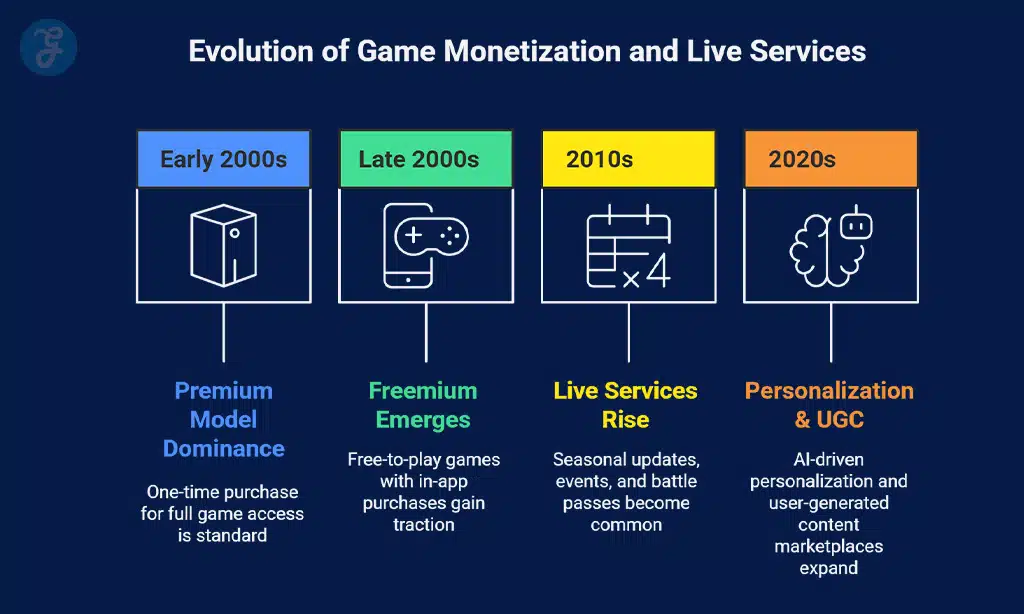
Finally, some of the most influential gaming trends revolve around how games are operated and monetized over time. Many of the biggest titles now follow a live-service model:
- Seasonal updates and events
- Evolving stories and modes
- Battle passes and cosmetic drops
- Regular balance patches and limited-time collaborations
Consulting and market analyses consistently point to live services, freemium models, and cross-platform delivery as central to sustaining growth. At the same time, AI and analytics are powering deep personalization:
- Adaptive difficulty that matches player skill.
- Recommended modes, events, or cosmetic bundles based on behavior.
Monetization Models in Modern Games
| Model | How It Works | Pros | Cons / Risks |
| Premium (one-time) | Pay once, full game access | Simple, transparent | Harder to sustain revenue over the years |
| Freemium / F2P | Free play, in-game purchases | Huge reach, flexible spending | Risk of pay-to-win or grindy design |
| Battle pass | Seasonal track with unlocks | Predictable revenue, fun progression | FOMO, pressure to “complete.” |
| Subscriptions | Monthly fee for library or perks | Stable recurring income, user retention | Sub fatigue, churn if value dips |
| UGC marketplace | Creator content sold or monetized in-game | More content with less internal dev workload | Quality control, economy balance, regulation |
The challenge for the future of the gaming industry is ethical design:
- Being transparent about odds, prices, and time investment.
- Avoiding predatory loops, especially for young players.
- Complying with regulations around loot boxes, gambling-like mechanics, and children’s privacy.
Studios that find a balance between sustainable business and player respect will build communities that last.
Bonus Shifts to Keep an Eye On
Beyond the seven main gaming trends above, a few additional shifts are worth watching:
- Esports & competitive ecosystems: Strong, well-supported competitive scenes can keep games alive for years, but require careful balance, anti-cheat, and spectator-friendly design.
- Indie & AA “middle tier” resurgence: Smaller teams can use AI tools, engines, and digital distribution to punch above their weight, offering creative risks that big AAA titles sometimes avoid.
- Sustainability & game preservation: As more games go digital, the industry faces questions about preserving online titles, energy-heavy infrastructure, and long-term access when servers shut down.
These areas may not dominate headlines every day, but they will shape how the industry matures.
How to Use These Gaming Trends (For Different Audiences)
Understanding gaming trends is valuable, but knowing how to apply them is what creates real impact. Whether you’re a gamer, a developer, or a business exploring opportunities in the gaming ecosystem, these trends offer actionable insights that can guide smart decisions.
If You’re a Gamer
- Try different platforms: Experiment with cloud gaming, cozy mobile titles, and VR if you can, to see which experiences you enjoy most.
- Be mindful of monetization: Know where your time and money are going; support games that respect your choices.
If You’re a Developer or Studio
- Prioritize cross-platform and cross-progression in your long-term roadmap.
- Test AI tools carefully: Use them to speed up workflows, but keep humans in the creative loop.
- Consider UGC tools: Give your community safe, fun ways to build inside your game.
- Design ethical monetization: Short-term revenue that harms trust is never worth it.
If You’re a Business, Brand, or Investor
- Look for ecosystems, not just one-off titles: live-service games, creator platforms, and cross-platform worlds.
- Pay attention to emerging markets, where mobile-first, cloud-assisted gaming and alternative payment methods are unlocking new audiences.
Frequently Asked Questions About the Emerging Gaming Trends
What are the biggest gaming trends shaping the future of the gaming industry?
Some of the biggest gaming trends shaping the industry include cloud gaming, generative AI, cross-platform play, user-generated content, AR/VR innovations, mobile gaming growth, and evolving live-service models. These trends influence how games are built, delivered, and played, creating more flexible, immersive, and personalized experiences for players worldwide.
How will cloud gaming change the way people play games in the coming years?
Cloud gaming removes the need for powerful hardware by letting players stream games directly to devices like TVs, laptops, and smartphones. As internet infrastructure improves globally, cloud gaming is expected to reduce the cost of entry, expand global access, and drive subscription-based gaming. This makes high-quality games more accessible, especially for players in emerging markets.
What role will AI play in the future of game development and gameplay?
AI is becoming central to modern game creation. It helps developers automate testing, generate art assets, build dynamic worlds, and create more realistic NPCs. For players, AI enables smarter enemy behavior, adaptive difficulty, and even personalized storylines or missions. As generative AI evolves, it will speed up production cycles while creating richer, more reactive game experiences.
Why is cross-platform gaming becoming so important?
Cross-platform gaming matters because it removes the traditional barriers between consoles, PCs, and mobile devices. Players can now play together regardless of hardware, making multiplayer communities larger and more active. Cross-progression allows players to carry their progress between devices, encouraging them to play more often and reducing the friction of switching platforms.
What types of games will grow the fastest in the near future?
Mobile games, cozy and wellness-focused titles, and live-service games are currently among the fastest-growing categories. Mobile continues to dominate global revenue, while cozy games appeal to players seeking low-stress entertainment. Live-service games grow through constant updates and evolving content. AR/VR titles may grow more slowly but will benefit from future hardware improvements.
Bottom Line: The Future of the Gaming Industry Is Connected, Intelligent & Player-Driven
Taken together, these gaming trends point to a clear direction:
- More access (cloud, mobile, cross-platform).
- More intelligence (AI-driven content and personalization).
- More creativity from players (UGC and creator economies).
- More ongoing evolution (live services, seasonal content).
The future of the gaming industry isn’t just about prettier graphics or bigger worlds. It’s about building flexible ecosystems where hardware, platforms, and even roles (player, creator, viewer) blur together.
If you align your strategy — as a gamer, developer, or business — with these trends, you’ll be better positioned to understand, enjoy, and shape what comes next in interactive entertainment.