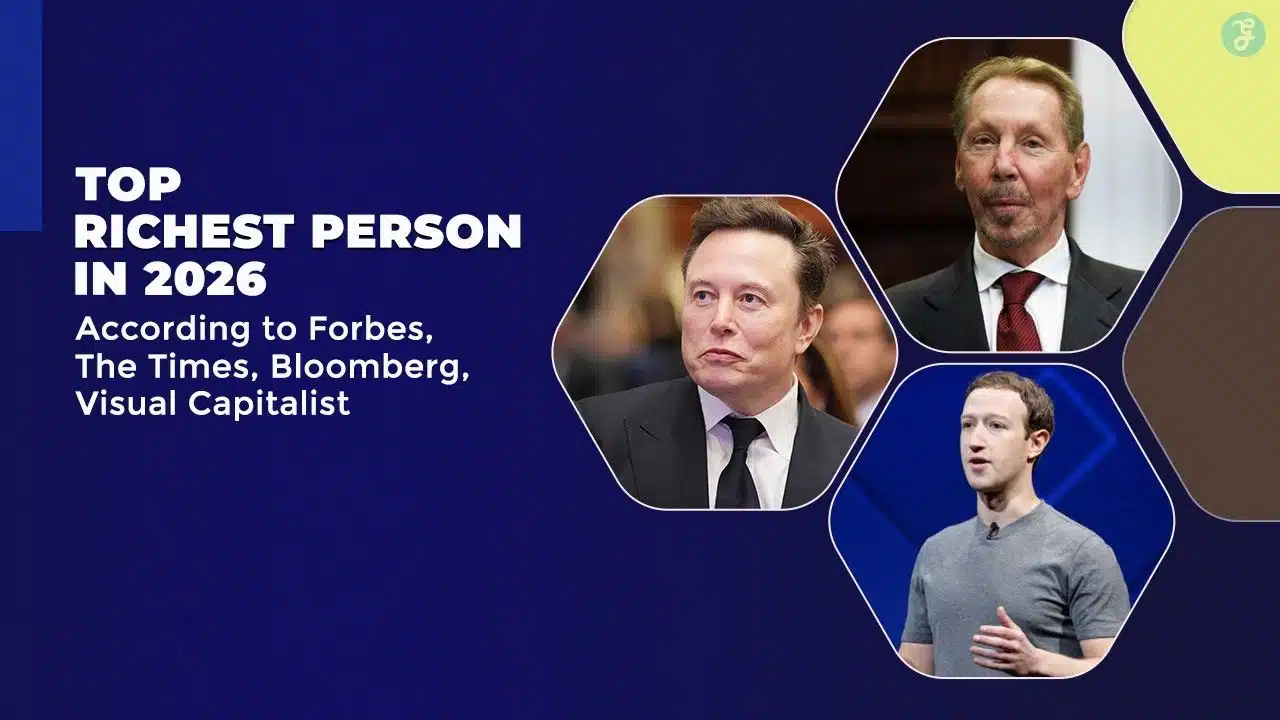
The top 20 richest person in 2026 sit at a strange intersection of money, power, and technological change. In a year when artificial intelligence, semiconductor demand, and luxury spending reshape markets almost overnight, the global billionaires list has become a real-time barometer of how the world economy works.
Forbes and Bloomberg now track these fortunes hour by hour. The Times’ rich lists and Visual Capitalist’s data-driven maps add local colour and long-term context to the same story. Together, they show a world where tech founders, luxury magnates, and a handful of industrial titans dominate the richest people in the world in 2026.
Against that backdrop, one question always returns: who is the world’s richest person in 2026, and who joins them in the top 20? The answer changes with each market swing, but the names at the top remain remarkably consistent.
This article looks at the top 20 richest person in 2026, based on a consolidation of Forbes billionaire rankings, Bloomberg’s Billionaires Index, coverage from The Times, and recent data-driven analyses from Visual Capitalist and other specialist outlets.
How Rankings for the Richest Person in 2026 Are Calculated
Forbes and the global billionaires list
Forbes started ranking billionaires long before wealth trackers went real-time. Its flagship list values stakes in public and private companies, property, art and other assets, then applies discounts where data is thin or ownership is opaque.
The real-time platform builds on that work. It updates fortunes as share prices move, as filings reveal new stakes or as private valuations change. When Tesla jumps or Nvidia slides, the top 20 richest person in 2026 can reshuffle in a single trading session.
This constant motion matters. It means any list is a snapshot, not a final verdict. Still, across weeks and months, the same names cluster at the top, which allows an editorial view of who truly dominates the richest people in the world 2026.
Bloomberg, The Times, and Visual Capitalist: different lenses
Bloomberg’s Billionaires Index comes from a different starting point. It leans heavily on market prices and securities filings, with detailed notes on how each fortune is constructed. The index updates daily and often moves slightly ahead of slower-refreshing lists.
The Times uses a narrower lens. Its rich list focuses on individuals and families with strong links to the UK, combining public disclosures with private briefings and transactional data. The Hinduja family, for example, sits at the top of the most recent edition, but the list also tracks fortunes built on British industry, real estate, and finance.
Visual Capitalist, meanwhile, turns these dense spreadsheets into maps and charts. It has shown, for instance, how a handful of American cities and a few Asian hubs now host the bulk of global ultra-wealth, and how technology and luxury have become the dominant sources of billionaire wealth.
Together, they give a three-dimensional picture of the richest people in the world 2026, not just a bare ranking.
Why estimates differ
Because each list uses its own models, estimates rarely match exactly.
Some of the reasons:
-
Tech holdings can move by tens of billions in a week.
-
Private valuations often lag reality.
-
Currency moves change the value of non-dollar assets overnight.
-
Some fortunes sit behind complex holding structures, which forces compilers to make assumptions.
That is why this ranking of the top 20 richest person in 2026 uses approximate net worth figures and focuses more on order and scale than on single-digit precision. The direction of travel matters more than the exact cent.
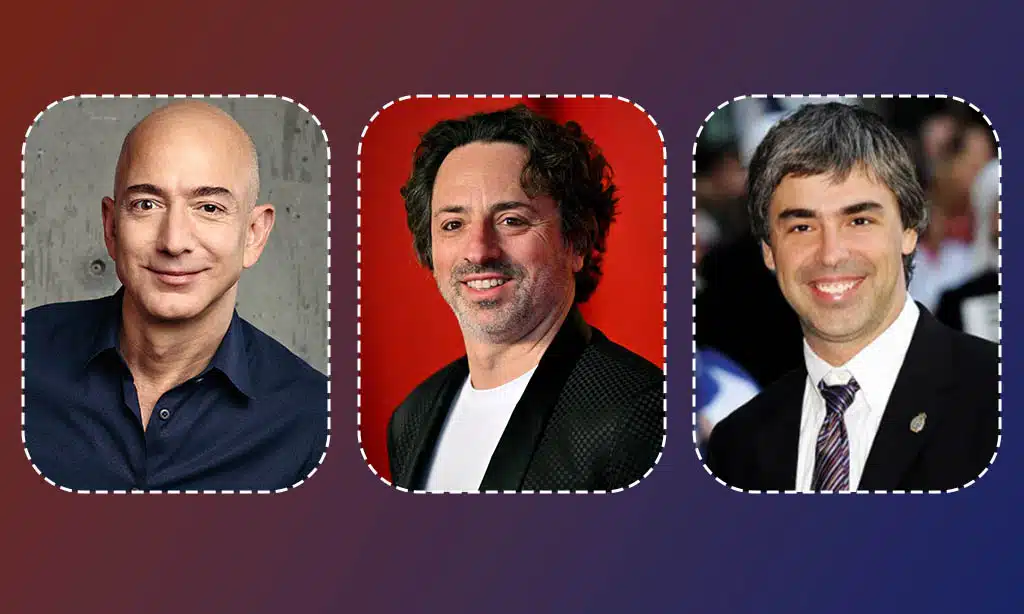
Top 20 Richest Person in 2026: Global Billionaires at a Glance
Drawing on the latest billionaire rankings, the top 20 richest person in 2026 look broadly as follows, with net worth rounded to the nearest billion dollars:
| Rank | Name | Approx. Net Worth (USD) | Main Source of Wealth | Primary Country |
|---|---|---|---|---|
| 1 | Elon Musk | ≈ $460+ billion | Tesla, SpaceX, other ventures | United States |
| 2 | Larry Ellison | ≈ $270 billion | Oracle, tech investments | United States |
| 3 | Jeff Bezos | ≈ $240 billion | Amazon, private investments | United States |
| 4 | Larry Page | ≈ $230 billion | Alphabet (Google) | United States |
| 5 | Sergey Brin | ≈ $215 billion | Alphabet (Google) | United States |
| 6 | Mark Zuckerberg | ≈ $200 billion | Meta Platforms | United States |
| 7 | Bernard Arnault & family | ≈ $180+ billion | LVMH luxury group | France |
| 8 | Jensen Huang | ≈ $155–160 billion | Nvidia (AI chips) | United States |
| 9 | Steve Ballmer | ≈ $150 billion | Microsoft stake | United States |
| 10 | Warren Buffett | ≈ $145–150 billion | Berkshire Hathaway | United States |
| 11 | Michael Dell | ≈ $130+ billion | Dell Technologies | United States |
| 12 | Amancio Ortega | ≈ $120+ billion | Zara / Inditex | Spain |
| 13 | Rob Walton | ≈ $120+ billion | Walmart stake | United States |
| 14 | Jim Walton | ≈ $120 billion | Walmart stake | United States |
| 15 | Alice Walton | ≈ $110+ billion | Walmart stake | United States |
| 16 | Mukesh Ambani | ≈ $110+ billion | Energy, telecoms, retail | India |
| 17 | Michael Bloomberg | ≈ $105–110 billion | Media and financial data | United States |
| 18 | Carlos Slim Helu | ≈ $105 billion | Telecoms, conglomerate | Mexico |
| 19 | Bill Gates | ≈ $100+ billion | Microsoft stake, investments | United States |
| 20 | Françoise Bettencourt Meyers | ≈ $85+ billion | L’Oréal stake | France |
These figures mirror the order consistently shown when cross-checking the Forbes billionaire rankings with Bloomberg’s own index and specialist summaries that aggregate both datasets.
Top Richest Person in 2026: Profiles of the Global Billionaires
1. Elon Musk – the world’s richest person in 2026
Elon Musk remains the world’s richest person in 2026, with a fortune that sits in the mid-hundreds of billions. His wealth is concentrated in Tesla and SpaceX shares, with additional stakes in ventures such as Neuralink and the Boring Company.
Musk’s ranking shows how aggressively markets now price long-term growth. Tesla’s valuation reflects not only car sales but also bets on autonomy and energy storage. SpaceX adds another layer of speculation around satellite networks and deep-space ambitions. The result: extreme volatility, but also a gap between Musk and the rest of the top 20 richest person in 2026.
2. Larry Ellison – cloud databases and compound returns
Oracle co-founder Larry Ellison sits in second place. His fortune comes mainly from a large stake in Oracle, complemented by holdings in Tesla and extensive real-estate investments.
Ellison benefited from the long transition from on-premise databases to cloud platforms. Oracle may not attract the same media attention as newer tech names, but its deep role in corporate infrastructure keeps its cash flows powerful. Ellison’s portfolio shows the force of patient compounding in enterprise software.
3. Jeff Bezos – e-commerce, cloud and space
Jeff Bezos built his wealth as the founder of Amazon. Even after stepping back from the CEO role, he retains a significant stake, which anchors his position near the top of the richest people in the world 2026.
Bezos also owns Blue Origin, the Washington Post and a series of venture investments. Together they turn his fortune into one of the most diversified in the top 20 richest person in 2026, spanning retail, cloud computing, media and space technology.
4. Larry Page – search, AI and quiet influence
Larry Page co-founded Google and helped shape the modern internet. His wealth stems mainly from shares in Alphabet, which continues to generate enormous free cash flow from search advertising, cloud services and AI-driven products.
Page keeps a lower public profile than some peers, yet his fortune tracks the same trends: the value of data, algorithms and scale. As generative AI and search evolve, his position in the richest people in the world 2026 reflects the enduring power of Alphabet’s core franchise.
5. Sergey Brin – the other half of the Google story
Sergey Brin shares the same origin story. He co-founded Google, helped design early search algorithms and later focused on the company’s more experimental projects. His net worth, like Page’s, rests largely on Alphabet shares and follows the same arc.
Together, Page and Brin show how one company can place two founders firmly inside the top 20 richest person in 2026 decades after its creation.
Meta Platforms, parent of Facebook, Instagram, and WhatsApp, still prints cash from targeted advertising. Mark Zuckerberg’s controlling stake leaves him with a personal fortune of around the low two hundred billion.
Meta’s share price swung sharply as investors questioned its metaverse bets, then recovered as the company refocused on AI-driven recommendation engines and cost control. That rebound explains Zuckerberg’s place among the richest people in the world in 2026.
7. Bernard Arnault & family – luxury in an age of volatility
Bernard Arnault’s LVMH group owns brands like Louis Vuitton, Dior, and Dom Pérignon. His fortune places him as the wealthiest European in the top 20 richest person in 2026 and the only non-tech billionaire at the very top.
LVMH’s strength rests on pricing power, scarcity, and global aspirational demand. Even when markets wobble, affluent consumers still buy handbags, jewellery, and champagne. That resilience has turned Arnault into the face of luxury capitalism.
8. Jensen Huang – AI chips and the hardware behind the boom
Nvidia’s rise from graphics specialist to AI infrastructure giant reshaped this ranking. Co-founder Jensen Huang now sits comfortably among the richest people in the world in 2026, with a fortune that has multiplied as demand for AI chips has exploded.
Nvidia’s processors power the data centres that run large language models and other advanced AI tools. As long as that demand holds, Huang’s position within the top 20 richest person in 2026 looks secure, though highly sensitive to any shift in expectations.
9. Steve Ballmer – old-school software, new-era valuation
Former Microsoft CEO Steve Ballmer owns a large personal stake in the company, which underpins his wealth. Microsoft’s strong position in cloud computing, productivity software and AI partnerships has pushed its valuation to record highs, lifting Ballmer into the upper tier of this list.
His ownership of the Los Angeles Clippers adds sporting visibility but represents a small slice of his overall fortune.
10. Warren Buffett – the investor who still outperforms
Warren Buffett stands out as the top 20 richest person in 2026. Unlike most names above him, he did not found a big tech company. Instead, he built Berkshire Hathaway into a conglomerate that owns insurers, railroads, utilities, and a large portfolio of public stocks.
Buffett’s presence here shows that patient, value-driven investing still works at scale, even in a market dominated by high-growth tech.
11. Michael Dell – from PCs to enterprise infrastructure
Michael Dell transformed a direct-to-consumer PC brand into a full-scale infrastructure and services business. Leveraged buyouts, complex deal-making, and a later return to public markets helped expand his fortune into the low-hundreds of billions.
His position in the top 20 richest person in 2026 reflects the quiet profitability of enterprise hardware and services that sit behind the cloud boom.
12. Amancio Ortega – fast fashion’s low-key billionaire
Amancio Ortega, founder of Inditex and its flagship brand Zara, remains one of Europe’s richest individuals. His fortune comes from fast fashion, efficient supply chains, and an enormous global store and property portfolio.
Ortega keeps a low media profile, yet his ranking underlines how retail empires can still compete with software in wealth creation.
13. Rob Walton – Walmart heir in the global elite
Rob Walton, eldest son of Walmart founder Sam Walton, holds a large share of the world’s biggest retailer. Dividends and decades of capital appreciation mean his wealth sits firmly inside the top 20 richest person in 2026.
Walmart’s resilience in essentials and groceries anchors the Walton family’s fortunes even as online competitors grow.
14. Jim Walton – another slice of the same empire
Jim Walton, another Walmart heir, owns a similar stake and therefore appears close to his brother in every major rich list. His presence reinforces how inheritance and family shareholding structures shape the richest people in the world in 2026.
15. Alice Walton – art patron and retail heiress
Alice Walton rounds out the trio. She combines her Walmart inheritance with an influential role in the arts, through museums and philanthropy. She remains one of the wealthiest women on the planet and a constant name inside the top 20 richest person in 2026.
16. Mukesh Ambani – India’s tech-enabled conglomerate
Mukesh Ambani leads Reliance Industries, which spans energy, petrochemicals, retail, and digital services. He is the richest person in India and the only South Asian billionaire in the global top 20.
Reliance’s Jio platform turned mobile data into a mass-market utility, while its retail arm pushes into everything from fashion to grocery. Ambani’s place among the richest people in the world in 2026 signals the growing weight of emerging markets in global wealth.
17. Michael Bloomberg – terminals, data, and influence
Michael Bloomberg built a data and news empire around the Bloomberg terminal, which remains embedded in global finance. His personal stake in the company, together with extensive investments, places him comfortably in the top 20 richest person in 2026.
Bloomberg also uses his wealth for philanthropy and political engagement, which keeps his profile higher than many peers with similar fortunes.
18. Carlos Slim Helu – telecom titan of the Americas
Carlos Slim Helu’s wealth comes mainly from telecoms in Mexico and across Latin America. Through América Móvil and related holdings, he built a position that once made him the richest person in the world and still keeps him among the richest people in the world in 2026.
His story highlights how infrastructure monopolies and near-monopolies can generate vast, persistent cash flows.
19. Bill Gates – software, vaccines, and global philanthropy
Bill Gates co-founded Microsoft and retains a sizeable stake, but much of his wealth now sits in a diversified investment portfolio overseen by Cascade Investment. He also commits large sums to global health, education and climate initiatives through the Gates Foundation.
Even after decades of giving, Gates remains in the top 20 richest person in 2026, which underlines how large the original Microsoft windfall was.
20. Françoise Bettencourt Meyers – the beauty of compounding
Françoise Bettencourt Meyers is the largest shareholder in L’Oréal and the richest woman in the top 20 richest person in 2026. Her wealth is tied to the long-term global expansion of beauty and skincare, sectors that have grown steadily across markets and income groups.
Her position mirrors Arnault’s in luxury: global consumer aspiration can be as powerful as cloud computing when it comes to compounding returns.
Trends Behind the Top 20 Richest Person in 2026
Tech dominance: AI, chips, and cloud
Look down this list and one pattern jumps out. Most members built their fortunes in technology or now rely on tech valuations. Musk, Ellison, Bezos, Page, Brin, Zuckerberg, Huang, Ballmer and Dell all sit on companies that power the digital economy or its AI-heavy next phase.
The top 20 richest person in 2026, therefore, doubles as a map of where investors expect future profits: in AI chips, cloud infrastructure, data platforms, and the software that orchestrates them.
Luxury, retail and resilient brands
Luxury and retail still matter. Arnault, Ortega and the Walton family prove that powerful brands, efficient logistics and real estate can compete with code. Their businesses thrive on scale, sourcing and intimate knowledge of consumer behaviour.
In downturns, these groups often hold up better than cyclical tech names, which helps smooth their long-term presence among the richest people in the world 2026.
Energy, telecoms, and emerging markets
Ambani and Slim represent another axis: emerging markets where energy, telecoms, and infrastructure have delivered outsized returns. Their fortunes grew as millions of new users came online and as domestic demand expanded.
Visual Capitalist’s geographic data shows the same pattern at the country level: the United States still dominates ultra-wealth, but Asia and parts of Latin America now host a growing share of billionaires and centi-millionaires.
Why Billionaire Lists Don’t Always Agree
The top 20 richest person in 2026 might look different depending on which list you open on a given day.
Forbes and Bloomberg use different assumptions about private valuations, debt and control premiums. A fast-moving stock or a new funding round can shift one fortune up or down by tens of billions. Compilers also apply different discounts when documentation is thin or when assets sit in complex holding structures.
The Times brings another variation by focusing on UK-linked fortunes, which means some global billionaires appear lower or not at all, while figures such as the Hinduja family feature prominently.
Visual Capitalist and similar outlets don’t try to create a definitive league table. Instead, they turn existing tables into maps and charts that show where wealth clusters and which sectors drive it.
Yet, despite these differences, the core membership of the richest people in the world 2026 remains stable. The same tech founders, luxury magnates and industrial titans appear again and again, even if their exact order shifts.
What the Top 20 Richest Person in 2026 Tell Us About the Global Economy
The top 20 richest person in 2026 is more than a list of names. It is a snapshot of how value is created and captured today.
Tech fortunes reflect the importance of data, networks, and software in every industry. Luxury and beauty fortunes show that status, identity, and brand still command a premium even in a digital world. Energy, telecoms, and infrastructure fortunes highlight the continuing need for physical assets that keep economies running.
At the same time, the concentration of wealth raises familiar questions. Policymakers debate how to tax unrealised gains, whether to rein in market dominance, and how to balance innovation with fairness. Campaigners point to the gap between billionaire wealth and median incomes. Philanthropy, however generous, cannot fully resolve that tension.
What seems clear is that the top 20 richest person in 2026 will not be the last word. AI may mint new fortunes in areas like robotics, biotech, and climate technology. Regulation may compress some existing valuations. New regions may produce more of the richest people in the world 2026 and beyond.
For now, though, this ranking captures the current billionaire order: a small group of individuals whose decisions, and whose companies, shape everything from the digital tools we use to the products on our shelves and the infrastructure under our feet.
Final Words
The top 20 richest person in 2026 reflect more than individual success stories. It captures the momentum of entire industries—from AI and cloud computing to luxury goods, telecom networks, and global retail. These fortunes rise and fall with market sentiment, yet the long-term trends behind them remain unmistakable. Technology continues to dominate, consumer demand for premium brands stays strong, and emerging markets contribute more influence each year.
While rankings will continue to shift as valuations move, the individuals in this year’s list offer a clear picture of where the world is heading. Their companies shape how people work, communicate, shop, and invest. As innovation accelerates, new wealth may emerge from unexpected sectors, but for now, the richest people in the world 2026 reveal the economic forces defining this moment—ambition, scale, risk-taking, and the global appetite for transformation.