TikTok has announced the partial restoration of its services in the United States after a nationwide ban briefly took effect on Saturday evening. The ban, which stemmed from national security concerns, marked a significant turning point in the ongoing scrutiny of the app’s Chinese parent company, ByteDance. However, intervention by President-elect Donald Trump played a crucial role in halting the app’s indefinite shutdown, at least temporarily. Here’s a detailed breakdown of the situation and its broader implications.
What Led to the Ban?
In 2024, Congress passed the Protecting Americans from Foreign Adversary Controlled Applications Act (PAFACA) with overwhelming bipartisan support. The legislation targeted apps with foreign ties that posed potential threats to national security, with TikTok being the primary focus due to concerns over data collection and the potential influence of the Chinese government.
The law required ByteDance to divest its U.S. operations within 270 days, a deadline that expired on January 19, 2025. ByteDance, instead of selling its U.S. operations, pursued a legal challenge, arguing that banning TikTok infringed on First Amendment rights. However, the Supreme Court unanimously upheld the law, citing credible risks of user data manipulation and misuse by foreign entities.
This decision set the stage for TikTok’s removal from U.S. app stores and a brief shutdown of its services late Saturday night. For many users, the app displayed a pop-up message that read:
“Sorry, TikTok isn’t available right now. A law banning TikTok has been enacted in the U.S. Unfortunately, this means you can’t use TikTok for now.”
The sudden disappearance of the app caused widespread panic among its 170 million American users, including businesses, content creators, and everyday users who rely on the platform for entertainment and engagement.
President-elect Trump Steps In
President-elect Donald Trump, set to take office on January 20, 2025, quickly moved to address the situation. Trump publicly criticized the immediate implementation of the ban, calling it unnecessarily disruptive. Early Sunday morning, he released a statement on his social media platform, Truth Social:
“I’m asking companies not to let TikTok stay dark! I will issue an executive order on my first day in office to extend the period of time before the law’s prohibitions take effect, so we can make a deal to protect our national security.”
The incoming president also assured U.S. service providers and app stores that they would not face legal repercussions for maintaining access to TikTok during this interim period. This reassurance paved the way for TikTok to resume operations, even as legal and political uncertainties loom.
TikTok’s Response and Restoration of Service
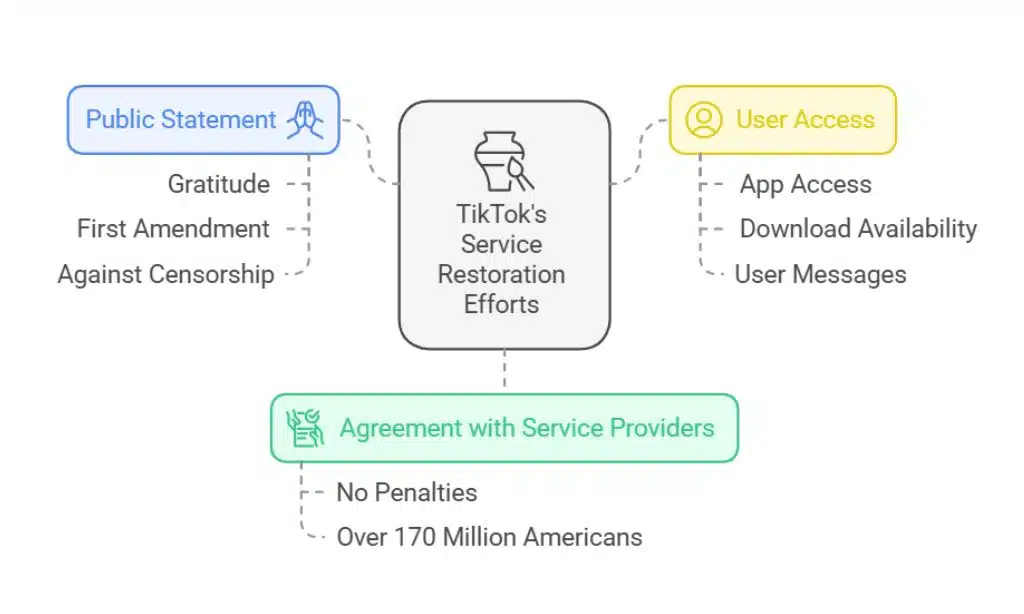
Following Trump’s announcement, TikTok confirmed it had begun restoring service in the U.S., citing an agreement with service providers. In a public statement, the company expressed gratitude for Trump’s efforts:
“In agreement with our service providers, TikTok is in the process of restoring service. We thank President Trump for providing the necessary clarity and assurance to our service providers that they will face no penalties providing TikTok to over 170 million Americans and allowing over 7 million small businesses to thrive. It’s a strong stand for the First Amendment and against arbitrary censorship.”
By Sunday morning, many users reported regaining access to the app, though it remained unavailable for download in major app stores operated by Apple, Google, and Samsung.
In a pop-up message displayed upon reopening the app, TikTok addressed users directly:
“Welcome back! Thanks for your patience and support. As a result of President Trump’s efforts, TikTok is back in the U.S.!”
Impact on Users and Businesses
The temporary shutdown of TikTok highlighted its profound impact on American culture and commerce. With over 170 million active users in the U.S., TikTok has become a key platform for personal expression, entertainment, and business growth.
Small businesses, in particular, have increasingly relied on TikTok as a cost-effective marketing tool. The platform’s ability to create viral trends and drive consumer engagement has made it a vital part of many companies’ advertising strategies. For these businesses, even a short disruption in TikTok’s availability can lead to significant financial losses.
Content creators also bore the brunt of the shutdown. Influencers like Charli D’Amelio and Bella Poarch, who have built massive followings and lucrative brand partnerships on the platform, faced potential income losses. Many creators took to other social media platforms to voice their frustration and seek alternative ways to connect with their audiences.
National Security Concerns Remain
Despite TikTok’s restoration, questions about its long-term future in the U.S. remain unresolved. The Supreme Court’s ruling highlighted serious concerns about ByteDance’s potential obligation to share user data with the Chinese government under national security laws. While TikTok has repeatedly denied these allegations, citing the use of U.S.-based servers and other security measures, critics remain skeptical.
The Biden administration initially refrained from enforcing the ban, leaving its implementation to the incoming Trump administration. While Trump’s intervention has provided a temporary reprieve, his executive order is expected to include strict conditions aimed at ensuring the app’s compliance with U.S. national security standards.
What’s Next for TikTok?
As TikTok resumes operations, the focus now shifts to potential long-term solutions. Experts suggest several possibilities, including:
- A U.S.-Based Ownership Model: ByteDance could pursue a partnership or sale involving American companies, ensuring greater transparency and local control over user data.
- Enhanced Data Protections: TikTok may need to implement more stringent measures to address concerns about data privacy and security.
- Ongoing Legal Battles: ByteDance is likely to continue exploring legal avenues to challenge the enforcement of PAFACA, though such efforts face significant challenges.
For now, TikTok users in the U.S. can breathe a sigh of relief, but the platform’s fate remains uncertain. President-elect Trump’s planned executive order may buy time for negotiations, but it will also set the stage for contentious debates over national security, free speech, and the future of digital platforms in an increasingly interconnected world.