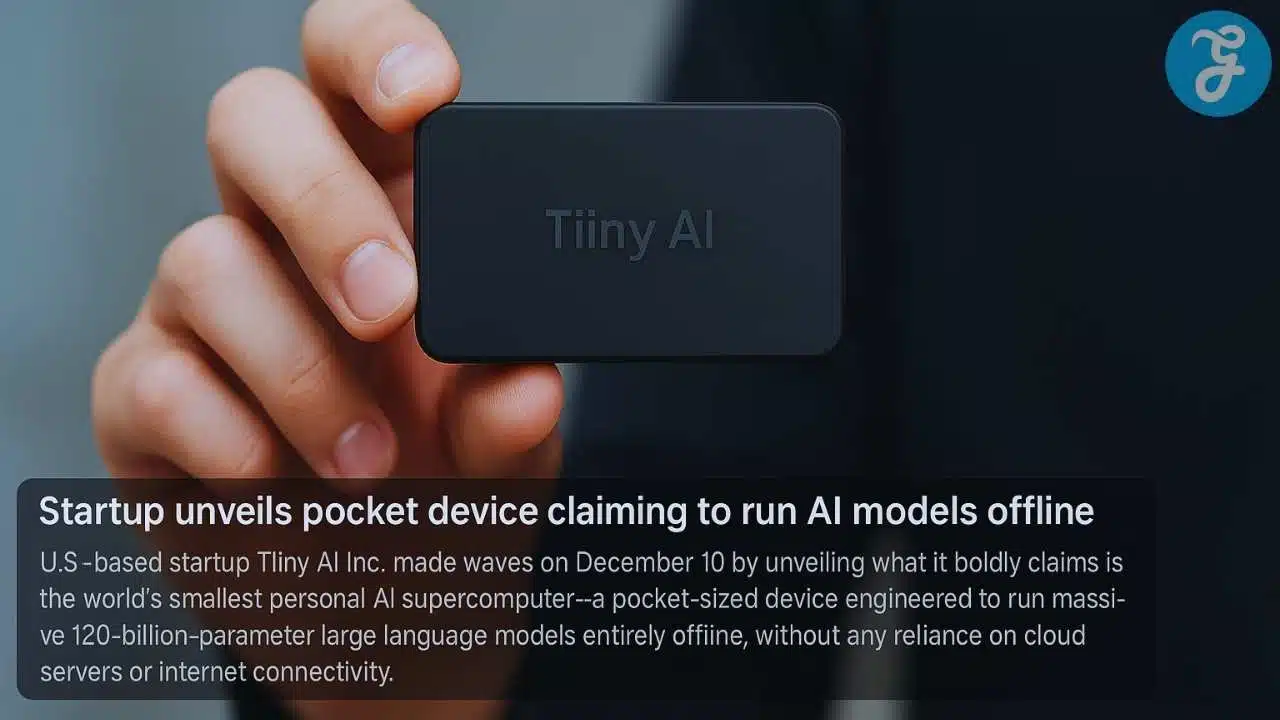
U.S. Based startup Tiiny AI Inc. made waves on December 10 by unveiling what it boldly claims is the world’s smallest personal AI supercomputer—a pocket-sized device engineered to run massive 120-billion-parameter large language models entirely offline, without any reliance on cloud servers or internet connectivity. Dubbed the Tiiny AI Pocket Lab, this Arm-based mini PC has already earned official verification from Guinness World Records in the category “The Smallest MiniPC (100B LLM Locally)”, cementing its place as a groundbreaking entry in the exploding on-device AI market.
At first glance, the Pocket Lab looks more like a sleek gadget from a sci-fi movie than a powerhouse computer. Measuring just 14.2 × 8 × 2.53 centimeters and weighing approximately 300 grams, it’s about the size of a thick smartphone or a small power bank, making it incredibly portable for developers, researchers, business travelers, or anyone who wants high-powered AI on the go. Despite its tiny footprint, the device packs serious hardware punch: a 12-core ARMv9.2 CPU paired with a custom neural processing unit (NPU) that together deliver around 190 TOPS (trillions of operations per second) of AI compute performance—all while sipping power at a modest 65-watt envelope. This efficiency is crucial for a device you could slip into your pocket or backpack without needing a bulky cooling system or constant wall outlet.
Memory and storage further set it apart from typical mini PCs. With 80 GB of high-speed LPDDR5X RAM and a 1 TB SSD, the Pocket Lab has the headroom to load and run enormous AI models that would overwhelm most laptops or smartphones. Tiiny AI asserts this setup enables seamless support for models up to 120 billion parameters, delivering inference speeds and quality they describe as comparable to GPT-4o, OpenAI’s cutting-edge multimodal powerhouse. Everything happens locally: your prompts, documents, images, or code stay on the device, processed with what the company calls bank-level encryption to safeguard sensitive information from prying eyes. No data leaves your hands, which is a game-changer in an era where cloud leaks and surveillance are constant headlines.
This isn’t just hype—it’s a direct response to the frustrations of cloud-dependent AI. As Samar Bhoj, Tiiny AI’s GTM Director, explained, “Cloud AI has brought remarkable progress, but it also created dependency, vulnerability, and sustainability challenges. We believe intelligence shouldn’t belong to data centers, but to people.” For professionals handling confidential data—like lawyers reviewing contracts, doctors analyzing patient notes, or executives running financial forecasts—the ability to query a 120B model without risking a breach is revolutionary. Imagine generating reports, debugging code, or even creating art during a flight with no Wi-Fi, all powered by hardware you own outright.
The Cutting-Edge Tech Powering Offline AI and Why It Works
What makes the Tiiny AI Pocket Lab feasible isn’t brute force hardware alone—it’s two innovative technologies that squeeze massive performance from constrained resources. At the heart is TurboSparse, a neuron-level sparse activation technique that dramatically boosts inference efficiency. Traditional AI models activate every neuron in their network for every input, wasting compute on irrelevant pathways. TurboSparse intelligently identifies and activates only the most pertinent neurons, slashing memory usage and computation by orders of magnitude. This is especially vital for large language models (LLMs), where billions of parameters mean gigabytes of data must shuffle through memory constantly. By focusing compute where it matters, TurboSparse lets a pocket device handle workloads that typically demand server farms.
Complementing this is PowerInfer, an open-source heterogeneous inference engine that’s exploded in popularity with over 8,000 GitHub stars. PowerInfer doesn’t treat all hardware equally—it dynamically routes computations to the best-suited component. Simple matrix multiplications might go to the CPU’s vector units, while complex neural network layers leverage the custom NPU’s specialized accelerators. This adaptive load-balancing mimics how modern supercomputers orchestrate thousands of chips, but scaled down to fit in your hand. The result? Fluid, responsive AI generation without the lag spikes or crashes common in underpowered local setups.
Together, these tools enable the Pocket Lab to support a wide ecosystem of open-source models with one-click installation. Users can drop in heavyweights like Llama (Meta’s versatile family for chat, coding, and reasoning), Qwen (Alibaba’s multilingual powerhouse optimized for non-English tasks), DeepSeek (excelling in math and logic), Mistral (efficient French-origin models blending speed and smarts), and Phi (Microsoft’s compact yet capable series for edge deployment). Beyond raw chatbots, it embraces AI agents via frameworks like OpenManus for autonomous task orchestration, ComfyUI for visual pipelines like image-to-video generation, and Flowise for no-code app building. Developers can chain models—say, using Llama for text analysis followed by a vision model in ComfyUI—all offline, creating custom workflows for everything from market research to creative prototyping.
Practical performance hinges on real-world factors like model quantization (compressing weights from 16-bit to 4-bit precision without huge quality loss) and context management (handling long conversations without forgetting prior details). Tiiny AI optimizes for these, promising sustained operation even under heavy loads. Thermal design is another unsung hero: in such a compact chassis, efficient heat dissipation prevents throttling, ensuring the NPU and CPU maintain peak TOPS over hours of use. Power-wise, the 65W draw means it needs a USB-C charger for prolonged sessions, but battery-powered operation is viable for lighter tasks, positioning it as a true mobile workstation.
Company Roots, Market Boom, and What’s Next for On-Device AI
Tiiny AI isn’t a fly-by-night outfit—formed in 2024, it unites elite talent from MIT, Stanford, HKUST, SJTU, Intel, and Meta, with research papers in top-tier venues like SOSP, OSDI, ASPLOS, and EuroSys. These aren’t marketing bullet points; they’re proof of deep expertise in systems optimization, the very foundation of squeezing 120B models into 300 grams. A multi-million-dollar seed round in 2025 from top global investors underscores market confidence, fueling rapid development amid fierce competition.
Timing couldn’t be better. The global AI edge computing market is on fire, projected to surge at a 22.50% CAGR through 2032, fueled by demands for real-time processing in autonomous vehicles, smart factories, healthcare wearables, and retail analytics. Latency plummets when AI runs locally—no round-trip to distant servers. Privacy soars, too: McKinsey data reveals 71% of consumers would ditch a brand over unauthorized data sharing, while enterprises grapple with compliance in GDPR, CCPA, and emerging AI regs. Sustainability plays in, as data centers guzzle energy equivalent to small countries; edge devices cut transmission overhead and centralize less power-hungry compute.
Pocket Lab slots into a vibrant landscape alongside smartphone NPUs (Apple’s Neural Engine, Qualcomm’s Hexagon), AI laptops (Intel Lunar Lake, AMD Strix Halo), and dev kits (NVIDIA Jetson, Raspberry Pi AI bundles). But its niche—massive LLMs in a Guinness-verified tiny form—targets power users underserved by phones (too weak for 120B models) and desktops (too bulky). Use cases abound: journalists fact-checking offline, traders simulating markets privately, educators running personalized tutors in remote areas, creators generating assets without subscriptions, or security teams analyzing threats air-gapped from networks.
Looking ahead, Tiiny AI teases full features and over-the-air upgrades at CES 2026 in January, likely including firmware tweaks, driver optimizations, and expanded model support to match AI’s blistering pace. Pricing remains under wraps, but expect a premium tag reflecting the specs—think high-end laptop territory, justified for pros who value autonomy over cloud convenience. Challenges loom: independent benchmarks will test GPT-4o parity claims, long-term reliability under heat/stress needs proving, and software ecosystem growth must rival bigger players. If it delivers, Pocket Lab could democratize elite AI, shifting power from Big Tech silos to personal hardware and sparking a new wave of privacy-first innovation.