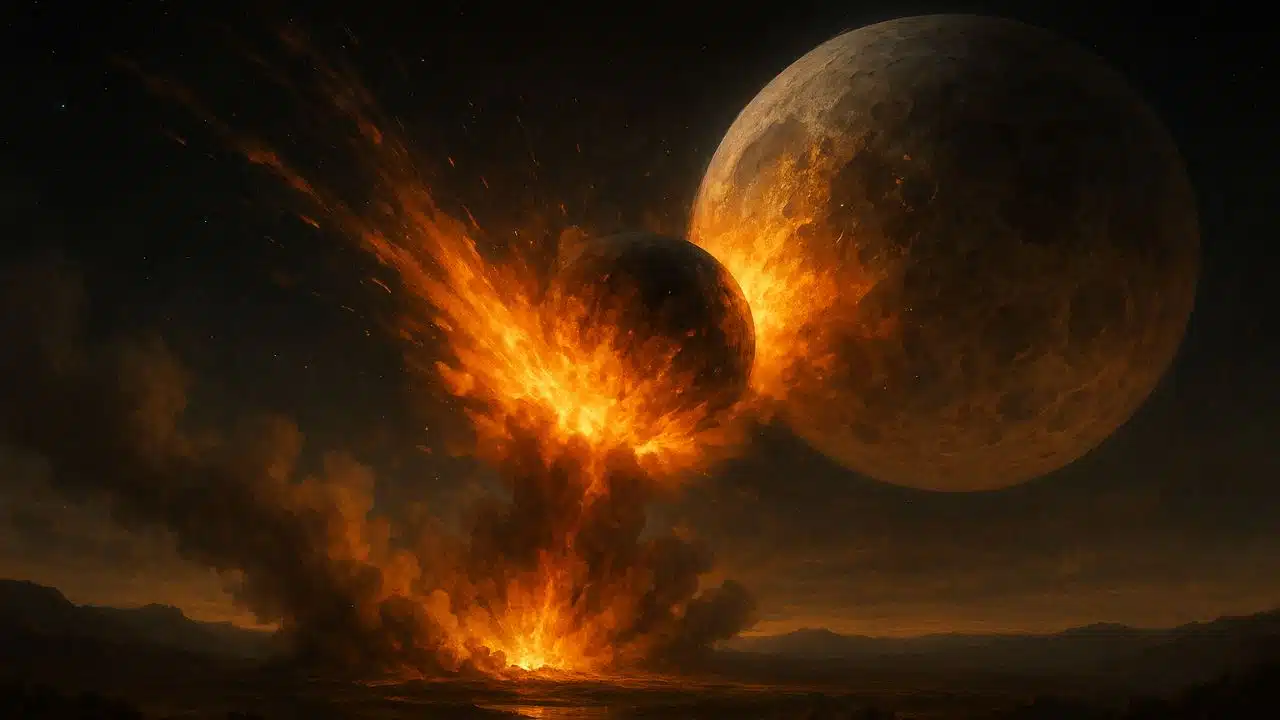
A groundbreaking new study has reshaped scientific understanding of how the Moon formed and where its mysterious parent body, Theia, originated. According to research published in Science on November 20, 2025, Theia — the Mars-sized planetary embryo that collided with the early Earth roughly 4.5 billion years ago — was not an outsider from the distant edges of the solar system, as some earlier theories suggested. Instead, Theia appears to have formed in the inner solar system, near both the infant Earth and the Sun.
This conclusion challenges decades of debate surrounding the Moon’s origins and adds an important new layer to the giant impact hypothesis, the leading scientific explanation for the Moon’s formation. The study was led by Dr. Timo Hopp of the Max Planck Institute for Solar System Research and Professor Nicolas Dauphas of the University of Hong Kong, who spearheaded a highly detailed isotopic analysis of both terrestrial and lunar materials.
Their work suggests a much more local and orderly early solar system — one in which neighboring planetary bodies formed from similar building blocks before catastrophic collisions shaped the worlds we know today.
Isotopic Fingerprints Reveal Theia’s True Origins
To determine the birthplace of Theia, the research team conducted one of the most precise measurements ever performed on iron isotopes. They analyzed 15 terrestrial rocks from different geological environments and six lunar samples that were brought to Earth during NASA’s Apollo missions.
Isotopes — variants of elements with different numbers of neutrons — act like cosmic fingerprints, preserving chemical clues about where celestial objects formed within the early solar system. Each region of the protoplanetary disk had its own distinct isotopic “signature,” shaped by temperature, solar radiation, and the distribution of dust and gas.
By comparing these isotopic fingerprints, the researchers discovered a striking pattern:
The Earth and Moon share nearly identical iron isotopic compositions, matching those typically found in non-carbonaceous meteorites that originated in the inner solar system.
These results imply that Theia was also born in this region, close to the early Earth.
Dr. Hopp emphasized the unprecedented scientific value of lunar materials, saying that “the samples returned from the Moon by space missions such as Apollo, Luna, and Chang’e are invaluable for understanding where we come from.” The lunar samples allowed scientists to peer deep into the past, revealing chemical markers that remained unchanged for billions of years.
The team extended their analysis beyond iron, studying the isotopes of chromium, molybdenum, and zirconium, each providing access to different layers of planetary formation and differentiation. By modeling how much of each element Theia contributed to both Earth and the Moon, they concluded that Theia may have formed even closer to the Sun than proto-Earth, placing it firmly in the inner region of the solar system.
This contradicts earlier theories that Theia might have come from the colder, more volatile-rich outer solar system, where carbonaceous chondrites originate. Instead of being a wandering foreign object, Theia was likely Earth’s cosmic neighbor.
Implications for Solar System Formation
The findings from this study significantly reshape our understanding of how the early solar system operated. Instead of a chaotic environment where planets captured material from both near and far, the evidence now points to a more organized and structured process.
If Earth and Theia formed from the same local reservoir of material near the Sun, this supports the idea that terrestrial planets — Mercury, Venus, Earth, and Mars — all grew from similar inner-solar-system building blocks. This insight strengthens existing models suggesting that rocky planets emerged gradually and locally as dust and stone clumped together under gravity and then collided repeatedly.
According to Professor Dauphas, “our results show that the Moon-forming impactor came from nearby. While theory allows for it to have come from afar, the measurements tell a different story. The ingredients that built our planet — and made it habitable — came from our neighbourhood.”
This conclusion also suggests that the conditions that led to Earth’s habitability may not be as rare or unpredictable as once thought. If Earth and Theia shared similar compositions and formed in close proximity, this opens new research avenues into how common Earth-like planets may be elsewhere in the universe.
Furthermore, the study strengthens the giant impact hypothesis, confirming that Earth and Theia were compositionally similar — either because they formed next to one another or because the cataclysmic collision mixed their materials so thoroughly that their isotopic fingerprints became indistinguishable.
What the Findings Mean for the Giant Impact Hypothesis
The giant impact hypothesis has dominated scientific thinking since the 1980s, proposing that a massive collision between Earth and Theia blasted material into orbit, which eventually coalesced into the Moon. However, one of the hypothesis’s biggest challenges has been explaining why the Earth and Moon have almost identical isotopic signatures, despite the assumption that they originated from two different worlds.
If Theia had formed far from Earth — for example, beyond Jupiter or near the outer solar system — its isotopic composition would differ substantially. Yet the measurements repeatedly show that the Moon and Earth are isotopically twins.
The new research neatly resolves this puzzle:
Theia and Earth were made of the same local material because they formed in the same region.
This not only supports the giant impact hypothesis but strengthens it, providing a clear chemical link between Earth’s earliest building blocks and the Moon’s formation. It suggests that Theia was not an exotic or chemically unique interloper but rather a familiar, nearby planetary embryo shaped by the same inner-solar-system environment as the young Earth.
The impact itself may have been violent enough to homogenize their materials completely. This would explain why the Moon’s composition aligns so closely with Earth’s mantle, while still preserving subtle differences that hint at its dramatic birth.
A Clearer Picture of the Solar System’s Violent Past
Taken together, this research builds a more complete and nuanced picture of how our solar system evolved during its chaotic youth. Instead of imagining Theia as a distant traveler or a rare visitor, scientists can now see it as part of Earth’s own local neighborhood — one of many planetary embryos competing, colliding, and merging to form the modern planets.
The nearly identical isotopic match between Earth and the Moon suggests a shared history, one shaped by local materials and dramatic celestial events. The study opens new doors for exploring how Earth acquired its unique chemistry, how rocky planets evolved close to the Sun, and how catastrophic impacts may have laid the groundwork for life as we know it.
By uncovering Theia’s origins, researchers have brought us a step closer to understanding not only how the Moon formed, but also how Earth itself came into being — and how the violent, dynamic processes of the early solar system shaped the world that billions of years later would become home to life.