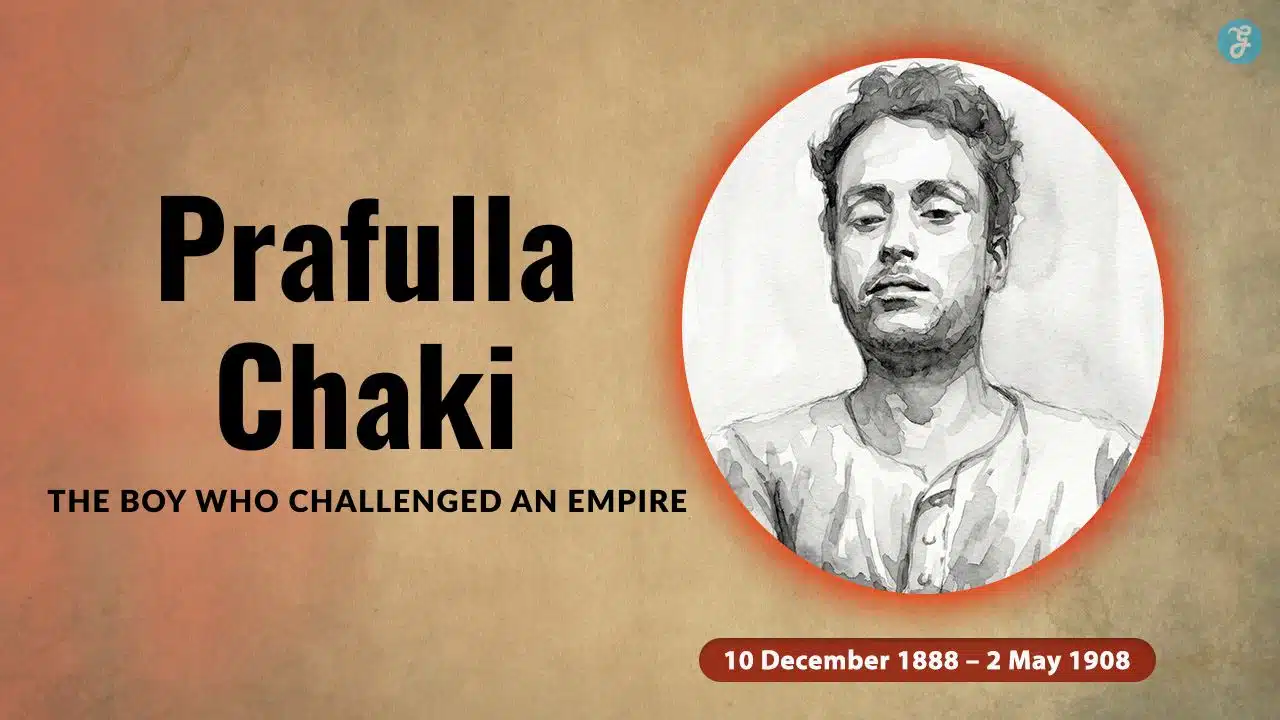
Today, as India marks the 137th birth anniversary of Prafulla Chaki, it becomes essential to revisit the extraordinary life of a young revolutionary whose courage continues to echo across generations. In an era when India was shackled under British imperial rule, Chaki—barely nineteen years old—stood up with fearless conviction and a burning desire to free his motherland. His story, though overshadowed by more commonly celebrated revolutionaries, remains one of the most electrifying chapters in India’s struggle for independence.
Prafulla Chaki was not just another figure in the long list of freedom fighters. He symbolized an age when young revolutionaries dared to challenge the might of the British Empire with nothing but raw determination, ideological clarity, and an unshakeable commitment to justice. He belonged to a revolutionary generation forged in the fires of Bengal’s political turmoil, a generation that believed in action over rhetoric and sacrifice over silence.
This article uncovers the untold story of Prafulla Chaki—the boy who defied colonial power, embraced danger without hesitation, and etched his name into the pages of India’s revolutionary history. His life is a testament to how youthful idealism, when guided by purpose, can script stories powerful enough to inspire an entire nation.
Bengal in Turmoil: The World Prafulla Chaki Was Born Into
To understand The Untold Story of Prafulla Chaki, we must first step into the Bengal of the late 19th and early 20th centuries—an era marked by deep political unrest, cultural awakening, and the shocking brutality of British rule. This period witnessed one of the most intense waves of nationalism India had ever seen.
The Partition of Bengal in 1905 by Lord Curzon was a deliberate attempt to divide and weaken nationalist sentiment. Instead, it ignited a fierce surge of patriotic fervor. Boycotts of British goods, swadeshi movements, and protest marches filled the streets. But beneath this public expression of dissent, a more radical, underground movement was quietly taking shape.
Secret revolutionary groups such as Anushilan Samiti and later Jugantar emerged as centers of training and ideological development. These groups believed the British could not be removed through petitions or pleas but only through direct action—even if that action demanded extraordinary sacrifice.
The British administration, alarmed by the growing defiance, responded with oppressive laws, police brutality, and unjust punishments. The environment became a tinderbox of anger and resistance. In such a powerful atmosphere of cultural nationalism and revolutionary zeal, young minds like Prafulla Chaki found their calling.
Early Life and Influences
Born on December 10, 1888, in the small town of Bogra (in present-day Bangladesh), Prafulla Chandra Chaki grew up in a middle-class Bengali family rooted in traditional values and a deep sense of culture. His childhood was unremarkable on the surface, but those who knew him described him as a boy of immense willpower, sensitivity, and quiet intensity.
From a young age, Chaki was drawn to stories of courage and patriotism. He read widely—Bengali literature, Vedic texts, and nationalist writings that shaped his worldview. Around this time, Bengal was experiencing a cultural renaissance led by intellectuals, poets, and philosophers who infused political consciousness into society. Chaki absorbed these ideas with enthusiasm.
It was in school that he first encountered revolutionary thought more directly. Influenced by senior students and local activists sympathetic to the freedom movement, Chaki began questioning British authority. His belief in armed resistance began to form early, particularly as he witnessed the mistreatment of Indians by colonial officials.
As Chaki matured, his hunger for action grew. He soon left behind the life of an ordinary student and moved toward a path that would define his destiny.
Journey to Radicalization: The Making of a Revolutionary
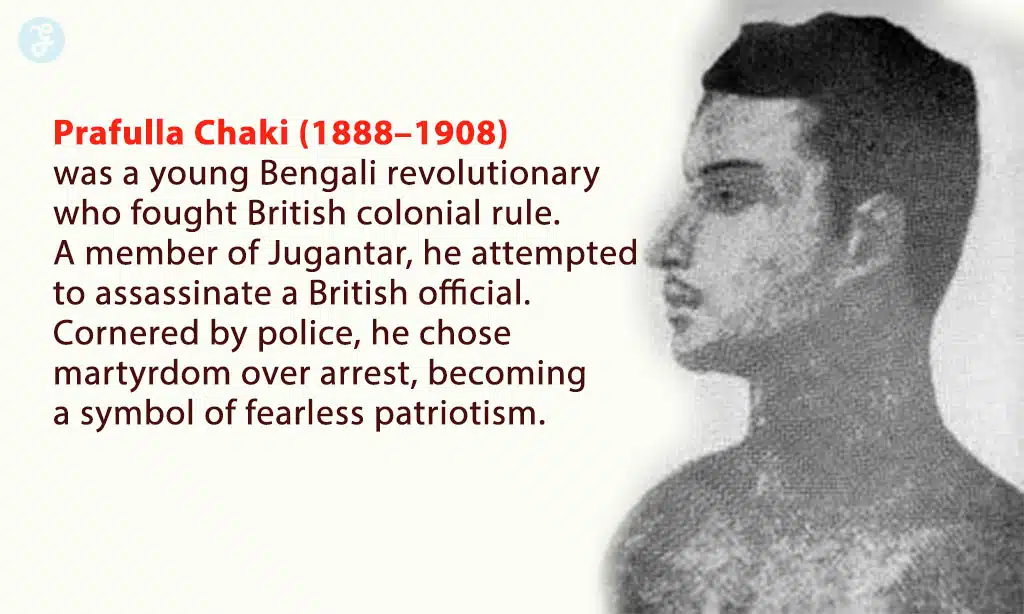
Prafulla Chaki’s evolution from a patriotic youth to a committed revolutionary was shaped by the political climate, personal conviction, and powerful mentors. During his teenage years, he joined Anushilan Samiti, a secret organization known for its rigorous physical training, moral discipline, and preparation for revolutionary action.
Chaki excelled in physical endurance, weapon handling, and covert operations. His determination, fearlessness, and discipline impressed senior leaders, including Barindra Kumar Ghosh (brother of Sri Aurobindo) and Hemchandra Kanungo, who were instrumental in the growth of Jugantar.
Training was not limited to physical skills. It included reading extremist literature, studying global revolutionary movements, and learning the art of secrecy. Chaki embraced all of it with unwavering dedication.
Over time, his commitment deepened into a burning resolve: the colonial government had to be challenged head-on. He was convinced that only a bold, carefully executed act of resistance could shake the foundations of British rule and inspire the masses. His name began to circulate among leaders seeking young men capable of undertaking missions that combined skill, intelligence, and fearless sacrifice.
Thus began Chaki’s journey from an idealistic teenager to one of Bengal’s most trusted revolutionary soldiers.
The Mission to Kill Kingsford: Planning the Impossible
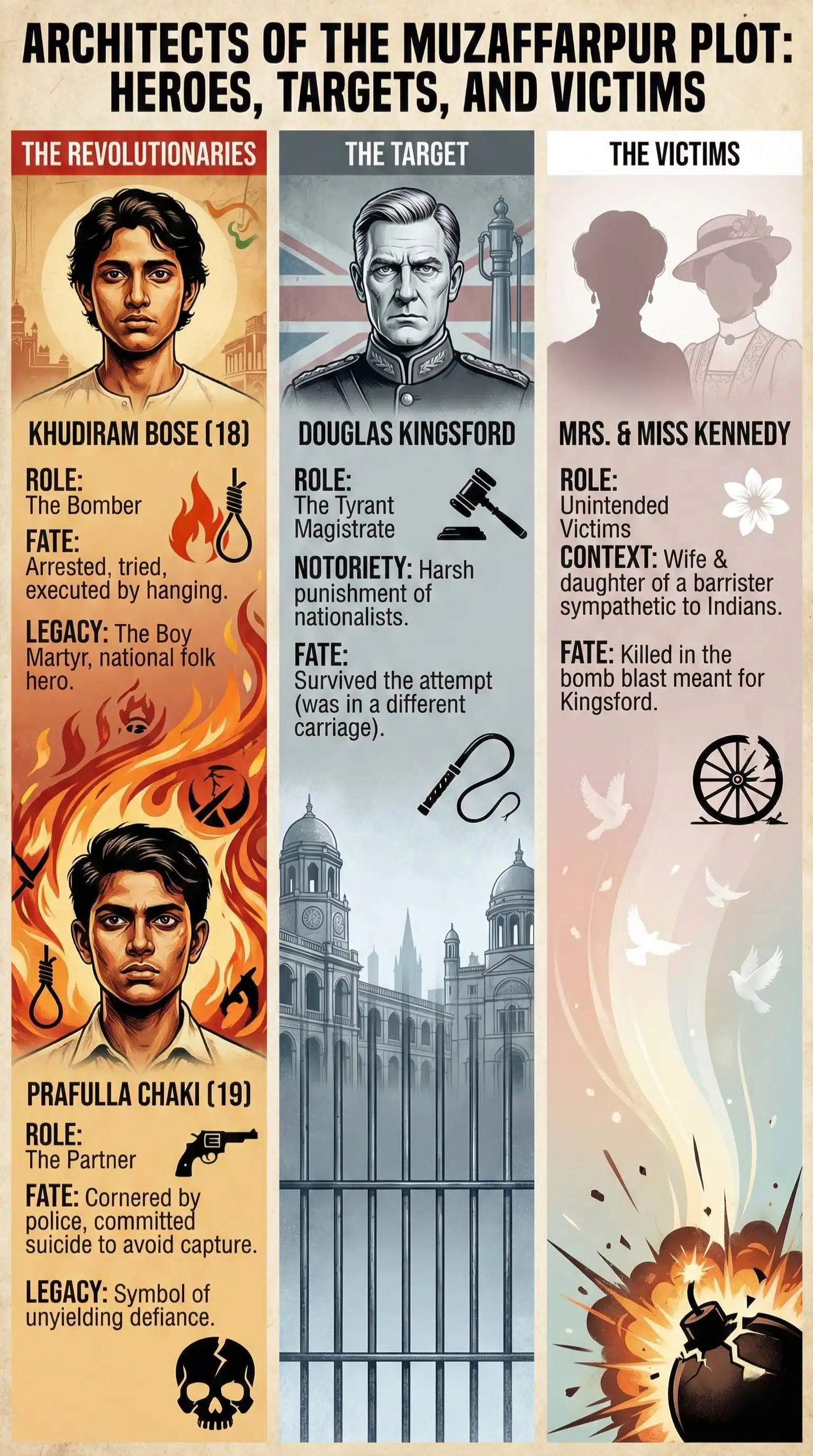
The plan that would make Prafulla Chaki a legend began with a man named Douglas H. Kingsford, the Chief Magistrate of Muzaffarpur. Kingsford was notorious for his harsh punishments against nationalist activists, including brutal sentences, public humiliations, and heavy fines designed to crush dissent.
His actions enraged the revolutionary community, particularly Jugantar. For them, eliminating Kingsford became not an act of revenge but a statement: the terror of British officials would no longer go unanswered.
The mission required extraordinary precision and absolute secrecy. After careful deliberation, Jugantar leaders selected two young men for the task—Prafulla Chaki and Khudiram Bose. Both were teenagers, yet both possessed an iron will and remarkable courage.
Their journey from Bengal to Muzaffarpur was a masterclass in covert strategy. They adopted disguises, changed identities, monitored Kingsford’s movements, and studied the layout of the town. They spent weeks waiting, watching, and calculating.
Despite their youth, they exhibited discipline far beyond their age. They knew the risks. They knew death was a likely outcome. Yet neither wavered.
The stage was set for an act that would shake the empire.
The Muzaffarpur Assassination Attempt: When Plans Change Destinies
On the evening of April 30, 1908, after weeks of surveillance, Chaki and Bose finally spotted a carriage leaving the European Club—one they believed carried Magistrate Kingsford.
With nerves of steel, the two advanced toward their target on a dimly lit road. Khudiram, carrying the bomb, hurled it at the carriage. The explosion tore through the night, sending shockwaves through the town.
But the mission took a tragic turn.
The carriage did not contain Kingsford. Instead, it carried two British women—Mrs. Kennedy and her daughter, who were instantly killed. The mistaken identity was a devastating twist of fate, altering the course of the young revolutionaries’ lives forever.
Within minutes, the police launched an unprecedented manhunt. Posters, rewards, and checkpoints appeared everywhere. Roads, rivers, and railways were guarded. The British administration, furious and alarmed, vowed to capture the attackers at any cost.
This moment marked the beginning of two separate journeys—Khudiram’s eventual capture and trial and Prafulla Chaki’s desperate flight toward freedom.
The Final Days: Prafulla Chaki’s Last Stand
After the explosion, Prafulla Chaki fled Muzaffarpur and embarked on a dangerous journey through the unfamiliar terrains of Bihar. Hungry, exhausted, and constantly evading British patrols, he moved from one location to another, relying on strangers, sympathizers, and sheer instinct.
But the net was closing in. British intelligence had successfully traced his movements. Informants identified him as a suspicious traveler. By the time he reached Samastipur Railway Station, the police had surrounded the area.
Chaki realized escape was impossible.
He had witnessed countless revolutionaries tortured brutally for information. He knew the British wanted to extract the names of Jugantar leaders. And he knew that his capture could endanger the entire movement.
In one final act of defiance, Prafulla Chaki chose death over submission.
He shot himself with the revolver he carried, sacrificing his life but protecting the identities of his comrades. His last act became a symbol of ultimate loyalty to the cause of freedom.
Why Prafulla Chaki’s Story Faded from Mainstream History
Despite his monumental courage, Prafulla Chaki’s name often receives less recognition compared to other revolutionaries. Several factors contributed to this historical oversight:
1. Early secrecy and limited documentation
Jugantar operated in deep secrecy. Many details of its operations—including individual contributions—were never officially recorded.
2. Overshadowing by more publicized figures
Revolutionaries like Khudiram Bose and Bhagat Singh became national icons due to their trials, speeches, and broader public impact. Chaki, who died before capture, remained less visible in newspapers and political debates.
3. Colonial distortions of revolutionary history
British administrators deliberately minimized revolutionary contributions, portraying them as acts of “terrorism” rather than resistance.
4. Fragmented regional narratives
In Bengal, Chaki is remembered with reverence, but nationwide narratives often overlook regional heroes.
Yet his role in shaping early revolutionary nationalism remains vital and undeniable.
Legacy of a Teen Revolutionary: The Impact He Left Behind
Even though he lived only nineteen years, the impact of Prafulla Chaki’s bravery transcends time. His sacrifice inspired countless revolutionaries who later carried forward the torch of armed resistance. The likes of Bhagat Singh, Surya Sen, and the HRA would find strength in the stories of early heroes like Chaki and Khudiram.
His martyrdom became a rallying point for youth-driven nationalism in Bengal. His life is frequently referenced in revolutionary literature, biographies, films, and regional history. Roads, memorials, and educational institutions stand in his name, ensuring that his legacy endures.
But more importantly, Prafulla Chaki represents something deeper—the audacity of youth. His story teaches us that courage does not depend on age, power, or resources. It grows from conviction, purpose, and the willingness to act when silence becomes surrender.
At a time when India reflects on its freedom struggle, remembering Chaki is essential. His life ignites a sense of pride and reminds us of the hidden chapters of history that shaped our independence.
Final Words: The Boy Who Challenged an Empire
As we commemorate the 137th birth anniversary of Prafulla Chaki, we rediscover not just a revolutionary but a symbol of unshakeable patriotism. The Untold Story of Prafulla Chaki is a story of a boy who rose from an ordinary background to challenge one of the most powerful empires in history. His courage, sacrifice, and unwavering belief in freedom continue to inspire generations long after his death.
Prafulla Chaki’s actions spoke louder than any manifesto. He proved that the spirit of resistance can thrive even in the youngest hearts. His journey—brief yet brilliant—remains etched in the legacy of India’s struggle for independence.
In remembering him today, we honor not just a hero of the past but a guiding light for the future. His life encourages today’s youth to stand for justice, question oppression, and never underestimate the power of conviction.
Prafulla Chaki may have lived only nineteen years, but the fire he ignited continues to burn—bright, fierce, and unforgettable.