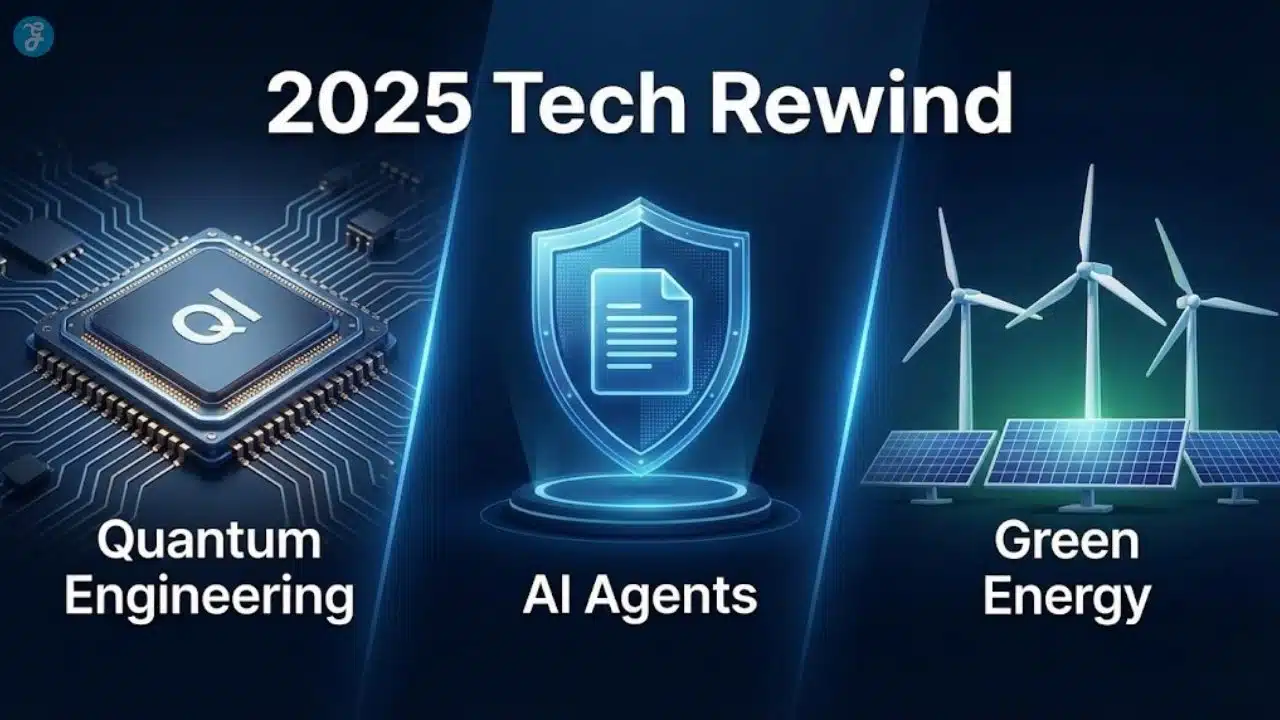
This tech rewind 2025 is not a list of shiny demos. It is a map of what strengthened, what scaled, and what still breaks when you put it in front of real users. The through-line is simple: once technology becomes useful, it stops being a feature and becomes a workflow.
If 2024 was the year tech promised a new era, 2025 was the year it started delivering the unglamorous parts that make the era real. Reliability, governance, integration, and infrastructure became the real story.
What changed in 2025 is that more workflows started to work consistently. That sounds boring until you realize that consistency is the difference between “interesting” and “inevitable.”
Ai Stopped Being a Chatbot and Started Becoming a Co-Worker
The biggest AI shift in 2025 was not only in capability. It was placement. AI moved into the tools people already use and started handling tasks that live inside real workdays.
That shift exposed a hard truth. The closer AI gets to actions, permissions, money, and customer data, the more it behaves like production software with real failure costs. In this 2025 tech rewind, the most important AI story is how quickly teams learned to treat assistants like systems, not magic.
What Agents Did Well in 2025
Agents delivered value where the task was repetitive, the goal was clear, and the downside of being wrong was limited. They also did surprisingly well when you gave them structure instead of freedom.
Common wins looked like this:
-
Drafting customer replies, then handing off for review
-
Summarizing meetings into decisions, owners, and deadlines
-
Triaging tickets into buckets with consistent labels
-
Extracting action items from long chat threads
-
Creating first-pass documentation and release notes
-
Preparing brief status updates from dashboards and logs
Teams got the best results when they designed the workflow so the agent “prepares” and a human “decides.” That single design choice prevented a lot of chaos.
Where Agents Caused Headaches
Most painful failures were not about intelligence. They were about boundaries, context mixing, or taking action too early.
Frequent pain points:
-
Misreading hidden instructions embedded in web pages or docs
-
Taking an action before confirming intent
-
Mixing up accounts, workspaces, or similar customer records
-
Copying sensitive text into the wrong channel
-
Triggering loops, like repeatedly “fixing” the same thing
-
Confidently completing the wrong workflow step
The lesson of 2025 was that autonomy is not a switch. It is a ladder, and skipping rungs is how you fall.
Why Standards Mattered Again
As AI moved into daily workflows, integration became the bottleneck. Teams wanted consistent ways to connect assistants to data and tools without rebuilding everything for each model and vendor.
Standards mattered because they reduced friction and clarified security:
-
Faster integrations across internal systems
-
Clearer permission models and audit trails
-
More predictable maintenance as tools change
-
Less vendor lock-in for basic connectivity
-
Easier governance because access becomes measurable
In 2025, “connectors” became as strategic as “models,” because the assistant that can safely reach the right systems wins.
Ai Economics Got Sharper
By the end of 2025, the conversation shifted from “Can it do it?” to “Can it do it reliably, quickly, and cheaply enough to matter?” That shift forced teams to track AI cost like they track uptime.
High-impact cost levers teams used:
-
Reducing unnecessary tool calls and rework loops
-
Using smaller models for simpler steps
-
Keeping context tight, clean, and relevant
-
Adding guardrails that prevent expensive mistakes
-
Measuring success rate and escalation rate, not vibes
This 2025 tech rewind is a reminder that AI is not only about intelligence. It is also about throughput, reliability, and unit economics.
Regulation Became Operational Work
2025 made governance feel real because more organizations faced concrete expectations for documentation, oversight, and safe deployment. Even outside strict legal requirements, customers and partners increasingly demanded evidence of control.
Governance became normal work:
-
Classifying AI systems by risk and intended use
-
Documenting data sources and known limitations
-
Logging actions, tool access, and human approvals
-
Running adversarial tests and incident drills
-
Training staff on safe use and escalation
The organizations that handled this well treated governance as a product feature. They built processes engineers could actually live with.
How Teams Matured Agent Rollouts
Most teams followed a similar curve, whether they admitted it or not. They started with assistance and moved toward action only after controls proved themselves.
| Maturity Stage | What The Agent Does | Human Role | Main Risk | What Teams Added To Move Forward |
|---|---|---|---|---|
| Assist | Summarizes, drafts, suggests | Reviews and edits | Wrong info | Templates, review routines |
| Recommend | Proposes actions and plans | Approves actions | Overconfidence | Structured output, validations |
| Act With Guardrails | Executes limited actions | Monitors exceptions | Permission misuse | Least privilege, logging, allowlists |
| Semi-Autonomous | Runs narrow workflows end-to-end | Audits and spot-checks | Hidden edge cases | Test suites, rollbacks, incident playbooks |
| Autonomous In Production | Runs continuously with controls | Oversees outcomes | Rare but costly failures | Defense in depth, monitoring, limits |
The big takeaway is that “safe autonomy” is built, not declared.
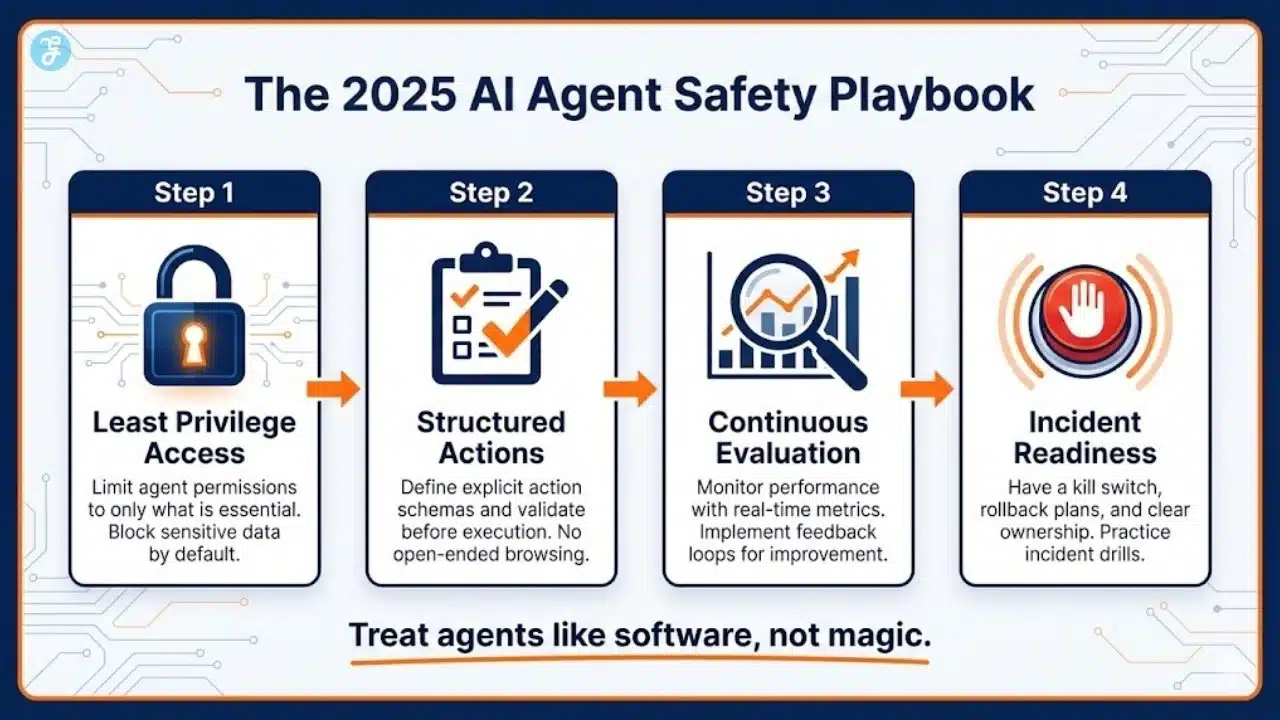
The 2025 Playbook for Building With AI Agents Safely
If there is one operator lesson that dominates this 2025 tech rewind, it is that agent safety is mostly workflow design. The safest agents in 2025 looked less like superheroes and more like well-trained teammates with checklists.
Teams that succeeded did not rely on one trick. They stacked simple controls until the system became predictable.
Start With Least Privilege, Then Earn Permissions
Broad access creates broad failure modes. If an agent can touch everything, it eventually will.
Least-privilege practices that worked:
-
Separate read access from write access
-
Gate money-moving actions behind explicit approval
-
Use domain allow lists for outbound communication
-
Block access to secrets by default
-
Rotate credentials and avoid long-lived tokens
-
Split workflows so one agent does not inherit all permissions
A good rule is that permissions must be explained in one sentence. If you cannot explain it, remove it.
Treat The Open Web As Untrusted Input
The web contains accidental instructions, malicious instructions, and confusing noise. Your system should assume that any page can try to hijack the agent’s behavior.
Practical protections:
-
Keep system rules outside user content
-
Never allow content to modify tool permissions
-
Require confirmation for external actions
-
Quarantine suspicious prompt-like strings when possible
-
Use safe browsing modes for high-risk workflows
This is less about paranoia and more about being honest. Untrusted input should not get privileged execution.
Make Actions Explicit And Verifiable
The strongest agent designs required the model to propose actions in a structured format. The software then validated those actions before execution.
Examples of “good” structured actions:
-
Create ticket with fields: project, title, priority, body
-
Send email with fields: recipients, subject, body, attachments
-
Update record with fields: record ID, changed fields, reason
-
Run query with fields: dataset, query, output type
-
Schedule meeting with fields: attendees, time window, agenda
This approach reduces surprises and produces logs that are actually useful.
Build Evaluation Like Testing
In 2025, serious teams stopped treating prompts like a one-time setup. They treated them like code, with regressions and measurable outcomes.
What the evaluation looked like:
-
A small test set based on real tasks
-
Adversarial cases, including misleading docs and injected instructions
-
Regression runs after any prompt or model change
-
Metrics like completion rate, escalation rate, and error severity
-
Human review focused on the most expensive failure classes
The goal is not perfection. The goal is to know your failure modes before customers do.
Plan For Incidents Before You Need Them
Agent incidents often look like normal bugs until they touch money, reputation, or sensitive data. Teams that survived incidents well built playbooks early.
Incident readiness checklist:
-
A kill switch to pause actions immediately
-
Versioned configs and rollback procedures
-
Credential revocation steps
-
Log access for rapid investigation
-
Clear ownership for re-enabling the agent
-
Limits on actions, like spend caps or message caps
In 2025, the calmest teams were the ones that assumed something would go wrong and prepared accordingly.
Risk And Control Mapping Teams Used
This table captures a common operator model: higher risk requires stronger controls.
| Agent Capability | Risk Level | Typical Failure | Practical Control |
|---|---|---|---|
| Summarize And Draft | Low | Missing context | Human review, templates |
| Search Internal Docs | Medium | Wrong policy | Trusted sources, versioning, validations |
| Update Tickets Or CRM | Medium | Wrong record | Record checks, confirmations, audit logs |
| Send Messages Externally | High | Wrong recipient | Domain allowlists, preview, approval gates |
| Run Financial Actions | Very High | Costly mistake | Two-person approval, limits, monitoring, rollbacks |
| Execute System Commands | Very High | Outage | Sandboxing, allowlists, dry-run mode, approvals |
This is the practical heart of agent safety, and it is why 2025 felt like the year AI grew up.
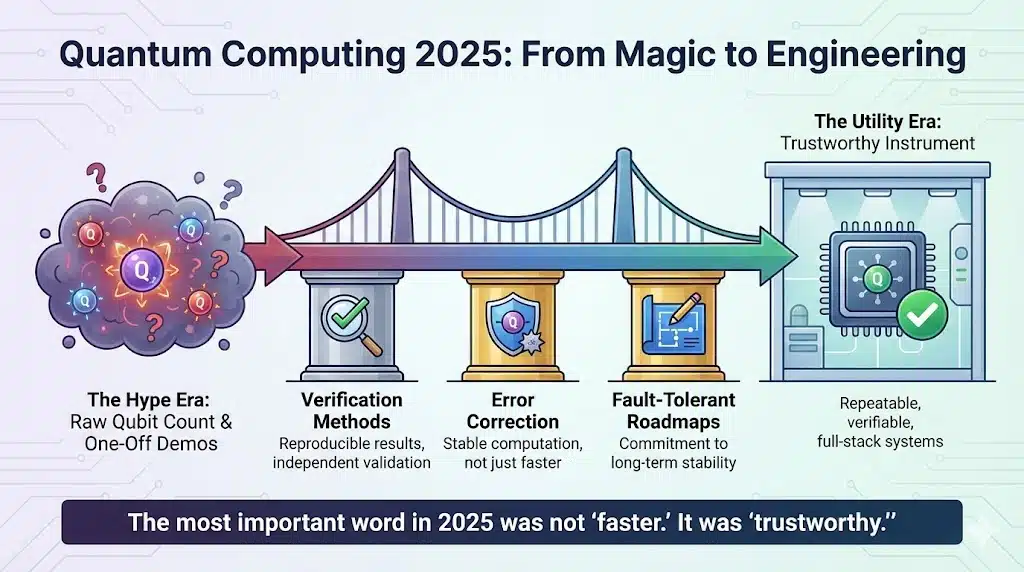
Quantum Leaps Started to Look Less Like Magic and More Like Engineering
Quantum computing did not become mainstream in 2025. What changed was the tone. More of the conversation shifted toward measurable progress: verification, stability, and error correction.
In this 2025 tech rewind, quantum matters because it moved closer to being an instrument you can trust. Trust comes from repeatability, and repeatability comes from engineering, not hype.
Verifiable Results Became A Bigger Theme
Quantum work earns credibility when outcomes can be checked. In 2025, more attention went to experiments designed to be validated repeatedly, not just celebrated once.
That matters for the rest of the tech world because verification reduces the gap between quantum headlines and quantum utility. It also creates clearer milestones for skeptics and supporters alike.
Error Correction Stayed The Center Of Gravity
The core problem remains simple. Qubits are fragile. Error correction is what makes longer computation possible.
In 2025, the field became more explicit about what scaling requires:
-
Better error models and diagnostics
-
Stronger classical control and calibration loops
-
Architectural choices designed for stability
-
Roadmaps anchored in fault tolerance, not only qubit count
The important shift is that progress started to look more “full stack.” Physics matters, but systems matter just as much.
Quantum Progress Filter For Non-Specialists
If you want a clean way to read quantum news, ask whether it improves trust or stability.
| Milestone Type | What It Means In Practice | Why It Matters | What To Watch Next |
|---|---|---|---|
| Verification Methods | Outcomes can be checked reliably | Builds confidence beyond demos | Independent replication |
| Better Logical Behavior | More stable computation over time | Enables longer algorithms | Lower error rates in realistic conditions |
| Stronger Control Stacks | Faster correction and monitoring | Turns physics into a system | Real-time correction at scale |
| Fault-Tolerant Roadmaps | Plans anchored in correction | Signals serious engineering | Deliverables that hold up |
That filter explains why 2025 felt different, even if quantum is still early.
Chips and Compute: Smaller, Stacked, And Strategic
Compute demand rose because AI demand rose. That made the chip story feel less like a niche industry and more like a foundation for everything else.
In 2025, scaling did not mean only smaller transistors. It also meant packaging, interconnection, memory, power delivery, and cooling. The winners built systems that moved data efficiently, not only chips that looked good on paper.
Process Improvements Still Mattered
Efficiency gains matter because they compound. Even modest improvements in performance per watt become massive when multiplied across fleets of servers and continuous inference workloads.
Process improvements helped:
-
Lower cost per workload
-
Reduce power and cooling pressure
-
Increase density without immediate rebuilds
-
Improve the feasibility of on-device and edge workloads
This is why the hardware strategy stayed tightly coupled to the AI strategy.
Packaging And Chiplets Mattered More Than Ever
Advanced packaging and chiplets became central because connecting compute effectively is a path to scale even when traditional shrinking slows.
Why packaging rose in importance:
-
Better yields by mixing chiplets
-
Faster iteration across product lines
-
Flexibility to tailor systems to workloads
-
A new bottleneck, packaging capacity itself
In 2025, the stack got more modular, and computer trends shaped decisions:
-
High-bandwidth memory as a limiter and differentiator
-
Networking fabrics as performance drivers for distributed AI
-
Power delivery and cooling as design constraints
-
Long lead times for critical components
-
Regional capacity planning as a business risk
The Compute Stack In One View
| Layer | What Changed In 2025 | Why It Mattered |
|---|---|---|
| Silicon | Continued efficiency gains | Lower cost per workload |
| Packaging | More chiplet-based scaling | Bigger systems, faster iteration |
| Memory | Bandwidth pressure remained intense | Many workloads bottleneck on memory |
| Networking | Faster fabrics became core | Distributed AI needs fast communication |
| Cooling And Power | Hard constraints tightened | Density forces infrastructure planning |
The compute story is not glamorous, but it quietly sets the speed limit for everything else.
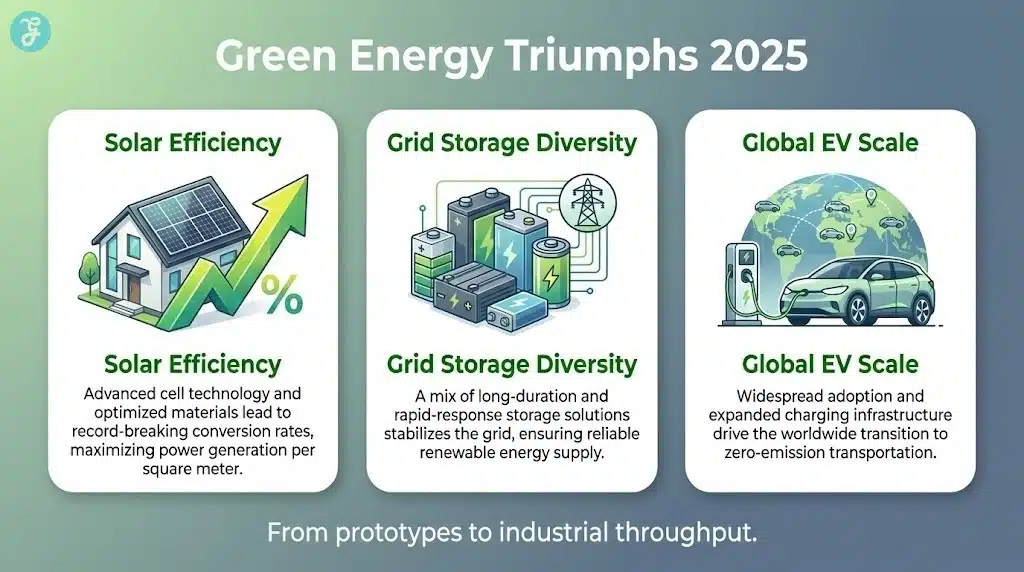
Green Energy Triumphs Looked Less Like Prototypes and More Like Throughput
If you want the most practical optimism in this 2025 tech rewind, it lives here. The clean energy story in 2025 was not one miracle device. It was compounding progress across renewables, solar efficiency, storage, electrification, and grid operations.
The key theme was scale. More deployments create more learning, and more learning creates more deployments.
Renewables Kept Stacking Capacity, But Grids Became The Bottleneck
Renewables continued expanding, and the operational playbook matured. Teams built faster, managed risk better, and improved performance.
At the same time, grid constraints increasingly determined what could actually be used. Without transmission, interconnections, and storage, the new generation cannot deliver full value.
Grid bottlenecks that showed up everywhere:
-
Slow interconnection queues
-
Transmission buildout delays
-
Local permitting friction
-
Shortage of specialized equipment
-
Need for better forecasting and flexibility services
-
Coordination complexity across utilities and regulators
In 2025, the grid became the story behind the story.
Solar Efficiency Gains Mattered Because Space And Cost Matter
Higher efficiency means more power from the same area. That matters for rooftops, dense regions, and constrained land.
In 2025, the solar story looked less like a single lab result and more like a pipeline of improvements that could be manufactured if durability and cost targets are met. The practical implication is simple: as output per area rises, the number of viable sites increases.
Storage Diversified Beyond One Chemistry
Storage expanded in two directions. Grid-scale deployments helped shift renewable power across hours, while research pushed safety, lifetime, and performance for a variety of use cases.
Where storage delivered value:
-
Short-duration grid balancing
-
Peak shaving and time shifting
-
Backup power and resilience
-
EV charging smoothing
-
Industrial load management
-
Microgrids for critical facilities
A broader storage toolkit reduces risk because different problems need different strengths.
Ev Adoption Became Structurally Global
EVs continued expanding across markets and price tiers. That pushed competition across manufacturing, software, and charging ecosystems.
The ecosystem matured as volume grew:
-
Service networks expanded
-
Resale markets stabilized
-
Charging reliability became a brand differentiator
-
Utilities increased planning for load growth
-
Fleets accelerated adoption where the economics were clear
The result is a feedback loop. Adoption drives infrastructure investment, and infrastructure reliability drives adoption.
Clean Energy Building Blocks In One View
| Building Block | 2025 Progress Signal | What It Enables | What Still Limits It |
|---|---|---|---|
| Renewables Deployment | More projects, better execution | Cheaper clean generation | Grid and permitting speed |
| Solar Efficiency Gains | Higher output per area | More power from rooftops | Durability, production cost |
| Grid Batteries | More installations and know-how | Smoothing and shifting renewables | Siting, supply chains |
| Ev Expansion | Broader models and markets | Lower transport emissions | Charging reliability, grid upgrades |
| Grid Modernization | Rising urgency and investment | Higher clean utilization | Lead times, coordination |
What Businesses Learned From Clean Energy In 2025
Many leaders wanted a single breakthrough. What they got was a new operating environment where energy became strategy.
Business takeaways:
-
Energy is now a strategy line item, not just a utility bill
-
Resilience planning matters more as loads rise
-
Electrification depends on local grid readiness
-
Data and forecasting increasingly drive savings
-
Long-term contracts and partnerships reduce volatility
-
Operations teams gained influence over sustainability outcomes
These are not feel-good changes. They are structural, and that is why they matter.
Space Became Infrastructure
Space in 2025 was less about spectacle and more about services. Connectivity, remote coverage, and launch cadence began to look like an infrastructure layer, similar to telecom and logistics.
That shift widened competition and raised new questions about policy, security, and reliability. The space economy increasingly looked like a business, not a science project.
Reusability and Iteration Cycles Kept Proving Their Value
When teams iterate faster, they learn faster. Progress in 2025 often looked like improved mission profiles, better recovery, and more consistent performance.
Those steps matter because they lower costs over time, and lower costs are what turn space into infrastructure rather than occasional headlines.
Direct-To-Device Connectivity Gained Visibility
Satellite connectivity to standard phones moved closer to practical use in limited forms. Early capabilities often focus on messaging and emergency scenarios, but the shift in expectations is large.
What direct-to-device can change:
-
Emergency communications during outages
-
Basic coverage in remote areas
-
Redundancy for critical services
-
New identity and fraud attack surfaces
-
New public expectations in disaster response
Coverage is not only a technical problem. It is also a trust and security problem.
Space As Infrastructure, Summarized
| Space Capability | What It Supports On Earth | New Challenge It Creates |
|---|---|---|
| Broadband Constellations | Connectivity and competition | Debris, regulation, spectrum |
| Direct-To-Device | Resilience and emergency access | Authentication, fraud risks |
| Launch Cadence | Faster deployment cycles | Industrial scaling complexity |
| Earth Observation | Climate, agriculture, security | Data governance and privacy |
This is the adult version of the space story, and it will keep growing.
The Hidden Theme of 2025: Reliability Became The New Status Symbol
Across AI, quantum, chips, energy, and space, the year rewarded the same thing. Systems that held up under real use beat systems that looked good in demos.
Reliability showed up in specific, repeatable ways:
-
AI agents: permissions, logs, structured actions, incident playbooks
-
Quantum: verification methods and correction-focused roadmaps
-
Chips: capacity planning, packaging, system-level scaling
-
Energy: deployment throughput and operational learning
-
Space: repeatable mission performance and service layers
This is why this 2025 tech rewind feels different. The story is not “tech got cooler.” The story is “tech got sturdier.”
What 2026 is Set Up to Fight About
The same forces that made 2025 practical will make 2026 competitive. The next year will be defined by operational battles, not only technical demos.
Here is the likely fight card.
| 2026 Battleground | What Will Be Debated | What Will Decide Winners |
|---|---|---|
| Agent Safety Vs Utility | How autonomous agents should be | Guardrails, evaluation, and incident readiness |
| Ai Cost Vs Quality | Value per dollar | Routing, smaller models, workflow design |
| Quantum Timelines | How soon “useful” arrives | Stability, verification, error correction |
| Chip Constraints | Who gets enough compute | Capacity, packaging, supply strategy |
| Grid Bottlenecks | How fast clean energy scales | Transmission, interconnection, storage |
| Satellite Connectivity | Who owns coverage expectations | Regulation, security, consumer trust |
If you want a simple forecast, watch who can scale without breaking trust. That is the new advantage.
What This Year Set In Motion
A strong demo gets attention once. A reliable workflow creates value every day. That is the core lesson of this 2025 tech rewind.
2025 was the year standards reduced friction, guardrails reduced disasters, and infrastructure turned ambition into throughput. The organizations that won were not the ones with the loudest launches. They were the ones who turned emerging technology into dependable routines.
If 2025 made tech more usable, 2026 will judge it like any other system. By uptime, cost, safety, and the ability to scale without breaking confidence.
Frequently Asked Questions
Here are the answers to the most commonly asked questions among readers about the 2025 tech rewind:
What Does “2025 Tech Rewind” Mean in This Article?
It is a year-end recap focused on practical progress. It highlights where technologies moved from impressive demos toward reliable workflows and operational systems.
Why Did Ai Feel Different in 2025 Compared to Earlier Years?
AI moved into tools and started doing tasks, not just answering questions. That shift forced teams to treat AI like production software with permissions, testing, monitoring, and incident response.
What Was The Biggest Safety Lesson About AI Agents In 2025?
Broad permissions create broad failures. Teams that succeeded started with least privilege, required structured actions, and built evaluation and rollback plans before letting agents take meaningful actions.
Did Quantum Computing Arrive in 2025?
Not for consumers. The key change was the focus on verification and error correction as engineering milestones, which made progress easier to measure and trust.
Why Are Grids Such a Big Part of The Green Energy Story Now?
Because generation alone is not enough. Transmission, interconnection speed, storage, and flexibility determine how much renewable energy can actually be used reliably.
What Should Readers Watch Most Closely In 2026?
Watch the operational layer. For AI, it is safety and cost control. For energy, it is grid buildout and interconnection reform. For quantum, it is stability and verified progress over time.