The Strategic Immunity Zone is no longer a theoretical concept discussed in the windowless briefing rooms of the Pentagon; it is being poured in concrete, right now, beneath the Zagros Mountains. While the world’s attention is fixed on the sterile, air-conditioned diplomatic suites in Muscat where American and Iranian negotiators are trading papers on sanctions relief, the real story is unfolding in the dust and roar of construction excavators south of Natanz.
As Prime Minister Benjamin Netanyahu meets with President Trump in Washington today, a dangerous disconnect has emerged between diplomatic optimism and ground reality. The West is negotiating based on the visible damage of the past, but Tehran is building for the future. This disconnect is driven by a fundamental shift in Iran’s Nuclear Bunker Strategy, which has moved from merely hardening facilities to burying them so deep that they render conventional military power obsolete.
We are witnessing the creation of a fortress designed not just to survive an attack, but to make the very idea of an attack futile.
The Mirage of Victory: Operation Midnight Hammer Revisited
To understand the peril of 2026, we must first dissect the illusion of 2025. It has been eight months since the “12-Day War” of June 2025, a conflict the Western world largely categorized as a tactical victory. Operation Midnight Hammer, the joint US-Israeli air campaign, was sold to the public as the definitive checkmate against Tehran’s nuclear ambitions.
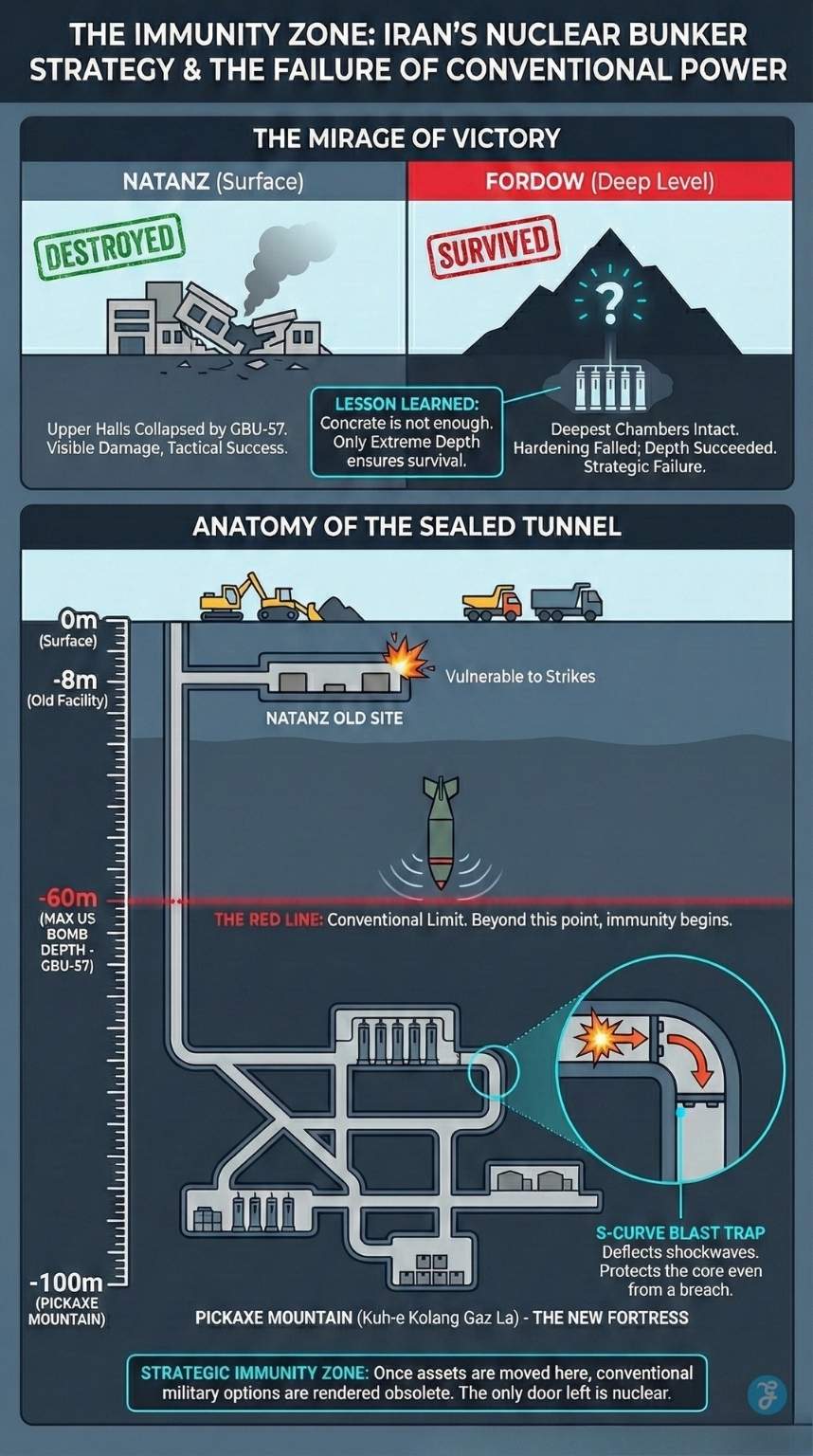
On the third night of that campaign, we watched satellite footage of the upper enrichment halls at Natanz collapsing under the weight of GBU-57 Massive Ordnance Penetrators. The results were visually spectacular: the roof caved in, delicate cascades of IR-6 centrifuges were shattered, and the facility was rendered “operationally inert.”
The Lessons of Survival
However, military success is often a matter of what you destroy versus what you miss. In the aftermath, a quiet, terrifying reality emerged. While the strikes neutralized the “exposed” capacity, they failed to penetrate the deepest sub-levels of the Fordow facility. This survival taught the Islamic Republic a crucial lesson: “hardening” a facility with concrete is a losing game against modern American ordnance.
The only true defense is extreme geological depth. Consequently, the regime did not surrender; they initiated the “Great Dig,” shifting resources to the new Kuh-e Kolang Gaz La (“Pickaxe Mountain”) complex, a site that represents the ultimate failure of Operation Midnight Hammer. We cut off the hydra’s head, only to watch it retreat into a cave where our swords can no longer reach.
Anatomy of the “Sealed Tunnel”: Why 2026 is Different
The facility at Kuh-e Kolang Gaz La is unlike anything the International Atomic Energy Agency (IAEA) has monitored in the past. To call it a “bunker” is a misnomer; it is a subterranean city bored into the heart of a granite monolith.
Intelligence estimates regarding the site place the main enrichment chambers at a depth of 80 to 100 meters (approximately 260 to 328 feet). To put this in perspective, the main halls of the old Natanz facility were buried under roughly eight meters of soil and concrete. Even Fordow, long considered the gold standard of hardened facilities, sits under approximately 60 to 80 meters of rock. The extra 20 to 40 meters at Pickaxe Mountain might seem negligible to a layman, but in the physics of bunker busting, it is the difference between vulnerability and invincibility.
Defeating the GBU-57
The primary weapon in the US arsenal for this task is the GBU-57 Massive Ordnance Penetrator (MOP). It is a marvel of engineering, a 30,000-pound bomb designed to slice through 60 meters of earth or 20 meters of reinforced concrete before detonating. But physics is a cruel mistress. The GBU-57 hits a hard limit against 100 meters of solid mountain granite. The kinetic energy required to penetrate that depth simply exceeds the structural integrity of the bomb casing.
Furthermore, Iranian engineers have adapted their designs to counter the specific blast mechanics of the MOP. Satellite imagery of the tunnel entrances reveals a distinct “S-Curve” design. Instead of straight shafts that allow a shockwave to travel linearly into the complex, the new tunnels feature sharp, 90-degree turns reinforced with blast doors. These “shock traps” are designed to dissipate the overpressure of a conventional explosion, protecting the delicate centrifuges deep inside, even if a bomb manages to breach the outer entrance.
The Zone of Immunity
This is the physical manifestation of the Strategic Immunity Zone. It is a threshold where the cost of a military solution spikes from “conventional airstrike” to “tactical nuclear weapon.” Once the nuclear assets are moved inside this mountain, the United States and Israel lose the “military option” as a credible lever of diplomacy. We cannot threaten to bomb what we cannot reach, and we cannot reach Pickaxe Mountain without crossing the nuclear taboo ourselves.
The “Open Threat”: Missiles as the Shield
While the “Sealed Tunnels” constitute the defensive component of Iran’s strategy, the “Open Threats” provide the offensive cover. It is a paradox that has confused many casual observers: Why is Tehran so quiet about its nuclear work yet so loud about its missile program?
The answer lies in the concept of “Deterrence by Punishment.” The regime understands that while the Strategic Immunity Zone is under construction, it is vulnerable. The concrete is still wet; the centrifuges are still in transit. To protect this window of vulnerability, they have erected a “Ring of Fire” using their ballistic missile arsenal.
Hypersonic Maneuvers
In the months following the 12-Day War Aftermath, Iran accelerated the testing of its Maneuvering Re-entry Vehicles (MaRVs). These are not the clumsy Scuds of the 1990s. The new Fattah-3 hypersonic missiles are designed with a singular purpose: to defeat advanced air defense systems like Israel’s Arrow-3 and David’s Sling. By demonstrating the ability to maneuver during the terminal phase of flight, Iran is signaling that it can penetrate the missile defense shields of Tel Aviv and Dubai.
This is the “Open Threat” that creates the political space for the “Sealed Tunnels.” The logic is brutal but effective: “If you try to bomb our mountain while we are building it, we will burn your cities.” This creates a paralysis in Western capitals. The cost of a preemptive strike is no longer just the diplomatic fallout; it is the potential saturation of Israeli or Saudi airspace with hypersonic warheads.
The “Delivery” Red Line
Prime Minister Netanyahu’s insistence on addressing the missile program at the Washington summit is not a tangential demand; it is the core of the issue. A nuclear warhead buried in a mountain is a science project. A nuclear warhead mated to a MaRV is an existential threat. Israel’s new “Red Line” for 2026 is no longer just about enrichment purity; it is about “delivery.” They are arguing, correctly, that a nuclear deal that freezes enrichment but ignores the missile carrier is a suicide pact. It allows the gun to be loaded and aimed, pausing only the final polishing of the bullet.
The “Missing” 400kg: A Breakout in the Dark
If the geology of Pickaxe Mountain is the shield and the missiles are the sword, then the uranium stockpile is the prize. And right now, the location of that prize is the single greatest intelligence failure of the post-war period.
Before the first bomb fell in Operation Midnight Hammer, the IAEA estimated that Iran possessed approximately 400 kilograms of uranium enriched to 60% purity. This is the “breakout stockpile”, material that is 99% of the way to weapons-grade. In the chaos preceding the June 2025 conflict, this stockpile vanished from the monitored storage facilities.
The Intelligence Black Hole
The IAEA’s “Lost Continuity” Report, leaked earlier this month, is a terrifying document. It admits that inspectors have lost “continuity of knowledge” regarding this specific batch of fissile material. It is currently in what the intelligence community calls “ambiguous storage”, likely dispersed across a network of small, nondescript civilian warehouses or smaller tunnel complexes to prevent a single lucky airstrike from destroying the entire hoard.
This creates a high-stakes shell game. The “Breakout Time 2026” is technically zero. With 400kg of 60% uranium, Iran could produce enough weapons-grade fuel for half a dozen bombs in less than two weeks. The only thing stopping them is the decision to do so.
The Transfer Nightmare
The nightmare scenario keeping the Mossad and the CIA awake at night is the “Transfer Event.” We know the ultimate destination for this material is the Strategic Immunity Zone at Pickaxe Mountain. Once that 400kg stockpile enters the complex and the blast doors are sealed, the game is over. The material enters the zone of immunity. We will never see it again until it is mounted on a missile.
The dilemma for Western intelligence is acute. If you detect a convoy moving the material, do you strike it? A strike on a convoy carrying 400kg of highly enriched uranium could disperse radioactive dust over populated areas, creating a “dirty bomb” effect that would be a humanitarian catastrophe. Yet, if you let the convoy pass, you forfeit the last chance to physically destroy the bomb’s fuel. It is a choice between a war crime and a strategic defeat.
Israel’s Dilemma: The “Bunker Buster” Gap
For Israel, this is not an abstract strategic puzzle; it is a question of national survival. And it is a question complicated by a glaring capability gap.
Despite being the region’s premier military power, Israel lacks the specific tool required to threaten Kuh-e Kolang Gaz La. The Israeli Air Force (IAF) flies the F-35I Adir and the F-15I Ra’am, formidable aircraft, but neither is capable of carrying the 30,000-pound GBU-57 MOP. That bomb is exclusively deployed by the American B-2 Spirit bomber. Israel’s heaviest bunker buster, the GBU-28, can penetrate perhaps 30 meters of earth, insufficient for the new mountain fortress.
Asymmetric Options
This “Bunker Buster Gap” places Jerusalem in an impossible position. They cannot rely on the United States to do the job, as Washington is currently paralyzed by war fatigue and election-year politics. Yet, they cannot do the job themselves with conventional airstrikes.
This has led to the development of “asymmetric counter-proliferation” tactics. Israeli military planners are reportedly war-gaming scenarios that involve precision strikes not on the mountain itself, but on its life support. The theory is that by destroying the ventilation shafts, power intakes, and access roads, you can “suffocate” the facility.
However, historical analysis suggests this is a delaying tactic, not a solution. Ventilation can be repaired. Generators can be brought underground. A siege of the mountain might slow the program down by months, but it cannot kill it. The only way to destroy the program is to crush the centrifuges, and for that, you need to get inside the rock.
The Samson Option
This existential angst is what drives the current friction between Netanyahu and Trump. Israel is realizing that it may soon face a binary choice: accept a nuclear Iran or launch a war that includes a ground invasion or unconventional weapons to breach the mountain. The “Samson Option”, the veiled threat of Israel’s own nuclear deterrent, is being whispered about more loudly than ever before. If the conventional tunnel is sealed, the nuclear silo may be the only door left open.
The Washington Split: Diplomacy vs. Reality
While the tectonic plates of the Middle East are shifting, Washington seems stuck in a diplomatic time loop. The current summit between Prime Minister Netanyahu and President Trump is being framed by the White House as an opportunity to “seal the deal” on a new framework for stability.
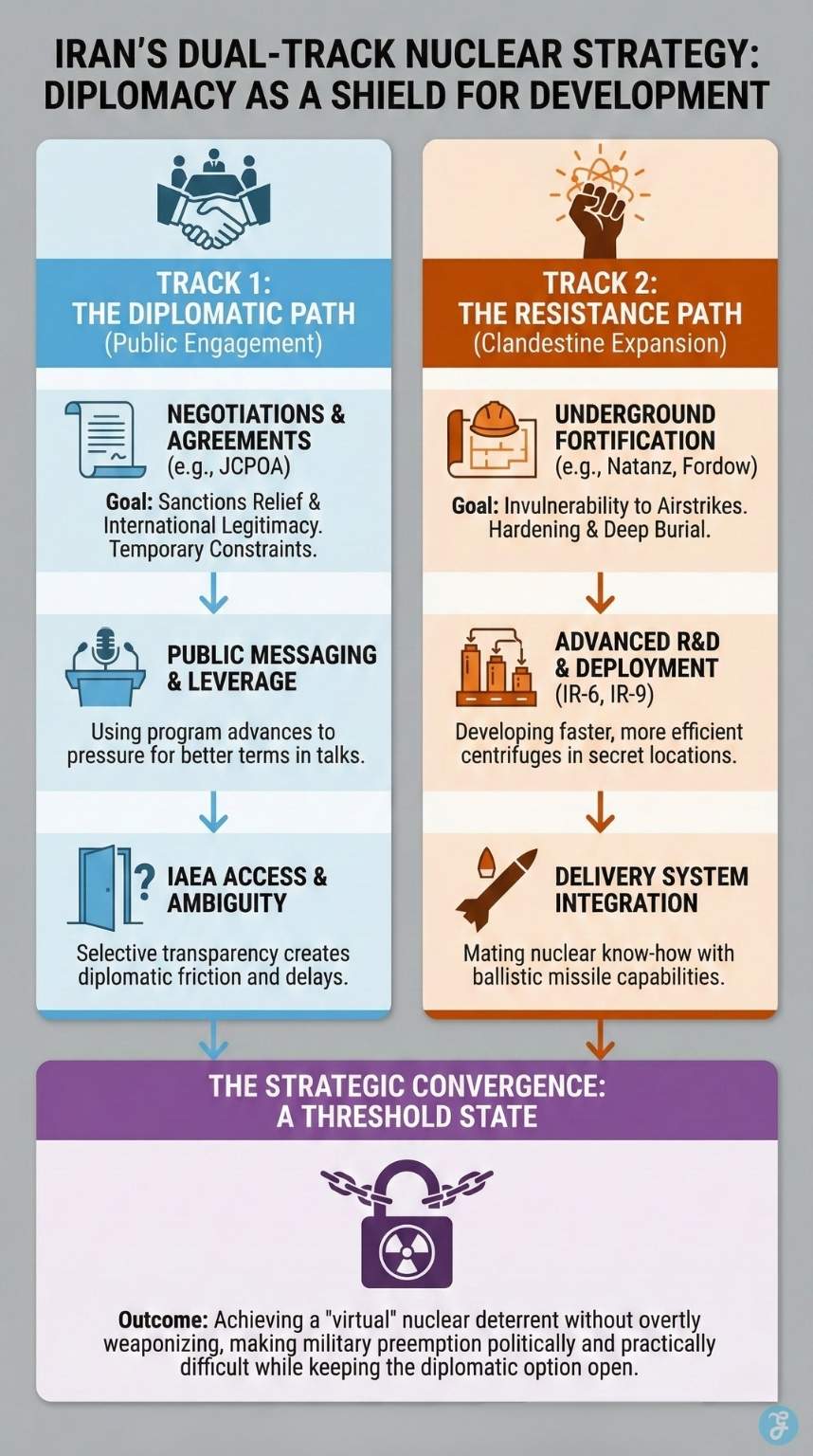
The American proposal, currently being floated in Oman, is essentially a “Freeze for Relief” agreement. The US would lift the crippling banking sanctions reimposed after the June War, and in exchange, Iran would agree to halt enrichment above 20% and allow inspectors back into some sites.
On paper, it sounds like a reasonable de-escalation. In reality, it is a capitulation. The fatal flaw in the American approach is that it treats the nuclear program as a software problem (enrichment levels) rather than a hardware problem (the tunnels).
Funding the Defeat
By agreeing to lift sanctions now, the United States would be providing the very funds Tehran needs to finish the construction of Kuh-e Kolang Gaz La. We would be paying for the concrete that seals our own defeat. A “freeze” on enrichment is meaningless if the facility to resume enrichment is being made invulnerable during the pause. It is akin to a police officer agreeing to stop shooting at a bank robber in exchange for the robber promising to stop shooting back, while the robber uses the ceasefire to lock himself inside the bank vault.
President Trump, eager for a foreign policy win to cement his legacy, is tempted by the deal. The “Deal Maker” instinct creates a bias toward signing a piece of paper. But Prime Minister Netanyahu is arriving with a different mandate. He is there to remind the President that a bad deal is worse than no deal, especially when the “bad deal” grants the adversary a Strategic Immunity Zone.
The disconnect is fundamental. Washington views the Iranian nuclear program as a political challenge to be managed. Jerusalem views it as a physical threat to be dismantled. The June War proved that “management” via limited strikes doesn’t work. It only hardens the resolve and the bunkers of the adversary.
The Binary Choice: A Fork in the Road
We stand at a precipice. The next six months will determine the nuclear future of the Middle East for the next century. As the construction cranes at Kuh-e Kolang Gaz La act as the hands of a doomsday clock, ticking down to the moment when the facility becomes operational, the West faces a binary choice. Neither option is palatable, but avoiding the choice is no longer possible.
Option A: Acceptance and Containment
This path requires the West to admit that the “June War” failed to achieve its strategic objectives. We accept that Iran will become a threshold nuclear state with an invulnerable bunker. We shift our strategy from “prevention” to “deterrence,” relying on the Cold War doctrine of Mutually Assured Destruction (MAD). We hope that the regime in Tehran is rational enough to love its own survival more than it hates Israel.
We live with the “Open Threats” and the “Sealed Tunnels,” and we accept that the non-proliferation treaty is effectively dead in the Middle East, likely triggering a cascade of nuclear armament in Saudi Arabia, Turkey, and Egypt.
Option B: Preemption and War
This path rejects the premise of an immune Iran. But this is not the limited, surgical preemption of 2025. This would require a campaign of absolute destruction targeting the entrances of Pickaxe Mountain before they are sealed. It would mean striking the “missing” uranium convoys regardless of the radiological risk. It would mean a war that engulfs the entire region, likely drawing in the US Navy and risking the closure of the Strait of Hormuz. It is a choice between a potentially catastrophic war now and a certainly catastrophic nuclear standoff later.
Final Words: The Last Red Line
As the excavators dig deeper into the Zagros Mountains, they are burying more than just centrifuges. They are burying the illusion that diplomacy without leverage can solve existential threats. They are burying the credibility of American military power to dictate outcomes in the region.
If we wait until the last truck enters the mountain, until the final blast door is locked and the Strategic Immunity Zone is fully established, we will have crossed the final red line. At that point, no amount of negotiation, sanctions, or conventional explosives will matter. We will be staring at a mountain that can say “No” to the world, and for the first time in history, we will have no way to force it to say “Yes.”
The tunnels are being sealed. The threats are open. And the time for choosing is running out.