
Many crypto holders feel stuck when they try to stake their coins for higher yields. Most blockchains pay periodic rewards that outpace bank rates. This guide shows seven smart ways to pick coins, join pools and use reliable validators, so you can watch your earnings grow.
Here we go.
Key Takeaways
- Stake major PoS tokens like Ethereum, Cardano (ADA) and Polkadot (DOT) to earn 4–10% APY; note lock-up periods, slashing penalties, and solo minimums (e.g., 32 ETH) or pool minima as low as 1 ETH.
- Spread stakes across Bitcoin, Ether, mid-cap and small-cap coins, multiple validators and pools; use crypto wallets, staking dashboards and block explorers to track rewards, uptime and network health.
- Join pools on Lido (10% fee) or Kraken (8% fee) to skip high entry bars, receive tradable tokens (stETH, bATOM), share node costs and lower slashing risk.
- Monitor staking performance each week (APY vs. target, validator uptime, slashing events) and review strategy quarterly; rebalance assets, compare fees, and track protocol updates via blogs, RSS feeds and governance portals.
- Use compounding: at 5% APY, 1,000 staked tokens grow to 1,280 in five years; combine dollar-cost averaging, hardware wallets and fee checks to boost long-term growth.
How do I choose the best cryptocurrency for staking?
Investors pick coins with strong fundamentals. PoS wallets lock tokens to earn rewards. Reputable tokens like Ether, ADA and DOT have thousands of active nodes. Staking rewards match your stake size.
Apply fundamental analysis for tech, use case, team and demand. Lockup periods differ by network. Passive income can add to capital preservation.
Diversify across Bitcoin, Ether, mid-cap and small-cap assets. Use crypto wallets and staking dashboards to track rewards rates. Lower energy use makes PoS greener than older proof of work coins.
Not all cryptocurrency support staking. Check validators and block explorers for network status.
What is the staking mechanism and how do lock-up periods work?
Staking with Proof of Stake lets users earn rewards by securing a blockchain. It works by token locking in smart contracts. Validators run nodes to confirm transactions and add blocks.
Delegation lets small holders join large stakes through a node operator. Some blockchains set a 32 ETH minimum staking requirement. A crypto exchange or centralized services can pool smaller funds.
A browser vault or hardware key can connect to these platforms.
Lock-up periods freeze funds for a set time. Unbonding stages free tokens after days or weeks. Early unstaking can incur penalties and cost rewards. Liquidity stays low during the lock-up, and no one welcomes frozen funds.
Networks pay out periodic rewards based on set rates. Crypto exchanges sometimes offer flexible staking tiers without strict lock-ups.
What rewards and risks should I consider in staking?
You can earn 4 to 10% APY on many networks. Proof of Stake tokens like ADA or DOT pay yield based on network size, lock-up length, and number of participants. Wallets like Ledger help you store private keys offline.
Transaction fees and slashing penalties may eat into those rewards.
Validators may slip or cause slashing if they misbehave or go offline. Token price drops can wipe out gains. Custodial platforms may freeze funds or vanish. Lock-up periods can block your liquidity for days or weeks.
Network outages or hacks can threaten your stake. Use risk assessment to pick assets and validators.
Why should I diversify my staking portfolio across different assets?
Diversifying cryptocurrency staking across coins acts as a risk management measure and eases market swings. Asset allocation across Ethereum, Polkadot, and Solana pools boosts portfolio optimization.
Yield farming on two or more chains gives a mix of lock-up terms. Each chain rewards differ in lock-up length and yield. Spreading capital across validator nodes and staking pools lowers counterparty risk.
Broad mixes sustain liquidity and maintain capital efficiency. Stakeholders tap staking rewards from multiple protocols and smart contracts. Analytics dashboards help track every position.
This strategy supports financial stability during market volatility.
How do I select reliable validators or platforms for staking?
Choose a staking platform with a solid track record. It should show strong staking security and audited proof of reserves. You can read CeFi yield product terms to check fees and payout rules.
Platforms that follow regulatory compliance publish deposit insurance details. Validator nodes should spread across multiple data centers to cut slashing risk. Ethereum 2.0 and major blockchains rely on proof of stake, so tools like smart contract audit help.
Binance or Coinbase let you start staking with just ten dollars. Hardware wallet support adds another shield to your tokens.
Track performance evaluation with uptime reports and reward logs. A weekly check of staking returns helps spot any payout drops. Risk mitigation steps include checking system update history and regtech reports.
Transparency standards on a site should state audit dates and reserve proofs. Centralized exchanges often promise income predictability, but you still need to watch your balance. A reliable validator lets you plan for monthly or yearly yields.
What are the benefits of staking pools and how do I join them?
Staking pools let small crypto holders earn consistent rewards, they handle all technical steps. Pools spread risk across validators and remove big minimum stake rules.
- Aggregated resources boost rewards. Pools collect delegated stakes from many users to run multiple validator nodes and cut idle time.
- Lower barriers let you stake any amount; you skip Ethereum’s 32 ETH solo limit and join with just one ETH.
- Managed infrastructure frees you from node upkeep; centralized services on Binance or Kraken handle all maintenance and security steps.
- Shared risk cuts slashing losses; a single validator penalty only hits a fraction of your stake.
- Flexible liquidity adds tradable tokens; pools issue stETH, RPL or bATOM so you can swap them in DeFi, yield farm, and fuel tokenomics.
- Platform selection matters; check fees, uptime logs, and transparency then compare Lido’s 10 percent commission to Kraken’s eight percent or any new protocol.
- Easy joining starts with a crypto wallet. Use MetaMask or Ledger to connect to a pool on a DeFi app or an exchange. Approve gas fees, then stake and watch rewards flow in.
How can I stay updated on network changes and protocol updates?
Check official project blogs, forums, and chat channels for protocol updates. Use RSS feeds or email alerts to get instant notices. Track governance portal proposals to cast votes on key changes.
Block explorers often flag fork warnings; scan them to spot sudden rule shifts.
Review upgrade announcements every week, protocol tweaks can change APY or lock-up periods. Regulatory news may affect platform terms or security requirements. Subscribe to code repository release notes and security bulletins to act fast.
Timely updates help you dodge risks and catch new staking chances.
How do I monitor and review my staking performance regularly?
Track staking rewards each week, and compare actual APY Annual Percentage Yield to your target yield. Use an analytics dashboard or a block explorer to pull performance metrics like validator uptime and network performance.
Log asset valuation daily, to spot market fluctuations fast. Flag any slashing events or downtime immediately.
Run a risk assessment monthly, to check fees and penalties against net returns. Scan staking costs, and see if they eat into your profit. Review portfolio allocation and shift tokens if one validator falls behind.
Adjust strategies to match personal goals and network updates.
What are the advantages of long-term staking for compound growth?
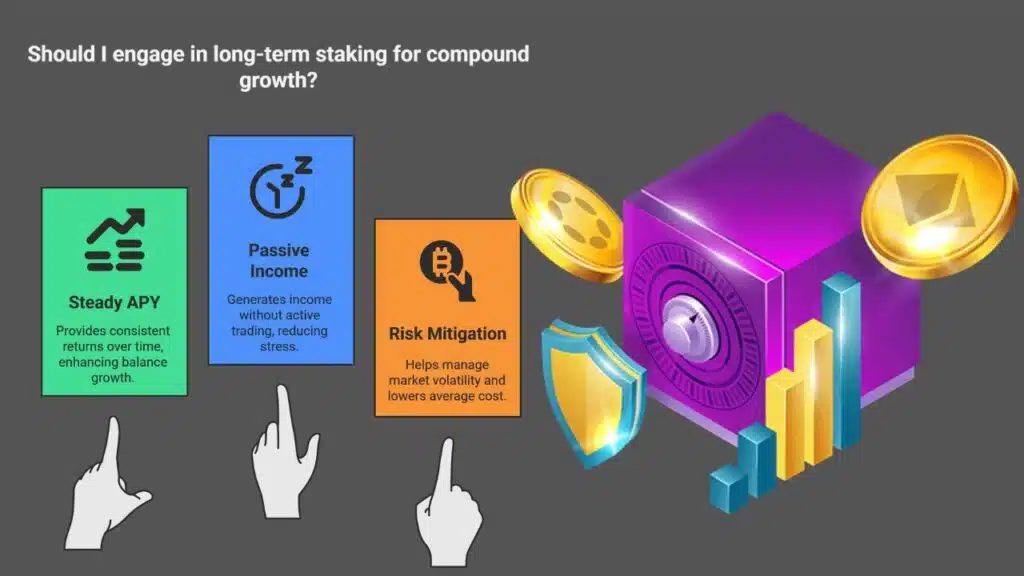
Steady APY from staking rewards can boost balances over time. APY factors in compounding interest, while APR shows only simple returns. Lock Ether on Ethereum through Lido and earn passive income.
Use CoinGecko’s Staking APY Calculator to map growth for long-term investment. That estimate shows 5% APY on 1,000 tokens becomes 1,280 in five years. Staking fills a yield farming role, but with less stress than trades.
Combine dollar-cost averaging with staking to smooth market volatility. You buy small amounts of digital assets each month and stake them on Tezos with MetaMask. That plan helps portfolio management and lowers your average cost.
It also aids risk mitigation. Locked tokens keep working for you. Over time, compounding can double or triple your initial stash.
How do I assess security measures to protect my staking investment?
Pick a cryptocurrency wallet with strong features, hardware device links, and regular updates. Store private keys offline like gold bars in a vault. Use two-factor authentication to lock down access.
Check staking platforms for auditing records, proof-of-reserves, and deposit insurance to boost trustworthiness.
Watch custodial risk if you hand over tokens. Scan news for hacking hits on CeFi or DeFi sites and move assets fast. Set a calendar to review security protocols and risk management steps every month.
Treat your staking investment like a locked safe.
How can I calculate and reduce staking costs?
Fees and penalties can shrink staking rewards fast. You might pay network transaction fees of 0.01 ETH per stake. A slashing penalty can cost up to 10% of your hold. I plug these figures into a staking calculator.
That shows net APY after pool fees, it factors in withdrawal limits and a 32 ETH minimum balance.
I cut extra transactions, I move coins in one batch. I pick a validator with low pool fees under 5%. I track reward accrual each day, so I know real returns. I scan a block explorer to check gas costs before I press send.
That habit stops hidden costs from nibbling my gains.
How should I adjust staking strategies based on market trends?
Market volatility can cut staking returns or boost them fast. Shift asset allocation across staking pools, digital wallets and DeFi platforms on trend analysis. Use risk management plans and risk/reward analysis to protect or grow stakes on Ethereum or Polkadot networks.
Watch market cycles, check network stats on block explorers and note protocol updates. Performance monitoring alerts you to regulatory changes that may force reallocation or unstaking.
Add options trading tools or lending strategies for yield generation in wild markets. Limit exposure to single tokens when market sentiment flips. Spread investments across tokens, platforms and pools to shape smarter investment strategies and boost diversification.
Ask a professional for advice on complex moves.
Why is it important to avoid overcommitting to one staking asset?
Diversifying staked coins cuts token-specific risk. Locking funds in one token can trap your liquidity. That can hurt you during a crash. Tokenomics flaws or protocol failures can wipe out most of your stake.
Spreading assets across validators and staking pools reduces slashing danger and platform failures. It smooths portfolio balance, boosts financial stability, and aids yield optimization.
Active risk management beats chasing high, concentrated returns.
How do I reevaluate and refine my staking strategy periodically?
You should review your staking plan each quarter. This process ties your financial goals to real network updates.
- Check staking performance monthly. Use a staking dashboard like DeFi Pulse or a block explorer such as Etherscan to track APY gains, rewards distribution, and network updates.
- Compare your APY with fresh network rates. Spot dips in Annual Percentage Yield APY and shift your tokens if you need better returns.
- Study market trends on Polkadot or Beacon Chain. Watch token price swings and run asset rebalancing to manage risk.
- Scan platform health and regulatory compliance. Follow SEC bulletins or local rules on Binance Smart Chain to guard your stake.
- Tune allocation adjustments after a validator lags or fees spike. Swap to a more stable node or a pool with lower charges.
- Set clear financial goals for compound growth. Align your term with an APY target and plan for compound yield.
- Review tax rules and reporting in your state. Use a staking calculator to map gains and prep for tax season.
- Learn from past rewards patterns. Log your wins and losses to refine your risk management and validator selection.
Takeaways
Long-term plans secure gains on blockchains through steady risk management. Picking a trusted node operator keeps coins safe. Spreading digital tokens across a reward collective and direct stakes can curb losses.
Watching APY and smart contract health helps tweak the tokenomics plan. Active review with a staking dashboard keeps you on track. A clear, patient approach pays off in the crypto game.
FAQs
1. What are the 7 staking strategies for long term crypto growth?
You can start with crypto staking on safe platforms, spread coins in different pools, pick a smart staking duration, use nodes that fit your risk style, try yield farming on the side, reinvest staking rewards early, and mix assets for portfolio diversification.
2. How do I pick the best staking platform for crypto staking?
Check security records, fees, and user feedback. Test with a small sum, talk in DeFi groups, watch how the system handles rewards, and then move on with more funds.
3. What is yield farming and compounding rewards?
Yield farming means you lend or stake coins to earn extra tokens. When you take those staking rewards and add them back to your stake, you build a snowball effect that boosts long term crypto growth.
4. How do risk management and portfolio diversification help my staking?
They keep your funds safe when markets swing. By spreading coins over pools and assets, you cut losses. You can set clear limits, have backup plans, and still chase gains without losing sleep.