South Africa has officially opened its doors to the global remote workforce, offering a unique opportunity to blend professional productivity with world-class landscapes. The South Africa digital nomad visa is designed specifically for individuals employed by foreign entities who wish to reside in the country for up to three years. By understanding the various application pathways, you can streamline your transition to life in cities like Cape Town or Johannesburg while maintaining your international career.
Our Selection Methodology
To curate this list of application methods, we evaluated each path based on its accessibility, processing speed, and legal reliability under the 2026 Department of Home Affairs guidelines. We prioritized routes that cater to different professional backgrounds—from corporate employees to independent freelancers—ensuring that each “way” provides a clear, documented trajectory. Our criteria also factored in the administrative burden, cost-effectiveness, and the specific documentation required for different residency durations.
Proven Paths to Securing Your South Africa Digital Nomad Visa
Navigating the immigration landscape requires a strategic approach tailored to your current location and employment status. The following methods represent the most effective ways to secure your permit and begin your South African journey.
1. The VFS Global Facilitation Route
Most applicants will interact with VFS Global, the official partner for South African visa processing in dozens of countries. This route is the most standardized, providing a clear online portal for document submission and appointment scheduling.
Best for: Applicants residing in major international cities where VFS manages the physical collection of biometric data.
Things to consider: Appointment slots can be limited during peak seasons, so it is vital to begin the digital portion of your application at least three months before your planned departure.
While VFS is the standard for many, some applicants may find a more direct route through government channels.
2. Direct Consular Submission
In regions where VFS Global does not have a presence, applicants must apply directly at the nearest South African Embassy or High Commission. This method allows for direct communication with consular officials who make the final decision on your file.
Best for: Nomads living in smaller jurisdictions or countries with a strong direct diplomatic presence from South Africa.
Things to consider: Requirements can sometimes vary slightly between missions, so double-checking the specific mission’s website for local “additional requirements” is essential.
For those who find the paperwork overwhelming, professional intervention can be a game-changer.
3. The Immigration Consultant Pathway
Engaging a South African immigration specialist ensures that your application is “decision-ready.” These professionals are well-versed in the nuances of the South Africa digital nomad visa and can often preemptively solve issues related to income verification or medical clearances.
Best for: High-net-worth individuals or those with complex employment contracts that don’t fit the standard “payslip” mold.
Things to consider: This is the most expensive option due to professional fees, but it significantly reduces the risk of rejection or lengthy delays.
Beyond the “who” of the application, the “how long” of your stay determines your tax strategy.
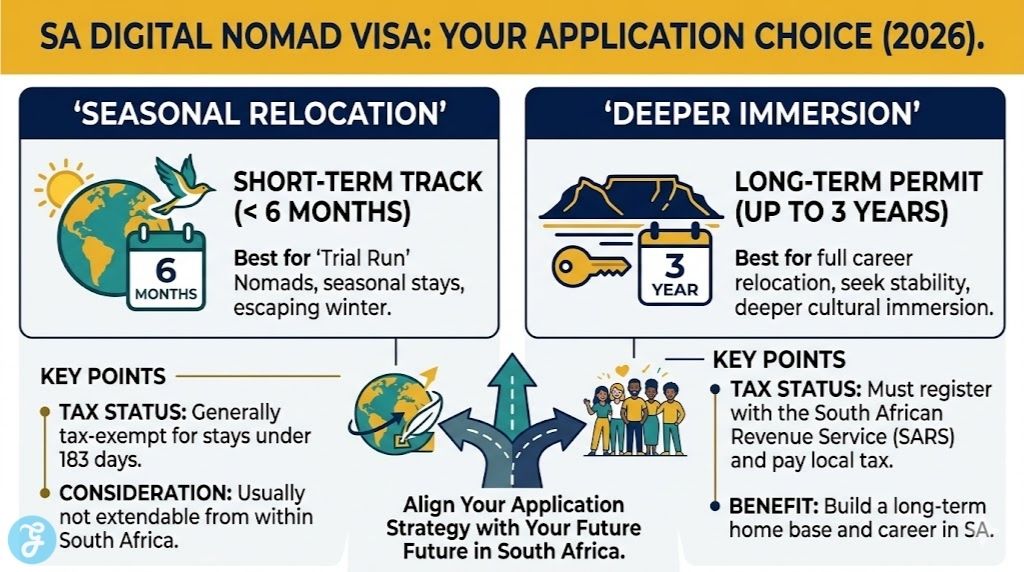
4. The Short-Term Six-Month Strategy
If you are looking for a temporary change of scenery without the complexities of tax residency, the 6-month version of the visa is the most efficient path. This allows for a half-year stay with minimal local tax administrative requirements.
Best for: Seasonal nomads looking to escape the Northern Hemisphere winter without triggering permanent tax obligations in South Africa.
Things to consider: While the application is simpler, this visa is not easily extended from within the country, often requiring a fresh application from abroad.
If a half-year isn’t enough, the long-term residency option provides much more stability.
5. The Three-Year Long-Term Permit
For those ready to fully relocate, applying for the maximum three-year duration is the most effective way to build a life in South Africa. This route requires proof of a long-term employment contract and local tax registration.
Best for: Career remote workers seeking a stable home base and a deeper cultural immersion in the Rainbow Nation.
Things to consider: You must register with the South African Revenue Service (SARS) and may be subject to local income tax if you spend more than 183 days in the country.
Independent workers have their own specific set of hurdles to clear during the application process.
6. The Verified Freelancer Route
Freelancers must apply by providing a comprehensive portfolio of client contracts and bank statements showing consistent income that meets the ZAR 650,976 threshold. This “way” focuses on proving the stability of your independent business.
Best for: Self-employed professionals and independent contractors with a diverse, non-South African client base.
Things to consider: The Department of Home Affairs requires clear proof that your income is derived entirely from foreign sources to prevent competition with the local labor market.
Finally, if you aren’t traveling alone, the family-based approach is the most cohesive way to move.
7. The Accompanying Dependents Pathway
South Africa allows the main visa holder to include a spouse and children in their application. This method consolidates the financial requirements, using the nomad’s income to cover the residency of the entire family unit.
Best for: Families and couples where one partner is a remote worker and the others will be residing as dependents.
Things to consider: Each family member requires their own set of medical and radiological reports, which can significantly increase the initial administrative workload.
Strategic Analysis
To help you decide which route is most suitable for your current situation, the information below compares the primary application methods based on cost, speed, and complexity.
| Application Method | Estimated Cost | Processing Speed | Document Complexity |
| VFS Global | Moderate | 8–12 Weeks | Standard |
| Direct Consular | Low | 6–10 Weeks | Moderate |
| Immigration Consultant | High | 4–8 Weeks | Low (Professional Handled) |
| Short-Term (6-Month) | Low | 4–6 Weeks | Minimal |
Our Top 3 Picks And Why?
-
VFS Global Route: This is our top pick for the average traveler because it offers the most transparent tracking system and a standardized list of requirements used globally.
-
Short-Term Strategy: We recommend this for first-timers because it offers the fastest approval times and avoids the immediate complications of South African tax registration.
-
Immigration Consultant: For those with the budget, this is the most reliable way to ensure a successful outcome, as they manage the intricate communication with the Department of Home Affairs on your behalf.
Preparation Checklist
Before you begin your application for the South Africa digital nomad visa, ensure you have checked off the following essential items:
-
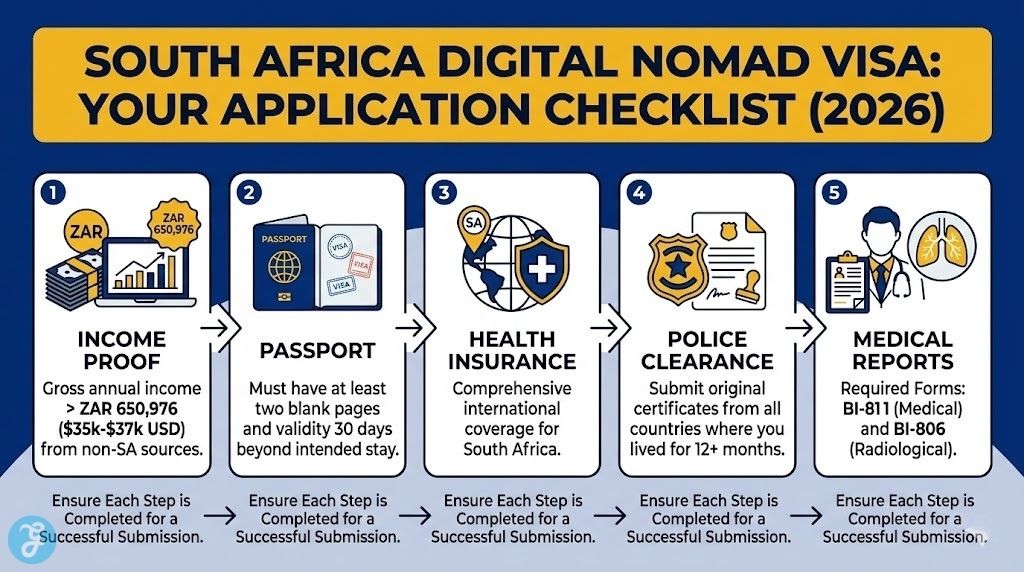
Proof of annual income exceeding ZAR 650,976 (approx. $36,000 USD).
-
A valid passport with at least two blank pages and 30 days of validity beyond your intended stay.
-
Comprehensive international health insurance with South African coverage.
-
Original police clearance certificates from every country you have lived in for 12+ months since age 18.
-
A signed employment contract from a foreign-based company.
Finalizing Your Move to the Rainbow Nation
The South Africa digital nomad visa represents a significant milestone for remote workers looking to experience the beauty and culture of the African continent. By selecting the application route that aligns with your professional status and timeline, you can minimize stress and maximize your time enjoying your new surroundings. Whether you choose the DIY VFS route or the expert-led consultant path, the key to success lies in meticulous documentation and early preparation.
FAQs
Do I need to pay tax in South Africa on this visa?
If you stay longer than 183 days in a 12-month period, you are generally considered a tax resident and must register with SARS.
Can I work for a South African company on this visa?
No, this visa strictly prohibits local employment. All your income must be derived from sources outside of South Africa.
How much does the visa cost?
Fees vary by country, but generally, you will pay a Department of Home Affairs fee of approximately $150–$200, plus any VFS service fees.
Are medical and radiological reports mandatory?
Yes, all applicants (except pregnant women and children under 12 for X-rays) must provide these reports to prove they are not carrying infectious diseases.