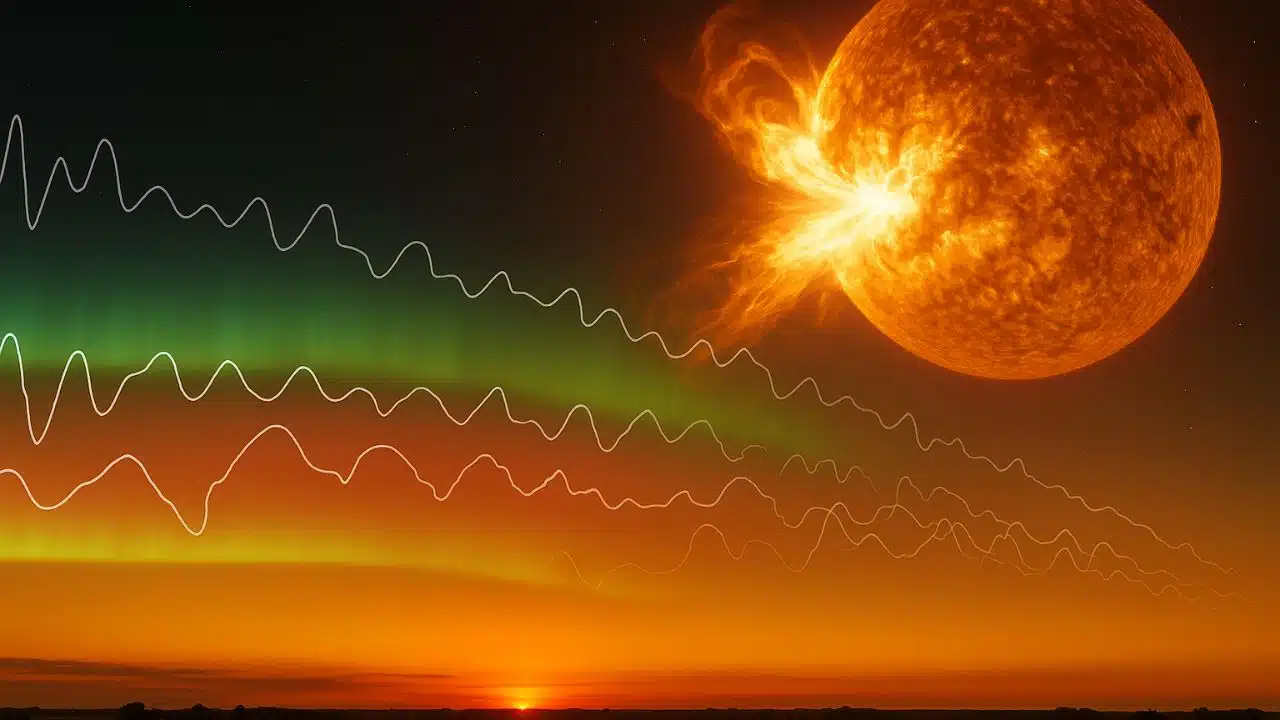
A series of unusually powerful solar eruptions this month has given scientists a rare opportunity to watch, in real time, how extreme space-weather events ripple through Earth’s upper atmosphere. From November 9 to 14, a cluster of intense X-class flares — the most energetic category of solar flares — erupted one after another from a single active region on the Sun, labeled AR4274. This rapid chain of events produced everything from brilliant auroras across low-latitude regions to serious disturbances in the ionosphere, the electrically charged layer of the atmosphere that enables radio communication, GPS positioning, and stable satellite operations.
While millions around the world admired brilliant curtains of color stretching across skies from northern Europe to states as far south as Florida, researchers at the New Jersey Institute of Technology’s Center for Solar-Terrestrial Research (CSTR) were tracking something far less visible but equally significant. Using NJIT’s radio observatories — including the Expanded Owens Valley Solar Array (EOVSA) and the newly operational Long Wavelength Array at Owens Valley Radio Observatory (OVRO-LWA) — scientists recorded how these solar eruptions jolted the ionosphere and altered radio-wave behavior across a wide range of frequencies.
The flare sequence itself was remarkable. On November 9, the solar region released an X1.7 flare. The next day brought an X1.2 flare. On November 11 came the standout event: an X5.1 flare, the strongest recorded so far in 2025. Then, on November 14, another major X4.0 flare erupted. Seeing four major X-class flares from the same region in less than a week is uncommon, and the cumulative impact proved just as extraordinary.
Because the flares occurred during nighttime hours in California, NJIT’s Big Bear Solar Observatory could not directly observe them in visible light. But the Owens Valley instruments were able to capture their atmospheric aftermath. EOVSA monitored microwave frequencies, similar to those used in satellite communications, while OVRO-LWA observed meter- and decameter-wave radio signals comparable to FM radio wavelengths. Together, these instruments revealed pronounced distortions in the ionosphere.
Under normal conditions, OVRO-LWA detects clean, nearly vertical type III radio bursts — signatures of high-speed electrons streaming through the solar corona and into interplanetary space. After these flares, however, the bursts appeared warped, curved, and chaotic at low frequencies. This distortion is a direct indication that the ionosphere was disturbed and behaving unpredictably. For ionospheric scientists, these changes were nearly as striking as the auroras filling social media feeds.
The solar flares also launched several coronal mass ejections, massive eruptions of magnetized plasma. These CMEs set off a powerful geomagnetic storm after striking Earth’s magnetic field. The storm reached the G4 level on NOAA’s five-point scale, marking it as a severe event. Measurements of the Dst index — a key indicator of how much Earth’s magnetic field is compressed — showed a dramatic plunge from about –40 nanoteslas to nearly –250 nanoteslas in just a few hours. Such a sharp drop indicates that Earth’s magnetic shield absorbed a significant blow, altering the flow of charged particles into the atmosphere.
Those charged particles produced the widespread auroras witnessed globally. Social groups devoted to aurora sightings reported a flood of images from regions that rarely, if ever, see the northern lights. Reports came in not only from northern U.S. states but also from Florida, where residents captured unexpected streaks of red, green, and purple illuminating the southern horizon. For space-weather researchers, this was a vivid reminder that Earth is highly connected to solar activity, despite the nearly 150 million kilometers separating our planet from the Sun.
The storm also served as an important test for NJIT’s expanding observational capabilities. OVRO-LWA recently transitioned to full solar-science operations, allowing researchers to probe the Sun’s middle corona — a region that remains difficult to observe yet plays a critical role in CME acceleration and magnetic restructuring. By combining this new instrument with EOVSA, scientists can now follow the progression of solar events from their earliest stages in the corona all the way to their effects on Earth’s upper atmosphere. This combined system is referred to as the Owens Valley Solar Arrays (OVSA), an integrated radio facility dedicated to advancing solar and space-weather research.
To deepen the analysis, NJIT researchers added another tool this year: a high-precision GPS receiver placed next to the OVRO-LWA. Nicknamed FLUMPH (Field-deployed L-band Unit for Monitoring Phase Hiccups), the device measures how solar-induced plasma irregularities disrupt real-world satellite-navigation signals. By pairing GPS data with ionospheric disturbances captured by the radio arrays, scientists can now track both the atmospheric turbulence and the resulting technological impacts at the same time. These measurements help illuminate why solar storms can degrade radio signals, interrupt aviation communications, distort GPS accuracy, and complicate satellite operations.
Researchers at CSTR emphasize that although this storm has passed, the scientific work to understand it is far from over. Because the Sun remains near the peak of its 11-year activity cycle, more strong flares and geomagnetic storms are likely in the coming months. Each event provides new insights into how the Sun’s magnetic forces evolve and how they influence Earth’s space environment. This knowledge is becoming increasingly important, given society’s dependence on satellite networks, GPS systems, communication towers, and other technologies vulnerable to space-weather disturbances.
As scientists continue to analyze data from this month’s storms, they note that such extreme events historically have the potential to disrupt power grids, interfere with radio and emergency communication systems, affect aviation routes, and even threaten spacecraft. While storm frequency will decrease as the Sun eventually moves toward its quieter phase, the solar cycle will rise again — and the next wave of extreme events will arrive in roughly 11 years. Understanding the current storm in detail will help the scientific community build better forecasting tools, improve mitigation strategies, and protect Earth’s increasingly space-reliant infrastructure.