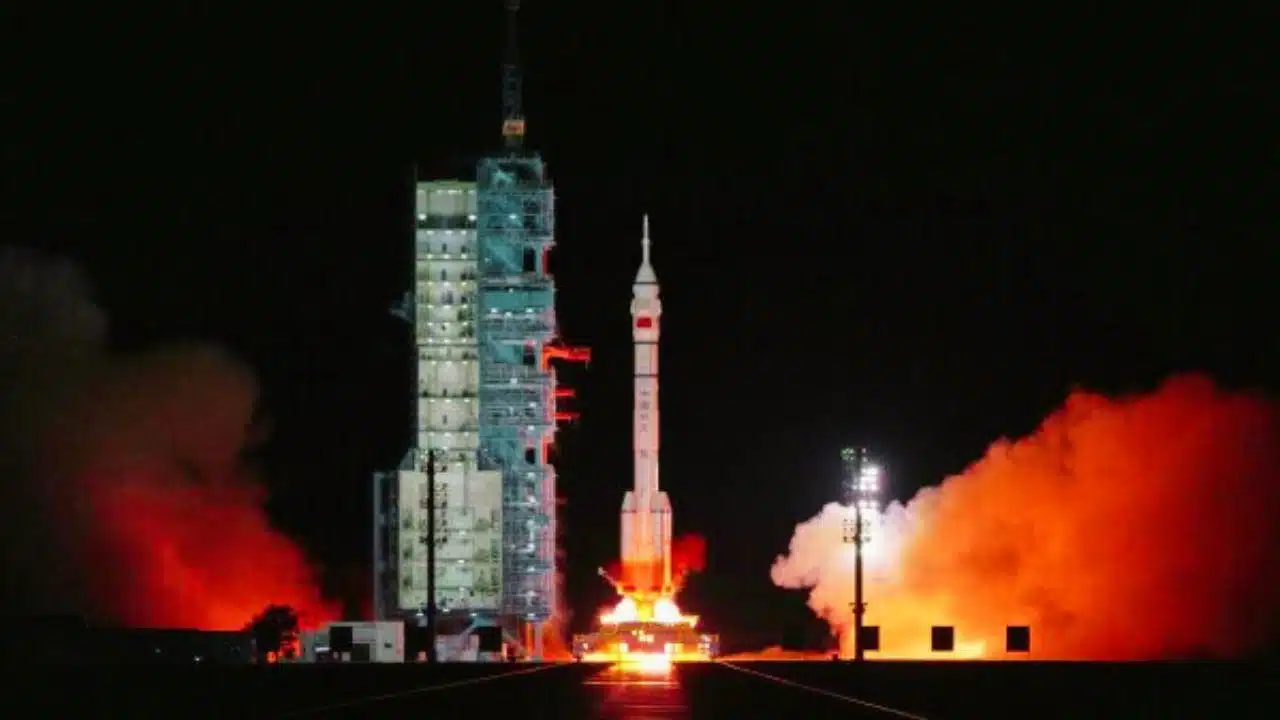
China is preparing to launch its next crewed spacecraft, Shenzhou‑22, ahead of schedule after debris damage to an earlier vehicle exposed a serious safety gap on the Tiangong space station and left the current crew without an emergency lifeboat in orbit.
Debris strike that cracked Shenzhou‑20
The chain of events began with Shenzhou‑20, which ferried three astronauts – Chen Dong, Chen Zhongrui and Wang Jie – to Tiangong in April 2025 for a roughly six‑month stay. In early November, as their return date approached, engineers detected tiny cracks in a window of the spacecraft’s return capsule, damage that mission officials say was most likely caused by the impact of small space debris traveling at orbital speeds.
Even hairline fractures in a crewed capsule’s window can be catastrophic, because the glass must withstand both the vacuum of space and the intense aerodynamic and thermal stresses of re‑entry, leading Chinese authorities to conclude that Shenzhou‑20 no longer met safety standards for a human landing.
Astronauts forced to swap spacecraft
The discovery threw China’s carefully choreographed crew rotation sequence into disarray. Under the original plan, the Shenzhou‑20 crew would depart in their own ship as the fresh Shenzhou‑21 trio settled in for a half‑year stint, leaving Shenzhou‑21 docked as a standby lifeboat. Instead, after a week of in‑orbit inspection, analysis and contingency planning, mission controllers ordered the three Shenzhou‑20 astronauts to come home in Shenzhou‑21, the vehicle that had just delivered their replacements.
The swap meant Shenzhou‑20 was left attached to Tiangong in a damaged, unflyable condition, while Shenzhou‑21 undocked early and brought Chen Dong and his crewmates back to a predawn landing in Inner Mongolia on November 14, ending 204 days in orbit.
Tiangong left without an escape vehicle
That emergency reshuffle solved the immediate problem of returning the Shenzhou‑20 crew but created a new one: the three Shenzhou‑21 astronauts remaining on Tiangong now have no working spacecraft to use in the event of a station emergency. For the first time since China began six‑month crewed rotations to Tiangong in 2021, the outpost is operating without a docked capsule capable of quickly evacuating its occupants.
Among those now effectively stranded until a new spacecraft arrives is 32‑year‑old Wu Fei, China’s youngest astronaut to fly to space, whose crew is scheduled to continue its half‑year mission conducting scientific experiments and station maintenance. The lack of an escape craft has raised concerns among outside experts, who note that other space stations, including the International Space Station, maintain multiple vehicles on standby to respond to debris threats, fire or depressurization.
Shenzhou‑22 pulled forward as safety fix
To plug this safety gap, China is now moving up the launch of its next Shenzhou mission. Shenzhou‑22, which had been slated for an April 2026 launch, will instead be sent to Tiangong ahead of schedule and reportedly without a crew on board, acting as a replacement lifeboat and cargo ship for the Shenzhou‑21 astronauts.
Once docked, Shenzhou‑22 will restore an emergency return capability for the station and allow the current crew to come home around April 2026 as originally planned, this time in a fresh spacecraft certified for re‑entry. Chinese space officials have described the timing of the launch only as “at an appropriate time,” but state media and regional outlets say preparations for the early mission are under way.
What happens to the damaged Shenzhou‑20?
The fate of Shenzhou‑20 itself remains unresolved and has become a technical and logistical challenge for the China Manned Space Agency. As long as the crippled ship occupies a docking port on Tiangong, it blocks future visiting spacecraft, yet sending it back through the atmosphere in its current state carries risks that engineers are still evaluating.
Experts cited in regional and international reports suggest two broad options: repairing and reinforcing the vehicle in orbit sufficiently to permit an uncrewed, controlled re‑entry, or undocking and deorbiting it directly for breakup over an uninhabited stretch of the Pacific Ocean. Chinese authorities have not yet announced which path they will take, and some analysts warn that leaving the vessel attached indefinitely would complicate future Shenzhou traffic and station expansion plans.
Lessons from Russia’s Soyuz “coolant leak” crisis
China’s contingency playbook for Shenzhou‑22 appears to draw on the experience of Russia’s Soyuz program, whose design served as the original template for the Shenzhou spacecraft. In December 2022, a micrometeoroid strike damaged the radiator of Soyuz MS‑22 docked to the International Space Station, forcing Russia to send up an uncrewed replacement, Soyuz MS‑23, to bring the crew safely home.
Russian space experts quoted in Chinese‑language and regional coverage say it is likely Chinese mission planners closely studied these “non‑standard situations” when drafting their response, from evacuation thresholds to the logistics of launching an empty rescue spacecraft on short notice. The Shenzhou‑22 plan mirrors that template: launch a fresh capsule, dock it to the station, and use it to repatriate astronauts whose original vehicle can no longer be trusted.
Space debris threat and China’s role
The Shenzhou‑20 incident has also reignited debate over the growing menace of space debris in low Earth orbit and China’s own contribution to the problem. The suspected culprit in the window cracking is a tiny, untracked fragment of debris – possibly a chip from an old satellite, rocket stage or previous collision – traveling at several kilometers per second, a regime where even millimeter‑scale particles can pierce shielding or fracture glass.
Ironically, analysts note, China itself was responsible for one of the worst single debris‑generating events in history when it destroyed a defunct weather satellite during a 2007 anti‑satellite test, producing more than 2,000 trackable fragments and tens of thousands of smaller ones that continue to threaten spacecraft today. The Shenzhou‑20 scare thus underscores how the debris environment is now endangering the very human spaceflight programs that helped create it.
Striking a balance between ambition and risk
For Beijing, the episode is an unwelcome reminder that operating a permanently crewed station demands constant vigilance and redundancy. Tiangong is a centerpiece of China’s ambitions to become a major space power, supporting scientific experiments, Earth observation and technology demonstrations, and serving as a platform for international cooperation outside the US‑led ISS framework.
By choosing to delay a crew’s return, swap spacecraft and rush forward an additional launch, China’s space authorities signaled that astronaut safety will take precedence over schedule, even as they press ahead with plans for more complex missions and potential crewed lunar flights later in the decade. Shenzhou‑22’s early debut will be closely watched as a test not only of China’s technical resilience but also of how the world’s newest space station manages the unforgiving realities of orbital life.