
Bangladesh has always been a land of stories, songs, and theater. From the days of the Language Movement to the Liberation War, culture was not just entertainment—it was a tool of identity and freedom. Yet today, as the country is flooded with global media, streaming platforms, and Western pop culture, many of our local voices are fading.
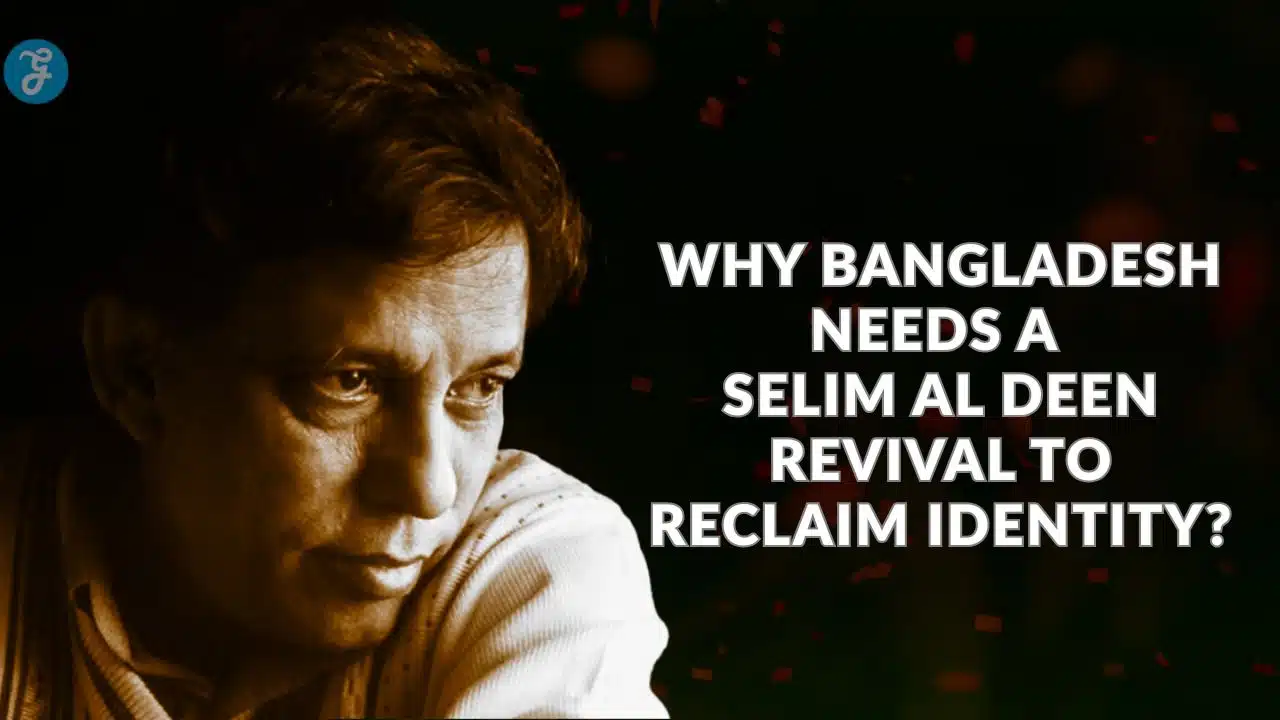
Among those voices, one name shines brighter than most—Selim Al Deen. On his 76th birth anniversary, we are reminded of a man who reshaped Bangladeshi theatre with vision, passion, and a deep love for folk traditions. His works were not just plays; they were lessons about life, history, and culture.
But more than a memory, Selim Al Deen is a need of the present. To reclaim our cultural identity, Bangladesh must return to his ideas, his theatre, and his spirit.
The Context of Cultural Identity in Bangladesh
The history of Bangladesh is deeply tied to culture. The Language Movement of 1952 proved that culture and identity are inseparable. The Liberation War of 1971 also showed how songs, poems, and theater could inspire unity and courage.
Yet, in today’s Bangladesh, culture faces new challenges. Globalization brings Western music, cinema, and fashion to our fingertips. Young people spend more time on TikTok, Netflix, or YouTube than in theaters or cultural centers. As a result, folk traditions, which once shaped the soul of this nation, are slowly being forgotten.
This cultural shift makes the revival of Selim Al Deen more urgent than ever.
Selim Al Deen—The People’s Playwright
Selim Al Deen was not an ordinary playwright. Born in 1949, he studied literature and became a teacher at Jahangirnagar University, where he later founded the Department of Drama and Dramatics. But his greatest contribution was not in classrooms—it was on the stage.
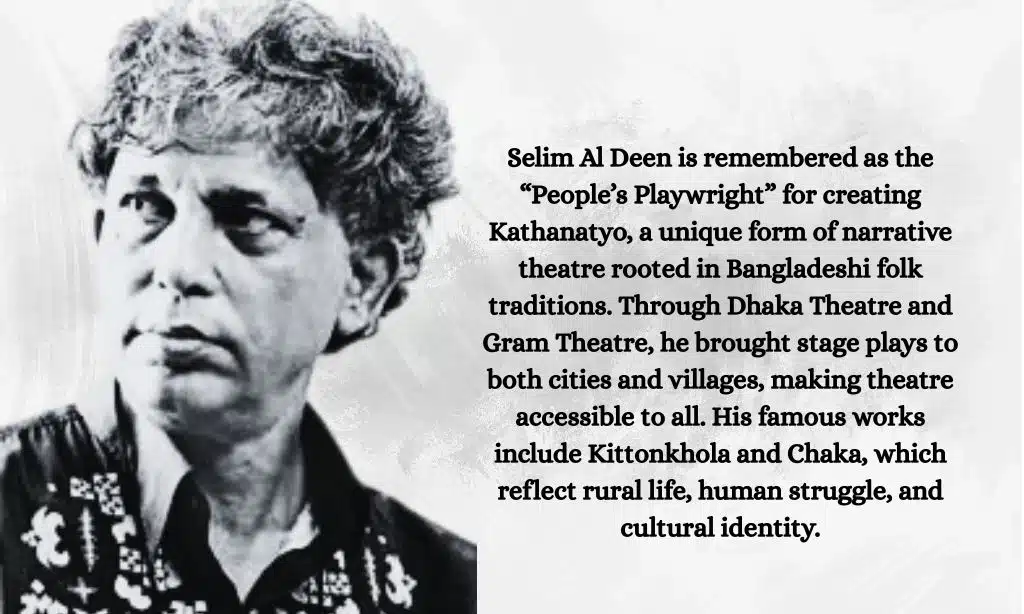
He believed that Bengali theatre should not copy Europe. Instead, it should grow from its own soil. He created the unique style of Kathanatyo, or narrative theatre, where a play could mix storytelling, music, song, dance, and poetry.
Through Dhaka Theatre and Gram Theatre, he took theatre to both cities and villages. His plays were not for elites; they were for farmers, workers, and ordinary people. He gave them a voice and showed that theater belongs to everyone.
The Cultural Gaps His Work Tried to Bridge
Bangladesh has always had two cultural worlds: one urban and modern, the other rural and traditional. Selim Al Deen worked to unite them.
-
In Kittonkhola (1985), he showed the struggles of village life, written with deep love for rural communities.
-
In Chaka (1991), he explored human suffering and destiny, proving that local stories could carry universal messages.
He also resisted colonial influence. For centuries, South Asian theatre had been shaped by Western styles like Shakespeare or Ibsen. Selim Al Deen challenged that trend. He argued that Bangla theater had roots of its own, older and deeper than Europe’s. His plays were both local and global—telling Bangladeshi stories but carrying meanings that touched audiences anywhere.
The Decline of Folk-Inspired Theatre After His Death
When Selim Al Deen passed away in 2008, Bangladesh lost more than a playwright. It lost a guiding spirit.
Since then, theater has slowly shifted. Urban productions have grown more elitist, often catering to a small audience instead of the masses. Meanwhile, the rise of digital entertainment—OTT platforms, social media, and global streaming—has stolen the spotlight from live plays.
The rural theatre movement that he dreamed of has weakened. And sadly, there has been little effort to preserve or modernize his works for new generations. Without revival, his legacy risks fading into history.
Why Bangladesh Needs a Selim Al Deen Revival Today
The call for a revival is not about nostalgia—it is about survival of cultural identity.
-
Cultural Identity Crisis: In a world dominated by Hollywood and Bollywood, Bangladesh risks losing its unique voice. Selim Al Deen’s theatre reminds us of who we are.
-
Education Beyond Schools: His plays can act as “people’s universities,” teaching history, values, and philosophy outside classrooms.
-
Global Recognition: Just as the world remembers Brecht or Tagore, Selim Al Deen can represent Bangladeshi theater on a global stage.
-
Youth Connection: Young people need role models from their own culture. A revival of his works in modern formats can bridge generations.
If Selim Al Deen Were Alive Today: How Would He Use AI, AR & VR in Theatre
Selim Al Deen was always a visionary. He refused to copy Western theatre and instead invented his own style rooted in folk traditions. If he were alive in 2025, it’s easy to imagine that he would treat modern technology—artificial intelligence (AI), augmented reality (AR), and virtual reality (VR)—not as threats, but as tools to expand his ideas.
-
AI for Storytelling: He might have used AI to collect folk tales from villages, archive dialects, and generate scripts that reflect the diversity of rural voices. For him, AI would be a digital assistant to preserve culture, not replace human creativity.
-
AR for Immersive Folk Theatre: Imagine watching Kittonkhola, where AR overlays turn a simple stage into a living paddy field or a village fair. This would make theater accessible and exciting for younger audiences.
-
VR for Global Reach: Selim Al Deen wanted Bangladeshi theater to speak to the world. With VR, his plays could be staged in Dhaka but experienced by audiences in London, New York, or Tokyo—creating a truly borderless theatre.
Instead of fearing modern tools, he would likely have embraced them to keep his people’s stories alive in a digital-first world.
Why Selim Al Deen Matters More in 2025 Than Ever Before
The year 2025 is not just another date—it is a turning point for culture. The digital age has made entertainment fast, global, and disposable. TikTok dances, Hollywood blockbusters, and AI-generated content dominate screens. But in this noise, the question of identity becomes urgent: What makes us who we are?
This is why Selim Al Deen matters more today than ever before. His theater was not just about performance—it was about remembering roots, uniting communities, and resisting cultural erasure. In 2025, when global culture often feels like a copy-paste cycle, his vision teaches us that originality comes from our soil, our stories, and our people.
Reviving Selim Al Deen now is not about going back to the past—it is about bringing the past into the future with new tools, new voices, and new energy.
The Risk of Forgetting Him—What Bangladesh Stands to Lose
If Bangladesh fails to revive Selim Al Deen’s vision, the risks are heavy:
-
Folk traditions will vanish, replaced by globalized entertainment.
-
Theater will remain elitist and lose its role as the people’s stage.
-
Bangladesh will lose its distinct cultural voice in the world.
-
New generations will grow up knowing Marvel superheroes, but not Kittonkhola or Chaka.
Takeaways
Selim Al Deen was more than a playwright; he was a cultural architect. He showed us that theater can be a bridge between rural and urban, tradition and modernity, and local and global.
On his 76th birth anniversary, remembering him should not just mean placing flowers at his grave. It should mean a call to action. Policymakers, artists, educators, and citizens must work together to revive his theatre and philosophy.
Because a nation that forgets its theater forgets its soul. And to remember Selim Al Deen is, in truth, to remember ourselves.