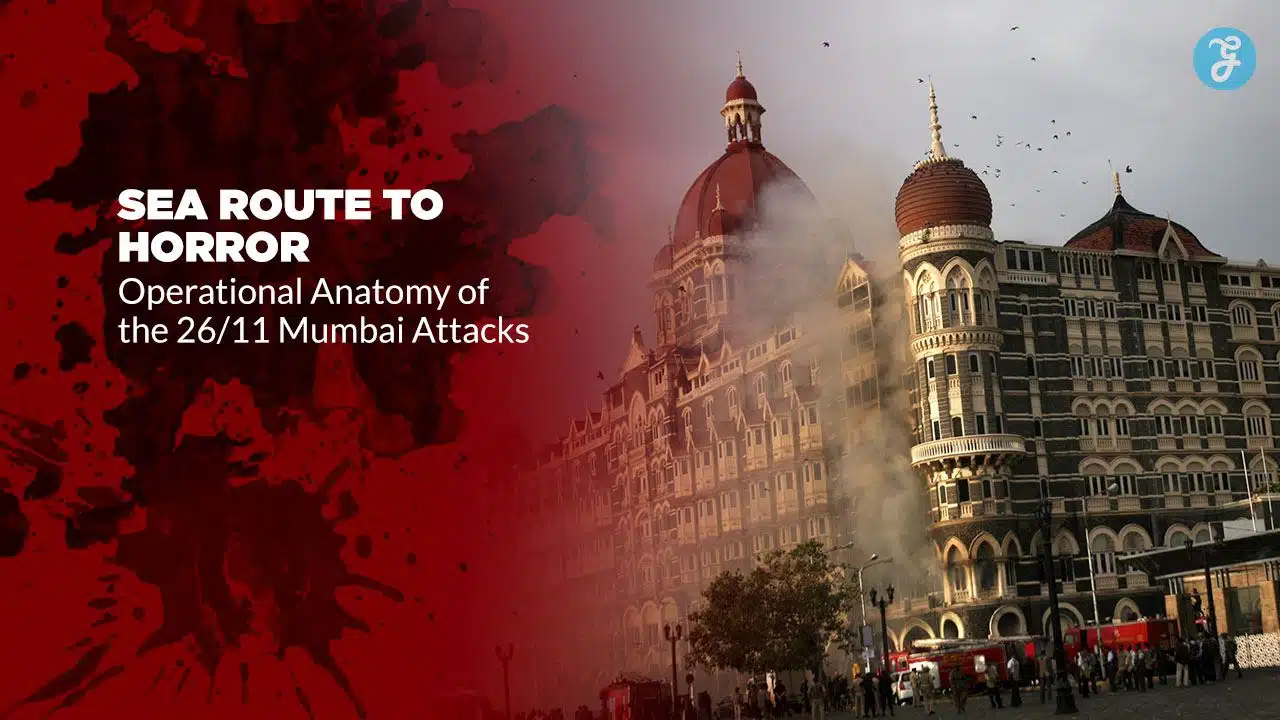
On the evening of 26 November 2008, Mumbai looked like any other busy weekday. Offices were closing, trains were crowded, and the streets around the Taj Mahal Palace Hotel, CST station, and Leopold Café were full of life. Within a few hours, that ordinary night turned into one of the darkest chapters in India’s history.
For nearly 60 hours, the city was under attack. Ten gunmen, trained and armed by the Pakistan-based group Lashkar-e-Taiba, moved across Mumbai and opened fire at hotels, a railway station, a Jewish centre and cafés. By the time the siege ended, 166 people were killed and more than 300 were injured.
Many people know 26/11 as a story of brave police officers, NSG commandos, hotel staff and ordinary citizens who helped others even as bullets flew. But there is another side of the story that we must understand very clearly: how ten men used the sea to reach Mumbai, and how this exposed huge gaps in India’s coastal and internal security.
This article looks at the operational anatomy of the attacks—the sea route, the planning, the failures and the reforms that followed. The goal is not to sensationalize the violence, but to learn from it so that a tragedy like 26/11 is never repeated.
Overview of the 26/11 Mumbai Attacks
Before we focus on the sea route and operations, it helps to see the big picture of the attacks.
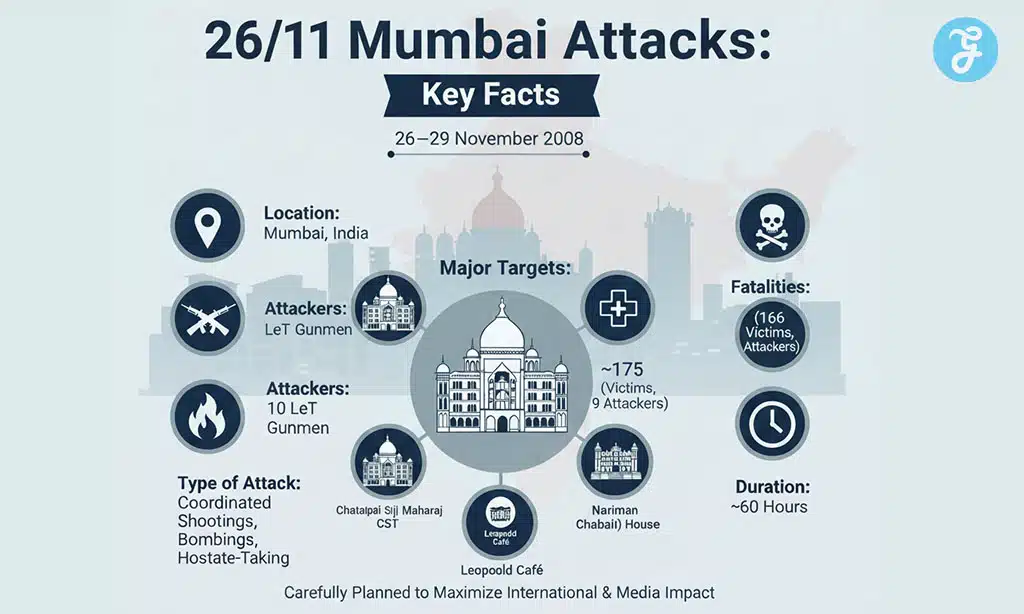
Key Facts at a Glance
| Aspect | Details |
| Dates | 26–29 November 2008 |
| Location | Mumbai, Maharashtra, India |
| Attackers | 10 gunmen linked to Lashkar-e-Taiba (LeT) |
| Major Targets | Taj Mahal Palace Hotel, Oberoi Trident, CST railway station, Leopold Café, Nariman (Chabad) House, Cama Hospital, Metro area |
| Type of Attack | Coordinated shootings, bombings, arson, hostage-taking |
| Fatalities | About 175 total deaths, including 9 attackers; 166 victims often quoted in Indian sources |
| Injured | 300+ |
| Duration | Around 60 hours |
| Surviving Attacker | Mohammed Ajmal Amir Kasab, later tried and executed |
The attacks were not random. They were carefully planned, with reconnaissance in Mumbai done earlier by operatives such as David Headley, and the selected targets were chosen to create maximum international and media impact.
How the Terrorists Reached Mumbai by Sea
One of the most chilling aspects of 26/11 is that the attackers arrived not by land or air, but through the Arabian Sea. This route allowed them to bypass many traditional checks and made the operation harder to detect.
From Karachi to the Arabian Sea
The journey began in Karachi, Pakistan. The attackers boarded a Pakistani vessel and sailed into the Arabian Sea. Intelligence and later investigations showed that the attackers had been trained at facilities linked to Lashkar-e-Taiba, which combined weapons training, navigation, and even simulated attacks on mock urban targets.
The sea route offered many advantages to the planners:
- Fewer surveillance systems compared to airports and land borders at that time.
- Huge traffic of fishing boats and small vessels, making it easier to hide.
- Long and complex coastline on the Indian side, difficult to monitor without strong coordination and technology.
The Hijack of the Indian Fishing Trawler Kuber
In the high seas, the terrorists hijacked the Indian fishing trawler Kuber off the Gujarat coast. The crew was killed, and Kuber became their “mother ship” for the final phase of the journey.
The choice of Kuber was strategic:
- An Indian-flagged boat raised fewer suspicions near the Mumbai coast.
- It allowed the terrorists to come closer to shore before switching to smaller craft.
- It highlighted serious gaps in monitoring of fishing vessels—thousands of such boats operate daily with limited tracking.
When Kuber was later found, investigators discovered GPS sets, satellite phones, weapons and other evidence that helped reconstruct the route and planning.
Final Approach—Inflatable Dinghies and the Landing Points
Near Mumbai, the attackers abandoned Kuber and used inflatable rubber dinghies for the last stretch. They landed in the Colaba/Badhwar Park area and other points along the city’s southern coastline.
Local fishermen later recalled that they found the men suspicious and tried to warn the authorities, but the response was slow and unclear.
This final phase showed several weaknesses:
- No systematic check of incoming small boats.
- Limited night patrols and coastal police presence.
- Poor communication channels between fishermen, local police and higher agencies.
The sea route made 26/11 not just an urban terror attack but also a maritime security failure.
The Operational Plan—From Landing to Multiple Attack Sites
Once on land, the ten attackers split into teams. Their actions followed a detailed plan aimed at spreading fear, stretching security forces, and grabbing global media attention.
Splitting Into Teams and Moving Across Mumbai
After landing, the attackers used taxis and walked towards pre-selected targets. They operated in pairs:
- Taj Mahal Palace Hotel – two attackers
- Oberoi Trident Hotel – two attackers
- Chhatrapati Shivaji Terminus (CST) and Cama Hospital area—two attackers
- Nariman (Chabad) House – two attackers
- Leopold Café and nearby areas—part of the same teams before moving to other sites
The timing and sequence created chaos. Shootings began almost simultaneously at CST, Leopold Café, and the hotels. Hostage situations soon followed.
Weapons, Communications and Remote Control
Investigations revealed that the attackers carried:
- Assault rifles (AK-type)
- Hand grenades
- Improvised explosive devices (IEDs) and explosives like RDX
- Mobile and satellite phones/VoIP devices
They stayed in constant touch with handlers in Pakistan, who monitored live TV coverage and gave instructions in real time. The handlers urged them to kill more hostages, start fires and prolong the siege to keep the world watching.
This remote control model showed a new level of “command-and-control” style terrorism, where the attackers were both fighters and media instruments.
Symbolic Targets and “Maximum Impact”
The choice of targets was not random:
- Luxury hotels (Taj and Oberoi Trident) symbolized India’s economic rise and hosted many foreign guests.
- CST station was one of India’s busiest railway hubs, crowded with ordinary commuters.
- Leopold Café was a popular tourist spot.
- Nariman (Chabad) House was a Jewish center, adding an international and religious angle.
By hitting these locations together, the planners wanted:
- High casualty numbers.
- 24/7 global news coverage.
- Pressure on the Indian state and international community.
The operational design therefore combined urban warfare, media warfare and psychological warfare.
Security and Intelligence Lapses—Where the System Failed
The 26/11 attacks did not happen in a vacuum. Later reports showed that there had been warnings and intelligence inputs about possible attacks, including those using the sea route. But the system failed to convert those warnings into action.
Warnings and Missed Signals
Indian and foreign intelligence agencies had shared information about:
- Possible terror plots against Mumbai.
- The interest of Lashkar-e-Taiba in major Indian cities.
- The risk of attack through the maritime route.
However, most alerts were broad and not linked to specific dates or exact targets. Different agencies held pieces of the puzzle, but coordination and information-sharing were weak. Decision-makers did not upgrade security to the level needed.
The Maritime Blind Spot
Before 26/11, India’s long coastline was a serious security weak point. Several issues stood out:
- Limited coastal radar coverage and poor integration of sensors.
- Marine police units in many states were understaffed and under-equipped.
- Fishing boats were not tracked through reliable ID systems or AIS devices.
- Jurisdiction overlaps between the Navy, Coast Guard, state police and port authorities.
In this environment, a small group of trained men could sail hundreds of kilometers, hijack a boat, and land near India’s financial capital with little resistance.
First Responders on the Back Foot
When the shooting started, Mumbai Police officers were the first to respond. Many of them had:
- Old weapons compared with the attackers’ automatic rifles.
- Little training in dealing with heavily armed terrorists in crowded public places.
Despite this, several officers fought bravely and gave their lives, including senior officers like Hemant Karkare, Vijay Salaskar and Ashok Kamte, and constables such as Tukaram Omble, who helped capture Ajmal Kasab alive.
Their courage prevented an already terrible night from becoming even worse, but the overall response showed that India was not fully prepared for such a complex, multi-site attack.
India’s Response—From Operation Cyclone to Systemic Reforms
The immediate and long-term responses to 26/11 reshaped India’s counter-terror and coastal security systems.
Counter-Terror Operations on the Ground
Once it became clear that Mumbai was under a major terror attack, different forces moved in:
- Mumbai Police and Railway Protection Force responded first at CST and nearby areas.
- Marine Commandos (MARCOS) of the Indian Navy were deployed, especially around the waterfront and the Taj.
- National Security Guard (NSG) commandos were flown in from Delhi.
Operations at the Taj, Oberoi and Nariman House were extremely complex. The attackers knew the layout well, had hostages, and used fire and explosions to slow the forces. It took almost three days to neutralize them.
Coastal Security Overhaul After 26/11
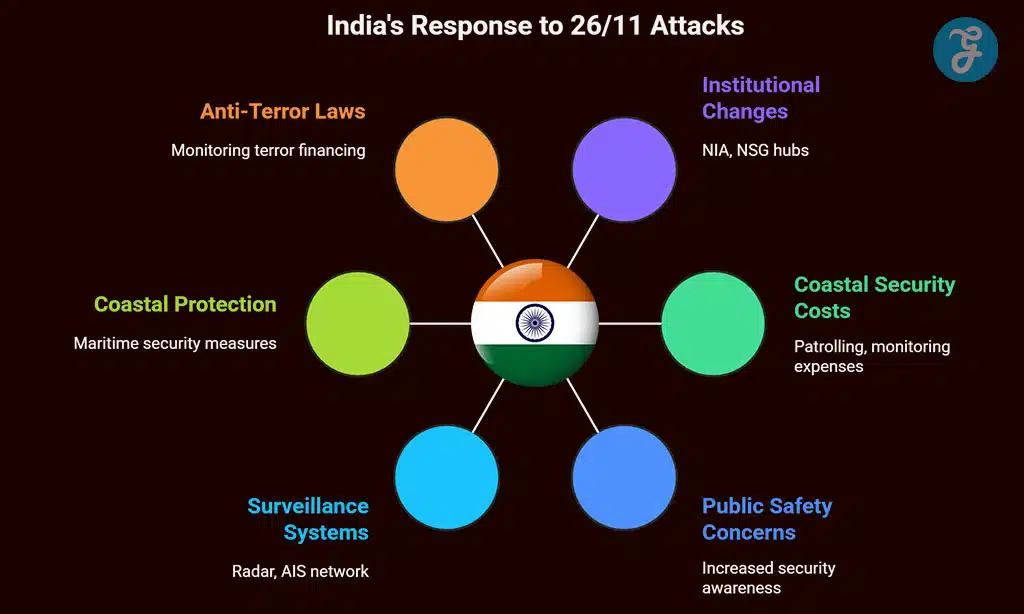
After the attacks, the government launched a major drive to strengthen coastal and maritime security. Key measures included:
- Three-tier coastal security system with defined roles for the Indian Navy (outer layer), Coast Guard (middle layer) and coastal/marine police (near shore).
- Setting up Joint Operation/Command Centers in Mumbai, Kochi, Visakhapatnam and Port Blair to coordinate information and response.
- Expansion of the Coastal Radar Chain and Automatic Identification System (AIS) network to monitor vessel movements.
- Strengthening of marine police stations and addition of high-speed boats for patrolling.
Despite these steps, many experts say that implementation has been uneven and that coastal security is still a “work in progress” even years after 26/11.
Institutional Changes—NIA, NSG Hubs and Legal Tools
The attacks also led to changes in India’s internal security institutions:
- Creation and empowerment of the National Investigation Agency (NIA) as a central body to investigate major terror cases across states.
- Setting up NSG hubs in cities like Mumbai, Kolkata, Chennai and Hyderabad to reduce response time in any future attack.
- Amendments to anti-terror laws and closer monitoring of terror financing and cross-border networks.
International cooperation also increased. For example, cooperation with the United States helped in tracking key conspirators like David Headley and Tahawwur Rana, and more recently, the US extradited Rana to India over his alleged role in the attacks.
Operational Lessons for Future Maritime and Urban Security
The 26/11 attacks remain a textbook case for security agencies and analysts around the world. They show how a small group of men, armed and guided from afar, can exploit gaps in both sea and city security.
Lessons from the Sea Route
Key maritime lessons include:
- Layered Defense is Essential: Security cannot rely on a single force or technology. A layered system—with radar, patrols, community reporting and intelligence fusion—is needed to spot unusual movements early.
- Fishing and Coastal Communities Are Frontline Eyes and Ears: Fishermen are often the first to notice suspicious vessels. After 26/11, programs were launched to issue ID cards, conduct awareness workshops and build hotlines between fishermen and security agencies. Effective use of this human network is critical.
- Technology Must Reach the Last Mile: Radar chains, AIS, GPS tracking and satellite links are valuable only if data from them reaches officers who can act on it. This requires integrated command centers and trained staff.
Lessons for Urban Counter-Terror Response
On land, the attacks highlighted several needs:
- Specialized training for local police in urban combat, hostage rescue basics and coordination with elite units.
- Better equipment—modern rifles, body armor, helmets and communication gear.
- Regular joint drills between police, NSG, armed forces, hospitals and city authorities to reduce confusion during emergencies.
Analysts also stress the importance of intelligence-led policing, where local police units are trained and encouraged to pick up early signs of radicalization or reconnaissance by terror cells.
Are We Really Safer Today?
Has India become safer since 2008? The answer is mixed.
On the positive side:
- There have been no attacks of similar scale and complexity in Mumbai since 26/11.
- Coastal radar coverage, marine policing and institutional structures like NIA and NSG hubs have clearly improved.
But challenges remain:
- Uneven implementation of coastal security measures across states.
- Rising threats from smaller, decentralized cells, lone-actor attacks and online radicalization, which require new methods and strong community engagement.
- Need for constant funding, training and political focus so that security reforms do not fade with time.
The real lesson of 26/11 is that security is not a one-time project. It is an ongoing process that must evolve as threats evolve.
Human Cost and Memory—Beyond Maps and Timelines
When we speak of “operational anatomy” or “coastal security,” it is easy to forget that 26/11 was, above all, a human tragedy.
Among the dead were:
- Commuters at CST who were simply trying to get home.
- Hotel workers who guided guests to safety and went back into danger.
- Police officers who rushed in with little protection.
- Staff and visitors at Nariman House, including children.
Every year, families of victims and survivors gather at memorials at CST, the Taj and other sites. Police personnel stand in silence. Wreaths are laid, candles are lit, and names are read out.
These ceremonies are not only about grief. They are also about reminding the country and the world that behind every statistic there is a story:
- A parent who never came home.
- A child who grew up without a mother or father.
- A police officer whose last act was to shield others.
Any discussion on strategy or security after 26/11 must keep these people at the center. Operational lessons have meaning only if they protect human lives and dignity.
How Much Threat Are India’s Big Cities Facing Today?
India’s big cities—Delhi, Mumbai, Bengaluru, Hyderabad, Kolkata, Chennai, and others—are still high on the radar of terrorist groups.
The good news:
- Since 26/11, there has been no attack of that scale in a major metro.
- Security systems, intelligence sharing, and coastal and urban policing have improved.
The bad news:
- Terror groups have not stopped targeting India.
- Instead of one big spectacular attack, many plots now involve smaller cells, lone attackers, or covert modules inside cities.
- Agencies are foiling more plots, but some still succeed.
The Overall Terrorism Picture
According to recent assessments (including the U.S. Country Report on Terrorism 2023 and Indian security think tanks):
- Most actual attacks still occur in Jammu & Kashmir, parts of the Northeast, and some central and eastern states with Maoist activity.
- Islamist terror groups like Lashkar-e-Taiba (LeT), Jaish-e-Mohammad (JeM), ISIS-inspired cells, and others remain active or aspirational.
- Urban centers are priority “high-value targets” because of crowds, media visibility, and economic importance.
So, India’s big cities are in a situation where:
- Risk is real, especially from hidden modules, online radicalization, and cross-border support.
- But security capacity is also much stronger than it was in 2008, with NSG hubs, better city policing, and more frequent intelligence-based raids.
Why Big Cities Are Still at High Risk
Big cities offer everything that terror planners look for:
- Crowded places: markets, metros, railway stations, religious gatherings, and festivals.
- Symbolic sites: parliaments, courts, historic monuments, luxury hotels, and foreign missions.
- Media impact: an attack in Delhi or Mumbai is instantly global news.
This is why security around locations like Red Fort, India Gate, major temples, airports, sea fronts, IT parks and malls is constantly being upgraded.
After 26/11, reforms included:
- NSG hubs in multiple metros to cut response time.
- Stronger city-level anti-terror units, bomb disposal squads and SWAT teams.
- Wider use of CCTV networks, number-plate recognition, metal detectors and access control in high-risk zones.
- More joint drills involving police, hospitals, and disaster-response forces in big cities.
These steps reduce the chances that an attack will succeed or escalate unchecked—but they do not reduce the threat to zero.
Latest Terrorist Activities and Plots Involving Big Cities (2023–2025)
Here is a short, updated snapshot of recent terror incidents and plots linked to Indian cities. This is not a full list, but it shows the kind of risks Indian metros still face.
Delhi Red Fort Car Blast, 2025
- In November 2025, a car packed with explosives blew up near Delhi’s Red Fort, killing around 12–13 people and injuring many more.
- Investigators say the blast was carried out by a Jaish-e-Mohammad–linked “white-collar” terror module made up of professionals such as doctors, a cleric and businessmen.
- The same network is linked to the seizure of around 2,900 kg of explosives and chemicals in Faridabad, showing both the scale of planning and the ability of agencies to uncover caches.
- The blast led to nationwide alerts and special security checks in major cities.
This single case shows two things at once: big risk (a successful VBIED attack in the capital) and big success (a huge amount of explosives seized and a large network exposed).
“White-Collar” Module and Explosive Mishap in Srinagar
- The explosives seized from this module were being examined at Nowgam police station in Srinagar when an accidental blast killed 9 people (mostly police and forensic staff) and injured more than 30.
- This tragic accident was not a terror attack itself, but it came directly from the handling of terror-linked explosives, underlining how dangerous these networks are even after seizures.
ISIS/ISKP-Linked Plots Targeting Multiple Cities
- In June 2024, the NIA filed a chargesheet against 17 ISIS operatives in the Delhi–Padgha module. The group was accused of radicalizing youth, making IEDs and planning attacks, including in and around the national capital region.
- Reports in 2023–24 note that NIA has busted dozens of ISIS-linked modules across India, many of them with plans involving cities and symbolic targets.
- In late 2025, Gujarat ATS arrested two youths from Uttar Pradesh and a doctor from Hyderabad for an ISKP-linked plot involving drone-delivered arms from Pakistan and plans to hit cities like Lucknow, Delhi and Ahmedabad.
These cases show a move towards tech-savvy, cross-border, and online-coordinated terrorism, where weapons may be sent by drones, and planners may sit in Afghanistan or Pakistan while recruiting youth in Indian cities.
Threat Messages and High Alerts in Mumbai
- In September 2025, Mumbai Police received a WhatsApp threat claiming that 34 “human bomb” vehicles and 14 Pakistani terrorists had entered India with 400 kg of RDX and planned massive attacks during Ganesh Visarjan.
- The message triggered a huge security response—extra checks, intelligence operations, and visible police presence. As of now, it is treated as a serious threat, and no such attack has taken place.
Even when threats turn out to be hoaxes or exaggerated, they revive memories of 26/11 and push agencies to test and tighten their systems again and again.
Continuing Violence in Jammu Region
While this is not a metro area, it is important for the big-city threat picture:
- In 2024, terror attacks hit 8 out of 10 districts in the Jammu region, killing 44 people, including 18 security personnel and 13 terrorists.
Why does this matter for cities? Because many terror networks test themselves and recruit in conflict zones like J&K and then try to move operatives or explosives into major cities later.
So, How Much Threat Do Indian Metros Face?
Putting it all together:
- Yes, there is a real and continuing terror threat to India’s large cities.
- Terror groups still see cities like Delhi and Mumbai as prime targets for high-impact attacks.
- Recent events—the Red Fort car blast, massive explosives seizures, and ISKP-linked plots—prove that the danger is not theoretical.
At the same time:
- Security forces are more proactive than ever. Many modules are being caught before they attack.
- Coastal and urban security has improved since 26/11, with better technology, stronger laws, dedicated agencies and NSG hubs.
For your article’s tone, you can sum it up like this:
India’s big cities live with a quiet, constant threat.
But they also live with a quiet, constant vigilance. Each foiled module, each seizure of explosives, and each alert response is another sign that the country learnt hard lessons from 26/11—and is still learning.
The Sea We Cannot Ignore
The 26/11 Mumbai attacks were more than a sequence of gunfights and explosions. They were the result of long-term planning, careful use of the sea route, and serious security gaps on land and at sea.
Ten men crossed the Arabian Sea, hijacked a small Indian boat, and walked into India’s financial capital. In doing so, they changed the way the country—and much of the world—thinks about urban and maritime terrorism.
Yet, even as we analyze operations and reforms, we must remember the human heart of this story. The bravery of hotel staff who led guests to safety. The courage of police officers who ran towards danger. The quiet strength of families who still live with loss. The resilience of Mumbai, which went back to work even as smoke rose from the Taj’s dome.
Understanding the operational anatomy of 26/11 is not an academic exercise. It is a moral responsibility. Every lesson learned, every gap closed, and every life protected in the future is a tribute to those who never came home that night.
The sea that carried terror to Mumbai in 2008 is the same sea that carries trade, fishermen, sailors and hope. The challenge for India—and for all coastal nations—is to make sure it never again becomes a silent highway for horror.