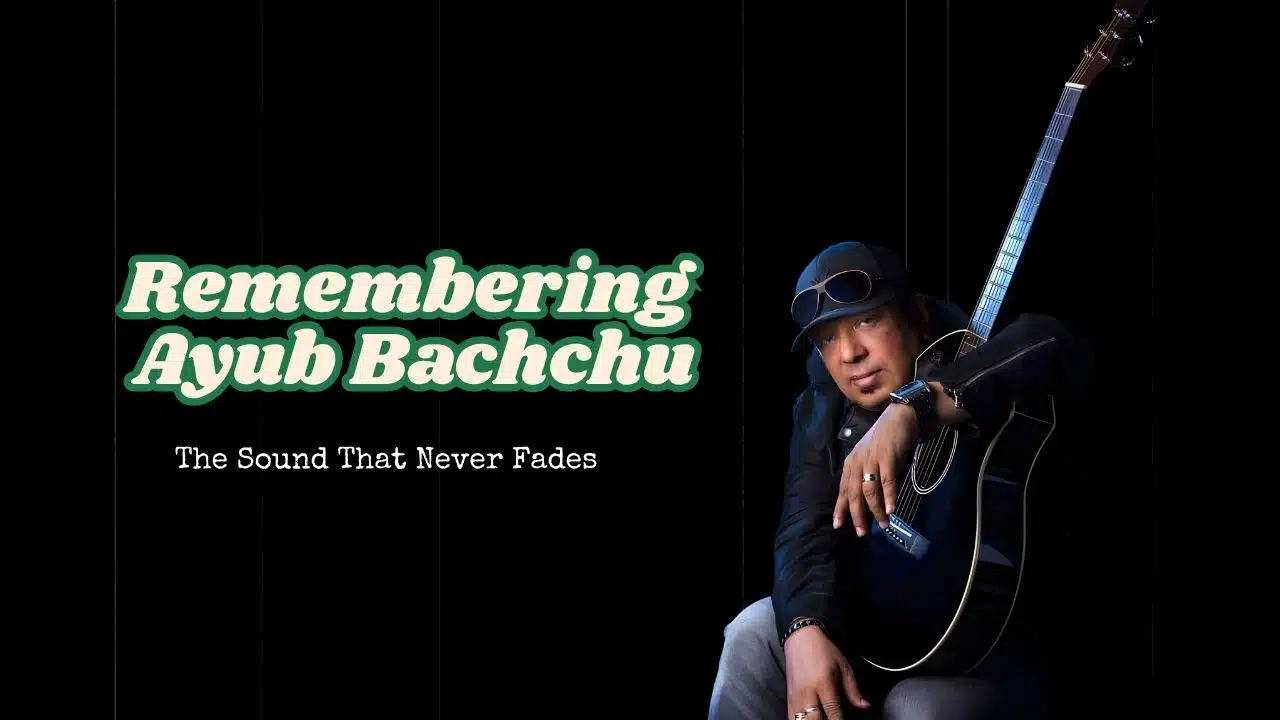
On an October morning in 2018, silence fell across Bangladesh. News of Ayub Bachchu’s passing spread like feedback through an amplifier—sharp, surreal, and unforgettable. For four decades, his guitar had been the nation’s pulse; when it stopped, an entire generation held its breath.
To many, he was more than a performer. He was the frequency of feeling—the man who made Bangla weep, dream, and rage through melody. Seven years on, his riffs still ripple through coffee shops, bus radios, and college canteens. Because Ayub Bachchu did not simply play guitar—he translated emotion into national language.
So, on his 7th death anniversary today, we are remembering Ayub Bachchu.
From Chattogram to Stardom: The Rise of a Rock Poet
Born in Chattogram in 1962, Ayub Bachchu grew up in a country learning to rebuild its rhythm after war. Amid scarcity, he found his first salvation in six strings. His teenage years were marked by experiments with cover bands, homemade amplifiers, and dreams far larger than the small port city he called home.
In the late 1970s, Bachchu joined Feelings, the band that would later evolve under James into Nogor Baul. But destiny soon called him elsewhere—to Souls, Bangladesh’s pioneering rock ensemble. There, as lead guitarist through the 1980s, he absorbed both musical precision and audience psychology. Each performance was a lab—and Bachchu was dissecting how sound could become social energy.
By the time he left Souls in 1991, he had outgrown the role of sideman. He wanted a band that reflected not just skill but spirit—one that could carry heartbreak, hope, and rebellion in equal measure.
LRB: When Love Ran Blind and the Revolution Began
In 1991, Ayub Bachchu founded LRB (Love Runs Blind)—a name both romantic and ironic in a conservative music industry that considered rock a foreign indulgence. He debuted with Bangladesh’s first double album, a defiant gesture that said, “We won’t fit in your format.”
The sound was raw, blues-soaked, and emotionally articulate. Tracks like Cholo Bodle Jai, Ferari Ei Monta Amar, Shei Tumi, and later Rupali Guitar turned everyday melancholy into mass catharsis. Each song became a mirror for a changing society—urban youth negotiating identity in a rapidly globalizing Dhaka.
“Bodle Jai” wasn’t just a lyric about transformation; it became a national mantra.
Bachchu’s leadership of LRB fused artistry with discipline. Rehearsals ran like corporate workshops—precise timing, tone audits, and stage drills. He balanced creative chaos with professionalism, establishing the template for modern band culture in Bangladesh.
| Era | Album | Defining Track | Cultural Impact |
|---|---|---|---|
| 1991–94 | LRB (Double Album) | First modern rock anthem in Bangla | |
| 1995–99 | Ferari Mon, Shukh | Rupali Guitar, Cholo Bodle Jai | Guitar as symbol of aspiration |
| 2000–2010 | Sporsho, Ochena Jibon | Ghum Vanga Shohore | Rock meets urban realism |
The Sound of a Generation: His Musical Philosophy
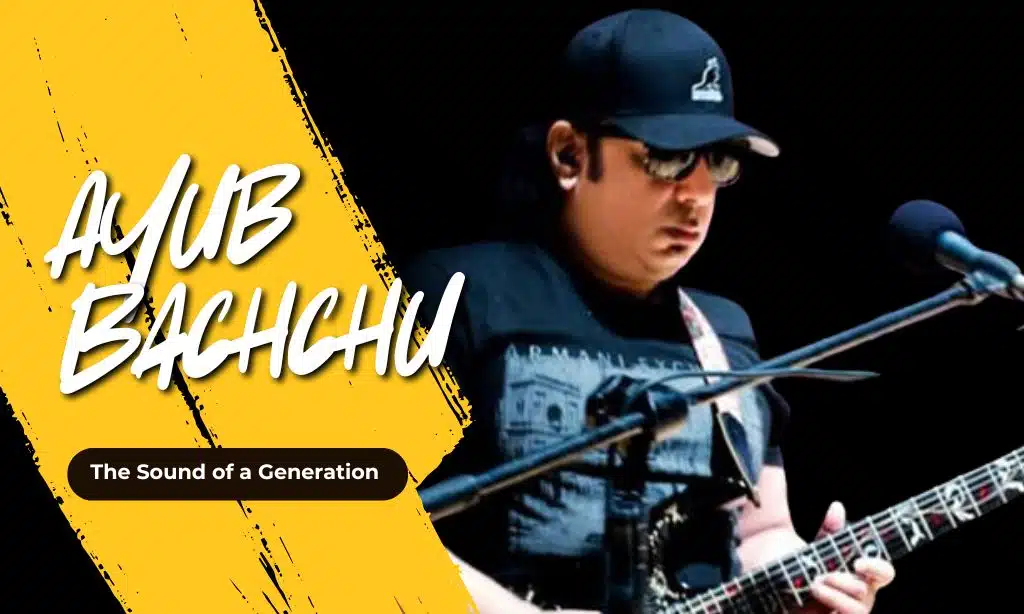
To understand Ayub Bachchu’s permanence, you must decode his sound. Technically, he was a bluesman. Emotionally, he was a philosopher with a Stratocaster.
His tone—smooth yet sharp, melancholic yet defiant—carried the warmth of Clapton and the precision of Knopfler but with distinctly Bengali phrasing. Each solo felt conversational: a cry, a confession, a release.
Lyrically, he avoided abstraction. His songs were stories of change, solitude, and resilience—themes that mirrored the post-liberation psyche. Where earlier Bangla music romanticized nostalgia, Bachchu articulated modern emotion: loneliness amid progress, love amid chaos.
He believed that music must tell the truth of its time. To commercial producers pushing pop formulas, he responded with integrity: “Sound may evolve, but soul must stay.”
The Cultural Impact: When a Guitar Became a Nation’s Symbol
In 1990s Bangladesh, guitars were luxury imports, and rock music was fringe rebellion. Ayub Bachchu changed that. His Rupali Guitar—the silver instrument that gleamed under concert lights—became a cultural symbol of aspiration. It told young Bangladeshis that creativity could be patriotic.
LRB’s concerts rewrote the social map. From stadiums in Dhaka to school fields in Rajshahi, AB’s shows became cross-class gatherings. Students, rickshaw-pullers, executives—all swayed to the same chord. He turned rock from niche to national, democratizing access to artistic emotion.
Television amplified his reach; by the early 2000s, his voice was background music to middle-class adolescence. In the pre-YouTube era, cassette shops survived on the LRB shelf.
Ayub Bachchu didn’t just perform music — he mainstreamed the idea of musical freedom.
Mentorship and Legacy: The Generations He Inspired
Beyond fame, Ayub Bachchu was a mentor. Young guitarists queued outside his practice studio for advice. He treated them not as fans but as apprentices. His rule was simple: play clean, play honest.
He advocated for artist rights and professional fees in a market that often exploited talent. He helped organize live-music circuits and inspired Bangladesh’s modern rock infrastructure—from university fests to independent sound engineering.
Artists such as Warfaze, Miles, Aurthohin, Artcell, and dozens more credit him as their north star. Even pop singers borrowed his phrasing and energy.
Bachchu was the bridge between classical Bangla lyricism and electric-age audacity. If James gave rock its fire, Ayub Bachchu gave it form.
“He taught us that rebellion can have melody,” said a young guitarist at a 2024 tribute show.
The Final Note
The morning of his death began like any other. By noon, Dhaka was a city in collective mourning. Crowds gathered at the Central Shaheed Minar, holding guitars instead of flowers. Television switched from politics to playback. Social media flooded with one refrain: “Cholo Bodle ”Jai”—again, but this time in tears.
His funeral in Chattogram resembled a state procession. Musicians carried his coffin as though it were a beloved instrument. Thousands followed—students, fans, factory workers, and police officers.
At his last stage, the microphone stood empty, spotlight unwavering. A minute of feedback hummed through the speakers—an accidental, haunting goodbye.
That day, Bangladesh didn’t lose a performer. It lost its sonic conscience.
The Sound That Never Fades: Remembering Ayub Bachchu
In the streaming era, Ayub Bachchu’s voice refuses to age.
On Spotify and YouTube, his songs continue to rank among Bangladesh’s most-played classics. Diaspora audiences—from Toronto to London—use his music as aural homecoming.
Remastered editions of Ferari Mon and Sporsho attract younger listeners who were children when he died. His lyrical themes—self-change, restlessness, authenticity—align uncannily with Gen Z’s search for meaning.
Cultural institutions now debate how to preserve his archives. Proposals for an Ayub Bachchu Music Foundation and a national guitar museum circulate yearly. Yet, his truest memorial remains intangible: every teenager in Bangladesh who picks up a guitar believing that emotion is a strength, not a flaw.
In classrooms, cafés, and cover-band stages, his name endures as a verb—to Bachchu is to play from the heart.
Takeaways
Ayub Bachchu’s story is not a chapter in Bangladeshi music; it is the spine that holds it upright. He democratized passion, professionalized artistry, and proved that language and rhythm could belong to everyone.
Seven years after his passing, his silver guitar still gleams in collective memory. Because legends don’t vanish—they modulate.
Every time the night hums with a distant riff, Bangladesh hears itself again.
As long as a guitar hums in a Bangladeshi night, the sound of Ayub Bachchu will never fade.