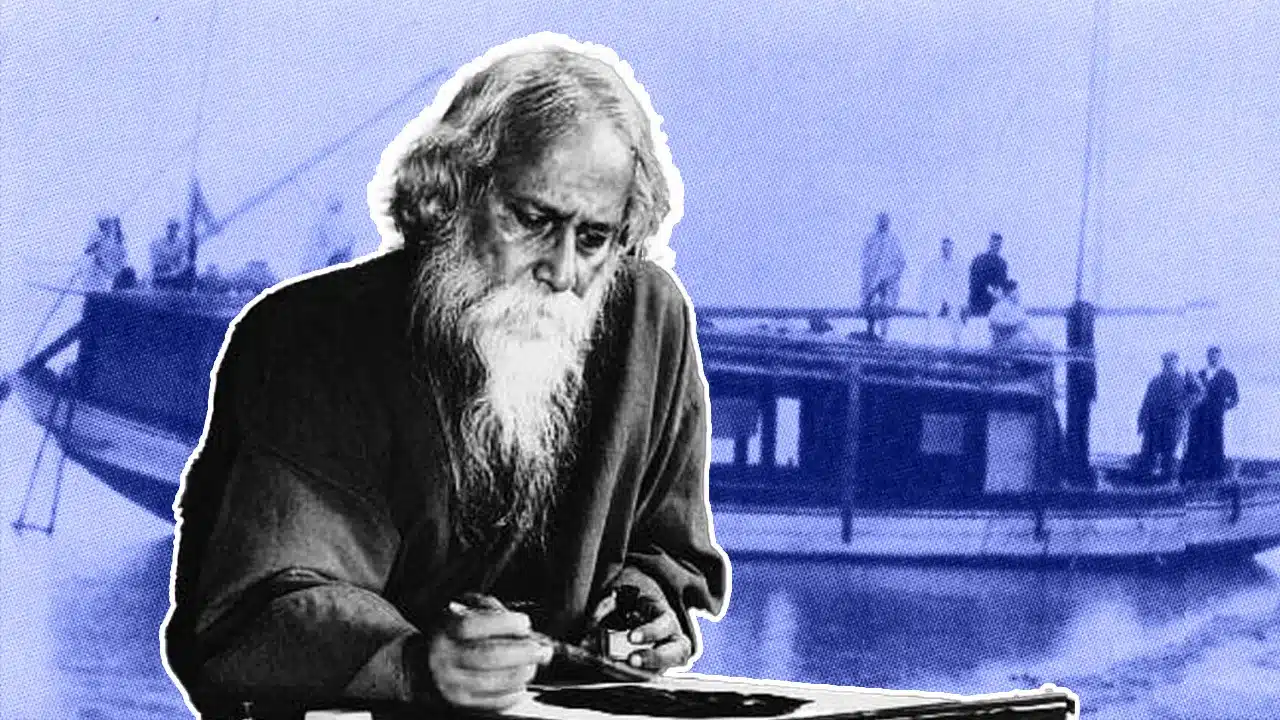
“I used to sail from Padma to Ichhamoti, from Ichhamoti to Boral, Huro Sagar, Chalan Beel, then Atrai, Nagor River, then after crossing the Jamuna and through Sajadpur canal to Sajadpur.“
From Chhinnapatraboli’s letters, we find a description of how Rabindranath Tagore traveled from Shilaidah to Shahzadpur (Sajadpur) and Patisar. From 1891 to 1901, he continuously stayed in Bengal. He used to come to Patisar in Naogaon to observe the condition of the estate until 1937. His grandfather, Prince Dwarkanath Tagore, bought this estate in 1830. Actually, to look after that estate, Tagore came to Patisar in 1891.
Vast harvest fields surround the Patisar Kachharibari, which is located in a natural setting. In front, there is an open ground where people gather every afternoon. There are a few localities nearby, and a local market sits once every week. The natural beauty of Patisar greatly influenced the poetic mind of Rabindranath Tagore. Many of his literary creations were written here. Tagore reflected the realistic lifestyle of the locals of Patisar in his philosophy and literary works.
Alongside many other humanitarian works, Rabindranath established a charitable dispensary for the neglected people of Patisar. He spent one lakh and eight thousand rupees from his Nobel Prize money to establish an ‘Agriculture Bank’ for the farmers. He introduced the use of mechanical ploughs for the development of the agricultural sector. Tagore also formed cooperative organizations for agriculture, knitting, and pottery. To educate illiterate local people, he built the ‘Kaligram Rathindranath Institution’ named after his son.
The boat ‘Padma’ was his favorite companion on the waterways, and he had another small boat as well. The natural beauty surrounding the river Nagor captivated Tagore, who produced many illustrious works. Sitting on the boat ‘Padma’, poet Tagore wrote the famous rhyme, “The palm tree standing on one leg rises high above all and peeks at the sky.” The palm tree is no longer there, but the river Nagor still flows near Patisar Kachharibari. Locals used to call the river Nagor ‘Chhoto Nodi’. The poem “Amader Chhoto Nodi” was also written here in Patisar.
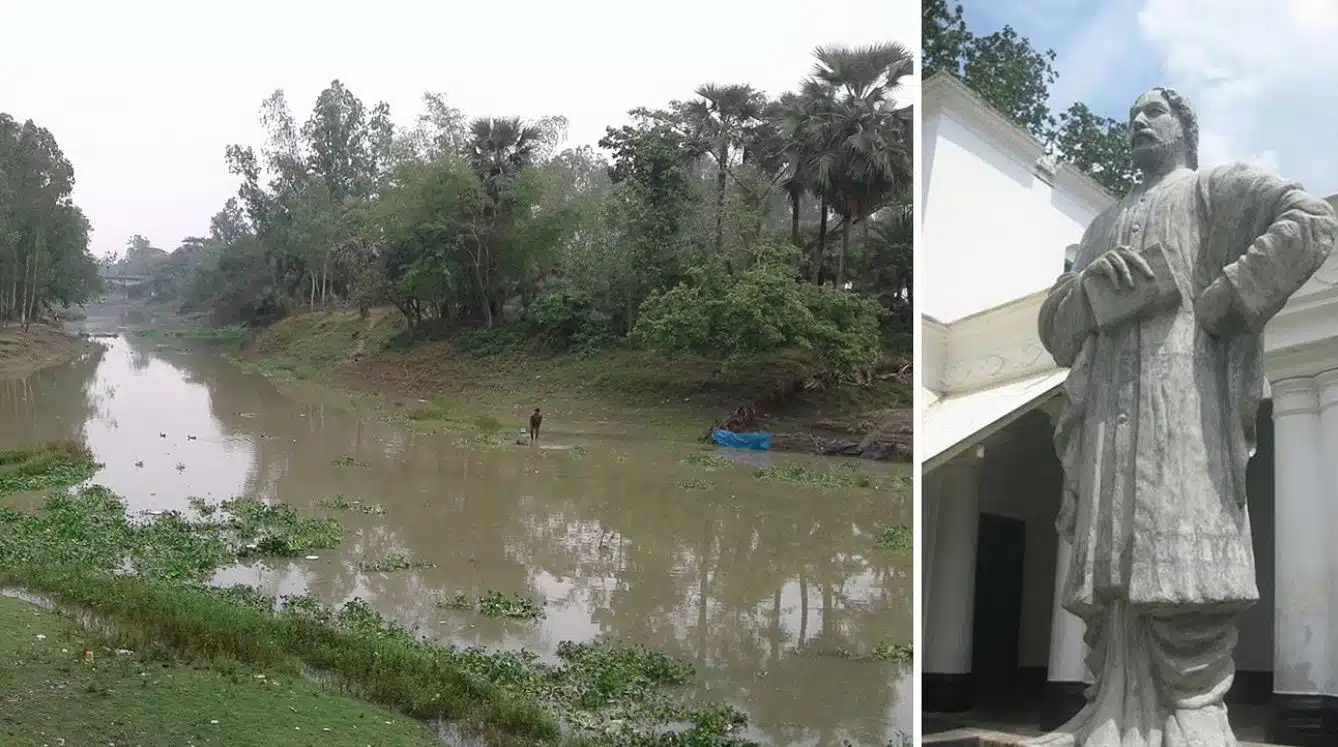
Throughout the summer, Nagor remains the same as Tagore described him. It still turns into a shallow water body during the summer month of Baishakh, resembling a canal having lost its active stream. However, in the rainy season, Nagor is full to the brim. In autumn, Catkin blooms by the edge of the river, seemingly playing a game with the clouds.
Nagor, which meets the Chalan Beel from Naogaon via Bogra’s Dupchanchia, is becoming narrower over time due to land-grabbing. It has lost its grace due to a lack of proper maintenance. To preserve the memories of Tagore, local authorities should take proper steps to rejuvenate the river by evicting illegal properties and stopping sand extraction from it.
Rabindranath also had plans to visit Dupchanchia, where Dupchanchia Model High School is situated on the bank of the river Nagor, only 20 kilometers away from Bogra city, which was renowned as Pundrabardhan some 1500 years ago. Educated and concerned people founded the school as a Sanskrit Toll toward the end of the 19th century. In 1920, it became an English school and was named ‘Middle English’ (M.E.) School. Finally, it became Dupchanchia High School in 1923. Ananta Mohon Kundu, an anti-colonial activist and student at this school, got in touch with Rabindranath Tagore.
On July 27, 1937, after finishing the ‘Punhyo’ festival at Patisar, Tagore desired to attend a reception ceremony at Dupchanchia High School but could not due to sudden physical illness on that day. It was his last day in Bengal. He conveyed his blessings with a letter, writing, “I wish all the success to Dubchanchia High School in its mission as one of the centres for imparting knowledge in the country.”
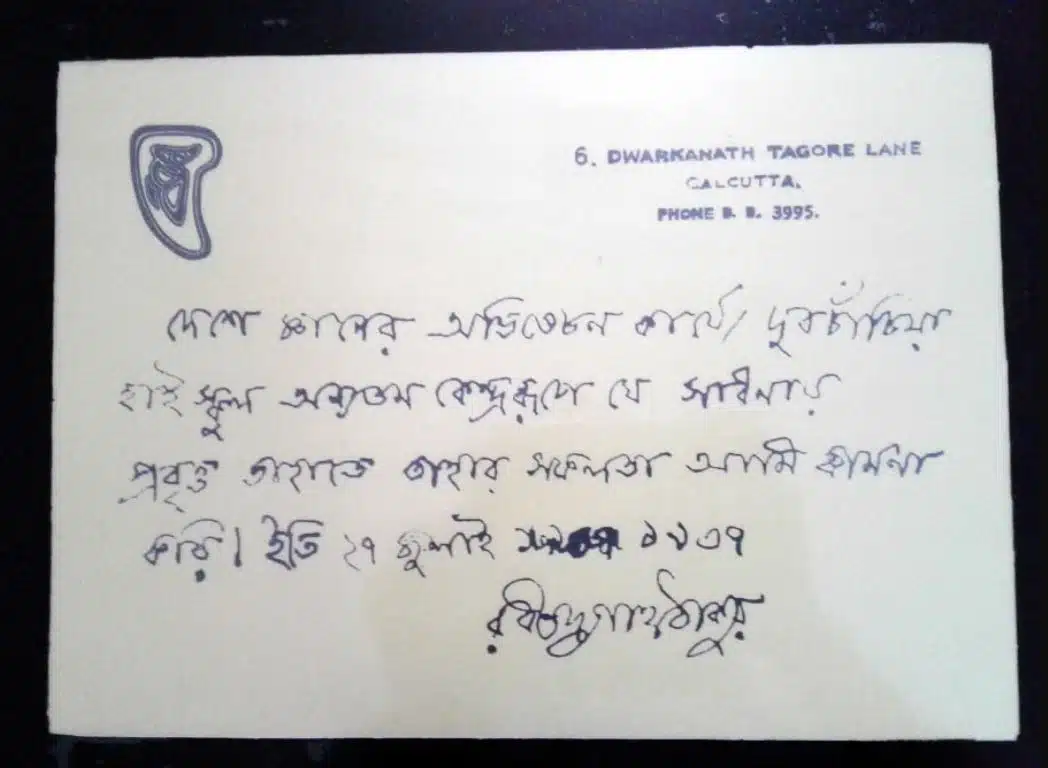
Many meritorious students passed from this school, including Ramendra Kumar Podder, who served as the Vice Chancellor of the University of Calcutta from June 20, 1979, to December 30, 1983.
Tagore’s writings at Patisar:
Rabindranath Tagore spent a long time at Patisar, and many of his literary works were written here. Some of them include “Biday Ovishap,” the poetry collection “Chitra,” the novel “Gora,” some parts of “Ghore Baire”, the short stories “Protihingsa” and “Thakurda,” and the article “Engrej O Bhartabasi.”. Notable songs written here include “Tumi sandhyar meghmala,” “Tumi amar nivrito sadhana,” “Bodhu miche rag korona,” and “Tumi noborupe eso prane.”. He wrote 54 poems from his renowned poetry collection “Chaitali” here. The famous poems “Dui bigha jomi” and “Sandhya” were also written in Patisar.
Our little river
Our little river flows in graceful loops
The summer heat dries her to a gentle flow,
Both cart and cattle travel across with ease
Her banks are high, her depths are shallow
The sand bed glitters, no trace of mud
The far bank shimmers with Kash flowers white,
where flocks of mynas chirp busily all day
And jackal calls arise at night
This bank shelters sleepy hamlets in the shade
of ranks of ancient mango and palm tree
At bath times, children swim and play
Splashing water at each other in noisy glee
Each day as their bathing is done
They catch little fish in nets of cloth
Women take home their pots scrubbed clean
Their washing all done, they return to their chores
When the rains descend, the river swells fast
Rushing waters raise voice in happy uproar,
The muddy torrent spins in eddies and swirls
Both banks uniting in joyous clamor
Awake, to join in the festival of rain.
N.B. The author has given permission for the republishing of this content on editorialge.com. The author of this article, Sukanta Parthib, initially published the same kind of content on thedailystar.net.