
Have you felt your focus fade and your memory slip during the day? A 2015 study showed that brain puzzles raise short term memory and boost thinking speed. This post will list five mobile mind games, including a brain training app, a focus booster tool, number puzzles, word puzzles, and logic challenges, to boost attention and spark problem solving.
Read on.
Key Takeaways
- A 2015 study found that brain puzzles boost short-term memory and thinking speed.
- Lumosity offers 50+ mini-games. It adapts tasks and gives three free games a day.
- Elevate packs 40+ daily drills, and users saw a 69% skill gain after four weeks.
- Peak tracks each win, shows real-time score charts, and adds contests on iOS and Android.
- Sudoku’s 9×9 grid and crossword puzzles (first in 1913; NYT and Bonza apps) sharpen logic, pattern skills, and vocabulary.
What is Lumosity and how does it improve your brain?
This mobile app provides quick cognitive training and brain exercises through fun games. It packs over 50 mini-games for word puzzles and number tests. Its adaptive algorithm tracks progress and adjusts tasks.
Neuroplasticity drives the program and helps your mind grow stronger.
A 2015 study found users boosted short-term memory and processing speed. Many people also reported sharper mental agility and attention improvement. The free plan gives three mini-games each day.
You can upgrade for all games and advanced progress tracking, but premium is not needed for gains. Gamification spurs memory enhancement and problem-solving skills.
How does Elevate help enhance cognitive skills?
Elevate packs over 40 brain training games that boost cognitive skills like word choice, reading speed, math skill, and listening. You pick three or four games a day on your mobile device or tablet.
The app gives personalized suggestions and tracks progress. It works on writing, speaking, reading, and math through interactive exercises. It also drives skill development and concentration improvement with daily goals and dashboards.
Users laud the clean design and easy use.
One study found regular players upped their cognitive skills by 69 percent after four weeks, while nonusers saw little change. The free tier lets you play three drills before it logs each ability.
Premium members unlock all 35 drills, get detailed analytics, and face tougher challenges. A sample exercise asks you to find ten percent of seven hundred or work out one percent of the same figure.
Lessons build mental agility, working memory, and focus over time.
What cognitive benefits does Peak offer?
Peak delivers an engaging interface, clear visuals pop on every mini-game. Users play focused rounds to drive memory improvement, they boost working memory and recall. Puzzle drills spark cognitive enhancement and mental agility, they sharpen attention and focus.
Quick exercises aim for problem-solving and neuroplasticity, they challenge the brain in minutes. Users slip in a game break, they find a playful twist on brain training.
The app logs each win, it offers real-time performance tracking and progress charts. Players view score trends, and spot weak spots for drills. Friendly contests add extra spice, you can race friends or top the leaderboard.
The user-friendly design adapts on phones and tablets, it runs on iOS and Android.
How can Sudoku sharpen your mind?
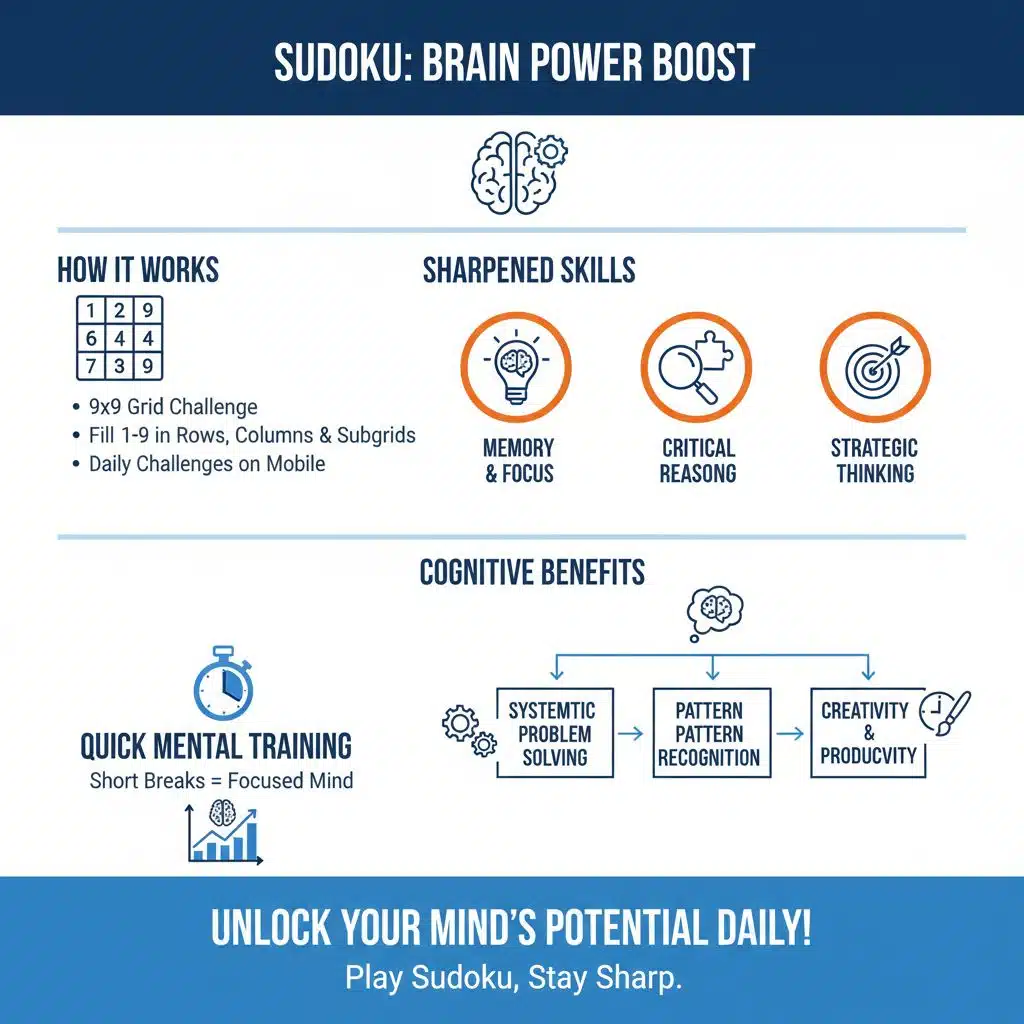
Sudoku uses a 9×9 grid and asks players to fill each row, column, and subgrid with the numbers 1 through 9. This puzzle builds short-term memory, concentration, and planning skills.
It forces critical reasoning as you cull wrong options. Each pattern you spot trains systematic problem solving.
Mobile apps bring daily challenges with rising levels that suit any age. Regular play hones strategic thinking and pattern recognition. Simple downtime with this grid challenge offers brain training, sparks creativity, and boosts productivity.
Gamers gain focus and attention even on short breaks.
How do crossword puzzles boost mental agility?
Crossword puzzles use word grids based on definitions. Solvers scan clues, link letters, fit words. This practice taps multiple brain areas and boosts vocabulary, linguistics, and analysis.
The first puzzle debuted in 1913, and it still fuels mental exercise after more than a century. New York Times crossword app offers a daily mini puzzle plus starter packs in the free version.
Bonza spices each session with vivid designs and fresh twists, keeping engagement high.
Regular wordplay training hones problem solving and critical thinking. Users recall general knowledge faster and flex cognitive skills every day. That fun habit feels like a chat with a buddy, not a dull drill.
What are the benefits of playing puzzle games?
Puzzle play boosts brain health, and it feels fun. Everyone wins when they tap a tile or fit a shape.
- Senior players who use brain training apps report clearer memory and better physical health.
- Adults who solve puzzles find stress relief after a long day of work.
- Young minds gain creativity development when they tinker with logic games during downtime.
- Friends and family enjoy social interaction while they share clues and celebrate wins.
- Regular engagement in Sudoku or word games leads to cognitive enhancement over time.
- Users often see productivity improvement as non goal directed play sparks new ideas and lifts mood.
- Solo players feel loneliness reduction when they join global game communities.
- Serious titles offer mental stimulation that suits children’s learning needs.
- Emotional wellbeing rises when gamers swap stress for playful challenges.
- Game sessions add downtime engagement that fuels both rest and renewed energy.
What tips can maximize the cognitive benefits of puzzle games?
Brain games can flex your mind with steady practice. These tips help you squeeze out every bit of mental juice.
- Pick game selection that adapts to your level for skill improvement and personalized engagement.
- Track your scores to see how repeated practice helps, even though science shows long-term IQ gains stay small.
- Use clear weekly targets to drive goal setting, add purpose, and spark mental stimulation.
- Limit play to 15 or 20 minutes a day to enforce time management, support gameplay balance, and avoid burnout.
- Break sessions with short rests to let new skills settle, curb addiction, and refine cognitive enhancement.
- Test free versions of Lumosity, Elevate or Peak to sample design aesthetics and core drills without cost.
- Rotate puzzle types like Sudoku, crosswords, Elevate drills, and Peak challenges to widen skill improvement and boost mental stimulation.
- Match game choices with personal goals like memory or speed for targeted personalized engagement.
Takeaways
These games give your mind a fun workout. Consider it a gym session for your gray matter. Brain trainer app offers quick tasks for memory improvement. Skill booster tool tests your focus fast.
Cognitive coach guide brings new mental challenges daily. Number puzzle and word workout sharpen logic and language skills. Regular play builds critical thinking and problem solving.
FAQs on Puzzle Mobile Games
1. What makes puzzle mobile games sharpen your mind?
These games stretch your logic, memory, and focus. A word puzzle, a number puzzle, or a shape game can boost brain power. It works like a gym for your mind.
2. Which types of mobile games train logic best?
Try shape puzzles and logic games. These apps ask you to fit pieces or solve steps. They test your mind like a maze and keep it sharp.
3. How long should I spend on these brain games each day?
Ten to twenty minutes can do the trick. Even five minutes in the morning can warm up your mind. Short sessions keep you eager and fresh.
4. Can daily play in puzzle games help in real life?
Sure. I once ran to catch a bus and spotted a tiny sign change in the crowd. My mind was sharp from daily play. Fun play can help you spot odd clues outside your screen.