
The Canadian healthcare landscape is often described as a single “national” system, but in reality, it is a collection of 13 distinct provincial and territorial plans unified by the Canada Health Act. As we navigate 2026, the gap between how healthcare is delivered in British Columbia versus Newfoundland or Ontario has widened due to new bilateral agreements and varying legislative responses to a national family doctor shortage.
Understanding these Provincial Healthcare Differences Canada is now more critical than ever, especially for those relocating or managing chronic conditions that require consistent access to specialists and medication.
How We Selected Our 7 Best Provincial Healthcare Differences Canada Facts
To identify the most impactful differences in 2026, we cross-referenced the latest Health Canada Departmental Plans with the 2026 provincial budget releases from Ontario, Quebec, and British Columbia. Our selection criteria focused on three main pillars: immediate financial impact on the patient, changes in the “scope of practice” for non-physician providers, and the availability of newly launched federal-provincial programs like National Pharmacare. We prioritized facts that highlight where a resident’s experience will differ significantly based solely on their postal code, ensuring the list captures the reality of the “post-pandemic” healthcare overhaul.
7 Essential Truths About Provincial Healthcare Differences Canada in 2026
The following guide breaks down the most significant shifts in the Canadian medical landscape, from digital data rights to the specific ways different provinces are tackling the primary care crisis.
1. The National Pharmacare “Tiered” Rollout
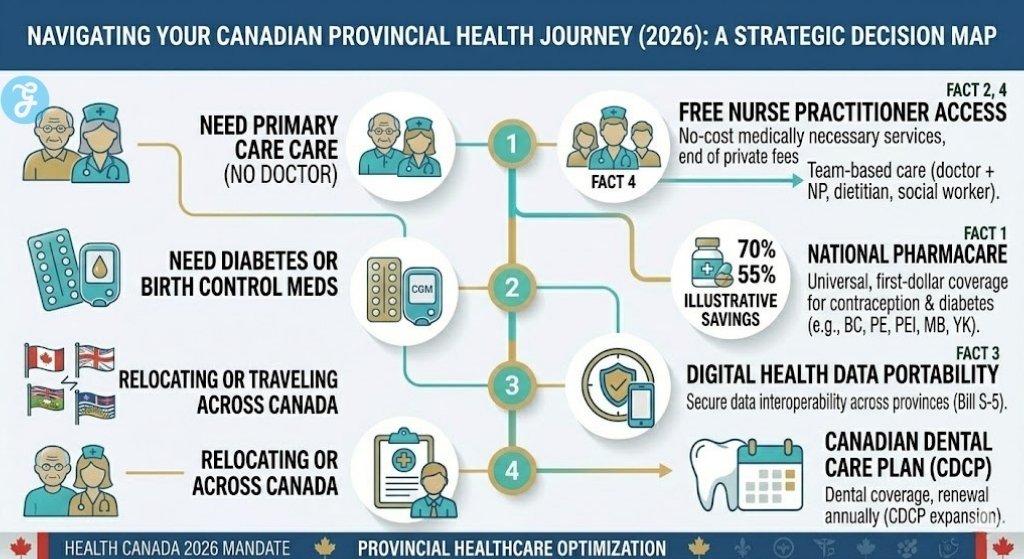
While “National Pharmacare” sounds universal, it currently exists as a series of individual bilateral agreements. As of early 2026, only residents in specific provinces—including British Columbia, Manitoba, Prince Edward Island, and the Yukon—have access to federally funded, first-dollar coverage for contraception and diabetes medications. In these jurisdictions, your diabetes or birth control costs are covered at the pharmacy counter regardless of your age or income.
Best for: residents in participating provinces with high medication costs.
Why We Chose It:
-
It marks the first major expansion of the Canada Health Act in decades.
-
It creates a significant financial “benefit gap” between participating and non-participating provinces.
-
It streamlines access to reproductive health and chronic disease management.
Things to consider:
-
If you live in a province that hasn’t signed the agreement, you still rely on private insurance or existing provincial safety nets.
2. The April 2026 “Nurse Practitioner” Coverage Rule
A landmark policy change taking full effect on April 1, 2026, ensures that Canadians can no longer be charged for medically necessary services simply because they are provided by a Nurse Practitioner (NP) rather than a physician. Historically, some private clinics charged for NP visits; this new federal directive mandates that provinces cover these services under their public insurance plans to maintain full federal funding.
Best for: patients in rural areas or those attached to “NP-led” primary care clinics.
Why We Chose It:
-
It effectively expands the “pool” of free primary care providers across Canada.
-
It stops the trend of “private-pay” fees for essential nursing consultations.
Things to consider:
-
While the service is now free, finding an NP with an open patient list remains as difficult as finding a family doctor.
3. The Interoperability Revolution (Bill S-5)
The 2026 Connected Care for Canadians Act (Bill S-5) is finally forcing provinces to adopt common digital health standards. This means that for the first time, your health data—labs, imaging, and history—can travel securely across provincial lines. Previously, a resident of Ontario seeking care in Quebec often had to “start from scratch” due to incompatible IT systems.
Best for: frequent travelers, snowbirds, and people moving between provinces.
Why We Chose It:
-
It addresses the “data blocking” that has historically plagued Canadian healthcare.
-
It reduces the need for duplicate tests, saving time and tax dollars.
Things to consider:
-
Full implementation is ongoing, and some legacy systems in smaller territories may still experience delays.
4. Quebec’s “Law 2” vs. Ontario’s Team-Based Model
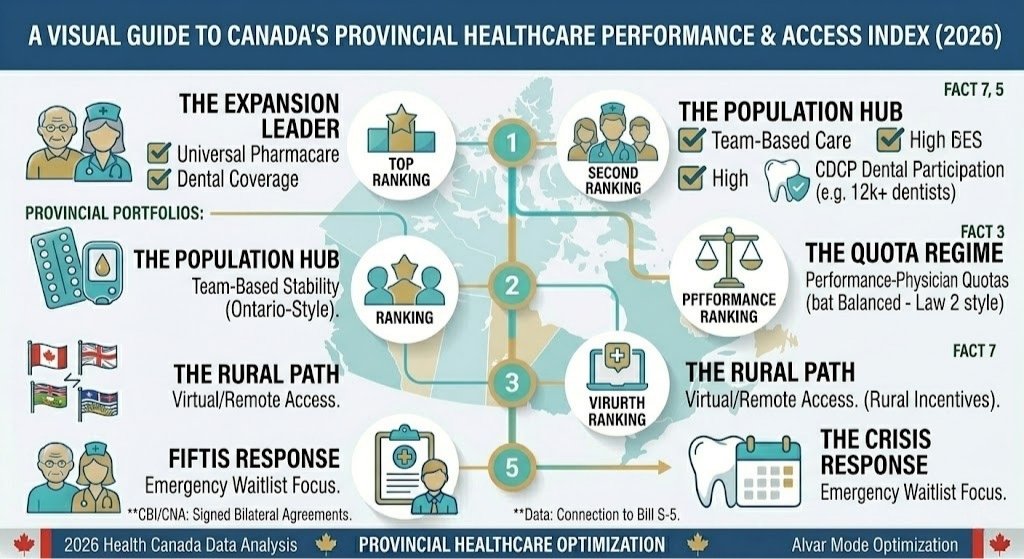
Provinces are taking radically different paths to solve the doctor shortage. Quebec has implemented “Law 2,” which ties physician compensation directly to the number of patients they see, threatening pay cuts of up to 15% if targets aren’t met. Meanwhile, Ontario is investing $1.1 billion into “Primary Care Teams,” which surround one doctor with nurses, dietitians, and social workers to handle a larger patient volume more holistically.
Best for: individuals deciding where to reside based on primary care stability.
Why We Chose It:
-
It showcases the ideological divide in how provinces manage their health workforce.
-
Quebec’s model has led to some physician “exodus,” while Ontario’s aims for “burnout reduction.”
Things to consider:
-
Ontario’s waitlist (Health Care Connect) has seen an 87% reduction in early 2026 due to these teams.
5. Wait Time Disparities (The Atlantic Gap)
Wait times for medically necessary treatment reached a national median of 28.6 weeks in late 2025/early 2026, but the “private cost” varies wildly. Residents of New Brunswick face the highest per-patient cost in lost productivity ($4,864), followed by Quebec. Conversely, Western provinces like BC and Alberta generally see slightly shorter waits for priority surgeries like hip and knee replacements.
Best for: patients awaiting elective surgeries or specialist consultations.
Why We Chose It:
-
It highlights the economic burden of “waiting,” which is not equal across Canada.
-
It reflects the severe specialist shortages in the Atlantic provinces compared to the West.
Things to consider:
-
These figures do not include the “wait to wait”—the time spent waiting just to see a specialist after a GP referral.
6. The Canadian Dental Care Plan (CDCP) Expansion
As of February 28, 2026, over 6.3 million Canadians have been approved for the CDCP. While it is a federal program, the “participation rate” of dentists varies by province. Ontario leads with over 12,000 participating oral health providers, while some smaller regions have fewer dentists willing to accept the federal fee schedule, impacting how easily a resident can actually use their coverage.
Best for: seniors and low-to-mid-income families without private insurance.
Why We Chose It:
-
It is the largest social program expansion in a generation.
-
It covers essential services like scaling, fillings, and root canals that were previously out-of-pocket.
Things to consider:
-
You must renew your coverage annually between April 15 and June 1, 2026, to keep your benefits.
7. Virtual Care: From Emergency to Essential
In 2026, virtual care is no longer a temporary fix but a permanent pillar of provincial plans. However, the type of virtual care you get depends on your province. Alberta has integrated virtual care deeply into its rural remote programs, while provinces like Saskatchewan continue to struggle with “difficult access,” where even virtual appointments can have multi-week wait times for unattached patients.
Best for: rural residents and those with minor, non-emergency health concerns.
Why We Chose It:
-
It has become the primary way “unattached” patients access a script or referral.
-
It represents the “modernization” goal of the 2026-27 Health Canada mandate.
Things to consider:
-
Not all virtual platforms are “fully covered”; some third-party apps still charge for “convenience” features.
An Overview Of 7 Provincial Healthcare Differences Canada Highlights
Navigating the Canadian system in 2026 requires understanding that “Medicare” is a living, shifting entity. While the federal government provides the funding and the broad rules (like the Canada Health Act), the provinces are the “laboratories” where different solutions—from Quebec’s mandatory patient quotas to BC’s universal pharmacare—are being tested in real-time.
Overview Of Provincial Healthcare Differences Canada: A Quick Look
The table below summarizes the current status of key health benefits across the major provinces as of the 2026 fiscal year. This allows for a quick comparison of where you stand to gain the most “coverage” benefits.
Overview Comparison Table
Use this table to identify which provinces have implemented the newest federal-provincial “Expansion” programs.
| Province | Pharmacare (Diabetes/Birth Control) | Dental (CDCP) Provider Access | Primary Care Model |
| British Columbia | Yes (Signed) | Moderate | Team-Based / Digital First |
| Ontario | No (Pending) | High (12k+ Providers) | Family Health Teams |
| Quebec | No (Pending) | Moderate | Law 2 (Quota-Based) |
| Manitoba | Yes (Signed) | Low | Recruitment-Focused |
| Saskatchewan | No (Pending) | Low | Rural Incentive Programs |
| Atlantic Canada | Mixed (PEI=Yes) | Moderate | Crisis-Management |
Our Top 3 Picks and Why?
-
National Pharmacare (BC/MB/PEI): This is our top pick because “free at the counter” is a rare and massive win for residents. It directly targets two of the most common healthcare costs: contraception and diabetes management.
-
Ontario’s Primary Care Teams: We chose this because it is the most sustainable answer to the doctor shortage. By using a “team” approach, it reduces physician burnout while actually connecting hundreds of thousands of new patients to a permanent provider.
-
The 2026 Nurse Practitioner Rule: This is a sleeper hit for 2026. By removing the “private-pay” barrier for NP visits, the federal government has effectively unlocked a massive section of the workforce for “free” primary care.
How to Choose the Right Provincial Healthcare Differences Canada Strategy by Yourself?
Since you can’t “buy” a provincial plan (it is based on where you live), your “strategy” involves knowing how to extract the most value from the province you are in or are moving to.
The Selection Framework
-
Check the Bilateral Status: Before moving, check if the province has signed the National Pharmacare agreement. If you have Type 1 diabetes, living in BC vs. Ontario could save you over $1,500 per year in insulin costs alone.
-
Verify Provider Density: Use the CDCP statistics to see if dentists in your new city are actually “participating.” A plan is only useful if there is a provider nearby who accepts it.
-
Identify the “Unattached” Path: If you don’t have a family doctor, look for the provincial “virtual care” or “NP-led” clinic rules. In Ontario, the “Primary Care Action Plan” is your best route to a team-based clinic.
-
Prepare for Data Portability: With Bill S-5, don’t accept “we can’t see your records” as an excuse. Ask your provider to use the new common digital standards to pull your data from other provinces.
The matrix below will help you decide which provincial system might best fit your specific healthcare needs in 2026.
Decision Matrix Table
This decision matrix compares situational priorities with the provinces currently leading in those specific areas.
| If your priority is… | Choose X if… | Choose Y if… |
| Zero-Cost Meds | Choose BC or PEI for the current Pharmacare benefit. | Choose Ontario if you have high-end private coverage. |
| Shortest Surgery Wait | Choose Alberta for generally better “Priority Procedure” metrics. | Choose New Brunswick only if you have a specific specialist already. |
| Finding a Family Doctor | Choose Ontario for their new “Primary Care Team” rollout. | Avoid Quebec if you want to avoid “Quota-Based” physician care. |
| Dental Coverage | Choose Ontario for the highest number of participating dentists. | Choose Quebec for a robust denturist network. |
The Final Checklist: 5-Point Health Plan
-
Confirm your eligibility for the CDCP and file your 2025 tax return before June 1, 2026, to renew.
-
If moving provinces, check the wait times for a Health Card (usually 3 months in Ontario/BC).
-
Ask your pharmacist if your current prescriptions fall under the National Pharmacare bilateral agreement.
-
Check if your local clinic is part of a “Primary Care Team” to see if you can access a dietitian or NP for free.
-
Set up a Digital Health ID to take advantage of the new 2026 data interoperability rules.
A Decent Future for Canadian Care
While the “crisis” headlines regarding wait times and doctor shortages remain true in 2026, the underlying structure of Canadian healthcare is modernizing rapidly. The combination of Bill S-5’s data rules, the expansion of Nurse Practitioner authority, and the slow but steady rollout of National Pharmacare means that the system is becoming more “connected” than ever before. The key to navigating Provincial Healthcare Differences Canada is to stay proactive, use the new federal-provincial tools, and understand that where you live in Canada now dictates not just your weather, but the very nature of the care you receive.