Programmatic Advertising Strategy 2026 has fundamentally shifted from volume to value. With global programmatic display ad spending projected to hit $436 billion this year, accounting for nearly 90% of all digital display spend, the “set it and forget it” mentality is no longer just lazy; it is a financial liability.
To succeed in this landscape, modern strategies must pivot toward Precision, Autonomy, and Efficiency. This guide is your tactical blueprint to dismantling the complex machinery of modern programmatic advertising and building a strategy that automates ad buys without wasting a single cent of your budget.
The Shift: Why the “Black Box” is Dead
For years, programmatic advertising was often viewed as a mysterious machine: you put money in one end, and hopefully, customers came out the other. But in 2026, that opacity is no longer acceptable, nor is it profitable.
If you are a marketer reading this today, you likely know the frustration of “ad waste.” You have seen your budget vanish into the ether of the open web, only to find your premium brand ads appearing on low-quality “Made for Advertising” (MFA) sites that no human actually reads. You have paid the “hidden tax” of ad tech intermediaries, where 15 to 30 cents of every dollar never even reaches the publisher.
The industry has moved beyond simple automation into the age of Agentic AI and Supply Path Optimization (SPO). It is no longer just about buying ads cheaply; it is about buying them efficiently using AI that doesn’t just predict outcomes but actively manages your budget in real-time to cut out the parasites in the supply chain.
The Mechanics: How Programmatic Works in 2026
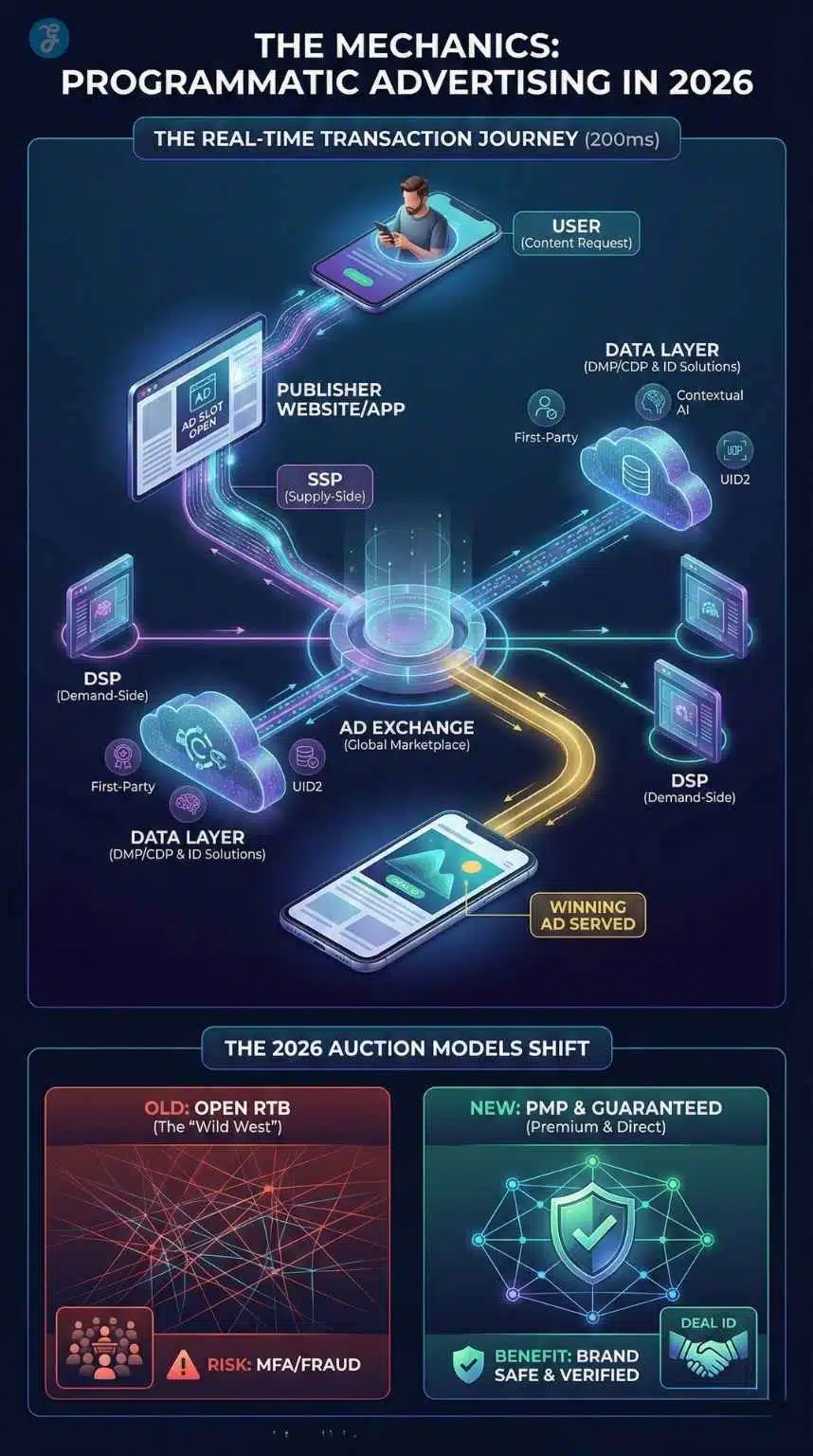
To fix your strategy, you must first understand the machine. While the core concept of programmatic advertising, using software to buy digital advertising, remains the same, the engine under the hood has been rebuilt.
The Ecosystem: A simplified view of a complex web
In the blink of an eye, less than 200 milliseconds, a complex transaction occurs every time a webpage loads. Here is the modern hierarchy of that transaction:
- The User: Visits a website (e.g., a news portal or a streaming service).
- The Publisher (SSP): The website owner uses a Supply-Side Platform (SSP) to say, “I have a slot open for an ad here. Who wants it?”
- The Ad Exchange: The digital marketplace where the auction happens.
- The Advertiser (DSP): You, the brand, use a Demand-Side Platform (DSP) (like Google Display & Video 360 or The Trade Desk) to say, “I want to reach a male, aged 25-34, interested in finance. I’ll bid $2.00.”
- The Data Layer (DMP/CDP): A Data Management Platform or Customer Data Platform informs the DSP, “Yes, this user matches your criteria.”
- The Decision: The highest bidder wins, and the ad is served.
The Auction Models: It’s Not All “Wild West” Anymore
In the past, most programmatic buys happened in the “Open Auction.” In 2026, smart money has moved elsewhere.
| Auction Type | Description | Pros | Cons |
| Real-Time Bidding (RTB) | The “Open Exchange.” Anyone can bid on any inventory. | Massive scale; lowest CPMs. | High risk of fraud; lower quality sites. |
| Private Marketplace (PMP) | Invitation-only auctions. Publishers invite specific advertisers. | Premium inventory; better data; brand safe. | Higher CPM floors; limited scale. |
| Programmatic Direct | Automated buying of guaranteed ad slots. No auction. | Guaranteed placement; 100% brand safety. | Highest cost; less flexibility. |
| Programmatic Guaranteed | A hybrid: You agree to buy a set number of impressions at a fixed price, but execute it programmatically. | Best of both worlds: automation + certainty. | Requires negotiation and commitment. |
The 2026 Shift: The most significant mechanical shift this year is the decline of the Open Auction for premium brands. Advertisers are tired of the uncertainty. We are seeing a massive migration toward Programmatic Guaranteed and PMPs, where the inventory is vetted, and the publisher relationships are transparent.
The “Budget Waste” Crisis and The Solution
Why do we need a new strategy? Because the old one was bleeding money. To automate without wasting budget, you must identify the “leaks” in your bucket.
The Three Horsemen of Ad Waste
1. Made for Advertising (MFA) Sites:
These are the cockroaches of the internet. MFA sites are designed solely to arbitrage ad revenue. They are cluttered with ads (sometimes 10+ per screen), have high bot traffic, and feature auto-playing videos that no one watches. In previous years, up to 20% of programmatic budgets were inadvertently funding these sites because their “Viewability” metrics looked good on paper (even if the “viewer” was a bot).
2. The “Ad Tech Tax”:
If you spend $1.00 on programmatic, how much reaches the publisher? In a bad supply chain, it might be only $0.50. The rest is eaten by DSP fees, exchange fees, SSP fees, data fees, and verification fees.
3. Resellers and Duplicate Paths:
Sometimes, an ad exchange doesn’t sell the inventory directly; they buy it from another reseller, who bought it from another reseller. Each “hop” adds a fee and latency.
The 2026 Fix: Supply Path Optimization [SPO]
Supply Path Optimization (SPO) is the single most effective way to stop wasting budget in 2026. It is the practice of auditing your supply chain and deliberately choosing the shortest, most transparent path to the publisher.
How to Execute an SPO Strategy:
- Consolidate Your SSPs: Instead of buying from 50 different exchanges, pick the top 5-7 that offer the most direct access to the publishers you care about.
- “Ads.txt” Verification: Ensure strict enforcement of ads.txt protocols. If a seller isn’t authorized by the publisher, do not buy from them. Period.
- Negotiate “Take Rates”: Large agencies are now negotiating capped fees with SSPs. If you are a smaller advertiser, look for DSPs that prioritize “transparent” supply paths.
- Embrace “Curation”: This is the buzzword of 2026. Curated Marketplaces are bundles of inventory (e.g., “The Sports Fan Bundle”) vetted by a human or advanced AI to ensure every site in the list is legitimate. By moving your budget from the Open Exchange to Curated Marketplaces, you instantly eliminate MFA sites.
Major Trends Shaping Programmatic in 2026
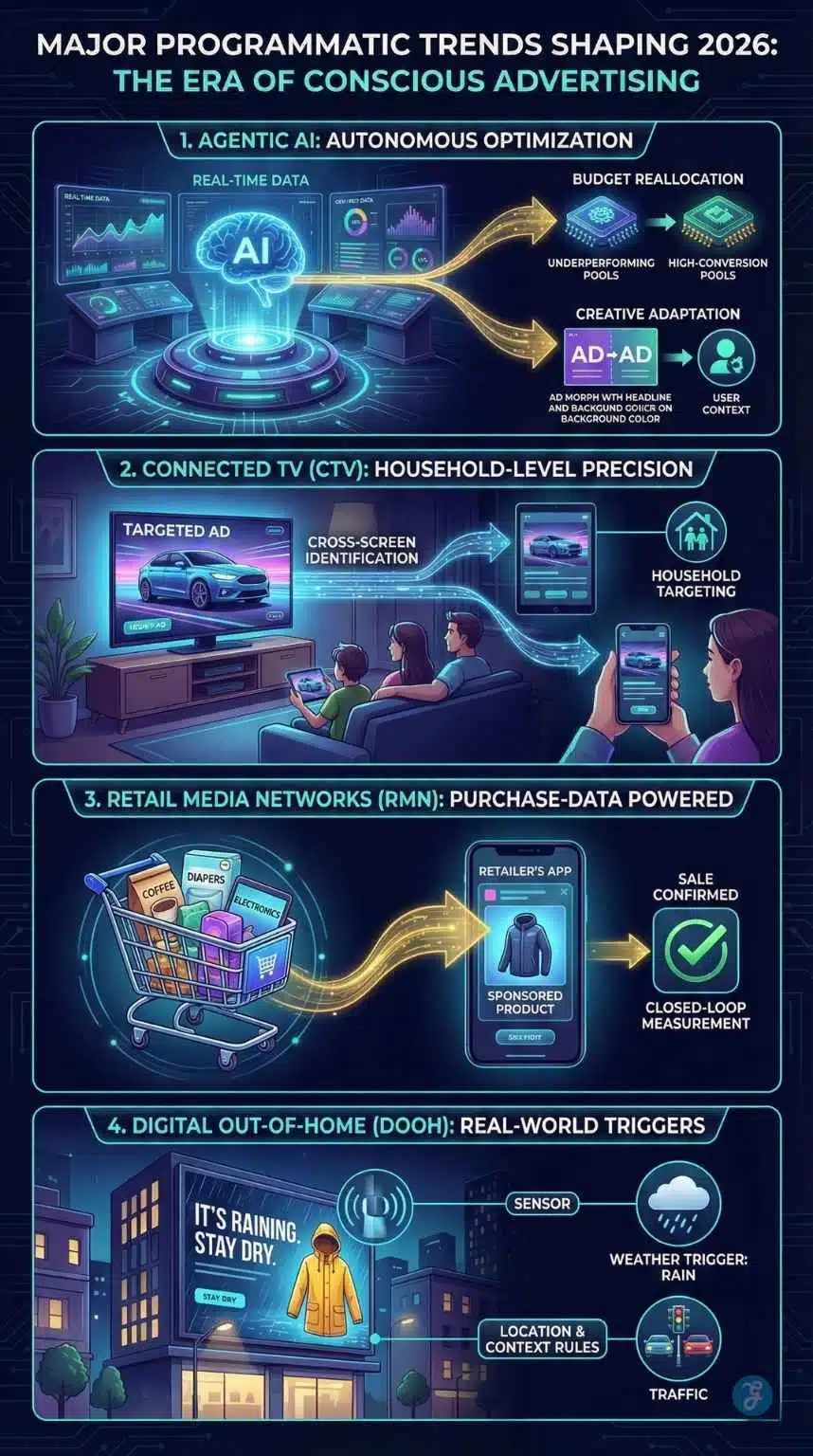
If SPO is the foundation, these trends are the skyscrapers we are building on top. These technologies define the Programmatic Advertising Strategy 2026.
Trend 1: The Rise of Agentic AI
We have talked about AI for a decade, but 2026 is the year of Agentic AI.
- Predictive AI (The Old Way): “I predict this ad will do well.” You, the human, then have to move the budget.
- Agentic AI (The 2026 Way): “I predicted this ad would do well, so I moved 20% of the budget there, changed the headline color to blue to match the user’s preference, and paused the underperforming creative on the news site.”
Agentic AI acts autonomously. It doesn’t just analyze data; it executes decisions. It can negotiate bids in nanoseconds based on complex goals like “Maximize Lifetime Value” rather than just “Get Clicks.” This reduces the human error factor and reacts to market changes (like a sudden news event) faster than any human trader could.
Trend 2: The Explosion of Connected TV (CTV)
Television is no longer a “broadcast” medium; it is a digital one. Services like Netflix, Disney+, Hulu, and even Amazon Prime Video are now heavily ad-supported and bought programmatically.
- The Opportunity: You can now target “Households with a household income >$100k who are in the market for a luxury SUV” while they are watching a hit show on their living room TV.
- The Challenge: Measurement. “Co-viewing” (two people watching one TV) makes 1-to-1 targeting harder. However, Automatic Content Recognition (ACR) data from smart TVs is solving this by telling advertisers exactly what is on the screen, regardless of the app being used.
Trend 3: Retail Media Networks (RMN)
This is the fastest-growing sector in advertising. Retailers like Amazon, Walmart, Target, and even Marriott Hotels have become media moguls.
- Why it wins: They have the “Holy Grail” of data: Purchase Data. They don’t guess if you like coffee; they know you bought a bag of dark roast last Tuesday.
- The Strategy: Brands are moving programmatic budgets into RMNs to close the loop. If you sell toothpaste, why guess on a news site when you can bid for an ad slot right on the “Checkout” page of a grocery app?
Trend 4: Digital Out-of-Home (DOOH)
Programmatic has left the browser. It is now on billboards, in elevators, and at gas pumps.
- Trigger-Based Buying: You can set programmatic rules for physical world ads.
- Example: “Only bid on this digital billboard in Chicago if the local weather is raining and the temperature is below 50 degrees” (perfect for a coffee or raincoat brand).
- Example: “Only show this ad during rush hour traffic.”
This ensures you aren’t paying for a billboard ad at 3 AM when the road is empty.
Step-by-Step Implementation Strategy
Knowing the trends is one thing; executing them is another. Here is your step-by-step Programmatic Advertising Strategy 2026 to ensure efficiency.
Step 1: Goal Setting [The “North Star”]
Don’t just say “I want awareness.” Be specific. The algorithm needs a clear target to optimize against.
- Branding: Focus on Cost Per Completed View (CPCV) for video or Target CPM for reach.
- Performance: Focus on Return on Ad Spend (ROAS) or Cost Per Acquisition (CPA).
- New 2026 Metric: Cost Per Attention Second (CPAS). (More on this in the measurement section.
Step 2: Audience Targeting & The “Post-Cookie” World
Third-party cookies are largely gone or irrelevant. You cannot rely on them.
- First-Party Data: This is your gold. Upload your email lists (hashed for privacy) into your DSP to retarget customers or find “Lookalikes.”
- Contextual Intelligence: This has made a massive comeback, powered by AI. Instead of tracking the user, track the content.
- Old Contextual: Putting a shoe ad on a sports site.
- AI Contextual 2026: Putting a shoe ad on a specific article about “Recovering from a Marathon Injury” that has a positive sentiment score. The AI reads the page like a human would.
- Identity Solutions: Use universal IDs like Unified ID 2.0 (UID2). These are encrypted identifiers that allow for tracking across the open web without compromising user privacy.
Step 3: Selecting the Tech Stack
You need the right tools.
- The DSP: Choose one that offers transparency. Google DV360 is great for scale; The Trade Desk is preferred by many for its objectivity (since they don’t own the media they sell).
- The Verification Partner: You must use a tool like DoubleVerify or Integral Ad Science (IAS). These tools act as a firewall, blocking your ad from loading on hate speech sites, adult content, or MFA farms.
Step 4: Creative Optimization (DCO)
You can have the best targeting in the world, but if your ad is ugly, it won’t work.
- Dynamic Creative Optimization (DCO): Use DCO tools to generate thousands of ad variations.
- Scenario: It’s raining in Seattle. The DCO automatically serves an ad with a rainy background and the text “Stay dry today.”
- Scenario: A user abandoned their cart. The DCO serves an ad showing the exact product they left behind, plus a 5% discount code.
Measuring Success: Beyond the Click
If there is one thing you take away from this guide, let it be this: Stop obsessing over Click-Through Rate (CTR). In programmatic display, the average CTR is often less than 0.1%. Optimizing for CTR often leads to “Fat Finger” clicks (accidental clicks on mobile) or fraud. A bot loves to click; a human rarely does.
The New King: Attention Metrics
In 2026, we trade in Attention. Technologies from companies like Adelaide or Playground XYZ use eye-tracking panels and AI to predict how much actual human attention an ad placement gets.
- The Shift: Instead of buying 1,000,000 impressions (where 50% might be at the bottom of a page, unseen), you buy 10,000 Attention Seconds.
- The Benefit: You pay for mental availability, not just pixel loading. A high-impact ad seen for 5 seconds is worth 100x more than a banner ad seen for 0.5 seconds.
Brand Lift Studies
Don’t guess if your branding worked. Run a Brand Lift Study.
- How it works: The DSP holds back a control group (who don’t see your ad) and compares them to an exposed group (who do). It then surveys both: “Have you heard of Brand X?”
- The Result: You get a scientific percentage increase in Brand Awareness or Purchase Intent.
Incrementality Testing
This answers the hardest question: “Would they have bought it anyway?”
By randomly excluding a portion of your audience from seeing ads, you can measure the incremental difference in sales. If the “ads group” bought 10% more than the “no ads group,” your incrementality is 10%.
Future Outlook and Sustainability
As we look toward the latter half of 2026 and beyond, two major factors will influence strategy: Green Media and Privacy.
Green Media Products (GMP)
Digital advertising has a carbon footprint. Every time an ad loads, servers spin, consuming electricity. A complex programmatic supply chain with 20 resellers generates massive carbon emissions.
- The 2026 Standard: Brands are now measuring Emissions Per Impression.
- The Win-Win: Spoiler alert, SPO (Supply Path Optimization) is also a sustainability strategy. By cutting out middlemen, you reduce server calls, which reduces carbon emissions and saves you money. It is one of the few areas where being “Green” actually improves profitability.
Privacy Sandbox and The Post-Regulation Web
With GDPR in Europe, CCPA/CPRA in California, and new federal discussions in the US, privacy is non-negotiable.
- Google’s Privacy Sandbox: This is the industry standard for anonymous targeting. It groups users into “Topics” (e.g., “Sports Fans”) rather than tracking individuals.
- Strategy: Ensure your DSP and data partners are fully integrated with Privacy Sandbox APIs. If you rely on old-school fingerprinting or shady data brokers, your campaigns will hit a wall.
A Quick Guide to 2026 Programmatic Acronyms
| Acronym | Full Name | What it Means for You |
| SPO | Supply Path Optimization | Cutting out middlemen to save fees and improve quality. |
| MFA | Made for Advertising | Junk websites to avoid at all costs. |
| CTV | Connected TV | Ads on streaming services (Netflix, Hulu, etc.). |
| DOOH | Digital Out-of-Home | Digital billboards you can buy programmatically. |
| DCO | Dynamic Creative Optimization | Ads that automatically change based on data (weather, location). |
| RMN | Retail Media Network | Ad platforms owned by retailers (Amazon, Walmart) are using purchase data. |
| UID2 | Unified ID 2.0 | An identity solution to track users without third-party cookies. |
| CPAS | Cost Per Attention Second | A new metric measuring the cost of actual human attention. |
Final Thought: The Era of “Conscious Programmatic”
The theme for Programmatic Advertising Strategy 2026 is “Consciousness.” We are no longer sleepwalking through ad buys. We are conscious of where our ads run (avoiding MFA sites). We are conscious of who is selling to us (SPO). We are conscious of the environmental impact (Green Media). And most importantly, we are conscious of the user’s attention.
Automation does not mean “set it and forget it.” It means using machines to handle the scale so that you, the human strategist, can handle the quality. By adopting Agentic AI, embracing curation, and focusing on attention metrics, you can finally achieve the holy grail of digital marketing: Automating ad buys without wasting a single dollar of your budget.
This is not just about saving money; it is about respecting the audience. When you stop spamming low-quality sites and start delivering relevant, high-quality creatives in premium environments, you aren’t just an advertiser anymore; you are a welcome part of the user’s digital experience. That is the winning strategy for 2026.