
Have you ever felt like you have to wear a mask of perfection the moment you step out your door? Many of us believe that leaders must be bulletproof and that showing any sign of struggle makes us look weak or incompetent. It often feels safer to hide our doubts behind a polished smile than to let anyone see the messy truth. But keeping up that act is exhausting. It leaves us feeling isolated, stressed, and misunderstood. The truth is actually the exact opposite of what we fear. A landmark 1966 study by psychologist Elliot Aronson revealed the “Pratfall Effect,” which shows that competent people become more likable when they make a mistake.
Your imperfections do not push people away. They actually pull them in. This is the Power of Vulnerability in Leadership and Life. It is not about being soft. It is about having the courage to show up as you are. Research from the 2025 Edelman Trust Barometer shows that trust in employers is wobbling, and the only way to steady it is through honest, human connection.
In this guide, we will walk through exactly how to drop the mask and build stronger, more real relationships. You will learn simple, proven strategies to build trust with your team and deepen your bonds at home. Ready to see how your “soft side” is actually your greatest strength? Let’s get started.
Defining Vulnerability in Leadership and Life
We need to clear up a major misunderstanding before we go any further. Vulnerability is not about oversharing your deepest secrets or crying in the boardroom. It is simply the refusal to hide your humanity.
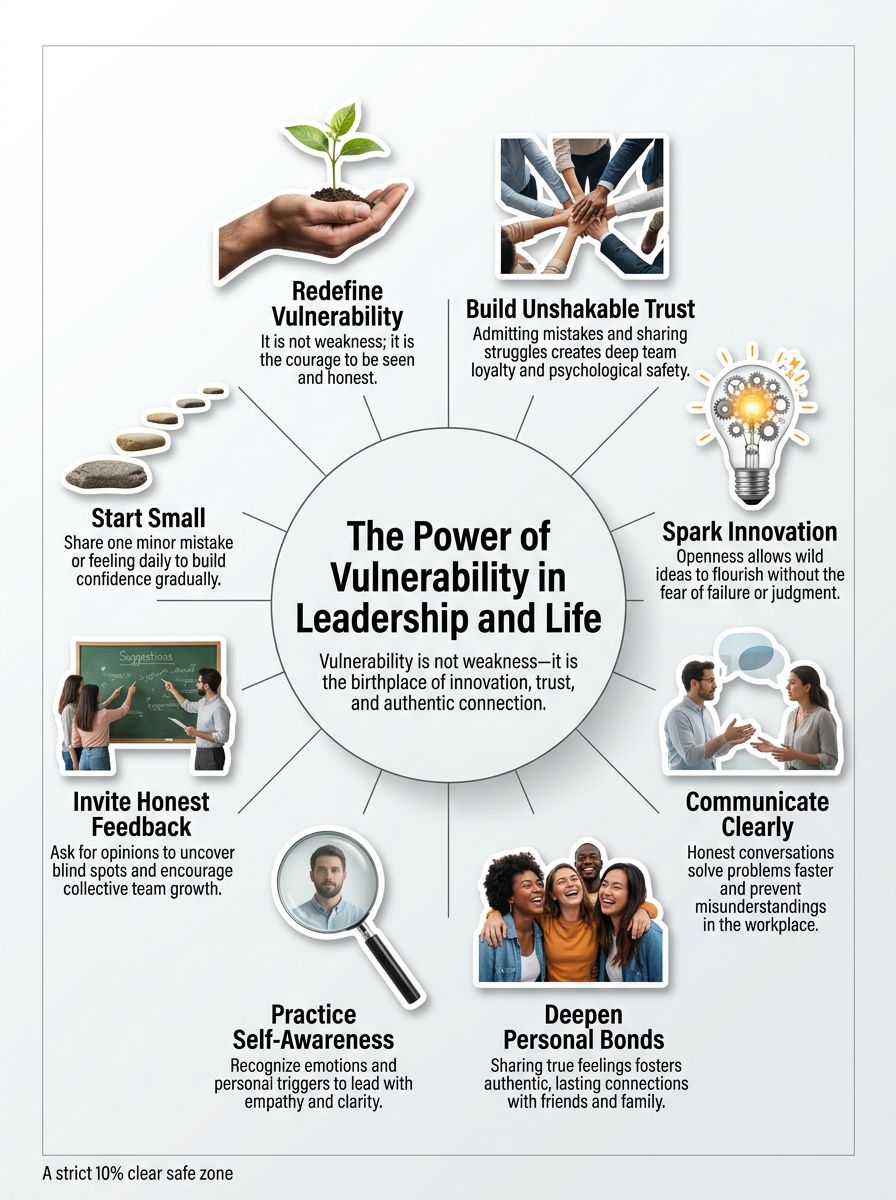
Think of it as the “Pratfall Effect” in action. When a highly capable leader admits, “I don’t know the answer to that yet,” they do not lose respect. They actually gain it because they have proven they value the truth over their ego. Vulnerability is the courage to say “I was wrong” or “I need help” when it would be easier to stay silent.
In your daily life, this might look like telling a friend you are feeling overwhelmed instead of saying “I’m fine.” It creates an opening for a real connection because it signals that you are safe to talk to. Brené Brown captured this perfectly when she said:
Vulnerability is the birthplace of innovation, creativity and change.
When you stop wasting energy on hiding your flaws, you free up that energy for growth. This shift transforms the culture around you, whether you are running a company or raising a family.
Why Vulnerability Matters
Vulnerability is the glue that holds relationships together. Without it, we are just trading information rather than truly connecting. It changes the mechanics of how we work and live by replacing suspicion with trust.
Building authentic connections
Trust is not built in a single big moment. It is built in tiny moments over time. Brené Brown calls this the “Marble Jar” concept. Every time you show up for someone, listen to them, or share a hard truth, you put a marble in their jar. You cannot demand trust from an empty jar.
An authentic connection happens when we lower our guard. If you present a perfect image, people can only admire you from a distance. But if you share a struggle, they can stand beside you. A simple admission like “I’m struggling with this project” invites your team to step up and support you. This creates a cycle of reciprocity where everyone feels safe enough to contribute their best work.
Encouraging open communication
People need to feel that their voice matters. The 2025 Edelman Trust Barometer highlights a “Crisis of Grievance” in the workplace, where employees feel ignored and undervalued. Vulnerability is the antidote to this feeling.
When a leader says, “I made a mistake here,” it gives everyone else permission to speak up about their own errors. This openness prevents small issues from growing into disasters. As Brown famously notes:
Clear is kind. Unclear is unkind.
Honest communication allows teams to solve problems faster. You stop protecting your ego and start protecting the team’s success.
Creating psychological safety
The most important factor for a high-performing team is psychological safety. Google proved this with their massive “Project Aristotle” study. They found that psychological safety was the number one predictor of team success, accounting for roughly 43% of the variance in performance.
Safety does not mean comfort. It means you can take a risk without being punished. Leaders set this tone. When you admit you are unsure, you signal that it is safe to be a learner. Solutions appear more often because people stop hiding their wild ideas. They know they will not be mocked for trying something new.
The Role of Vulnerability in Leadership
Leadership skill is not about knowing all the answers. It is about asking the right questions. Vulnerability transforms you from a distant commander into a trusted guide.
Building trust within teams
Managers account for a staggering 70% of the variance in team engagement, according to Gallup’s 2024 analysis. This means your behavior directly dictates whether your team cares about their work. Trust grows when you are human first and a boss second.

When you are honest about the challenges ahead, your team rallies. They stop wondering what you are hiding and start focusing on the mission. This honesty spreads quickly. Team members begin to support each other because they know that asking for help is encouraged, not punished.
Strong bonds form in the trenches. When you share the burden of a tough quarter or a failed launch, you build a loyalty that a paycheck alone cannot buy. Small acts of courage create a foundation that holds firm under pressure.
Inspiring collaboration
Collaboration dies in an environment of perfectionism. If everyone is afraid to look foolish, no one will suggest the half-baked idea that could turn into the next big breakthrough. A vulnerable leader breaks this deadlock.
Satya Nadella did this at Microsoft by shifting the culture from “know-it-alls” to “learn-it-alls.” He admitted that the company had lost its way and needed to listen more. This humility opened the door for massive collaboration. People stopped competing with each other and started building on each other’s ideas. The result was a resurgence of creativity and market dominance.
Driving innovation and creativity
Innovation requires failure. You cannot invent something new if you are terrified of getting it wrong. Leaders who frame mistakes as learning opportunities see a 30% boost in innovation, according to research cited by the Harvard Business Review.
When you admit your own failures, you destigmatize the process of trial and error. Your team feels safe to experiment. They will pitch the risky idea or try the new tool because they know their leader values the attempt. This is how stagnant companies become industry leaders.
Vulnerability as a Strength in Personal Life
Your personal life thrives on the same principles as your work life. The walls you build to protect yourself are the same walls that keep love and connection out.
Fostering meaningful relationships
The difference between a lasting relationship and a failed one often comes down to how we handle “bids” for connection. The Gottman Institute found that successful couples turn toward each other’s bids for attention 86% of the time, while couples who divorce do so only 33% of the time.
A bid can be as simple as a sigh or a comment about the weather. Ignoring it shuts down the connection. Answering it builds a bridge. Vulnerability is the willingness to make those bids and to respond to them with care. It is about saying “I missed you” or “I’m sad” instead of retreating into silence.
Embracing personal growth
You cannot grow if you cannot admit where you are starting from. The “Johari Window” is a powerful tool for this. It maps out what you know about yourself versus what others see. The “Blind Spot” is where growth happens.
Asking a friend, “What is one thing I do that pushes people away?” is terrifying. It is also the fastest way to grow. You do not need to change everything overnight. Small steps matter. Read a book on emotional intelligence. Ask for feedback. Admit when you are jealous or insecure. These small acts push your boundaries and expand your self-awareness.
Overcoming fear of judgment
We often hold back because we suffer from the “Spotlight Effect.” This is a psychological phenomenon where we believe people are paying far more attention to us than they actually are. In reality, most people are focused on their own lives.
Brené Brown reminds us that courage is telling our story with our whole heart. The fear of judgment feels heavy, but it lightens the moment you speak it out loud. Try sharing one honest thought today. Tell a friend, “I’m actually really nervous about this.” You will likely find they breathe a sigh of relief and say, “Me too.” That shared moment destroys the fear.
Challenges of Embracing Vulnerability
Opening up feels risky because it is risky. Walking into a meeting or a family dinner without your armor takes guts. You might worry about losing control or respect.
Addressing resistance and fear
Fear tells you that if you show emotion, you will look weak. This is a biological survival mechanism, but it is outdated for modern life. In a team setting, fear manifests as silence. People nod along while secretly disagreeing because they are afraid to rock the boat.
Courage is feeling that fear and doing it anyway. Leaders can break down these walls by normalizing the struggle. If you treat a mistake as a crime, people will hide the evidence. If you treat it as data, people will share it. Little by little, you replace a culture of fear with a culture of learning.
There is a fine line between vulnerability and oversharing. You want to be relatable, not reliable. A leader who cries in every meeting creates anxiety. A leader who admits, “This is a tough challenge, but I have a plan to get us through it,” creates confidence.
This is the concept of “bounded vulnerability.” You share your feelings to drive the mission forward, not to unload your emotional baggage on your team. You can own your errors while still holding firm on your standards. Real authority comes from this mix of humanity and competence.
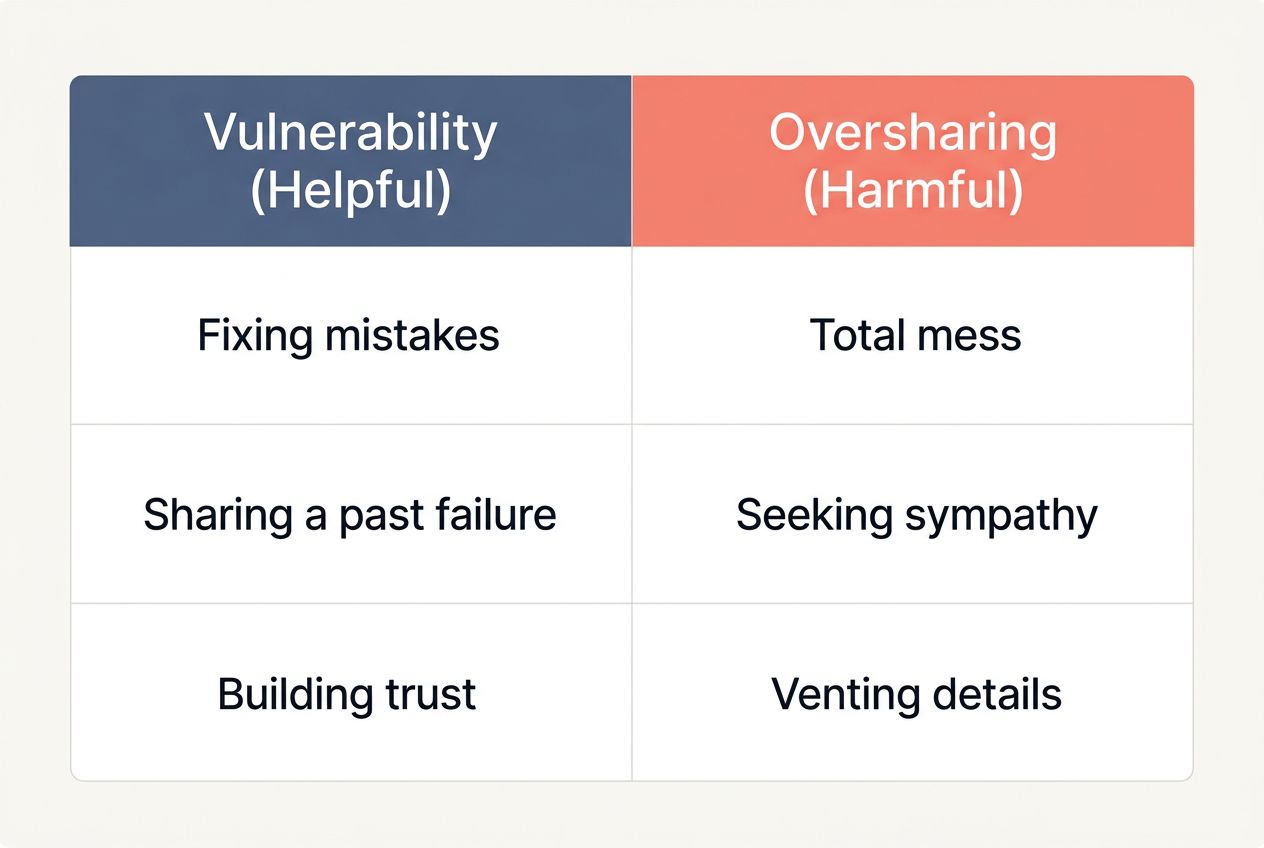
| Vulnerability (Helpful) | Oversharing (Harmful) |
|---|---|
| “I made a mistake on the budget, and here is how I’m fixing it.” | “I’m a total mess, and I don’t know what I’m doing with this money.” |
| “I’m feeling a bit stressed today, so please bear with me.” | Venting about personal divorce details for 20 minutes in a staff meeting. |
| Sharing a past failure to teach a lesson. | Sharing a raw, unprocessed trauma to get sympathy. |
Not every workplace celebrates openness. In some “tough guy” cultures, showing emotion is seen as a liability. You have to be smart about reading the room. You might be a chameleon at first.
If you work in a rigid environment, start small. You do not need to pour your heart out. Just start by asking more questions and admitting when you need input. Trust is universal, even if the expression of it varies. In Japan, vulnerability might look like deep humility. In a New York startup, it might look like brash honesty. The goal is connection, whatever form that takes.
How to Cultivate Vulnerability as a Skill
This is a muscle you can build. You do not wake up one day perfectly vulnerable. You practice it in small, safe ways until it becomes natural.
Practicing self-awareness
You cannot share what you do not know. Self-awareness is the foundation. It requires you to slow down and check in with yourself.
- Name your emotions: Studies show that simply labeling an emotion (“I am feeling anxious”) reduces the stress response in your brain.
- Know your values: What do you stand for? It is easier to be vulnerable when you know why you are doing it.
- Own your story: Accept your past mistakes as part of your journey, not things to be hidden.
- Watch your body language: Are your arms crossed? Are you looking at your phone? Open posture signals an open mind.
- Journal your triggers: Write down what makes you defensive. This helps you catch yourself next time.
- Pause before reacting: The “Viktor Frankl gap” is the space between stimulus and response. Use that space to choose a better reaction.
- Check your impact: Ask yourself, “Did my honesty help the team, or did it just make me feel better?”
Seeking feedback from others
Feedback is the breakfast of champions, but it can be hard to swallow. You need to actively invite it.
- Use the “2-Minute Rule”: At the end of a meeting, ask, “What is one thing I could have done better in the last two minutes?” It lowers the stakes.
- Ask specific questions: Instead of “How am I doing?”, ask “Did I interrupt too much in that call?”
- Listen without defending: This is the hardest part. Just say “Thank you.” You can decide later if the feedback is valid.
- Reward the messenger: If someone gives you tough feedback, thank them publicly. It shows it is safe to speak truth to power.
- Look for patterns: If three people tell you that you are a poor listener, it is time to listen to them.
- Admit when you are wrong: When feedback is accurate, own it immediately. It builds massive credibility.
Taking small steps toward openness
Start with “low stakes” vulnerability. You do not need to bare your soul to the CEO on day one.
- The “Check-In” Protocol: Start meetings with a “Red, Yellow, Green” check-in. “I’m Yellow today because my kids are sick.” It builds empathy instantly.
- Share a small failure: Tell a story about a time you messed up a minor task.
- Ask for help. Pick a small project and ask a peer, “I’m stuck on this, can you take a look?”
- Admit a knowledge gap: Say “I don’t know what that acronym means” instead of nodding along.
- Express gratitude: Be specific. “I really appreciated how you handled that client” is a moment of connection.
- Apologize quickly: If you snap at someone, say “I’m sorry” within the hour. Do not let it fester.
Examples of Vulnerable Leadership in Action
Sometimes you need to see it to believe it. These leaders proved that dropping the armor is a smart business move.
Brené Brown’s insights on vulnerability
Dr. Brené Brown put this topic on the map. Her 2010 TED Talk went viral because she touched a nerve. She explained that we numb our vulnerability, but you cannot numb hard feelings without also numbing joy and gratitude.
Her research with thousands of people showed a clear pattern. The most resilient people were those who believed they were worthy of love, flaws and all. They embraced the “suck.” They leaned into the discomfort. Her work proves that vulnerability is the most accurate measure of courage we have.
Real-world examples of leaders embracing authenticity
Howard Schultz provided a masterclass in this during the 2008 financial crisis. Starbucks was struggling. Instead of blaming the economy, he sent a memo admitting that the company had “lost its way.” He then did the unthinkable: he closed 7,100 stores for a day to retrain baristas on how to make the perfect espresso.
It cost millions in lost sales. Critics laughed. But Schultz stood in front of his employees and admitted they had chosen speed over quality. That act of vulnerability and recommitment to values turned the company around. Similarly, Satya Nadella’s book Hit Refresh details how he had to learn empathy as a father and a leader to transform Microsoft. He admits his early mistakes freely, which makes his current success feel earned and accessible.
The Benefits of Vulnerability in Leadership and Life
The payoff for all this brave work is tangible. It shows up in the bottom line and in your blood pressure.

Improved trust and loyalty
Engagement creates retention. Gallup found that teams with highly engaged managers (who are often the most vulnerable) see 51% less turnover. People do not leave companies; they leave bosses who do not care about them.
When you are real, you create a “tribe” mentality. Your team protects you because you protect them. Loyalty becomes personal. They will stay late to finish a project, not because they have to, but because they want you to succeed.
Enhanced emotional well-being
Wearing a mask is stressful. It keeps your cortisol levels high. Letting it drop is a physical relief. You stop scanning the room for threats and start enjoying the people in it.
Harvard Business Review studies consistently show that leaders who practice self-compassion and openness have lower burnout rates. You realize you do not have to carry the weight of the world alone. You have a team to help you carry it.
Strengthened leadership impact
Vulnerability is a force multiplier. It amplifies your message. When you speak from the heart, people listen.
A leader who admits, “I’m scared about this market shift, but here is why I believe in us,” is far more inspiring than one who pretends the shift is not happening. Authenticity cuts through the noise. It builds a legacy of leaders who are strong enough to be gentle.
Practical Strategies for Integrating Vulnerability
You have the “why” and the “what.” Here is the “how” for your daily routine.
Initiating Small Steps Towards Vulnerability
Make these actions a habit, like brushing your teeth. Consistency beats intensity.
- The “Monday Morning Story”: Start the week by sharing one personal thing you did on the weekend. It humanizes you.
- The “I Don’t Know” Challenge: Try to say “I don’t know” at least once a week when you genuinely are unsure.
- Ask “What am I missing?”: This invites others to fill in your blind spots.
- Thank people for the small stuff: “Thanks for catching that typo” reinforces that you value accuracy over your own ego.
- Share the credit: Publicly point out who did the real work. It shows you are secure enough to shine the light on others.
- Admit when you are tired: “I’m running on fumes today” helps others manage their expectations of you.
- Normalize failure: Celebrate a “Failure of the Month” where someone tried something bold that did not work.
Establishing Safe Zones for Open Dialogue
You need to build the container before you can fill it with trust.
- Create “Rumbler” meetings: Use Brené Brown’s term for a meeting where it is safe to struggle with a problem. “Let’s rumble with this” means “Let’s get messy and honest.”
- Set ground rules: “No interrupting” and “Assume positive intent” are crucial for safety.
- Protect confidentiality: If someone shares a struggle, it stays in the room. One leak sinks the ship.
- Listen actively: Put the phone away. Close the laptop. Eye contact is the currency of trust.
- Validate feelings: You do not have to agree with someone’s anger to validate it. “I can see why you are frustrated” goes a long way.
The Bottom Line
Vulnerability is the ultimate power move. It takes immense courage to show your true thoughts and feelings in a world that often rewards pretending. But the reward is worth the risk. You build a team that trusts you, a family that knows you, and a life that feels authentic.
Leaders who embrace this truth do not just get better results; they get better lives. They sleep better. They laugh more. They build legacies that last. Start today. Ask one question. Share one fear. Drop one mask. You will be amazed at who is waiting to meet the real you.