OpenAI, the multi-billion-dollar research lab behind ChatGPT, ignited a new front in the artificial intelligence wars this week, launching the OpenAI Atlas browser in a direct and audacious challenge to Google’s decades-long dominance of the web.
The new browser, announced Tuesday (October 21, 2025) and made immediately available on Apple’s macOS, is not merely an alternative to Chrome. It is a fundamental attempt to shift how users interact with the internet—moving away from the traditional search bar and toward a conversational, AI-driven “agent” that understands context, remembers user history, and takes action on their behalf.
Key Facts: The Atlas Launch
- What It Is: “ChatGPT Atlas,” an AI-first web browser from OpenAI, built on the open-source Chromium engine.
- Availability: Launched globally for Apple’s macOS on October 21, 2025. Versions for Windows, iOS, and Android are “coming soon.
- The Core Feature: A premium “Agent Mode” that allows the AI to autonomously perform multi-step tasks like booking flights, ordering groceries, or summarizing research.
- Market Disruption: The announcement sent shockwaves through the market. Alphabet (Google) stock fell significantly, with some reports estimating a loss of over $100 billion in market value in the immediate aftermath.
- The Target: Google Chrome, the undisputed market leader, which holds an estimated 71.9% of the global browser market as of September 2025.
- The Strategy: To leverage ChatGPT’s massive 800-million-plus user base into a new ecosystem, turning the browser itself into an intelligent assistant.
A ‘Once-a-Decade Opportunity’
For nearly two decades, the web has been synonymous with Google. Its Chrome browser, launched in 2008, unseated Microsoft’s Internet Explorer and became the ubiquitous gateway to the digital world, cementing Google Search as the internet’s central utility.
OpenAI is betting that this paradigm is over.
In a video presentation accompanying the launch, OpenAI CEO Sam Altman framed the release in historic terms. “This is a rare, once-a-decade opportunity to rethink what a browser can be about and how to use one,” Altman stated. “Tabs were great, but we haven’t seen a lot of browser innovation since then.”
The innovation OpenAI proposes is to embed its powerful generative AI directly into the fabric of browsing. Instead of a user opening tabs, searching, copying information, and pasting it elsewhere, Atlas is designed to do the work for them.
“It’s using the internet for you,” Altman said.
What is the OpenAI Atlas Browser?
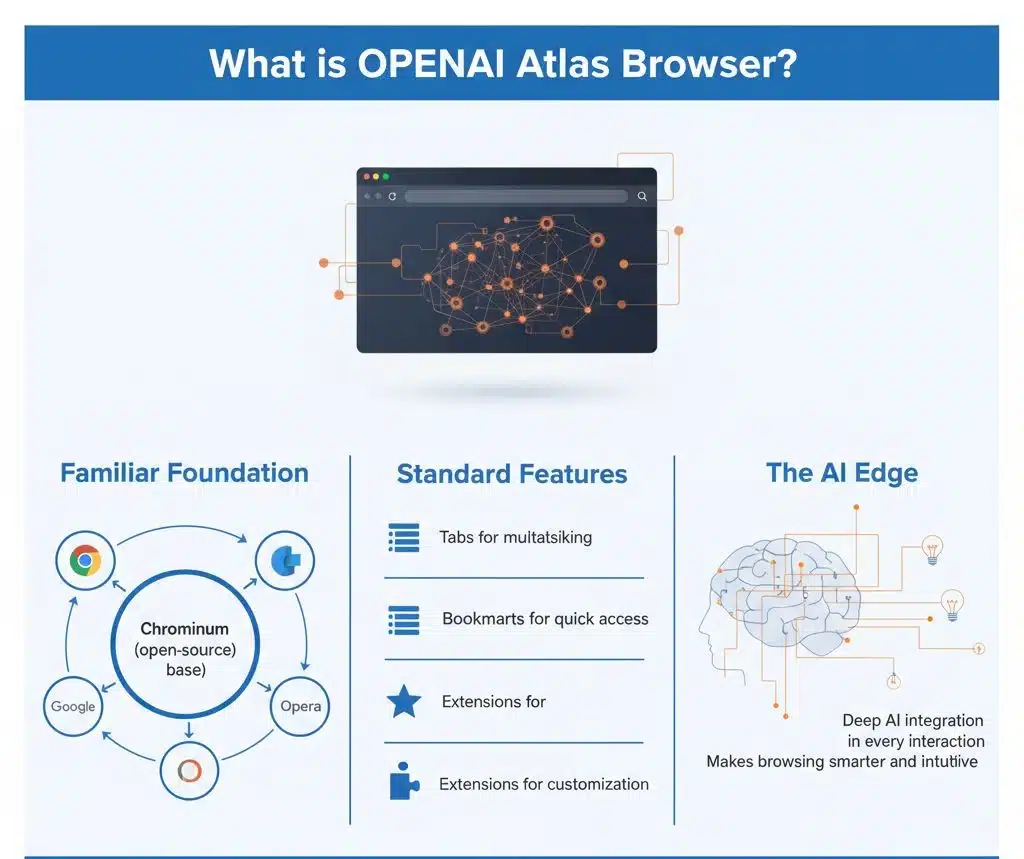
At first glance, Atlas looks familiar. Built on Chromium, the same open-source project that powers Google Chrome, Microsoft Edge, and Opera, it supports standard features like tabs, bookmarks, and extensions. The difference lies in the AI integration that permeates every interaction.
Core Features: Agent, Memory, and Inline Chat
The browser is built around three main AI pillars:
- Chat & Inline Editing: A persistent “Ask ChatGPT” sidebar is available on every webpage. Users can ask the AI to summarize the content, compare products on a shopping site, or analyze data. A “Cursor Chat” feature allows users to highlight any text on the web—such as an email draft in Gmail—and ask ChatGPT to edit it inline (e.g., “Make this sound more professional”).
- Memory: Atlas introduces an optional “Browser memories” feature. With user permission, ChatGPT can remember context from previously visited sites. A user could, for example, ask, “Show me the job postings I looked at last week and summarize their key requirements.” This memory is managed in settings and can be deleted.
- Agent Mode (Premium): This is the browser’s headline feature, currently in preview for paid ChatGPT Plus and Pro subscribers. “Agent Mode” turns the browser into a functional assistant. In a demo, OpenAI developers showed Atlas finding an online recipe and then autonomously navigating to a grocery website, adding the necessary ingredients to a cart, and proceeding to checkout. This “agentic AI” is designed to handle complex, multi-step tasks that traditionally require significant human effort.
Privacy and Data Use
Anticipating privacy concerns, OpenAI has stated that user browsing content will not be used to train its AI models by default. Users must explicitly opt-in to allow their browsing data to be used for training. Users can also control which sites ChatGPT can access, clear their history to erase “memories,” and use a standard incognito mode.
Data & Statistics: The Behemoth vs. The Challenger
The “Browser Wars” of the 1990s (Netscape vs. Internet Explorer) and the 2000s (IE vs. Firefox vs. Chrome) were battles for market share. This new war is a battle for the internet’s core interface. The stakes are immense.
- Google’s Market Dominance (Sept 2025): Google Chrome is the clear incumbent. According to data from StatCounter, Chrome held approximately 71.9% of the global browser market share in September 2025. Apple’s Safari was a distant second at 18.6%, followed by Microsoft Edge (5.1%) and Firefox (2.2%).
- The User Base Disparity: While Chrome boasts an estimated 3 billion worldwide users, OpenAI’s ChatGPT has a massive and highly engaged user base of its own, estimated at over 800 million users. OpenAI’s strategy is to convert this active AI audience into browser users.
- Wall Street’s Verdict: Investors reacted immediately to the threat. On Tuesday, October 21, Alphabet (Google’s parent company) saw its market capitalization fall by over 4%, a drop that the Hindustan Times reported as a “loss of $100 billion in market value,” signaling deep investor anxiety over a credible threat to Google’s core search and ad revenue business.
Official & Expert Analysis: A ‘Formidable Competitor’
The launch of Atlas is not happening in a vacuum. It comes as Google itself is racing to integrate its own Gemini AI into Chrome and Search. Other AI-native browsers, such as Perplexity’s “Comet,” have also entered the fray.
However, OpenAI’s scale and financial backing from Microsoft make it a uniquely “formidable competitor,” according to Melissa Otto, head of research at S&P Global Visible Alpha.
An Ironic Gift to Google?
The timing of the Atlas launch has a significant and ironic legal implication. Google recently secured a major victory in its landmark antitrust case with the U.S. Department of Justice (DOJ).
The DOJ had argued that Google maintained an illegal monopoly in search, in part by paying billions to be the default on browsers like Apple’s Safari. The government had sought remedies as drastic as forcing Google to divest its Chrome browser.
However, U.S. District Judge Amit Mehta ultimately ruled against the forced sale of Chrome last month. A key part of his reasoning was that emerging AI technologies, specifically naming OpenAI’s ChatGPT, were already reshaping the competitive landscape and represented a new, powerful threat to Google’s search dominance.
The launch of the OpenAI Atlas browser just weeks later serves as a powerful, real-world validation of Judge Mehta’s argument—and provides Google with potent “ammunition” to argue against future antitrust breakups.
The ‘Anti-Web’? Early Criticism Emerges
While the launch was met with excitement in the tech community, it also drew immediate and sharp criticism. The core concern is that an AI-first browser does not help users navigate the web, but rather replaces it.
Anil Dash, a prominent technologist and blogger, called Atlas “the first browser that actively fights against the web” and labeled it an “anti-web browser.
Dash argues that by default, Atlas substitutes its own “plagiarized” AI-generated content for the web. He notes that a search for “Taylor Swift” returned a synthesized page of text with “literally zero links to Taylor Swift’s actual website.”
The fear, shared by publishers and content creators, is that if Atlas is successful, it will “cut content creators further out of the loop,” summarizing their work without sending traffic (and its associated revenue) to their sites.
What to Watch Next
The launch of Atlas for macOS is just the first shot. The real battle will begin when the Windows, iOS, and Android versions are released. Google’s response will be critical; the company is expected to accelerate the integration of its powerful Gemini AI into Chrome to counter Atlas’s “Agent Mode.”
This is no longer a simple competition over speed or features. It is a fundamental divergence in vision: Is the internet a library of links to be searched, or a sea of data for an AI agent to consume and act upon?
With the launch of Atlas, users, not companies, will begin to decide the answer.
The Information is Collected from MSN and Yahoo.