January 8 is a date that carries a surprisingly wide range of global meaning. In one corner of the world, it’s remembered as a founding day for a liberation movement that would change Africa’s political future. In another, it’s tied to a speech that tried to redesign the rules of international peace after World War I. In yet another, it marks deaths and birthdays of people whose work shaped science, music, and public imagination.
What makes January 8 especially interesting is that it highlights a simple truth: history is not only made through wars and leaders. It’s also made through institutions, ideas, and culture—through the way people organize, communicate, and create.
This in-depth report follows your requested structure while keeping the coverage globally balanced and easy to scan.
At A Glance: January 8 In World History
| Area | Event | Why It Still Matters |
|---|---|---|
| United States | George Washington delivers the first State of the Union (1790) | Sets the model for how modern states publicly define priorities |
| International Politics | Wilson’s “Fourteen Points” speech (1918) | A foundational text for modern diplomacy and self-determination debates |
| South Africa | African National Congress founded (1912) | A cornerstone organization in the anti-apartheid struggle and post-apartheid politics |
| China | Zhou Enlai dies (1976) | A major transition signal in a politically intense year |
| Science history | Galileo Galilei dies (1642) | A lasting symbol of evidence-based inquiry and intellectual freedom |
| Global Crisis | Flight PS752 shot down after takeoff from Tehran (2020) | A stark lesson in escalation risk and civilian vulnerability |
| South America | Brasília unrest (2023) | A modern example of institutional stress and political polarization |
The Bangalee Sphere
A Nation Steps From Victory Into Governance (Bangladesh, 1972)
India’s Reform And Literary Currents That Still Speak
January 8 also points to two powerful strands in Indian history, especially connected to Bengal and North India: social reform and literary modernism.
Keshab Chandra Sen And The Bengal Renaissance Legacy
Keshab Chandra Sen, a major reform figure associated with the Brahmo movement and the larger Bengal Renaissance ecosystem, died on January 8 (1884). His life sits inside a key 19th-century question that still feels modern: how do societies reform from within while encountering new ideas, technologies, and power structures from outside?
He became part of a broader push that engaged education, women’s status, religious debate, and social practice. Even when people disagree with reformers like Sen, the significance is clear. They forced public conversations that shaped civic life, especially in urban Bengal.
Why it matters today: Modern South Asia still debates the same themes, including reform versus tradition, the role of faith in public life, and how communities handle social change without losing identity.
Ashapurna Devi: A Bengali Voice That Turned Private Lives Into Public History
Ashapurna Devi, born January 8 (1909), is celebrated for turning everyday Bengali women’s lives into literature that feels like social documentation. She captured the pressures inside domestic spaces where tradition, duty, education, and desire collided. That is why readers still return to her. She did not write “small stories.” She wrote society.
Why it matters today: Her work keeps reminding us that the household is a political place. It is where gender roles harden or soften, where class is reproduced, and where modernity enters slowly through habits, education, and expectations.
Mohan Rakesh: Hindi Modernism And The Urban Inner Life
Mohan Rakesh, born January 8 (1925), helped reshape modern Hindi literature and theatre. His writing helped bring the inner conflicts of modern life, including alienation and moral ambiguity, into Indian storytelling without needing epic heroes.
Why it matters today: The modern South Asian city still lives inside the questions Rakesh raised, including identity, belonging, love, duty, and the loneliness that can exist even in crowds.
Birth And Death Anniversaries
Notable Birth Anniversaries
| Name | Year | Field | Why Remembered |
|---|---|---|---|
| Ashapurna Devi | 1909 | Bengali literature | Major novelist of women’s lives, social change, and modern Bengali identity |
| Mohan Rakesh | 1925 | Hindi literature and theatre | Pioneer voice in modern Hindi storytelling |
| Fearless Nadia | 1908 | Indian cinema | Early action heroine and stunt icon in Indian film history |
Notable Death Anniversaries
| Name | Year | Field | Legacy |
|---|---|---|---|
| Keshab Chandra Sen | 1884 | Reform, philosophy | A defining figure of reform-era debates in colonial Bengal |
International Observances And Holidays
January 8 is not dominated by one global UN-style observance, but it carries a handful of widely noted, media-friendly days that people use to spark learning and public interest.
Earth’s Rotation Day
Earth’s Rotation Day is often observed on January 8 as a popular science celebration. People use it to talk about what the rotation of Earth means in daily life, including timekeeping, day and night cycles, and how scientific proof often relies on clever observation and measurement.
Why it matters today: This is an easy entry point into scientific literacy. When society argues about evidence, climate, vaccines, or technology, the deeper issue is often the public’s comfort with how science proves things.
Orthodox Christmas Season Effects (In Some Countries)
In several countries where Orthodox Christian calendars shape public rhythms, early January can include extended holiday schedules around Christmas and New Year. The exact “holiday on January 8” varies by country and by year, but the cultural effect is consistent: travel spikes, public offices adjust, and news cycles slow down.
Why it matters today: Holiday calendars influence economics, migration patterns, and even political timing. Culture shapes state behavior more than many people realize.
Reader-Friendly Observance Table
| Observance | Where It’s Noted | What People Do |
|---|---|---|
| Earth’s Rotation Day | International, popular culture | Science explainers, classroom activities, astronomy content |
| Orthodox holiday extensions (varies) | Parts of Eastern Europe and Eurasia | Public closures, family gatherings, travel and religious observance |
Global History
United States: Institutions, War, And Social Policy
1790: The First State Of The Union
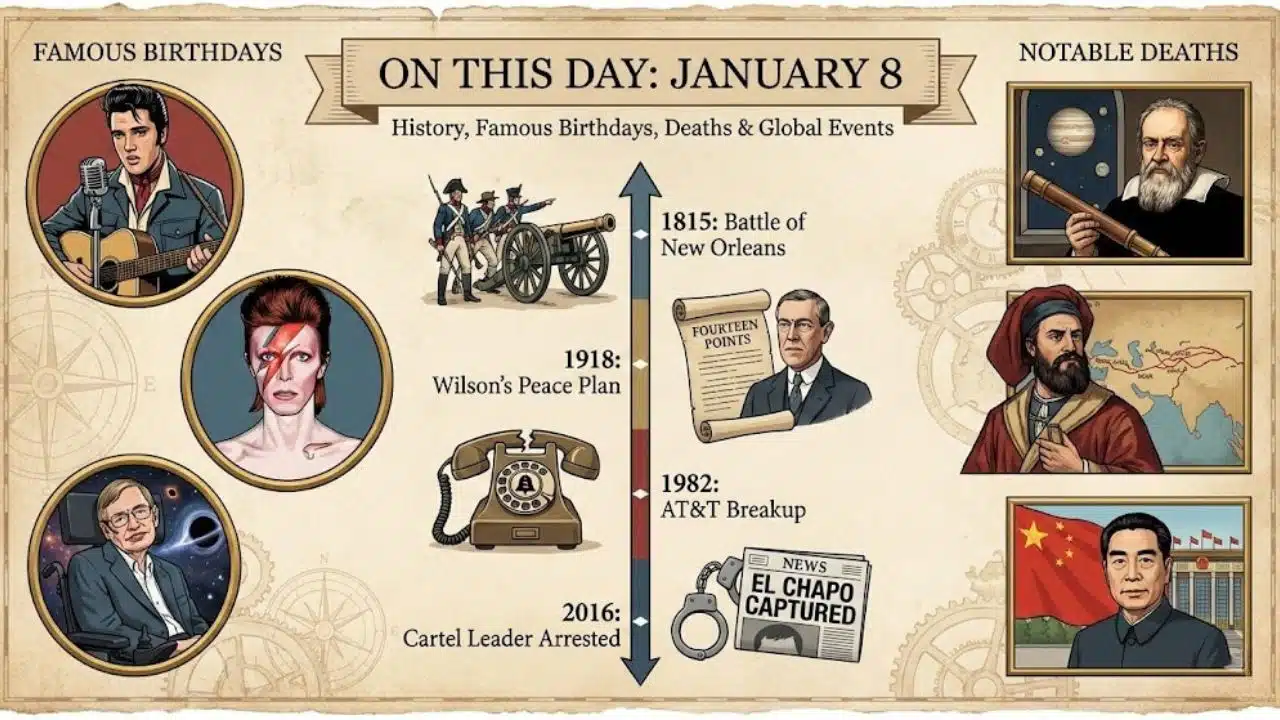
George Washington delivered the first State of the Union style annual address on January 8, 1790. Even if today’s versions look like political theatre, the original idea remains powerful: leaders must publicly report conditions and propose priorities.
Why it matters today: Modern governance often depends on narrative. Budgets, laws, and public trust follow the story a government tells about what matters.
1815: The Battle Of New Orleans
The Battle of New Orleans, fought January 8, 1815, became one of the most mythologized U.S. victories of the War of 1812. It boosted Andrew Jackson’s status and entered national memory as a story of underdogs and defense.
Why it matters today: Nations often build identity around remembered victories. The emotional afterlife of battles can outlast their direct strategic value.
1867: Voting Rights Expansion In Washington, D.C.
In a Reconstruction-era milestone, Black men in D.C. gained the right to vote after a major legislative clash with President Andrew Johnson.
Why it matters today: It shows how voting rights are often contested through power struggles, not simply granted through moral consensus.
1918: Wilson’s Fourteen Points Speech
On January 8, 1918, President Woodrow Wilson outlined the Fourteen Points. It promised a vision of diplomacy with transparency, reduced militarism, and self-determination.
Why it matters today: The language of self-determination still fuels politics worldwide. The promise and the controversy both continue, especially when ideals clash with strategic interests.
1964: The “War On Poverty” Framing
Lyndon B. Johnson’s January 8, 1964 State of the Union speech used the phrase “war on poverty” as a moral and policy mission.
Why it matters today: Governments still frame social policy as “wars” on problems. That language can mobilize resources, but it can also oversimplify complex causes.
China: A Death That Signaled A Political Turning Year
1976: Zhou Enlai Dies
Zhou Enlai’s death on January 8, 1976 had massive symbolic and emotional impact in China. It became part of a larger pattern of public mourning and political tension in a year often remembered as a hinge between eras.
Why it matters today: When a key figure dies during a high-pressure period, grief becomes political. Public mourning can become a referendum on the direction of a country.
South Africa: A Long-Arc Organization Is Born
1912: African National Congress Founded
The ANC was founded on January 8, 1912. It began as an organized effort to advocate for Black South Africans’ rights and later became central to the anti-apartheid struggle and post-apartheid governance.
Why it matters today: Liberation movements that become governing parties face a difficult transition. They must move from protest logic to policy logic while still carrying the moral weight of the past.
Europe: Science And Statecraft
1642: Galileo Galilei Dies
Galileo died on January 8, 1642. He remains a symbol of modern science, especially the tension between evidence-based inquiry and institutional authority.
Why it matters today: Galileo’s story is often simplified, but the core lesson is timeless. Societies progress when they protect the right to test ideas against evidence.
1959: Charles de Gaulle Begins His French Presidency
De Gaulle’s presidency began on January 8, 1959, solidifying the Fifth Republic’s stronger executive model.
Why it matters today: Constitutional design is not abstract. It shapes how countries handle crisis, paralysis, and leadership transitions.
Middle East And Global Crisis: January 8, 2020
Iran Escalation And Flight PS752
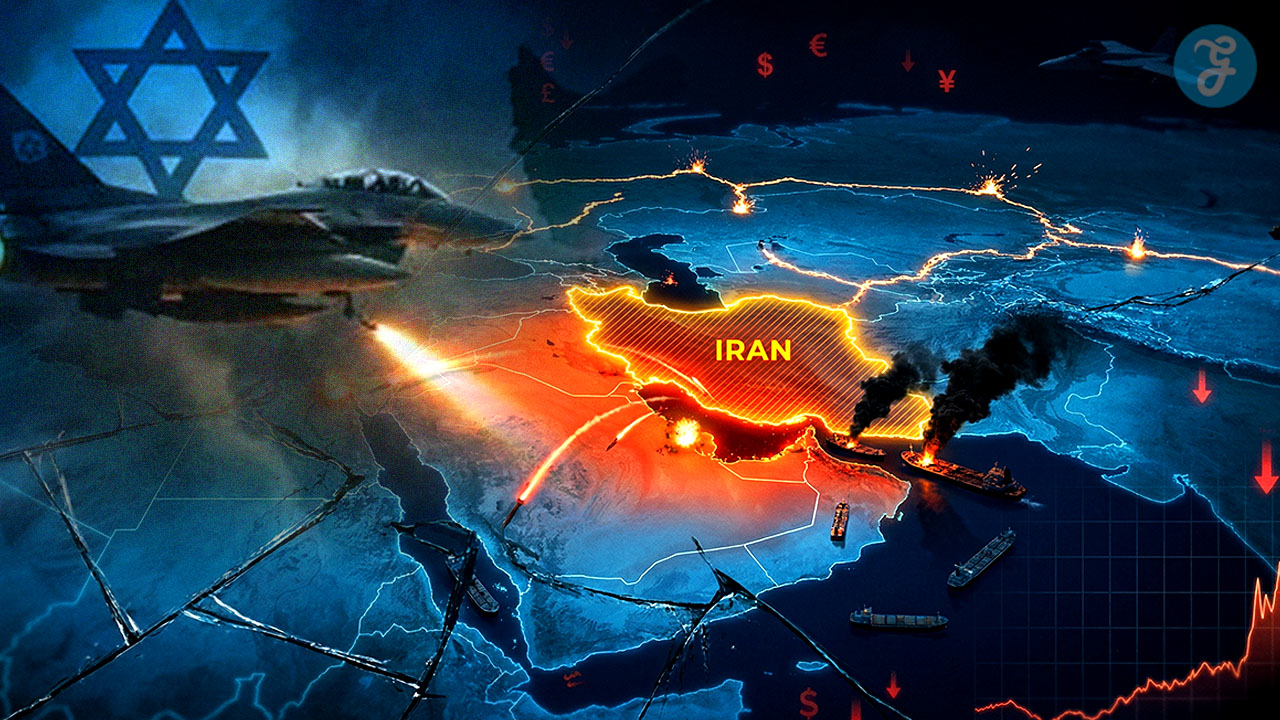
January 8, 2020 became one of the most tragic examples of how fast crisis spirals can destroy civilian life. After heightened military tensions, Ukraine International Airlines Flight 752 was shot down shortly after takeoff, killing everyone aboard.
Why it matters today: The event forces an uncomfortable truth. In high-alert situations, states can make catastrophic errors. Civilian protection depends not only on technology but also on restraint, communication, and accountability.
South America: Democracy Stress-Tested (Brazil, 2023)
On January 8, 2023, Brazil faced a major democratic shock when rioters stormed key government buildings in Brasília.
Why it matters today: Modern democracies are increasingly tested not only at the ballot box but also through attempts to delegitimize results, pressure institutions, and normalize political violence.
Notable Births And Deaths (Global)
Famous Birth Anniversaries
| Name | Born | Nationality | Why Famous |
|---|---|---|---|
| Elvis Presley | 1935 | United States | Rock and roll icon, global cultural influence |
| Stephen Hawking | 1942 | United Kingdom | Theoretical physicist and popular science communicator |
| David Bowie | 1947 | United Kingdom | Music innovator and cultural shape-shifter |
| Shirley Bassey | 1937 | United Kingdom (Wales) | Legendary vocalist, iconic film theme performances |
| Carolina Herrera | 1939 | Venezuela / United States | Fashion designer and global style influence |
| Cynthia Erivo | 1987 | United Kingdom | Award-winning actress and singer, major stage and film roles |
| Noah Cyrus | 2000 | United States | Singer and actress, Grammy-nominated artist |
| Kim Jong Un (birth year disputed) | 1980s | North Korea | Leader whose exact birth year is publicly disputed |
Famous Death Anniversaries
| Name | Died | Nationality | Why Remembered |
|---|---|---|---|
| Galileo Galilei | 1642 | Italian | Scientific revolution figure and evidence-based inquiry symbol |
| Zhou Enlai | 1976 | Chinese | Major modern statesman in a transition era |
| Robert Baden-Powell | 1941 | British | Founder of the global Scouting movement |
| Terry-Thomas | 1990 | British | Distinctive comic actor and cultural personality |
Did You Know? Trivia For January 8
-
January 8 links two very different “global blueprints.” Wilson’s Fourteen Points imagined a post-war world order, while Washington’s first annual address modeled how a president speaks to a legislature about national direction.
-
The ANC’s founding date is a reminder that many political “overnight” victories are actually a century-long accumulation of organizing, coalition building, and public persuasion.
-
January 8 is one of the rare dates where pop culture and public intellect overlap in the birthday list. You can move from Elvis to Hawking to Bowie without leaving the same day.
Takeaways
January 8 is a reminder that history isn’t neatly separated into “politics,” “science,” or “culture.” On this date, those worlds repeatedly overlap. A speech can reshape how nations imagine peace. A liberation movement’s founding can influence generations of resistance and governance. A scientist’s life and death can become a symbol for how humans argue with authority using evidence. And a single day’s birthdays can connect pop music, fashion, and scientific thought into one shared cultural timeline.
In the end, January 8 shows how the world moves forward in two ways at once: through big public events that change institutions, and through quieter cultural forces—books, performances, ideas—that change how people think. If you treat it as more than a date, it becomes a lens: a way to see how power is organized, how truth is negotiated, and how human creativity keeps rewriting the future.