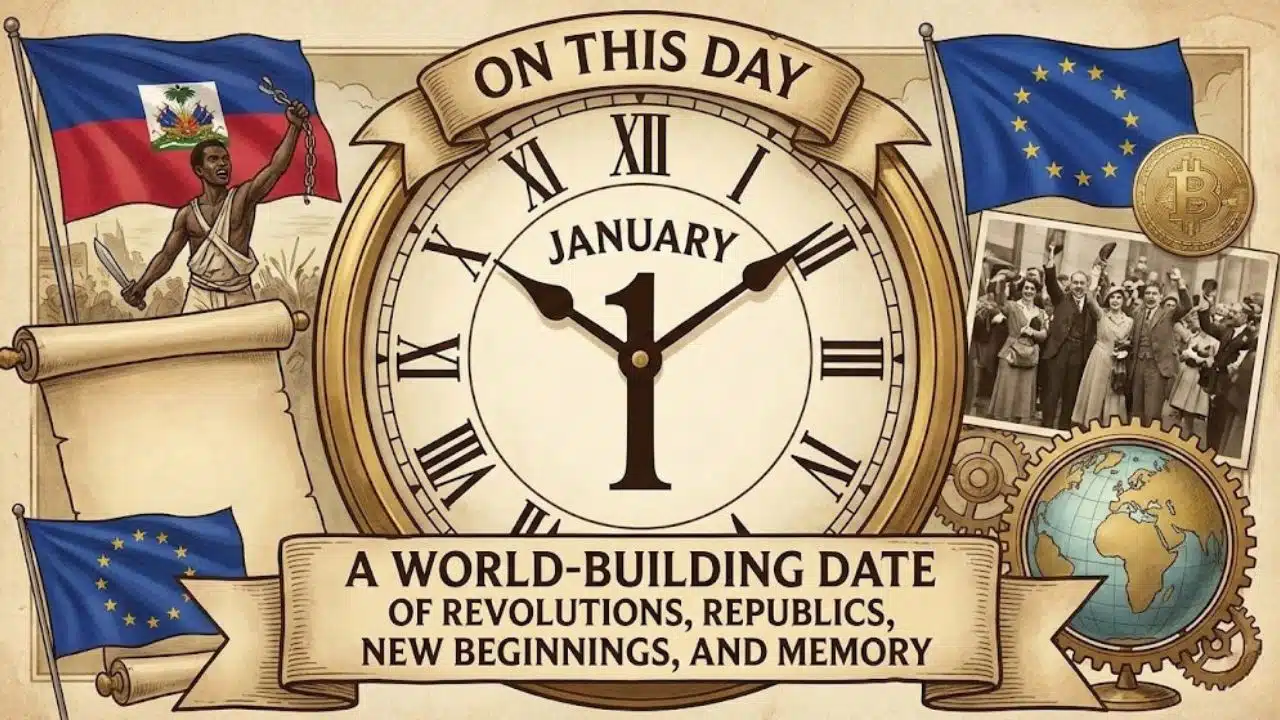
January 1 is easy to file away as “just New Year’s Day.” But historically, it’s also a date when states are born, empires proclaim power, laws flip society’s moral direction, and institutions quietly begin shaping daily life for decades.
This “On This Day January 1” report brings together the Bangalee sphere (Bangladesh + India) and a deliberately global spread—Africa, the Americas, Europe, the Middle East, and Asia—so the day feels like what it truly is: a crowded crossroads of human history.
At A Glance: January 1 Timeline
| Year | What Happened | Where It Matters Most |
|---|---|---|
| 1801 | Acts of Union take effect; “United Kingdom of Great Britain and Ireland” begins | UK & Ireland |
| 1804 | Haiti declares independence | Caribbean, Black Atlantic history |
| 1863 | Emancipation Proclamation issued | United States, global anti-slavery history |
| 1877 | Delhi Durbar begins; Queen Victoria proclaimed Empress of India | South Asia, colonial history |
| 1901 | Commonwealth of Australia formed (Federation) | Australia |
| 1912 | Republic of China officially established | China & East Asia |
| 1947 | Canadian citizenship comes into force | Canada |
| 1949 | RBI nationalised effective Jan 1 | India & South Asia finance |
| 1956 | Sudan declares independence | Africa & Arab world |
| 1959 | Cuban Revolution triumphs as Batista flees | Latin America, Cold War |
| 1960 | Cameroon becomes independent | Africa |
| 1962 | Western Samoa achieves independence | Pacific |
| 1973 | UK, Denmark, Ireland join European Communities | Europe |
| 1979 | US–PRC diplomatic relations begin | Global geopolitics |
| 1983 | ARPANET transitions to TCP/IP (“Flag Day”) | Tech history |
| 1984 | AT&T divestiture implemented | US telecom & tech economy |
| 1994 | NAFTA enters into force | North America trade |
| 1995 | WTO begins operations | Global trade system |
| 1999 | Euro launched (non-cash) | Europe |
| 2002 | Euro banknotes/coins introduced | Europe |
| 2014 | Denver begins retail recreational cannabis sales | US policy shift |
| 2024 | Major Noto Peninsula earthquake | Japan & disaster risk history |
The Bangalee Sphere (Bangladesh & India)
Historical Events
Delhi Durbar of 1877: Empire on display, nationalism in the shadows
On January 1, 1877, the British staged a grand imperial assemblage in Delhi—often called the “Proclamation Durbar”—to proclaim Queen Victoria as Empress of India.
It’s tempting to see this as pure ceremony, but its long-term significance is political: spectacle and hierarchy were used to legitimize colonial rule at the very moment Indian public life was sharpening its questions about representation, rights, and governance. The Durbar also remains controversial in historical memory because it occurred during the Great Famine of 1876–78—an example of how power can prioritize image over human survival.
Reserve Bank of India nationalised (effective January 1, 1949): a quiet reset of economic sovereignty
India’s central bank was nationalised with effect from January 1, 1949. While the policy may sound technical, it represented something deeper: the early post-independence state asserting more direct control over the financial engine of the economy.
Why does this matter today? Because central banking is not just “finance.” It shapes everyday life—credit, inflation, currency stability, and crisis response. This January 1 change helped define how modern India would govern money, growth, and economic stability.
Famous Births
Satyendra Nath Bose (1894): from Kolkata to the language of the quantum world
Satyendra Nath Bose—born January 1, 1894 in Calcutta (now Kolkata)—helped reshape physics through work that later became the foundation of Bose–Einstein statistics. The particle class known as “bosons” traces its name to his legacy.
In the Bangalee imagination, Bose is more than a scientist. He symbolizes an era when Bengal’s universities and intellectual circles were producing global-impact ideas despite the constraints of empire.
Jasimuddin (1903): the rural heart of Bengali literature
Jasimuddin, born January 1, 1903, is celebrated as “Palli Kabi”—the poet who brought village life, folk rhythms, and pastoral storytelling into the modern Bengali canon.
His significance today isn’t only literary. In a world where “progress” often flattens local memory, his work preserves the textures of rural Bengal—language, labor, love, and loss—as a cultural archive of everyday life.
Famous Deaths
January 1 is not especially dense with widely agreed Bangalee-region death anniversaries in mainstream global archives compared with some other dates. Still, it often becomes a day of remembrance because New Year’s reflections naturally pull people toward legacy—personal and national.
Cultural/Festivals & Observances
Kalpataru Day (January 1, 1886): a Bengali spiritual anniversary
In parts of Bengal, January 1 is observed as Kalpataru Day, associated with a blessing tradition linked to Sri Ramakrishna on January 1, 1886.
It matters culturally because it shows how a global calendar date (Gregorian New Year) can become localized into regional devotional memory—religion adapting without surrendering identity.
New Year’s Day in Bangladesh & India: a modern public ritual
Beyond fireworks and greetings, January 1 functions as a civic reset: school and office calendars, goal-setting, and family gatherings. In cities like Dhaka and Kolkata, it’s also a media moment—annual retrospectives, cultural specials, and renewed public debate about what kind of year society wants to build.
International Observances & Holidays
Major International Days
World Day of Peace (January 1): a global peace message at the year’s first sunrise
January 1 is observed by the Catholic Church as the World Day of Peace, framed as a moral call to place peace-making at the start of the year.
Even outside religious contexts, the idea is powerful: beginning the calendar with a public emphasis on peace, dignity, and human responsibility.
National Days (Independence / Statehood / Major Anniversaries)
-
Haiti — Independence Day (1804): A landmark in world history as a successful revolution by formerly enslaved people created the first Black republic.
-
Sudan — Independence Day (1956): Sudan begins independence as a republic, ending colonial-era governance structures.
-
Cameroon — Independence Day (1960): A major step in African decolonization history.
-
Samoa — Independence Day (1962): A notable independence milestone in the Pacific.
-
Australia — Federation Day (1901): Australia forms the Commonwealth through unification of six colonies.
Global History
United States
The Emancipation Proclamation (1863): a moral pivot with political teeth
On January 1, 1863, Abraham Lincoln issued the Emancipation Proclamation, declaring enslaved people in rebelling states “shall be free.”
Its impact was not immediate everywhere—freedom depended on Union control—but its historical weight is immense. It redefined the Civil War’s meaning, accelerated the abolitionist cause, and reshaped the legitimacy of the Union war effort at home and abroad.
Policy shifts in daily life: Denver retail cannabis sales begin (2014)
On January 1, 2014, Denver began legal retail sales of recreational cannabis. The event became part of a larger shift in public policy, taxation, law enforcement practices, and national debate about criminal justice.
Russia
January 1 has long served as a “reset lever” for administrations worldwide. As states modernize, they often pick this date to standardize law, finance, and governance. In Russia’s history, calendar reforms and state modernization efforts frequently used symbolic timekeeping to project control and modern identity.
China
Republic of China established (1912): the symbolic break from dynastic rule
January 1, 1912 marks the formal establishment of the Republic of China—an historic break from dynastic rule and a redefinition of political legitimacy in China.
Modern East Asian political history—questions of sovereignty, identity, revolution, and modernization—cannot be understood without the shockwave created in this period.
United Kingdom
A new political entity begins (1801): the United Kingdom of Great Britain and Ireland
On January 1, 1801, the Act of Union takes effect, bringing the Kingdom of Great Britain and the Kingdom of Ireland together under a new political structure.
This reshaped representation, identity, and imperial administration for generations—and remains relevant in debates about sovereignty and constitutional identity.
Europe
Europe’s institutions “switch on”
January 1 is often a milestone date in Europe’s institutional story:
-
A major phase of European integration begins operating in the late 1950s.
-
The European Communities expand in 1973 with the UK, Denmark, and Ireland joining.
-
The euro begins its life as a non-cash currency at the end of the 1990s.
-
Euro banknotes and coins arrive for everyday use in 2002.
These milestones show how slow, administrative decisions can reshape daily life—changing prices, travel, work, and the idea of belonging.
Australia
Federation (1901): six colonies become one Commonwealth
On January 1, 1901, six colonies unite to form the Commonwealth of Australia. Nationhood here is negotiated and legal—built through a constitution, not a sudden overthrow.
Canada
Canadian citizenship begins (1947): identity becomes a legal category
On January 1, 1947, Canadian citizenship becomes a distinct legal status. This has deep consequences for identity, migration, rights, and the meaning of belonging.
Rest Of World
WTO begins operations (1995): trade rules become more enforceable
The WTO begins on January 1, 1995, shaping how disputes are handled and how trade rules are enforced globally.
NAFTA enters into force (1994): North America’s trade architecture shifts
On January 1, 1994, NAFTA begins, shaping cross-border trade patterns, labor debates, and environmental policy discussions.
Cuban Revolution victory (1959): a Cold War turning point
January 1, 1959 marks the collapse of Batista’s government and the rise of the Cuban revolutionary leadership—an event that dramatically reshaped Latin America’s politics and Cold War geopolitics.
Japan’s Noto Peninsula earthquake (2024): disaster becomes history instantly
On January 1, 2024, a major earthquake struck near Japan’s Noto Peninsula. Such events quickly become part of modern history because they change policy, preparedness, infrastructure, and community memory.
Notable Births & Deaths
Famous Births (Expanded List)
| Name | Born | Nationality | Known For |
|---|---|---|---|
| Satyendra Nath Bose | 1894 | Indian | Quantum physics; Bose–Einstein statistics |
| Jasimuddin | 1903 | Bangladeshi | Iconic Bengali pastoral poet |
| E. M. Forster | 1879 | British | A Passage to India, Howards End |
| J. D. Salinger | 1919 | American | The Catcher in the Rye |
| Betsy Ross | 1752 | American | Revolutionary-era American lore |
| Frank Langella | 1938 | American | Stage and screen actor |
| Verne Troyer | 1969 | American | Actor and performer |
| Christine Lagarde | 1956 | French | Global finance leadership roles |
Disputed / dual-date note: Paul Revere
His birthday is sometimes recorded with “Old Style vs New Style” calendar conversion, which is why different sources can show different dates.
Famous Deaths
| Name | Died | Nationality | Known For / Legacy |
|---|---|---|---|
| Louis XII | 1515 | French | King of France |
| Grace Hopper | 1992 | American | Computing pioneer |
| Hank Williams | 1953 | American | Country music legend |
| Townes Van Zandt | 1997 | American | Influential singer-songwriter |
| Roberto Rossellini | 1977 | Italian | Film director; neorealism icon |
| Margaret Sheridan | 1982 | American | Actress |
| Theodor W. Adorno | 1969 | German | Philosopher and cultural critic |
Death-date nuance: Hank Williams
Some records emphasize that he was found and officially pronounced dead on January 1, though the actual moment of death may have occurred hours earlier.
“Did You Know?” Trivia
-
January 1 is a favorite date for governments because it makes legal change feel clean, measurable, and administratively easy.
-
The modern internet has a January 1 milestone: a major network protocol transition in 1983 helped define the architecture that later became the internet.
-
Haiti’s independence begins on January 1, creating a new nation whose impact on global politics and abolition debates reached far beyond the Caribbean.
Takeaways: January 1 As A Mirror Of What Humanity Chooses To Begin
January 1 is a global ritual, but it’s also a historical machine. Leaders use it to start new laws, nations use it to declare themselves into being, and societies use it to tell themselves a story about the year ahead.
From the birth of ideas in Bengal’s intellectual history to independence movements across Africa and the Caribbean, from the proclamation of freedom in the United States to the launch of new economic systems in Europe—January 1 shows how the calendar can become a stage for power, hope, and transformation.